Investing in Tigers Eye Stone: A Collector’s Value Guide
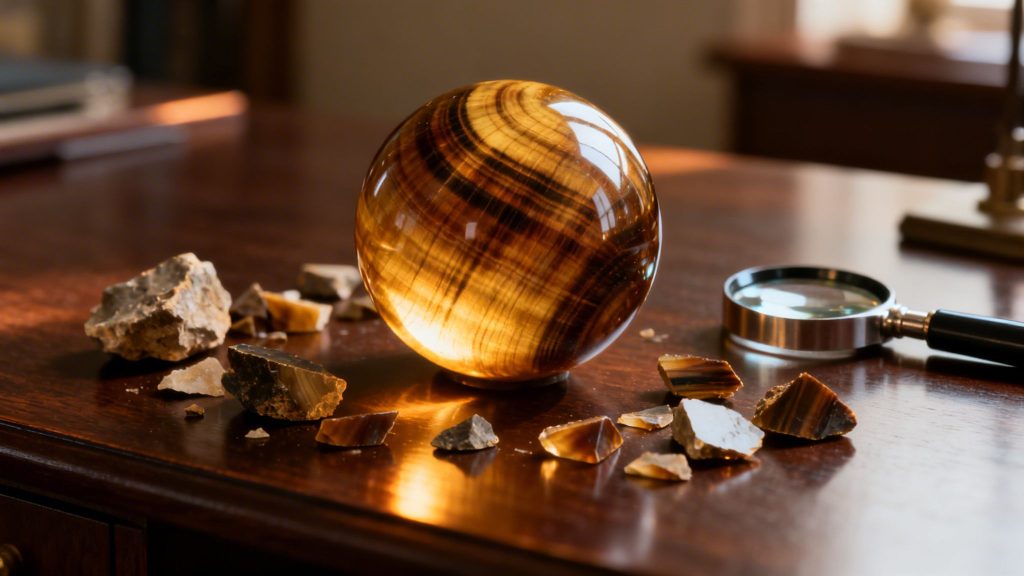
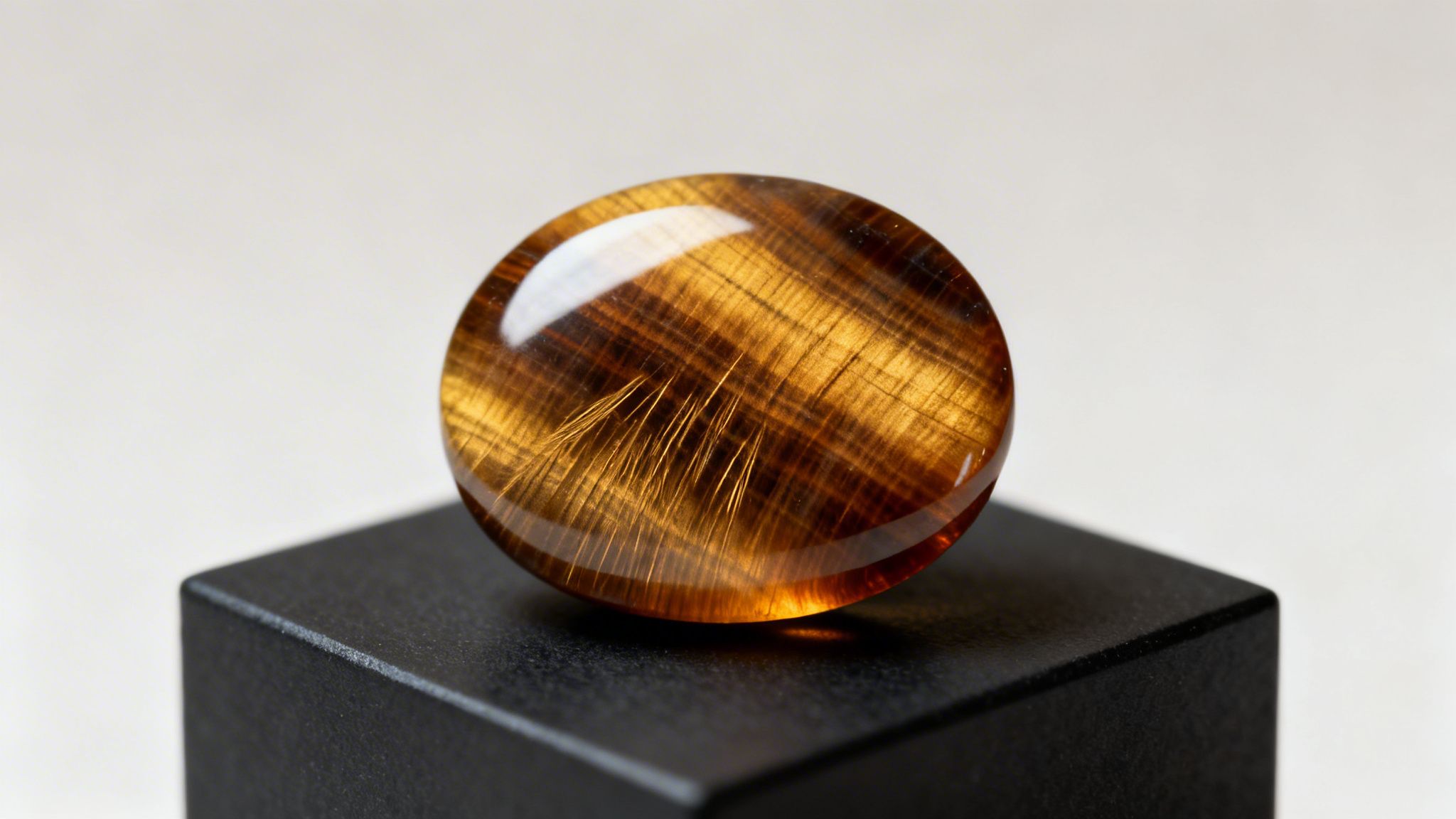
Tiger's eye is a stone that feels alive in your hand. Its signature shimmer, a silky band of light that moves beneath the surface, defines its character. This optical effect, known as chatoyancy, is not just a visual curiosity; it is the primary driver of the stone's value as a collectible asset.
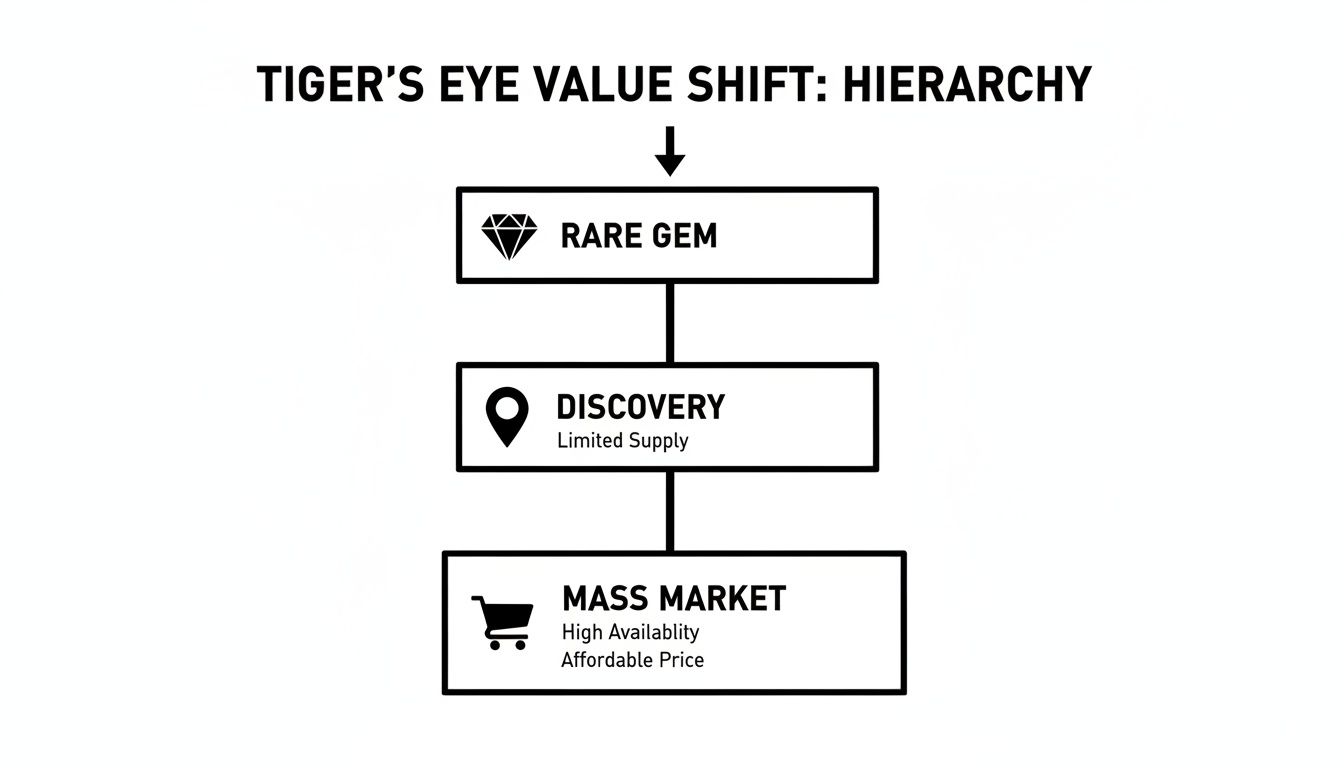
While new discoveries shifted tiger's eye from a rare gem to an accessible stone, exceptional specimens remain a prized acquisition. For discerning collectors and designers, quality is paramount. Therefore, understanding the factors that create value is essential.
Understanding the Value of Tigers Eye Stone
Tiger's eye holds a unique position in the mineral market. It is accessible enough for new collectors, yet it offers significant depth for seasoned investors. Its history provides a perfect case study in supply and demand, which directly shapes its modern valuation. Today, quality separates a decorative object from a true investment.
In the 19th century, for example, tiger's eye was considered a precious stone. Its value rivaled that of diamonds due to extreme scarcity. European elites prized it as a definitive status symbol. However, the discovery of massive deposits in South Africa flooded the market, altering its classification and making it more accessible. You can explore these market dynamics in our guide to precious vs. semi-precious stones.
Key Drivers of Market Value
Even with widespread availability, a vast quality gap exists between commercial-grade stones and investment pieces. An expert eye focuses on a few critical factors. These drivers determine a tiger's eye stone's true worth and its potential for appreciation.
These are the primary factors:
Chatoyancy: The flash is everything. A sharp, fluid "cat's eye" band of light commands the highest prices. A crisp line that glides smoothly across the entire surface is the goal.
Color and Clarity: The most sought-after specimens show a rich, warm, golden-brown color. They lack dull gray undertones or distracting host rock (matrix).
Provenance and Cut: A stone's origin can influence its quality. Moreover, the skill of the lapidary is crucial. A masterfully cut stone that maximizes the optical effect is worth significantly more.
At Astro West, we evaluate every specimen against these criteria. Our direct relationships with miners provide access to superior rough material unavailable to the mass market. This focus on sourcing and expert cutting defines a collector's piece.
The Shifting Value Of A Global Treasure
The market history of tiger’s eye is a classic lesson in supply and demand. Every collector should understand this story. It explains how perceived rarity defines worth and how a single discovery can reshape a market. This knowledge is key to identifying true value today.
During the 19th century, tiger’s eye was among the rarest gems in the world. Limited known deposits made it a precious stone. Its mesmerizing golden flash captivated European jewelers and high-society collectors. As a result, owning a piece was a mark of significant wealth.
This scarcity created a market where tiger's eye was treated like fine art or a rare watch. Each piece represented a major investment due to the tight supply. That era of exclusivity, however, was about to end dramatically.
The South African Discovery
Everything changed in the late 1800s. The discovery of enormous deposits in South Africa transformed the market. A stone that was once incredibly scarce became available on an industrial scale. This monumental find completely flooded the market.
The impact on its price was immediate and profound. Historical trade records show the value of tiger’s eye plummeted by as much as 80-90% within a decade. While this crash made the stone affordable for many, it also rewrote its investment narrative. This abundance is why beautiful, entry-level specimens are so approachable today. You can explore more historical price guides about this fascinating gemstone shift.
This history is crucial for collectors. In a market flooded with standard material, the hunt for exceptional quality becomes paramount. While common tiger's eye is plentiful, a museum-quality specimen with perfect chatoyancy remains genuinely rare and valuable.
From Scarcity To Discerning Quality
The price correction did not destroy the value of tiger's eye; it refined it. The market shifted from prioritizing ownership to seeking out perfect examples. Today, real value lies in specimens that stand far above mass-market material.
Several key factors now separate an investment-grade tiger's eye from a common stone:
Exceptional Chatoyancy: A sharp, unbroken, and liquid-like "eye" that moves smoothly is the number one value driver.
Superior Color: The most prized pieces have rich, saturated golden-brown tones without any dull or gray areas.
Size and Form: Large, flawless spheres or cleanly cut slabs for décor are far rarer and more valuable than small, tumbled stones.
Provenance: A specimen from a mine known for high-quality material adds a unique story, boosting its market appeal.
Therefore, while the South African discovery made tiger’s eye widely available, it also created a more sophisticated market. Collectors and designers now hunt for pieces representing the pinnacle of natural artistry. This sustained demand ensures that top-tier tiger's eye stone remains a worthy asset.
How Experts Grade Tigers Eye Stone Quality
Distinguishing a common tiger's eye from an investment piece requires a trained eye. While many stones exhibit a pleasant shimmer, the qualities that determine market value are highly specific. At Astro West, we evaluate specimens like professional gemologists, focusing on the details that justify price and long-term asset potential.
The single most important factor is chatoyancy. This is not a passive glimmer but a dynamic band of light. In a top-quality stone, this luminous line should be sharp, clear, and unbroken. It must glide smoothly across the entire surface as you rotate it, creating a sense of life within the mineral.
The Primacy of Chatoyancy
A weak, blurry, or patchy chatoyancy immediately lowers a stone’s grade. A collector should look for a single, crisp beam of light. It must travel from one end of the specimen to the other without fading. This visual perfection results from the precise parallel alignment of internal fibers, a rare accident of nature.
For this reason, the quality of this optical phenomenon is the main differentiator. It separates commercial-grade material from collector-worthy pieces. A stone with a perfect, rolling flash is significantly harder to find and, as a result, far more valuable. This specific quality is what serious collectors and designers seek for a centerpiece.
Beyond the Flash: Color and Clarity
While chatoyancy is king, other factors significantly influence a stone’s valuation. Color intensity and clarity are the next criteria. The most desirable tiger's eye boasts a deep, saturated golden-brown hue. It must be free from dull, muddy, or grayish tones that diminish its natural vibrancy.
Equally important is the absence of unwanted matrix, the host rock where the tiger's eye formed. Specks or patches of matrix disrupt the stone’s visual flow. Therefore, a clean specimen with uniform color and no distracting inclusions will always command a higher price. For a deeper understanding of these factors, this diamond clarity and color guide offers relevant parallels.
The chart below shows how tiger's eye shifted from a rare gem to a mass-market stone. This history underscores why top quality is now the primary driver of real value.
This shift highlights a key point for collectors. As the stone became common, standards for elite specimens tightened. This created a distinct market for discerning buyers seeking proven quality.
This table breaks down how each quality factor is judged, from basic commercial material to museum-grade specimens.
Tigers Eye Quality Grading Matrix
Quality Factor
Commercial Grade (Low Value)
Collector Grade (Mid Value)
Museum Grade (High Value)
Chatoyancy
Weak, blurry, or multiple bands. Fades in and out.
Strong, single band visible across most of the stone.
Sharp, bright, unbroken band that rolls fluidly across the entire surface.
Color
Dull, muddy, or washed-out browns and yellows. Grayish tones.
Good saturation with classic golden-brown color. Minor variations are acceptable.
Deep, vibrant, and highly saturated golden-brown hues. Exceptional color consistency.
Clarity
Obvious matrix patches, spots, or internal fractures.
Minor matrix inclusions or small specks visible.
"Eye-clean" with no visible matrix, cracks, or disruptive inclusions.
Cut & Polish
Poor orientation hiding chatoyancy. Dull or scratched surface.
Good orientation. Smooth polish with minor surface imperfections.
Masterfully cut to maximize chatoyancy. Flawless, "wet look" polish.
As you can see, achieving "Museum Grade" status requires the flawless alignment of all four factors. This confluence is what makes such specimens so incredibly rare and valuable.
The Importance of Cut and Polish
Finally, one cannot overlook the skill of the lapidary. An expert cut is always oriented to maximize chatoyancy. This ensures the band of light is perfectly centered and travels down the stone's longest axis. A poor cut can completely negate an otherwise excellent optical effect.
A superior polish enhances both the chatoyancy and the stone's natural luster. It creates a smooth, glassy surface that feels substantial and luxurious. This craftsmanship transforms a natural specimen into a finished art object, elevating it to a collectible asset.
These grading principles are fundamental to building a collection of lasting worth. For collectors looking to train their eye, our complete crystal identification guide offers more tools for assessing mineral specimens. Ultimately, the perfect combination of vibrant color, flawless clarity, and a masterful cut elevates a tiger's eye into the realm of investment-grade collectibles.
Where a Tiger’s Eye Comes From and Why It Matters
For collectible minerals, a specimen's backstory is as important as its aesthetics. This concept, provenance, documents a specimen's history and authenticity. It has a direct impact on value. For tiger’s eye, knowing its origin separates a decorative rock from a traceable geological asset.
Understanding the global supply chain is crucial for any serious buyer. The market is well-established, with a few regions supplying over 85% of all tiger's eye. South Africa remains the dominant force, producing over 60% from its historic Northern Cape mines. Western Australia is another major player, contributing 20-25%. This accessibility highlights the critical need for expert sourcing to find investment-grade material. You can find more detail in this updated analysis of the tiger's eye market.
The Importance of Direct Sourcing
With so much commercial-grade material on the market, the challenge is not finding tiger's eye, but finding top-tier rough stone. This is where direct relationships with miners and field experts become a strategic advantage. Mass-market suppliers typically buy in bulk, mixing high- and low-quality material indiscriminately.
In contrast, a curated gallery like Astro West leverages its long-standing network. This provides first access to newly discovered pockets and superior-grade veins. These partnerships allow our experts to select rough specimens at the source, bypassing the commoditized supply chain. We hand-select only the rough material showing exceptional potential for chatoyancy, color, and clarity.
A specimen's journey from a mine in the Northern Cape to a polished sphere in our gallery is fully traceable. This commitment to scientific integrity and authenticity isn't just a promise. It is the bedrock of our reputation and your confidence as a collector.
How Provenance Drives Value
The specific mine or region a tiger's eye comes from directly affects its appearance and market value. For example, some deposits in Western Australia are known for producing material with a brilliant, almost metallic sheen. Meanwhile, certain South African mines yield large, clean nodules perfect for crafting impressive decorative spheres.
This link between origin and quality adds a layer of connoisseurship to collecting. An educated buyer knows a specimen from a famed location is a piece of documented geological history. This traceability is a key factor in long-term value appreciation, much like the provenance of a fine painting. Our guide on how to start a collection of rare rocks and minerals explores this concept further.
Ultimately, authenticating a specimen’s origin moves it from a generic category into a specific class of collectible. It confirms the stone is natural, untreated, and was sourced ethically. For anyone building a collection of lasting worth, that assurance is everything.
Market Pricing For Rare Tiger's Eye Varieties
Determining the price of tiger's eye involves navigating two distinct markets. On one hand, affordable tumbled stones offer an easy entry point for new collectors. On the other, monumental decorative spheres represent serious natural art investments. The key is understanding how quality, size, and rarity translate directly into value.
The market for this stone rewards exceptional quality fiercely. Standard golden tiger's eye can be found for as little as $5 to $20 per carat for smaller, lower-grade pieces. However, for a premium specimen with vivid, rolling chatoyancy, prices can easily jump to $20 to $100 per carat.
Recent market analysis shows how much rarity moves the needle. For instance, a top-quality red tiger's eye can command up to 2.5 times the price of a standard golden stone. Learn more about the latest tigers eye valuation data to see how these numbers break down.
This price jump directly reflects the grading factors discussed. A large, flawless sphere with a perfect cat's-eye effect is exponentially rarer than a small, included cabochon. Its price will reflect that scarcity, which is where real investment potential lies.
The Premium on Scarcity: Hawk's Eye and Bull's Eye
While golden tiger's eye is the most recognized, its rarer cousins excite serious collectors. These color variations are not artificial; they are natural geological quirks. As a result, this scarcity can elevate their value to two or three times that of a comparable golden specimen.
Hawk's Eye (Blue Tiger's Eye): This is the unoxidized, original form of tiger's eye. Its striking blue-gray flash comes from the original crocidolite fibers before their replacement by quartz and iron oxides. Because it is the geological precursor, it is far less common and a key target for collectors.
Bull's Eye (Red Tiger's Eye): This red variety forms when standard tiger's eye is exposed to natural geothermal heat. The process alters the iron in the stone, shifting its color from gold to a deep, rich red. While this effect can be produced artificially, naturally occurring Bull's Eye is very scarce and commands a much higher price.
The market recognizes this rarity. For example, a high-quality golden tiger's eye sphere might be valued in the hundreds of dollars. An equivalent sphere of natural Hawk’s Eye or Bull’s Eye, however, could easily be valued in the thousands. This premium underscores a core principle of collecting: verifiable rarity always drives value.
Consider the luxury watch market. A standard steel chronograph is a classic. However, the limited-edition platinum model or a unique "error dial" version trades in an entirely different financial league. It is all about verifiable scarcity.
From Carats to Decorative Objects
The pricing model for tiger's eye shifts completely from small gems to large, decorative pieces. While gems are priced per carat, massive spheres and slabs are valued as whole objects. Here, overall aesthetic impact, size, and freedom from flaws become the most important factors.
A large, polished sphere of museum-grade tiger's eye measuring 12 inches or more in diameter is an object of immense rarity. Finding a single, massive nodule of rough stone clean enough to produce such a piece is an incredible challenge.
Because of this, these monumental objects are not just decorative items; they are significant natural art investments. Their value can appreciate steadily over time. This growth is driven by demand from discerning collectors and high-end interior designers.
From Our Collection to Yours: How to Care For and Display Tiger's Eye
Acquiring a high-quality tiger's eye means becoming the custodian of a piece of natural art. Protecting its condition is the best way to preserve its long-term value. This holds true whether it joins a curated mineral collection or serves as a striking design element.
The good news is that tiger's eye is remarkably durable. It has a Mohs hardness of 7. This makes it far more resilient than many decorative minerals like calcite or fluorite. This toughness makes it highly resistant to everyday scratches, ensuring it stays pristine.
Preserving Its Condition and Value
Even with its durable nature, a few simple practices will maintain your piece's flawless appearance. Your primary goal is to protect its polish. A perfect, lustrous surface is what allows the stone's famous optical effect to truly shine.
Cleaning Your Piece: Use a soft, damp cloth and lukewarm water. Avoid harsh chemicals, abrasive pads, or ultrasonic cleaners. These can degrade the polish over time, diminishing the stone's reflective quality.
Preventing Damage: While it resists scratches, tiger's eye can chip or fracture from a hard impact. Display large spheres or slabs in secure, low-traffic areas. If worn as jewelry, remove it before strenuous activity.
Proper care is straightforward. In return, your piece will retain its mesmerizing beauty, securing its place as a lasting asset. For more ideas, consult our expert advice on how to display crystals to enhance any space.
Displaying Tiger's Eye in Luxury Interiors
Tiger's eye is a powerful design element. It brings organic warmth and sophisticated texture to any curated space. Its golden-brown tones pair beautifully with minimalist, modern, or classic aesthetics. The key is to let the stone’s natural artistry speak for itself.
A large, polished tiger's eye sphere, for instance, becomes a dynamic sculpture on a simple pedestal. As light in the room changes, its rolling chatoyancy shifts and moves. This creates a living piece of art that naturally draws the eye and starts conversations.
Similarly, a thick, polished slab can serve as a breathtaking tabletop. It can also be mounted as compelling wall art, like a geological abstract painting. These applications elevate the mineral from a simple collectible into a commanding design object. A confident acquisition is one you can enjoy daily while knowing its value is built to last.
Is Tigers Eye A Good Investment?
For the right pieces, absolutely. It is crucial to understand the two distinct markets. The vast majority of tiger's eye is common-grade material, which is stable but not an investment vehicle.
The real investment lies in museum-grade pieces with exceptional chatoyancy, color, and clarity. These specimens are genuinely rare. Their value is driven by extreme scarcity and demand from serious collectors, paralleling the fine art market. An investment in a premier tiger's eye is an investment in verifiable natural art.
How Can I Tell If A Tigers Eye Stone Is Real?
Your hands and eyes are your best tools. Real tiger's eye has a noticeable weight because it is a type of quartz. It will feel cool and substantial in your palm, not light and plasticky.
The chatoyancy provides the definitive clue. On a genuine piece, the shimmering band of light appears to glide beneath the surface, creating a sense of depth. Fakes often have a stripe of metallic paint sitting on top. Be suspicious of any piece with perfectly uniform, artificial-looking stripes or a lightweight feel.
At Astro West, every specimen undergoes rigorous verification by our experts. We guarantee the authenticity and natural origin of every piece. This ensures your acquisition is a genuine geological treasure with traceable provenance.
Does Tigers Eye Appreciate In Value?
Historically, the finest examples of all minerals have shown steady appreciation. While the market for common tiger's eye remains flat due to abundance, investment-grade specimens follow a completely different trajectory.
As the best and largest pieces enter private collections and museums, the supply of elite-quality material shrinks. This growing scarcity, combined with consistent demand from discerning buyers, creates a strong foundation for long-term value growth.
What Makes One Tigers Eye More Valuable Than Another?
It all comes down to a few key factors, but one is paramount. Chatoyancy is the primary value driver. A valuable piece will have a sharp, unbroken, and fluid "eye" that glides smoothly across the entire stone as you move it.
After that, you assess color, clarity, and cut. A deep, saturated golden-brown is more desirable than a washed-out tan. The stone should be free of distracting host rock. Finally, the cut must be masterfully executed to maximize the optical effect.
At Astro West, we provide the expertise needed to distinguish a simple stone from a true asset. Explore our curated collection of tigers eye and other fine minerals to find a piece of natural history that speaks to you.