Black Friday Meteorite Deals: Your Guide to Out-of-This-World Savings
Imagine holding a piece of the cosmos, a visitor from the outer reaches of our solar system that traveled for billions of years before landing on Earth. That’s the magic of meteorites. And this Black Friday, you have the perfect opportunity to own one of these celestial treasures without breaking the bank. Get ready for some of the year's best Black Friday meteorite deals, where cosmic history becomes surprisingly affordable.
Unveiling the Best Meteorite Deals of the Season
This year, Black Friday is set to be a stellar event for meteorite enthusiasts and aspiring collectors alike. Reputable dealers and online shops are slashing prices on a wide range of specimens, from the common but captivating Chondrites to the rare and beautiful Pallasites.
Think of it this way: a meteorite is a rock that has fallen to Earth from space. These fragments are leftovers from the formation of our solar system, making them some of the oldest materials you can touch. During their fiery journey through our atmosphere, they develop unique features like a fusion crust (a glassy, melted exterior) and regmaglypts (thumbprint-like indentations).
This Black Friday, you'll find incredible discounts on these cosmic artifacts. Whether you're a seasoned collector looking for a rare slice of a lunar meteorite or a newcomer hoping to find an affordable iron meteorite to start your collection, the deals will be plentiful. It's the perfect time to acquire a piece that resonates with you.
To give you a quick snapshot of what to look for, here are the key types you might find on sale.
Fusion crust, regmaglypts, Widmanstätten patterns (in iron meteorites)
Collector's Focus
Origin, classification, size, shape, and aesthetic appeal.
As you can see, the variety is vast, making the hunt for Black Friday deals even more exciting.
What to Look for in Black Friday Sales
The key to a successful Black Friday meteorite hunt is knowing what makes a good deal. Just as a collector might admire a unique purple amethyst geode for its beauty, a meteorite collector looks for authenticity, classification, and provenance.
Authenticity is Key: Only buy from reputable dealers who provide a certificate of authenticity. Black Friday is a prime time for fakes to appear on the market.
Know Your Types: Iron meteorites are often the most affordable and make great starter pieces. Stony-irons like Pallasites, with their gem-like crystals, are more expensive but stunning.
Size vs. Rarity: A small fragment of a Martian meteorite might be a better investment than a large, common Chondrite. Decide what matters more to you.
This Black Friday is the perfect opportunity for anyone who feels drawn to the stars. A meteorite isn't just a rock; it's a tangible piece of the universe, a story of cosmic travel that you can hold in your hand.
Whether you want to start a new hobby, find a unique gift, or add a rare specimen to your collection, the Black Friday sales are the place to start. If you're new to identifying minerals and space rocks, a good crystal identification guide can be a helpful resource to learn about terrestrial stones, too.
The Cosmic Story of a Meteorite
Every meteorite on sale this Black Friday tells an epic story, a journey across millions of miles and billions of years. Most originate in the asteroid belt between Mars and Jupiter, where ancient planetary bodies collided and shattered. These fragments drifted through space until they were captured by Earth's gravity.
Then, the fiery climax happens. As the meteoroid plummets through our atmosphere at incredible speeds, friction and pressure create intense heat, melting its surface and forming a dark, glassy fusion crust. This process, known as ablation, also carves out unique thumbprint-like patterns called regmaglypts.
The incredible forces at play are what make each meteorite a unique survivor of a cosmic ordeal. Finding a specimen with a well-preserved fusion crust is a key goal for many collectors.
The Perfect Conditions for Survival
For a meteorite to be found, the conditions of its fall and landing have to be just right. It's a delicate balance of size, entry angle, and composition.
Entry Angle: A steep angle can cause the meteoroid to burn up completely, while a shallow angle might cause it to skip off the atmosphere. The "Goldilocks" angle allows it to slow down enough to survive.
Composition: Dense iron meteorites are more likely to survive the atmospheric journey than fragile stony meteorites.
Landing Zone: Meteorites that land in dry, stable environments like deserts (e.g., the Sahara) or polar ice caps (Antarctica) are preserved much better and are easier to find.
These intricate factors mean that every meteorite found is a minor miracle. The specific way these elements combine explains why some falls result in thousands of fragments (a "strewn field") while others produce only a single stone. For a deeper look at how mineral formations occur on Earth, check out our collector's guide to quartz crystal clusters.
Global Sources and Famous Falls
Meteorites are found all over the globe, but some locations are famous for producing specific types that you'll likely see in Black Friday deals.
Some of the most significant sources include:
Argentina: Home to the Campo del Cielo iron meteorite, known for its large, sculptural specimens.
Russia: Famous for the Sikhote-Alin fall of 1947, which produced many individual iron meteorites with striking regmaglypts.
Northwest Africa (NWA): A vast desert region where countless meteorites, including rare lunar and Martian ones, are found by nomads and hunters.
The subtle differences in the chemical makeup of these cosmic visitors allow scientists to classify them and trace their origins back to specific parent bodies in the solar system.
Why Are They So Prized by Collectors?
The value of a meteorite lies in its incredible story and scientific importance. It's a physical link to the cosmos, offering clues about the formation of planets and the origins of life. While many stones are known for their earthly beauty, a meteorite is different. It’s a scientific artifact and a piece of cosmic art rolled into one.
This unique quality makes it a celebrated item for anyone fascinated by space, science, or the sheer wonder of the universe. It connects us to something vast and ancient, a reminder of our place in the cosmos. It doesn't just look cool; it expands our perspective.
A Strong Connection to Science
In the world of collecting, meteorites are most strongly linked to scientific discovery. Their composition tells us about the building blocks of our solar system.
Iron Meteorites: Believed to be the cores of ancient, shattered planetesimals. When cut and etched, they reveal stunning Widmanstätten patterns, an interlocking crystal structure that can only form over millions of years of slow cooling in space.
Stony Meteorites (Chondrites): These are some of the most primitive materials in the solar system. They contain tiny, colorful spheres called chondrules, which are droplets of molten rock from the early solar nebula.
By studying these different types, scientists can piece together the 4.6-billion-year history of our cosmic neighborhood.
You can think of the solar system as a vast archaeological site. Iron meteorites are the structural beams of ancient buildings, and Chondrites are the pottery shards and tools. Both are essential for understanding how everything was built.
Using Meteorites in Your Collection
The appeal of meteorites isn't just academic; they are beautiful and fascinating objects to own and display. Their unique shapes and textures make them incredible conversation starters.
For instance, placing a small Sikhote-Alin specimen on your desk can be a powerful reminder of cosmic forces and perseverance. Its twisted, shrapnel-like appearance is a direct result of its explosive journey through the atmosphere.
Likewise, holding a smooth, palm-sized Campo del Cielo meteorite can be an incredibly grounding experience. Its weight and density are surprising, connecting you to the iron heart of a long-dead world. This makes it a genuinely practical tool for sparking curiosity and contemplation.
Practical Ways to Shop for Meteorites
Understanding the science is one thing, but actually navigating the Black Friday deals to find your perfect meteorite is where the real fun begins. These cosmic travelers aren't just for museums—they can be the star of your collection, and Black Friday is the best time to buy.
The simplest way to start is by looking for deals on well-known iron meteorites like Campo del Cielo or Sikhote-Alin. They are relatively affordable, have a compelling story, and their metallic sheen is undeniably cool. Many dealers offer small, authenticated fragments for under $50, making them an accessible entry point.
Where to Find the Best Deals
Beyond just looking for low prices, the trick is to shop from reputable sources, especially during a sales rush like Black Friday. When you buy from a trusted dealer, you're not just getting a rock; you're getting a guarantee of authenticity and provenance.
Here are a few strategic places to hunt for deals:
On Reputable Dealer Websites: Many established meteorite sellers will have dedicated Black Friday sections. Sign up for their newsletters in advance to get early access.
In Online Mineral Marketplaces: Websites that host multiple vetted sellers can be a great place to compare prices on similar specimens. Look for sellers with high ratings and clear return policies.
At Virtual Gem & Mineral Shows: Some shows now have an online component. This is a fantastic way to discover new dealers and find exclusive show discounts.
If you're interested in creating displays that are both beautiful and educational, learning how to display crystals and other specimens is a game-changer.
Using Black Friday for a Smart Purchase
For more focused collecting, Black Friday is an incredible opportunity to acquire a rarer piece at a discount. Perhaps you've been wanting a slice of a Pallasite with its beautiful olivine crystals, or a fragment classified from a specific, witnessed fall.
One powerful technique is to use a watchlist. Many online stores allow you to "favorite" items. Add the meteorites you're interested in to your list before Black Friday, and you'll be notified instantly if they go on sale. This saves you from endless scrolling and helps you act fast on a great deal.
This simple decision tree shows how Black Friday deals can help you start or grow your collection.
As you can see, whether you're a curious beginner or a serious collector, Black Friday meteorite deals offer a clear path to owning a piece of the cosmos.
How to Care for Your New Meteorite
To keep your new meteorite stable and looking its best for years to come, a little care goes a long way. This is especially true for iron meteorites, which are, after all, mostly iron and susceptible to rust here on our oxygen-rich planet.
Think of it like preserving an ancient artifact. Your meteorite has survived for billions of years in the vacuum of space. Now that it's on Earth, your job is to protect it from our humid environment.
Simple Physical Preservation
Keeping your meteorite clean and stable is a gentle process. The whole point is to prevent rust and degradation without damaging the specimen's unique features, like its fusion crust.
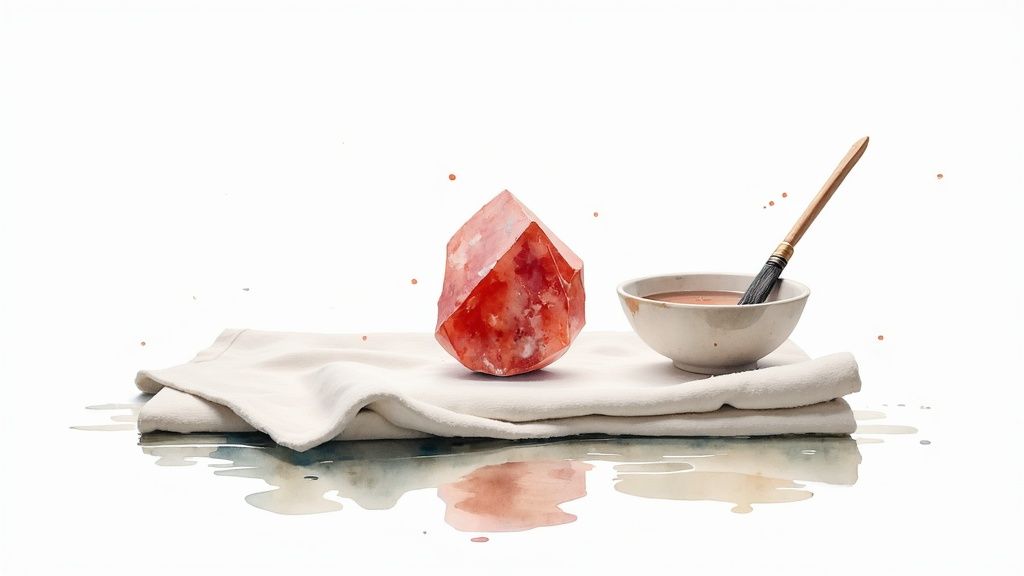
For most meteorites, especially irons, water is the enemy. Never clean them with water. Instead, use a very soft, dry brush—like a mushroom brush or an old makeup brush—to gently dust it off.
It's crucial to avoid harsh chemicals and abrasive cleaners. For iron meteorites, applying a light coat of mineral oil or a specialized meteorite preservative can help seal out moisture and prevent rust.
Also, be mindful of where you display it. A dry environment is best. Consider placing a desiccant pack (the little silica gel packets you find in packaging) in your display case to absorb ambient moisture. If you're just starting your collection, check out this guide to the best crystals for beginners for tips on caring for earthly minerals.
Best Practices for Handling and Storage
Proper handling is key to preservation. The oils on your hands can accelerate rusting on iron meteorites. It's a good practice to handle them with cotton gloves or to wash and dry your hands thoroughly before touching them.
Here are a few safe and effective tips:
Display Cases: A closed display case is your best friend. It keeps dust off and helps maintain a stable, low-humidity environment. Acrylic membrane boxes are fantastic for smaller specimens.
Labeling: Always keep the identification card or certificate with your meteorite. This preserves its provenance and value.
Avoid Sunlight: Just like with some crystals, direct sunlight can, over a very long time, affect the patina of a meteorite. A spot with indirect light is always a safe bet.
A Smart Buyer's Guide to Meteorites
Buying a meteorite this Black Friday should be an exciting discovery, not a source of stress. To make sure you walk away with a genuine piece of space rock—and one that is worth what you paid for it—it helps to know what separates an authentic specimen from a "meteorwrong."
Once you know what to look for, you can assess any potential purchase with a confident eye, whether you're scrolling through online Black Friday deals or visiting a rock shop.
Evaluating Authenticity and Price
When you're looking at a meteorite, think about its key characteristics: Does it have a fusion crust? Is it unusually dense for its size? Is it attracted to a magnet (most are)? A skilled seller will highlight these features.
The first thing to verify is authenticity. This is where buying from a member of a reputable organization like the International Meteorite Collectors Association (IMCA) is a huge advantage. Members are vetted and adhere to a strict code of ethics.
Price is determined by rarity, type, size, and aesthetics. An unclassified stony meteorite might sell for less than a dollar per gram, while a slice of a Martian meteorite could be over $1,000 per gram. Black Friday is your chance to get these at a significant discount.
Most common iron meteorites like Campo del Cielo will sell for $1 to $5 per gram, making them an affordable entry point for new collectors.
A key thing to remember is that a "perfectly" shaped meteorite is often a fake. Real meteorites are irregularly shaped, often with rounded edges from atmospheric melting. Be wary of anything that looks too much like a movie prop.
Finding Reputable Sellers
Finding a seller you can trust is the most important step in making sure you're getting a real meteorite. A good seller will always provide detailed information, including the meteorite's official name or find location, its classification, and a certificate of authenticity.
Here are a few essential questions to ask:
Are you a member of the IMCA or another professional organization? This is a strong indicator of a trustworthy dealer.
What is the provenance of this specimen? Knowing its history (where and when it was found) adds to its value.
Can I see photos from multiple angles, and with a scale cube? This helps you judge its size and condition accurately.
As meteorite collecting has grown in popularity, the market has expanded. You can find more information on market trends from institutions that study them, like the detailed quartz market analysis from IMARC Group, which shows how geological materials are tracked. With more options out there than ever, it's crucial for buyers to do their homework. Armed with the right questions, you can confidently find a genuine meteorite that’s perfect for you this Black Friday.
Common Questions About Meteorites
When you start exploring the world of meteorite collecting, a few practical questions always pop up. Getting clear, straightforward answers is the best way to connect more deeply with your cosmic treasure and buy with confidence.
Let's clear up some of the most common queries about buying and owning a meteorite.
Is It Legal to Own a Meteorite?
Yes, in most parts of the world, it is perfectly legal to own, buy, and sell meteorites. The general rule is "finders keepers." If a meteorite falls on public land in the United States, for example, it can be collected. If it falls on private property, it belongs to the property owner.
Some countries have different laws, claiming ownership of all meteorites found within their borders. This is why knowing the provenance is important. However, any meteorite you find for sale from a reputable dealer this Black Friday will be legal to own.
How Can I Tell if a Rock Is a Meteorite?
Distinguishing a meteorite from a terrestrial rock (a "meteorwrong") can be tricky, but there are a few key tests. First, most meteorites are much denser than Earth rocks and will feel unusually heavy for their size.
Second, the vast majority of meteorites contain iron-nickel metal and will stick to a strong magnet. You can test this easily. Lastly, look for a fusion crust—a thin, dark, glassy coating on the exterior.
Genuine meteorites will almost never have bubbles or vesicles (like lava rock). They are typically solid. If you see tiny, shiny metallic flecks in a stony-looking rock, that's a good sign. Perfectly round or spherical rocks are almost never meteorites.
When in doubt, always buy from a trusted source. That's the only way to be 100% sure.
At Astro West, we believe in the authentic beauty and power of natural treasures. Explore our ethically sourced and expertly vetted collection of fine minerals, fossils, and handcrafted jewelry to find the perfect piece for your journey.