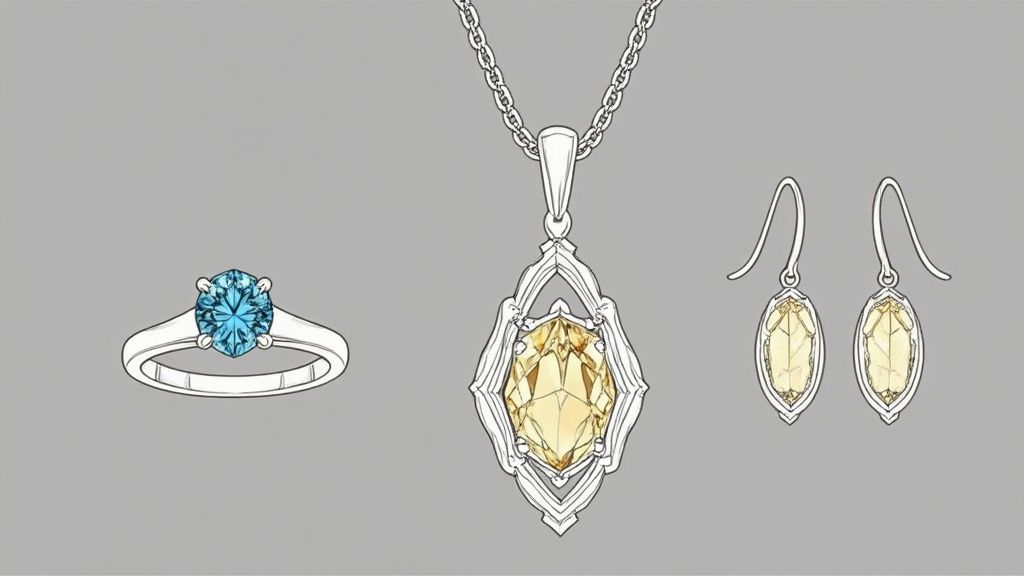
The line between precious and semi-precious stones used to be simple. For centuries, the "precious" club was an exclusive one, limited to just four members: diamond, ruby, sapphire, and emerald. Everything else—no matter how beautiful or rare—was lumped into the "semi-precious" category.
But let's be honest, that distinction is a relic of the past. It’s more about tradition than a hard-and-fast rule of a stone's actual value today. In reality, some so-called semi-precious gems are now rarer and command higher prices than their "precious" counterparts.
Debunking the Great Gemstone Divide
The modern gemstone market has completely blurred the old boundaries. The original classification made sense centuries ago when diamonds, rubies, emeralds, and sapphires were truly the rarest minerals known to man. Every other stone, from amethyst to zircon, was naturally considered secondary.
Today, that's just not the case. New discoveries have flipped the script. While the labels still hang around, they're no longer a reliable indicator of a gemstone's worth. The distinction is now more about cultural weight and history than market value. Precious stones are deeply tied to ideas of luxury and milestone events, keeping them in high demand for fine jewelry.
This shift means that a top-tier semi-precious stone can easily be worth more than a low-quality precious one. For instance, a flawless, vibrant Paraiba tourmaline or a brilliant tsavorite garnet can fetch a higher price per carat than a commercial-grade emerald riddled with inclusions.
The key takeaway is that quality, rarity, and individual beauty matter far more than an outdated label. A stone's value is determined by its unique characteristics, not the category it falls into.
Getting a handle on this nuance is the first step for any collector or jewelry lover. If you're thinking about starting your own collection, our guide on how to start a collection of rare rocks and minerals is a great place to begin.
To get us started, here’s a quick breakdown of the traditional classifications. Just keep in mind that what truly defines a gemstone’s value is a much richer story.
Feature
Precious Stones
Semi-Precious Stones
Primary Examples
Diamond, Ruby, Emerald, Sapphire
Amethyst, Garnet, Topaz, Tourmaline, Peridot
Historical Context
Traditionally seen as the world's rarest and most valuable gems
A catch-all category for every other gemstone
Modern Value
Can be exceptionally high, but hinges entirely on quality (the 4Cs)
Incredibly varied; the rarest specimens can easily outprice precious gems
Common Perception
Linked with royalty, luxury, and major life moments
Often viewed as more accessible, fashionable, and diverse
Comparing Gemstone Durability and Brilliance
Forget the traditional labels for a moment. What really matters when choosing a gemstone are its physical properties—how it holds up to real life and how it plays with light. This is where we get into the practical stuff, like hardness and brilliance, which dictate everything from a stone's ideal setting to how often you can actually wear it without worrying.
One of the most important metrics in the gem world is hardness, which we measure using the Mohs scale. This scale, running from 1 (softest) to 10 (hardest), isn't about strength but about a mineral's ability to resist scratches. A higher number means the stone can handle the accidental bumps and scrapes of daily life far better.
Hardness and Everyday Wearability
Precious stones are famous for being tough. Diamonds are at the very top, a perfect 10, making them incredibly resilient and the go-to for pieces like engagement rings that see constant action. Rubies and sapphires, both part of the corundum family, are right behind them with a hardness of 9. That's more than enough durability for any type of jewelry you can imagine.
Semi-precious stones, on the other hand, cover a much wider spectrum. Some are impressively durable, like topaz and spinel, which both clock in at an 8 on the Mohs scale. But many others are significantly softer. Take opal (5.5-6.5) or moonstone (6-6.5)—they're absolutely beautiful, but they need a bit more TLC and are much safer in earrings or pendants than in a ring that's exposed to daily wear.
Think of the Mohs scale as a practical guide for matching a gemstone to your lifestyle. Anything rated 7 or higher is generally considered tough enough for a ring you wear regularly. Softer stones? They're better off in more protected settings where they can shine without the risk.
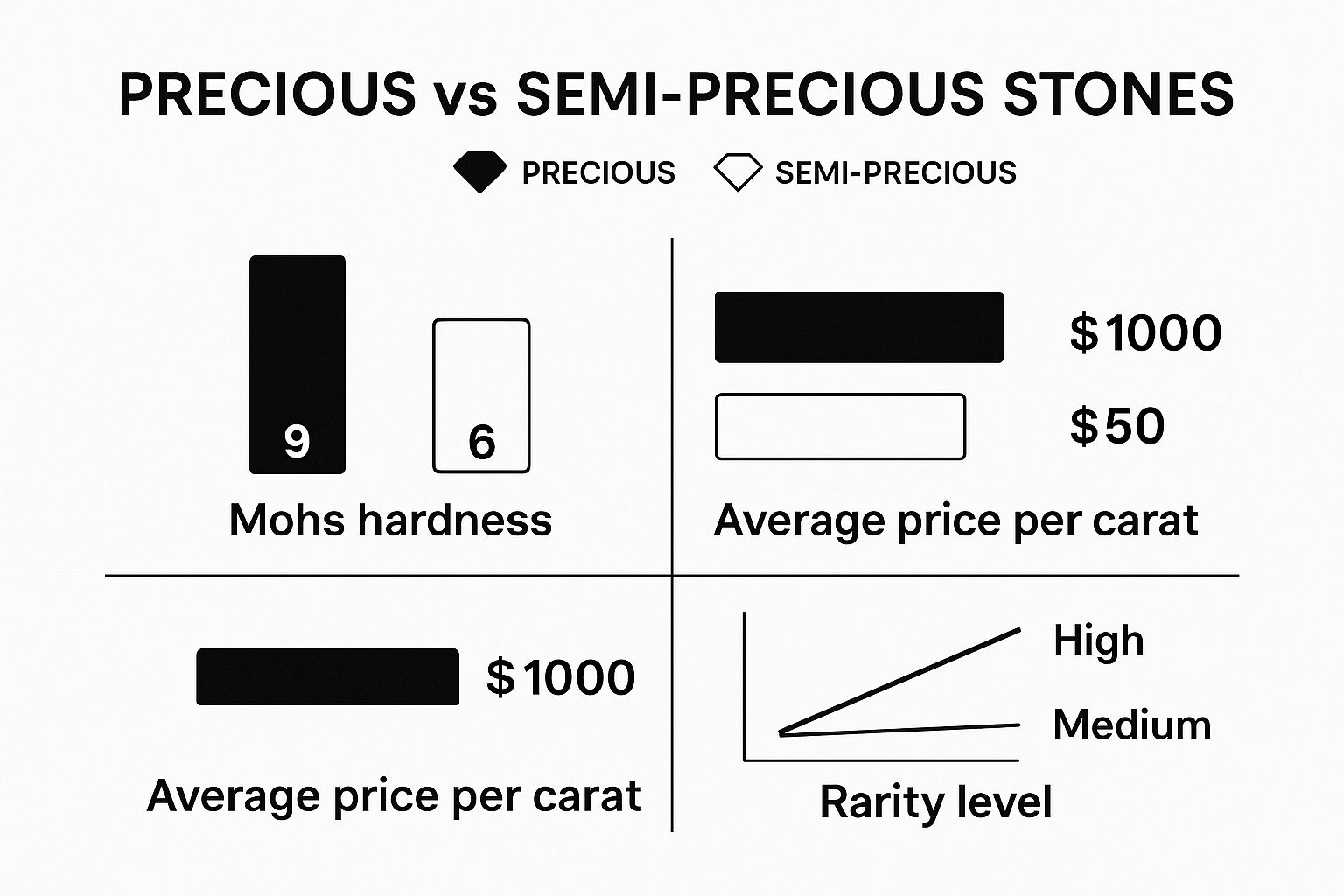
This infographic breaks down the key differences between the two categories at a glance.
As you can see, precious stones tend to dominate in hardness and rarity, which directly ties into their higher average cost per carat.
To give you a clearer picture of how these properties translate to jewelry, here’s a quick comparison of some popular gems.
Gemstone Hardness and Use Case Comparison
Gemstone
Category
Mohs Hardness
Primary Use Case
Diamond
Precious
10
Engagement rings, everyday wear
Sapphire
Precious
9
Rings, necklaces, earrings
Ruby
Precious
9
Rings, pendants, statement pieces
Topaz
Semi-Precious
8
Rings, earrings, versatile jewelry
Spinel
Semi-Precious
8
Rings, often as a sapphire alternative
Amethyst
Semi-Precious
7
Pendants, earrings, occasional-wear rings
Opal
Semi-Precious
5.5 – 6.5
Pendants, earrings, protected settings
This table really highlights how hardness dictates a stone’s ideal role. The toughest gems can handle anything, while the softer ones are best reserved for pieces that are less exposed.
Brilliance and Visual Fire
Brilliance—that captivating "sparkle"—is all about a gem's refractive index (RI). This number measures how much a stone bends light. A higher RI means more light gets bounced back to your eye, creating that dazzling fire everyone loves.
Here’s a quick look at how they stack up:
Diamond: With an RI of 2.42, diamonds are in a league of their own. Their ability to return light is what gives them that iconic, fiery sparkle.
Sapphire & Ruby: These precious gems have an RI around 1.77, giving them a bright, rich, and vivid appearance.
Spinel: A standout semi-precious stone, spinel has a strong RI of 1.72, allowing it to hold its own against sapphires in the brilliance department.
Quartz (Amethyst/Citrine): These popular semi-precious gems have a more modest RI of 1.54, which results in a softer, more subtle glow rather than a sharp sparkle.
But the lines can get blurry. A masterfully cut semi-precious stone like zircon can easily outshine a poorly cut sapphire. If you want to dive deeper into what makes each mineral unique, our crystal identification guide is a great resource.
Ultimately, while precious gems often have the edge in hardness and brilliance, there are plenty of semi-precious stones that offer incredible beauty and solid durability for the right piece and occasion.
How Gemstone Rarity and Quality Determine Value
While the old labels of "precious" and "semi-precious" give us a bit of historical context, they're not a reliable map for navigating a gemstone's actual market value today. The true worth of any gem is a much more interesting story, a mix of its rarity, raw beauty, and what the market is currently demanding.
This is all measured using a universal system known as the 4Cs: Color, Clarity, Cut, and Carat weight. These factors apply to every single stone out there, creating a level playing field where quality, not classification, is king.
This is why a truly exceptional tourmaline can easily fetch a higher price than a mediocre emerald. A commercial-grade emerald, cloudy and full of visible inclusions, might sell for just a fraction of the cost of a flawless, electric-blue Paraiba tourmaline—a "semi-precious" gem that collectors go wild for.
The Four Cs in Action
To really understand what makes a gem valuable, you have to get a feel for the 4Cs. Let's break down how these criteria put all stones, precious or not, on equal footing.
Color: For most gems, this is everything. Value is driven by a stone's hue (its pure color), tone (how light or dark it is), and saturation (its intensity). A richly saturated, vibrant color is the goal, whether you're talking about a fiery "pigeon's blood" ruby or a golden Imperial topaz.
Clarity: This is all about the absence of internal flaws (inclusions) or surface marks. A flawless diamond is the gold standard, but some stones, like emeralds, are almost expected to have some "garden" inside. In those cases, the type and location of the flaw are what really impact the value.
Cut: The cut is pure artistry—it's what unlocks a stone's inner fire and brilliance. A master cutter can take a good stone and make it magnificent by maximizing its color and the way it plays with light. This craft boosts the value of an amethyst just as much as it does a sapphire.
Carat Weight: This is simply how much the gem weighs. One carat equals 200 milligrams. For top-tier stones, the price per carat doesn't just climb—it leaps. That's because larger, high-quality gems are exponentially rarer. For a jaw-dropping example of both size and quality, take a look at this Natural Yellow Diamond Crystal that weighs in at over 21 carats.
The market doesn't just see a "ruby" or a "garnet"; it sees a specific combination of quality attributes. A large, clean, perfectly cut tsavorite garnet will always be more valuable than a small, included, poorly cut ruby.
Rarity Beyond the Label
At the end of the day, the simple laws of supply and demand have the final say. Some "semi-precious" stones are only found in one place on Earth, making them far rarer than diamonds, which are mined all over the world. Tanzanite, for instance, comes from a tiny mining area in Tanzania. Its extremely limited supply is what fuels its high value.
This shift in focus—from outdated labels to individual merit—empowers you as a buyer. It encourages you to look past old categories and appreciate each stone for its own unique beauty and quality. For a deeper dive into figuring out what your own pieces are worth, check out a practical guide to valuing jewelry and gemstones. Your eye should always be on the stone's character, not just its name.
How to Choose the Right Gem for Any Occasion
Knowing the difference between precious and semi-precious is one thing, but applying that knowledge is where the real fun begins. The debate disappears pretty quickly when you’re trying to pick the perfect stone for a specific piece of jewelry. Your final choice should always come down to your lifestyle, your budget, and what you want the piece to do.
Let's walk through a few common scenarios. Thinking about how different gems work in these real-world contexts will help you make a choice you’ll love every single time.
Selecting a Stone for an Engagement Ring
When it comes to an engagement ring, durability isn't just a feature—it's everything. This is a piece of jewelry that’s meant to be worn every day, so it needs to stand up to life’s inevitable knocks and bumps. That makes hardness the most critical factor.
It’s no surprise that precious stones like diamonds (Mohs hardness of 10) and sapphires (Mohs hardness of 9) are the classic go-tos. They’re incredibly tough, resisting scratches and holding up beautifully through years of wear and tear.
But don’t overlook some of the hardier semi-precious stones. Spinel (8) and topaz (8) are fantastic contenders, offering serious durability and a stunning range of colors, often at a much more accessible price. They strike a great balance between toughness and unique personality for a ring designed to last a lifetime.
While gorgeous, softer stones like opal (5.5-6.5) or moonstone (6-6.5) are generally a risky choice for an engagement ring. Their lower hardness makes them prone to damage, so they are much better suited for pieces that don't see as much action.
Finding a Gem for a Statement Piece
For a show-stopping necklace or a pair of cocktail earrings, the rules change completely. These pieces are worn less often and are naturally more protected, so you can shift your focus to pure visual impact. Think vibrant color, impressive size, and unforgettable character.
This is where the incredible diversity of semi-precious stones really gets to shine. You can find massive, eye-catching gems with unbelievable color saturation without the hefty price tag of their precious cousins.
For maximum effect, consider gems like these:
Amethyst: A deep, regal purple quartz that’s often found in large, clean stones perfect for a bold pendant.
Citrine: This sunny yellow-to-orange gem brings a warm, radiant glow to any design.
Labradorite: Famous for its mesmerizing "labradorescence," or play-of-color, this stone delivers a dynamic, almost mystical look.
Since these pieces aren't subjected to the same daily abuse as a ring, you can confidently choose a stone with a Mohs hardness of 7—like amethyst or citrine—and let its beauty be your guide.
Choosing an Affordable Gem for Everyday Earrings
For earrings you can wear day in and day out, you need a stone that hits the sweet spot between durability, beauty, and affordability. The gem has to be tough enough for regular wear but doesn't need the top-tier hardness you’d demand from a ring.
This is the perfect opportunity to explore some of the most versatile and budget-friendly semi-precious stones out there. Garnet, with its rich red hues and a respectable hardness of 6.5-7.5, is a wonderful choice. In the same vein, blue topaz and peridot offer brilliant color and solid durability for daily use.
These gems give you a pop of color and personality without a major investment, making them ideal for building a jewelry collection you can truly live in. You get the joy of wearing genuine gemstones every day, knowing they’re more than sturdy enough for the job.
Protecting Your Gemstone Investment
Whether your collection is built around precious diamonds or filled with vibrant semi-precious tourmalines, taking care of them is the only way to protect their beauty and value. Gemstones simply aren't all created equal. Each one has unique physical properties that dictate exactly how it needs to be handled, cleaned, and stored.
Knowing where a gem lands on the Mohs scale of hardness is your first clue. Tougher stones like diamonds, sapphires, and rubies can handle more robust cleaning methods. Softer, more delicate stones, on the other hand, require a much gentler touch to avoid doing serious damage.
Tailoring Your Cleaning Method
For the vast majority of gemstones, the safest cleaning method couldn't be simpler: warm water, a touch of mild dish soap, and a very soft toothbrush. This approach is gentle enough for stones like amethyst, garnet, and topaz. But you absolutely must avoid this for porous stones like turquoise or opal—they can actually absorb the water and chemicals, which can lead to ugly discoloration.
For the really durable stones rated 9 or higher on the Mohs scale, an ultrasonic cleaner can work wonders. These machines use high-frequency sound waves to shake dirt and grime loose from all those tiny, hard-to-reach spots.
Safe for Ultrasonic Cleaners: Diamonds, sapphires, and rubies generally do just fine in these cleaners.
Avoid Ultrasonic Cleaners: Never put emeralds, pearls, opals, turquoise, or any stone with significant inclusions into an ultrasonic cleaner. The vibrations can easily cause them to fracture.
When in doubt, always stick with the gentle soap and water method. It’s better to be safe than sorry.
Proper storage is just as critical as cleaning. Gemstones can scratch each other, so a diamond ring tossed in a jewelry box can easily damage a softer amethyst or tanzanite. The ideal solution is to keep pieces separated.
Smart Storage and Protection
Preventing scratches and chips is fundamental. Storing each piece of jewelry in its own soft pouch or in a lined jewelry box with separate compartments is a highly effective strategy. If you’re a collector with loose stones, something like a dedicated rock collection display case will keep them safe, organized, and beautifully displayed.
Beyond just storage, be mindful of what you're doing day-to-day. It’s always a good idea to take your rings off before you hit the gym, do any gardening, or clean with harsh chemicals.
For your most valuable pieces, insurance offers an essential layer of security. Before you can insure them, though, you'll need to know exactly what they're worth, which is why getting a professional jewelry appraisal is so important. This simple step protects your investment against loss, theft, or damage and gives any serious collector true peace of mind.
Answering Your Top Gemstone Questions
When you start digging into the world of precious vs. semi-precious stones, a lot of questions pop up. To help clear up any lingering confusion, I’ve put together answers to some of the most common queries we hear. This should give you the confidence you need, whether you're buying your first piece or adding to a serious collection.
We'll cover everything from the role of lab-grown gems to the investment potential of stones that aren't one of the "big four."
Are Lab-Grown Gems Precious or Semi-Precious?
This is a great question, and the answer is simpler than you might think. A lab-grown gem has the exact same chemical, physical, and optical DNA as its natural twin. Because of this, a lab-created diamond is still a precious stone, and a lab-grown amethyst is still a semi-precious stone.
The classification sticks to the mineral’s identity, not its origin story. The real difference is in how they’re made and what they cost, with lab-grown options often being a more accessible way to get into fine jewelry.
Can Semi-Precious Stones Be Good Investments?
Absolutely. While the investment spotlight usually shines on precious gems, some rare and exceptionally high-quality semi-precious stones can be fantastic assets. Think of gems like Paraiba tourmaline, Imperial topaz, and tsavorite garnet—their extreme rarity and collector demand have caused their value to skyrocket.
The key to a good investment isn’t the category label, but a combination of quality, rarity, and provenance. A top-tier tsavorite garnet can easily outperform a low-quality emerald as an asset over time.
Where Do Pearls Fit in This Classification?
Pearls are in a league of their own. They’re organic gems, created by living creatures, not minerals formed deep in the earth. Historically, their incredible value and royal associations put them on the same level as precious stones.
Today, gemologists usually give them their own special category. Still, a high-quality natural pearl from the South Sea or Tahiti is universally seen as being on par with the finest precious gems. Their rarity and timeless elegance ensure their status.
How Can I Verify if a Gemstone Is Real?
Authenticating a gemstone is a job for the pros. While you can get a feel for a stone by looking for inclusions with a jeweler's loupe, the only surefire way to know what you have is to get a gemological report from a trusted laboratory.
For any significant purchase, insist on buying from a reputable dealer who provides a certificate. The Gemological Institute of America (GIA) is the global authority, and their reports give you complete peace of mind by detailing a stone’s every characteristic and confirming it’s the real deal. It’s a critical step for verifying value and protecting your investment.
At Astro West, we believe every mineral, fossil, and gemstone tells a story millions of years in the making. For over 60 years, our family-run gallery has been dedicated to sharing these natural treasures, from beginner-friendly crystals to museum-quality specimens. Each piece in our collection is ethically sourced and authenticated by our in-house experts, ensuring you invest in genuine, enduring beauty. Explore our curated selection of fine minerals, fossils, and handcrafted jewelry today.