Natural Ruby vs. Synthetic Ruby: A Collector’s Guide to Value
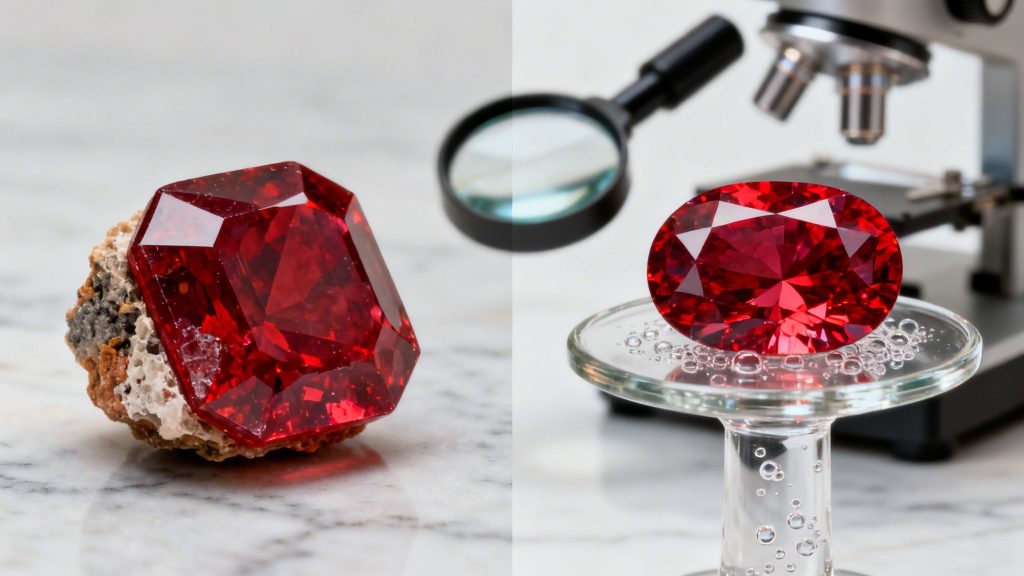
The critical difference between a natural ruby and a synthetic ruby is not chemistry. Instead, it is their origin, rarity, and fundamental worth. A natural ruby is a tangible piece of Earth’s history, formed over millions of years. Therefore, it is a genuine asset that can appreciate in value. A synthetic ruby, however, is the product of a rapid, repeatable scientific process—a beautiful but common commodity with no long-term financial upside.
Understanding a Ruby's True Worth
For any collector or investor, understanding the difference between natural and synthetic rubies is essential. Although both are technically corundum, their market journeys are vastly different. Consequently, this journey defines their value. One is a geological artifact, a unique treasure born from immense rarity. The other is an engineered product, visually stunning but endlessly replicable.
A natural ruby’s value is welded to its scarcity. The precise geological conditions required to create one are incredibly rare. As a result, the world's supply of top-tier, gem-grade rubies is fixed. With limited supply and steady demand, its value tends to grow over time. This makes a natural ruby more than just a beautiful object; it is a collectible asset and a store of value, much like fine art or a rare fossil.
In sharp contrast, a synthetic ruby's value is based on production cost. Since labs can mass-produce them, they lack the rarity that underpins investment value. Their price reflects technology and labor, not geological chance. Therefore, synthetic rubies do not appreciate and have no secondary market for serious collectors.
Core Differentiators at a Glance
Navigating the market means being clear on these key differences. A ruby's value and desirability are driven by its origin and rarity. This conversation extends beyond simple identification into asset potential, a topic we explore in our guide to distinguishing between precious and semi-precious stones. This framework is essential for making a sound acquisition.
The table below breaks down the essential differences influencing a ruby's value, rarity, and desirability.
Natural vs. Synthetic Ruby: Key Differentiators
Attribute
Natural Ruby (Geological Artifact)
Synthetic Ruby (Engineered Product)
Origin
Formed deep within the Earth over millions of years.
Created in a laboratory in a matter of weeks.
Rarity
Extremely rare, especially in high quality and large sizes.
Not rare; can be produced on demand.
Inclusions
Typically contains natural imperfections (inclusions).
Usually flawless or has artificial tells like gas bubbles.
Market Value
Appreciates over time; a tangible investment asset.
Depreciates; holds no secondary market or collector value.
Provenance
Possesses a unique geological history and provenance.
Lacks historical significance or unique origin story.
Collector Desirability
Highly sought-after as a collectible and store of value.
Valued for aesthetics in fashion jewelry only.
Ultimately, these differences highlight why one is a treasured piece of Earth's legacy. The other is a beautiful but fleeting piece of technology. For the discerning buyer, the choice depends on whether they seek an enduring asset or a decorative object.
Comparing Origins: Rarity Versus Replication
The origin of a ruby is the foundation of its price. A natural ruby’s journey is a story of geological chance. Its creation requires a perfect recipe of aluminum oxide and chromium under intense heat and pressure. This demanding process makes high-quality, gem-grade rubies exceptionally scarce.
This natural scarcity drives their value. Every natural ruby is a finite geological treasure from a limited global supply. Its worth is fundamentally tied to its rarity, the same principle governing the market for all true collectibles.
Synthetic rubies, on the other hand, are products of controlled industrial replication. They are crafted in a lab through human ingenuity and technology. Therefore, their origin story is one of efficiency and predictability, not geological chance.
The Science of Replication
Labs use methods like flame-fusion to produce rubies that are chemically identical to natural ones. These processes mimic natural formation but compress an eons-long timeline into weeks. As a result, factories can produce flawless crystals consistently and in massive quantities.
This ability to replicate rubies on demand eliminates scarcity. While they may look perfect, synthetic stones are commodities. Their value is dictated by production costs, not by intrinsic rarity. For a parallel, the discussion on the real differences in lab grown vs natural diamond options offers useful insights.
A synthetic ruby, no matter how perfect, can never possess the one quality that defines a true asset: rarity. Its predictable creation means it lacks the inherent scarcity and historical provenance that make a natural specimen a genuine store of value.
A Tale of Two Markets
This fundamental difference in origin creates two separate markets with opposite value trajectories. The market for natural rubies is fueled by collector demand for a finite resource. The market for synthetic rubies, however, is driven by industrial supply and consumer demand for affordable alternatives.
Production numbers reveal the reality. A staggering 99.9% of all corundum mined worldwide never qualifies as gem-quality ruby. Meanwhile, synthetic factories have produced over 1 million kg annually since the 1990s. In contrast, the annual global output of natural rubies is a mere 500-1,000 kg.
This scarcity explains why natural ruby prices have hit peaks of over $1 million per carat. The legendary 25.59-carat Sunrise Ruby, for example, sold for $30 million. This vast difference in availability is why a natural ruby is a collectible asset, while a synthetic ruby is not. One is an investment in rarity; the other is a purchase of a manufactured product.
How to Identify an Authentic Ruby
Distinguishing a natural ruby from a synthetic one requires a trained eye and the right tools. However, the single biggest indicator is often visual perfection. A truly flawless ruby is almost unheard of in nature. If a stone seems too perfect, it is likely a product of a controlled lab.
Natural rubies are defined by their internal characteristics, which gemologists call inclusions. These are not flaws; they are microscopic fingerprints left during the stone’s formation. They are the definitive proof of a natural origin, separating a geological treasure from a synthetic lookalike.
Synthetic rubies, conversely, often betray their rapid, controlled creation. Knowing what to look for is essential for any serious buyer. Our crystal identification guide offers a broader look at evaluating mineral specimens.
Natural Inclusions: The Signature of Authenticity
The most common inclusions in natural rubies are fine, intersecting needles of the mineral rutile. This feature is known beautifully as silk. When these needles align perfectly, they can create a stunning star-like effect called asterism, a highly prized trait.
Other tell-tale signs of a natural origin include:
Mineral Crystals: Tiny crystals of other minerals trapped inside the ruby as it grew.
Healing Fissures: Delicate, fingerprint-like patterns, which are scars from when the crystal healed itself.
Color Zoning: Uneven patches or angular bands of color, showing inconsistent chromium distribution.
These features are the stone's birthmarks. They tell a unique story of its journey, adding character and providing verifiable history that enhances its value. An expert always looks for these first.
Telltale Signs of Synthetic Creation
Synthetic rubies reveal their lab origins with different, more systematic characteristics. The Verneuil method, a common production technique, often leaves behind clear signs of a rapid, machine-driven process.
The key takeaway is this: natural inclusions are random and unique, reflecting a stone's chaotic history. In contrast, the "flaws" in a synthetic ruby are often repetitive and systematic, revealing its controlled, artificial creation.
Common indicators of a synthetic stone include:
Curved Striae: Under magnification, you might see faint, curved growth lines, a classic sign of the flame-fusion process. Natural rubies always show straight, angular growth patterns.
Gas Bubbles: Microscopic spherical bubbles can get trapped within the stone during its creation. These are almost never found in natural rubies.
The table below breaks down the key identifiers that distinguish natural rubies from their synthetic counterparts.
Visual and Scientific Authentication Markers
Identification Marker
Natural Ruby Characteristics
Synthetic Ruby Indicators
Inclusions
Rutile needles (silk), mineral crystals, "fingerprints."
Gas bubbles, flux remnants, metallic inclusions.
Growth Lines
Straight, angular zoning following crystal structure.
Curved striae or growth lines (common in flame-fusion).
Color Distribution
Often shows color zoning or uneven patches.
Typically very uniform, even color distribution.
Fluorescence
Variable, often inert to moderate red under UV light.
Strong, vibrant red fluorescence under long-wave UV light.
Spectroscopy
Shows specific absorption patterns indicating natural origin.
May show patterns indicative of specific manufacturing methods.
While these markers are reliable, modern techniques are constantly evolving. Therefore, professional verification is more important than ever for a significant purchase.
The Necessity of Professional Gemological Analysis
Visual cues are a good start but are not foolproof. Some newer synthetic processes can produce stones with convincing inclusions. Additionally, heat treatments on natural rubies can sometimes mask their identifying features.
For any ruby of significant value, a professional gemological analysis is non-negotiable. A certificate from a reputable lab like the Gemological Institute of America (GIA) provides an unbiased, scientific verdict. This report confirms the ruby’s natural origin, its geographic provenance, and any treatments. This expert verification is the ultimate protection for your investment, confirming the ruby is a genuine geological artifact.
Analyzing Investment Potential and Market Value
When it comes to investment, the line between a natural and a synthetic ruby is absolute. A natural ruby's value is a direct result of its rarity. It is a finite masterpiece driven by supply and demand. A synthetic ruby, however, is a product of technology with a value tied to manufacturing costs. It is a beautiful object, but it is a commodity, not an asset.
This fundamental difference is critical when viewing them as assets. The finest natural rubies, especially from legendary mines like Burma’s Mogok Valley, have a long history of appreciation. Their worth is built on color, clarity, cut, and carat but is elevated by origin and treatment status.
Natural Rubies as Tangible Assets
A top-tier natural ruby behaves much like fine art or a blue-chip stock. Its value is about history and pedigree. An untreated ruby with the famous 'pigeon's blood' color, for example, is a constantly appreciating asset. Its supply is essentially gone, while demand from collectors only grows stronger.
Provenance plays a massive role. A ruby with a documented history from a famed mine will always command a premium. That traceability adds a layer of value a synthetic stone can never replicate. This is a crucial factor when choosing from the best gemstones for jewelry with an eye on future value.
The secondary market for natural rubies is robust and global, driven by collectors, investors, and heritage auction houses. Conversely, there is virtually no secondary collector market for synthetic rubies, as their unlimited supply prevents any potential for appreciation.
The price gap illustrates the difference. A high-quality 1-carat natural ruby can fetch anywhere from $10,000 to $100,000. A visually identical synthetic version costs just $100 to $500. This chasm is why savvy collectors focus on natural stones. Top Burmese rubies, for instance, surged 300% in value between 2000 and 2020.
The Commodity Status of Synthetic Rubies
Synthetic rubies are priced based on manufacturing efficiency. As technology improves, production costs decline, often causing their market price to drop. They are beautiful and durable but lack the scarcity essential for investment value. Therefore, they function as decorative objects, not financial assets.
They fill an important role in creating accessible fashion jewelry. However, they should never be confused with an investment-grade specimen. To understand tangible assets better, review a modern guide to investing in luxury items. The core principles of rarity and market demand are the same across all high-value collectibles.
Ethical Sourcing and Verified Provenance
When ethics are discussed, synthetic rubies seem like an easy winner. After all, a lab-created stone bypasses mining entirely. For a serious collector, however, that view is too simple. The real conversation centers on the verifiable, responsible story behind a natural stone.
Synthetic rubies do offer an ethical guarantee by design. Their laboratory origin avoids environmental or labor concerns, making them a sensible choice for fashion jewelry. For a collectible asset, however, the story is more nuanced. The pinnacle of conscientious collecting is not an artificial stone; it is a natural one with a fully documented, ethical history.
This is where a premier gallery like Astro West stands apart. We invest immense effort into building direct, transparent supply chains. We work exclusively with trusted mining partners committed to stringent ethical and environmental practices. This meticulous sourcing ensures every natural ruby in our collection is conflict-free and has a documented history, elevating it to an appreciating asset.
The global synthetic ruby market was valued at around $4.42 billion in 2024. This growth is almost entirely fueled by demand in fashion jewelry. Yet, for collectors, investment logic points firmly toward natural rubies, whose market value is driven by rarity and history. You can explore more market data in this comprehensive market report.
An ethically sourced natural ruby with clear provenance represents the highest standard of responsible collecting. It combines a magnificent natural wonder with verifiable peace of mind, reinforcing its status as a superior tangible asset.
Verification and Collector Confidence
A ruby’s ethical journey must be as clear as its crystal structure. This requires tangible proof, not just a seller's word. Documentation from the source, combined with independent gemological certification, provides rock-solid verification for a confident acquisition.
This level of traceability accomplishes two critical things for an investor. First, it guarantees ethical integrity. Second, it adds a powerful layer of value. A documented history, or provenance, can dramatically increase a ruby's market worth.
Ultimately, while synthetic stones offer a simple answer to ethical questions, they do so by stripping away rarity and history. An ethically sourced natural ruby, however, offers both. It stands as a testament to responsible stewardship, delivering beauty, history, and a clear conscience in a single, appreciating investment.
Acquiring a Ruby with Confidence
Acquiring a significant natural ruby is a major decision—an investment in beauty, history, and rarity. Therefore, the entire process must be built on expertise and trust. The line between a geological treasure and a synthetic lookalike underpins its long-term value, making verified authenticity non-negotiable.
At Astro West, our approach is grounded in meticulous curation and unwavering verification. We have spent years building direct relationships with miners and trusted sources worldwide. This ensures every ruby we handle meets our demanding criteria for quality, ethical sourcing, and rock-solid provenance.
Guidance from Acquisition to Asset
Our in-house expertise, backed by certifications from premier labs like the GIA, provides certainty for a confident purchase. We guide clients through the subtle details that drive a ruby's value. These include the specific hue of a "pigeon's blood" red or the delicate patterns of natural inclusions. This educational approach transforms a purchase into a well-informed investment.
A confident ruby acquisition is not just a transaction. It is the transfer of a rare piece of natural history, backed by verifiable science and expert curation, ensuring its legacy and value for generations.
This decision tree helps map out the right choice based on your primary goal.
As the flowchart shows, the path toward a collectible asset with investment potential leads to a natural ruby. If budget is the primary concern, synthetic options offer an affordable alternative.
Securing a Lasting Legacy
Ultimately, our role is to help you select more than just a gemstone. We help you choose a lasting asset that promises both aesthetic enjoyment and enduring worth. We cut through market complexities so you can focus on the beauty and history of the specimen itself.
Choosing a natural ruby is a decision to own a piece of the Earth's legacy. With the right guidance, it becomes an acquisition marked by certainty and the promise of lasting value.
A Collector's Q&A on Rubies
Here are answers to common questions we hear from collectors weighing natural versus synthetic rubies. Clear, expert answers are key to making a sound decision and protecting the long-term value of your collection.
Can a Jeweler Always Spot a Synthetic Ruby?
While an experienced jeweler can often identify obvious fakes, definitive authentication requires more than a loupe. It takes a certified gemologist using specialized equipment to analyze the stone’s internal inclusions and growth patterns. Therefore, for any serious acquisition, a certificate from a reputable gemological lab is non-negotiable. That document confirms a ruby's authenticity and solidifies its value as a tangible asset.
How Does Treatment Affect a Natural Ruby's Value?
Treatments have a massive impact on a natural ruby's market value. Heat treatment, a common practice to improve color, is widely accepted but results in a lower price than a comparable untreated stone. However, more invasive treatments like fracture-filling with glass will dramatically reduce a ruby’s value and compromise its integrity.
Untreated natural rubies are the rarest of the rare and, as a result, command the highest prices on the market. They represent the superior choice for any serious collector focused on long-term appreciation and asset quality.
Is There a Place for Synthetic Rubies in a Collection?
Synthetic rubies have their place, but not in an investment-focused collection. They are excellent for decorative or fashion jewelry where affordability and aesthetics are the main goals. Moreover, they possess the same physical hardness as natural rubies, making them quite durable. The key is to view them as well-crafted objects, not as collectible assets. They do not hold or build value over time.