Investing in Malachite in Azurite: A Collector’s Guide
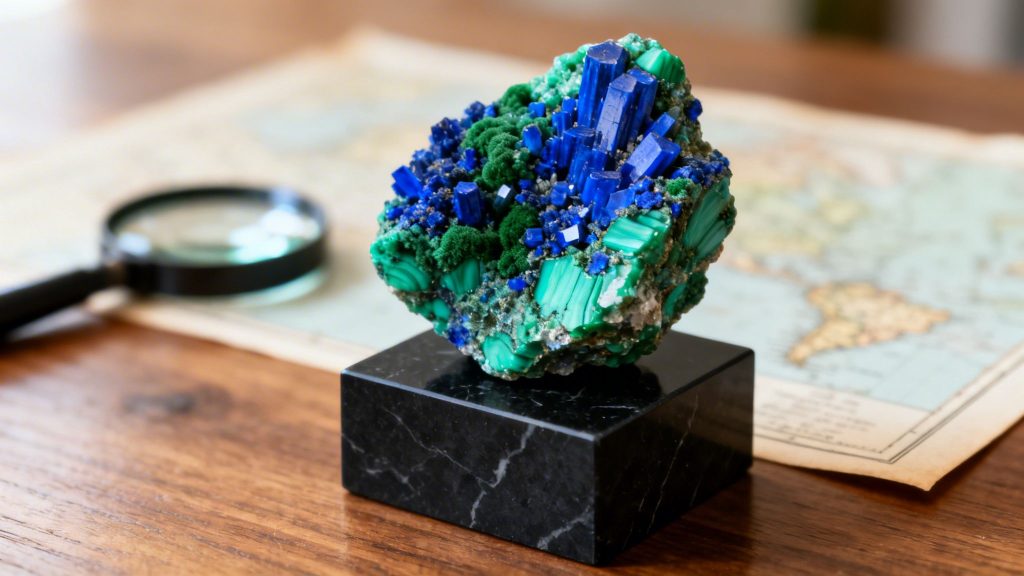
A stunning specimen of malachite in azurite represents more than a mineral. It is a piece of natural art where geology and investment potential intersect. These captivating pieces form through the slow oxidation of copper deposits. Additionally, their history stretches from ancient pigments to modern luxury décor, directly informing their value.
Understanding a Premier Mineralogical Asset
Malachite and azurite are geological siblings. Both are chemically similar copper carbonates, yet they form under slightly different conditions. Azurite, with its iconic deep blue hue, is the less stable of the two. Over geological time, it often transforms into vibrant green malachite through a natural process called pseudomorphism.
This transformation creates the breathtaking patterns collectors seek. For example, the dramatic interplay between electric blue crystals and velvety green formations tells a story of change, rarity, and time. As a result, not all specimens are valued equally. The most desirable pieces capture a dynamic balance between both minerals, representing a snapshot of that geological process. This inherent scarcity and aesthetic power position malachite in azurite as a cornerstone asset for any sophisticated collection.
Key Factors Defining Value
For collectors, distinguishing an investment-grade specimen from a decorative one is critical. The market evaluates these natural sculptures based on several specific, time-tested attributes. Understanding these factors is the first step when you curate a fine mineral collection with Astro West.
Here are the key value drivers you need to know:
Color Saturation and Contrast: Pieces with vivid, distinct color separation between the blue and green command higher prices. Muddled or blended tones significantly reduce value.
Crystal Formation: Sharp, well-defined azurite crystals paired with lustrous, botryoidal malachite are far more valuable than massive, indistinct forms. Collectors seek well-preserved crystal structure.
Aesthetic Balance: The flow and arrangement between the two minerals create a visual narrative. Therefore, a harmonious, balanced specimen is always preferred.
Provenance: Specimens from historically significant or depleted localities, like the Tsumeb Mine in Namibia, carry a substantial premium due to their legacy and market scarcity.
Acquiring a top-tier malachite in azurite specimen is analogous to purchasing a masterpiece of natural art. Its value is secured by undeniable rarity, beauty, and the specific geological circumstances required for its existence. This makes it a reliable store of value with a proven history of appreciation, similar to fine art or luxury watches.
How Formation and Rarity Drive Market Value
The value of any collectible is a story of scarcity. For malachite in azurite, that story is written by geology itself. The journey from a simple copper deposit to a stunning combination specimen is a delicate dance of chemistry, pressure, and time, making each piece a natural limited edition.
Azurite and malachite are secondary copper minerals. This means they form after primary copper ore is exposed to the elements. Azurite, with its iconic deep blue, is the more fragile and chemically unstable of the two. It requires very particular environmental conditions to form well-shaped crystals, which makes spectacular azurite specimens rare on their own.
The Science of Transformation
The true value creation occurs when those conditions shift. A slight change in water chemistry or atmospheric carbon dioxide can destabilize azurite. When this happens, it begins a slow transformation into its more stable cousin: vibrant green malachite.
This process is called pseudomorphism, where one mineral replaces another while perfectly preserving the original crystal’s shape.
A specimen showing brilliant blue azurite crystals partially transforming into deep green malachite is not just a rock. It is a snapshot of geological time. It captures a fleeting moment in a process that takes eons, making it far rarer and more desirable than a specimen of either mineral alone. This dynamic interplay is a primary driver of its market value.
This transformation is not random. Malachite forms easily in common, slightly alkaline environments. However, azurite needs much rarer, more acidic conditions with abundant carbonates. This chemical selectivity explains why azurite is less common and why it so often alters into the more stable malachite over time.
From Geological Process to Investment Grade
This geological interplay between stability and transformation directly creates collector value. A complete pseudomorph, where malachite has fully replaced an azurite crystal, is a collectible curiosity. However, specimens caught mid-transformation command the highest market premiums.
These are the key formation-related clues that signal a higher-value, investment-grade piece:
Partial Pseudomorphs: Specimens showing sharp azurite crystals with a clear, partial takeover by malachite are exceptionally prized.
Distinct Boundaries: The cleaner the line between the blue azurite and the green malachite, the higher the aesthetic appeal and monetary value.
Preserved Crystal Habit: Malachite that has replaced azurite but perfectly maintains the original sharp, bladed crystal shape is exceedingly rare and sought-after.
Ultimately, the same natural process that creates these combination pieces also guarantees their rarity. This is similar to the specific conditions required for other valuable gems to form. To better understand how unique geological processes create value, see our guide on how amethysts are formed. This knowledge allows a collector to see beyond simple beauty and recognize the geological provenance that underwrites a specimen’s long-term worth.
A Collector's Framework for Valuing Specimens
Valuing a malachite in azurite specimen is similar to appraising a rare vintage car or fine watch. It is not just about appearance; specific, measurable qualities separate a decorative rock from a true investment-grade asset. Once you learn to identify these details, you can spot pieces with real potential for long-term appreciation.
The most important factor is the interplay between the two minerals. Azurite and malachite are beautiful on their own, but their combination tells a story of geological change that excites collectors. Learning to read that story is the first step toward building a top-tier collection.
Evaluating Color Saturation and Contrast
A specimen’s visual impact begins with its color. For malachite in azurite, value lies in the dynamic between two hues. Deep, electric-blue azurite against vibrant, emerald-green malachite creates a powerful aesthetic that collectors and designers covet.
The gold standard is a specimen with high color saturation and sharp contrast. Muddled, pale, or blended tones diminish a piece’s desirability and, therefore, its market value. The boundary between the blue and green should be crisp and dramatic.
Specimens with intense, vivid colors will always command a premium. This is especially true for pieces intended for luxury decor, where visual impact is paramount. A piece with weak coloration lacks the same market power or long-term value.
Analyzing Crystal Formation and Habit
Beyond color, crystal structure is a major indicator of quality. Azurite is known for its sharp, well-defined monoclinic crystals, often in bladed or tabular shapes. Malachite, conversely, usually appears in botryoidal (bubbly) or velvety masses. Preservation of these distinct forms is critical.
A specimen with sharp, lustrous azurite crystals partially coated by rich, velvety malachite is worth far more than one with indistinct forms. This comes down to rarity. Well-formed crystals are much harder to find in nature and offer a clearer window into the mineral's growth history.
Key Value Drivers for Malachite in Azurite Specimens
Attribute
High-Value Indicator (Investment Grade)
Lower-Value Indicator (Decorative Grade)
Color
Deep, saturated blues and vibrant greens with sharp, dramatic contrast.
Pale, muted, or "muddy" tones with blurry color boundaries.
Crystal Form
Sharp, defined azurite crystals with distinct malachite habits (botryoidal/velvety).
Indistinct, massive, or poorly formed crystals with no clear separation of habits.
Composition
A balanced, aesthetic arrangement; often a partial pseudomorph showing clear replacement.
Clunky or imbalanced composition; one mineral heavily dominates the other.
Luster & Condition
Bright, glassy (vitreous) luster on azurite; silky sheen on malachite. No significant damage.
Dull or earthy luster; noticeable chips, fractures, or abrasions.
Provenance
Originates from a classic, historically significant, or depleted locality (e.g., Tsumeb, Bisbee).
From a common source or has an unknown or unverified origin.
This table serves as a mental checklist when evaluating a specimen. By looking for these high-value indicators, you train your eye to spot the pieces that are truly exceptional and worthy of investment.
Assessing Specimen Composition and Provenance
Finally, a specimen’s overall balance and origin complete its value profile. A piece where azurite and malachite create a harmonious flow is almost always preferred over asymmetrical arrangements. The true treasures are partial pseudomorphs that tell a clear geological story of transformation.
Additionally, a specimen’s provenance—its place of origin—acts as a significant value multiplier. For example, a classic piece from a world-famous and now-closed mine like the Tsumeb Mine in Namibia carries undeniable historical weight. These locations are legendary for producing specimens with unique characteristics, and their scarcity ensures their value will appreciate. It is like owning a painting from a celebrated artist’s most famous period; the history is integral to the value.
Identifying Top-Tier Provenance and Localities
In the world of fine minerals, geography is value. A specimen’s place of origin, or provenance, can elevate its worth from a decorative object to a world-class asset. For malachite in azurite, knowing where a piece was mined is as important as its color or crystal quality.
Each famous locality produces specimens with a distinct mineralogical signature. As a result, collectors will always pay a premium for pieces from these legendary sites. A specimen’s story begins deep within the Earth, but its market narrative is defined by its origin.
Premier Mines and Their Legacies
Certain locations are synonymous with exceptional quality. These mines produced malachite in azurite specimens that set the global standard for beauty and rarity. They are therefore foundational pillars of the collector market.
Milpillas Mine, Mexico: This mine is famous for breathtaking, electric-blue azurite crystals with a brilliant luster. Specimens from Milpillas are highly sought after. Moreover, a combination piece with malachite represents a modern classic. You can learn more about this region in our overview of crystals from Mexico.
Tsumeb, Namibia: The Tsumeb mine is legendary. Now closed, it produced an astonishing variety of mineral forms. Tsumeb specimens are famous for their complex pseudomorphs and unique associations, making any piece a prized historical artifact.
Bisbee, Arizona, USA: Another classic American locality, the mines of Bisbee produced the iconic "Bisbee Blue" azurite. They also yielded some of the richest green malachite known. Specimens from here are cornerstones of major museum and private collections.
Understanding Historical Significance and Market Premiums
A mine's historical context directly influences a specimen’s price. For example, pieces from Chessy, France, the original "type locality" for azurite, carry a serious premium for their historical importance. These are not just minerals; they are pieces of scientific history.
While malachite and azurite appear in roughly 80% of copper mines globally, quality and character vary dramatically. For instance, the unique crystal angle from Chessy gives its minerals a distinct look that experts can identify. Valuable intergrowths from these top-tier mines can also increase a specimen’s value by as much as five times over a single-mineral piece, a detail you can explore further on sites like webmineral.com.
A specimen’s label is more than just a location; it is a testament to its rarity, history, and unique character. Whether it is the electric blue of Milpillas or the historic weight of Tsumeb, provenance authenticates value and secures a specimen’s place as a lasting asset. This is why verifiable origin is non-negotiable for serious collectors.
Verifying Authenticity with Mineralogical Details
Distinguishing an investment-grade mineral from a common look-alike requires more than a quick glance. For malachite in azurite, verifying authenticity means examining the subtle mineralogical details that define a top-tier specimen. This knowledge empowers collectors to make confident acquisitions backed by science.
At their core, malachite and azurite are basic copper carbonates born from the same elemental soup. A surprisingly small chemical difference controls their completely different colors and crystal shapes. Experts use this key detail for verification.
Chemical Signatures and Crystal Habits
The main distinction comes down to copper content and molecular structure. Chemically, malachite's formula is Cu₂CO₃(OH)₂ with 57.48% copper, while azurite is Cu₃(CO₃)₂(OH)₂ with 55.3% copper. This slight difference directly shapes their physical form, or crystal habit. Azurite forms sharp, tabular or bladed crystals. Malachite, conversely, almost always develops into botryoidal (bubbly) or fibrous masses.
A key marker of authenticity is seeing these different crystal structures adjacent to one another. If a piece shows both minerals with an identical texture, that is an immediate red flag, as it contradicts their natural growth patterns. An authentic, high-quality combination specimen will showcase these distinct habits in clear contrast.
Practical Steps for Verification
When examining a specimen, look for tell-tale signs of authenticity. Note how the velvety, rounded malachite masses seem to flow over or replace the sharp, angular azurite crystals. This visual evidence of pseudomorphism is a powerful sign of a genuine, natural process.
Both minerals are also quite soft, with a Mohs hardness of 3.5 to 4. A scratch test will damage the specimen and should be avoided. However, knowing their softness helps distinguish them from harder, artificial materials like plastic or glass. For collectors wanting to build evaluation skills, our crystal identification guide provides more foundational knowledge. Ultimately, understanding these mineralogical details allows you to read the scientific story embedded within the stone.
Acquiring and Protecting Your Investment
Acquiring a fine specimen of malachite in azurite is an exciting moment. Once it is yours, the next chapter begins: protecting its beauty and value for the long term. These minerals are not just stunning; they are also surprisingly delicate.
Both azurite and malachite are soft, ranking just 3.5 to 4 on the Mohs hardness scale. This means they can be easily scratched by a common steel knife blade. Therefore, you should always handle specimens with care, holding them by the sturdier matrix to avoid pressure on fragile crystals.
Best Practices for Preservation and Display
Think of preserving your specimen like caring for a fine work of art. You must control its environment. As copper carbonates, these minerals are sensitive to factors that can degrade their color and structure over time, directly impacting their value.
You should shield your piece from:
Direct Sunlight: The brilliant blue of azurite is particularly vulnerable to UV light. Prolonged exposure can cause it to fade and darken, diminishing its appeal and value.
High Heat: Heat can cause dehydration and stress the mineral’s internal structure, leading to instability or cracks.
Acids and Chemicals: This is critical. Even a mild household cleaner can react with the minerals, causing permanent discoloration and surface etching.
A thoughtful display actively protects your piece. Placing your malachite in azurite under a glass dome or inside a display case guards it against dust and accidents. To enhance its features, use focused, cool LED lighting. This dramatically highlights the mineral interplay without generating the harmful heat of traditional bulbs.
The most critical step in any acquisition is ensuring the piece is authentic and its provenance is verified. Acquiring a specimen from a trusted gallery like Astro West guarantees you are not just buying a mineral, but investing in a documented asset whose history and quality are secure. This peace of mind is the bedrock of any serious collection, elevating your purchase into a confident investment backed by expertise.
A Few More Things You Might Be Wondering
Finally, let's address common questions that arise when collectors consider adding malachite in azurite to their portfolios. This practical advice from seasoned experts helps you navigate the market with confidence.
Does Malachite in Azurite Appreciate in Value?
Yes, high-quality malachite in azurite with strong provenance and aesthetics has a proven record of appreciation. Much like fine art or a vintage watch, its market value is a direct result of rarity and intense demand. As the world's best mines become depleted, the supply of top-tier specimens diminishes. As a result, the value of exceptional pieces already in circulation naturally increases.
What Is More Valuable, Azurite or Malachite?
As a general rule, well-formed azurite crystals are rarer and often more valuable than malachite of similar quality. The specific geological conditions needed to create sharp azurite crystals are much less common.
However, the most valuable specimens feature a balanced interplay between both minerals. A piece capturing a partial pseudomorph, where velvety malachite artfully replaces sharp azurite crystals, is incredibly prized. It is like capturing a rare geological event frozen in time. This dynamic creates the most excitement among collectors and, therefore, the highest market value.
A key takeaway for any collector is that the combination is often worth more than the sum of its parts. The narrative of transformation captured in a single specimen makes it an exceptional and sought-after asset.
How Can You Tell if Malachite in Azurite Is Real?
An authentic specimen has specific mineral traits that are difficult to convincingly replicate. The key clues are the textures. Look for malachite's bubbly, botryoidal shapes or its soft, velvety coating against azurite’s sharp, bladed monoclinic crystals. A genuine piece will show these different textures, often with clear boundaries where one mineral meets the other. Most importantly, you should always acquire from a reputable gallery that provides documentation of provenance. This is your best guarantee of authenticity and protects your investment.
Discover a curated collection of authentic, investment-grade mineral specimens at Astro West, where each piece is hand-selected for its verifiable origin and exceptional quality. Find your next geological masterpiece today.