When it comes to megalodon teeth, the number that stops every collector in their tracks is 7.48 inches. That’s the official length of the largest, most reliably measured megalodon tooth ever found—a monstrous fossil pulled from the rich deposits of Peru. This single specimen is the undisputed king, a true outlier that redefines what we thought was possible for these ancient predators.
Unveiling the Record-Breaking Megalodon Tooth
For enthusiasts, finding any tooth that breaks the six-inch barrier is the dream. Those are the "holy grail" fossils, remnants of the biggest, baddest sharks that patrolled the Miocene and Pliocene oceans. But the 7.48-inch record-holder? It’s in a completely different league.
It's hard to overstate just how rare a tooth of this size is. The vast majority of megalodon teeth that turn up are between three and five inches long. They're still incredibly impressive, but they don't quite capture the sheer scale of a fully grown, titan-sized megalodon.
To put it in perspective, far less than 1% of all megalodon teeth ever found are over 6 inches (152 mm). Teeth that stretch past the 7-inch (178 mm) mark are so mind-bogglingly rare that most seasoned collectors will go their entire lives without ever seeing a genuine, unrestored one in person. According to research from the Florida Museum of Natural History, these massive teeth likely came from the largest, most mature individuals in the population.
What Makes a 7-Inch Tooth So Special?
Finding a tooth this massive isn't just luck; it's the result of a perfect geological and biological storm. First, you needed a truly colossal megalodon to live and die in an area with prime fossilization conditions, like the coastal deposits of Peru. The environment had to have fine sediment that could bury the tooth quickly, shielding it from millions of years of erosion and hungry scavengers.
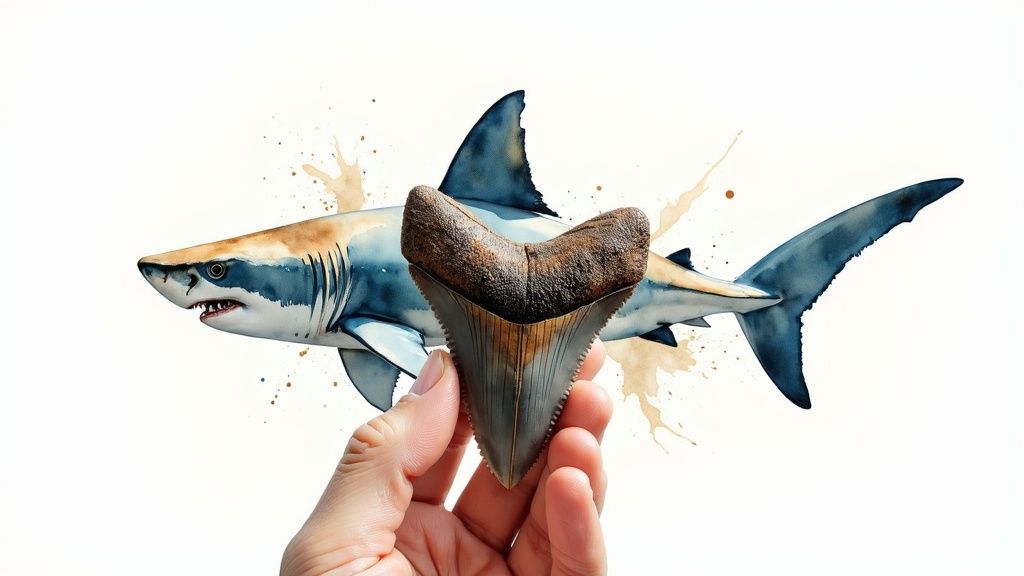
This infographic really helps to visualize just how enormous the 7.48-inch record-holder is when placed next to a human hand.
The image says it all—this single tooth is almost as long as an adult’s entire hand. It's a powerful, tangible reminder of the creature it once belonged to.
Preservation quality is the other critical piece of the puzzle. After millions of years buried underground, many large fossils are found broken, worn down, or heavily damaged. An authentic 7-inch tooth with razor-sharp serrations and a perfect, intact root is more than just a fossil; it’s a pristine artifact from a lost world.
While owning a world-record tooth might be out of reach for most, you can still get a sense of that awe-inspiring scale with a top-tier specimen. For example, you can find an impressive 6+ inch megalodon tooth available for collectors that offers a real, tangible connection to the titans that once ruled the ancient seas.
How a Single Tooth Reveals a Giant Predator
A megalodon tooth is way more than just a fossil. It’s a biological blueprint that lets scientists piece together an ancient leviathan. When you hold one, you’re not just holding a relic; you're holding the key that unlocks the mind-boggling scale of the shark it came from.
So, how do paleontologists turn a single fossil into a full-sized predator? It's a fascinating bit of scientific detective work. By studying the relationship between tooth size and body length in modern sharks—like the great white—researchers have built reliable models to estimate the size of their extinct relatives. This allows them to map out the dimensions of a creature that vanished millions of years ago with surprising accuracy.
The Math Behind the Monster
The most widely accepted method is a simple but powerful rule of thumb. Measuring megalodon teeth is the go-to technique for estimating the prehistoric shark's size, and statistical studies show a rock-solid correlation: for every one inch of tooth height, scientists estimate the shark was roughly 10 feet (about 3 meters) long.
Following that math, a 7.5-inch tooth would have belonged to a megalodon measuring around 75 feet (23 meters) in length. It’s a staggering thought. You can dig deeper into how the biggest megalodon teeth inform size estimates and their market value over at The Fossil Exchange.
This calculation helps us wrap our heads around the immense scale of these animals. A shark with teeth the size of an adult’s hand wasn't just big; it was a behemoth that would dwarf even the largest great whites in our oceans today. This connection between a single fossil and a 75-foot monster is what makes the hunt for the largest megalodon shark tooth so thrilling.
A single megalodon tooth isn’t just a piece of the animal—it's a stand-in for the whole predator. It tells a story of immense size, incredible power, and a creature perfectly adapted to its environment.
A Weapon Built for Whales
These colossal teeth weren't just for show. They were perfectly evolved tools designed for a very specific job: hunting the giant whales of the Miocene and Pliocene eras. The megalodon's dental arsenal was built for maximum damage.
Shearing Power: The thick, robust blade was engineered to withstand enormous pressure, letting it slice through thick blubber, muscle, and even bone.
Serrated Edges: Just like a steak knife, the fine serrations along the edges created a sawing action that made every bite devastatingly effective.
Immense Bite Force: Its jaws could generate one of the most powerful bites of any known animal, capable of crushing the ribs of a prehistoric whale with ease.
Picture a modern lion hunting a buffalo. The lion uses its claws and teeth to take down prey much larger than itself. Now, scale that up to an oceanic battleground where the predator is the size of a bus and the prey is an ancient whale. The largest megalodon shark tooth was the primary weapon in this epic prehistoric hunt, cementing its owner's place as the undisputed apex predator of its time.
A Closer Look at the Megalodon's Arsenal
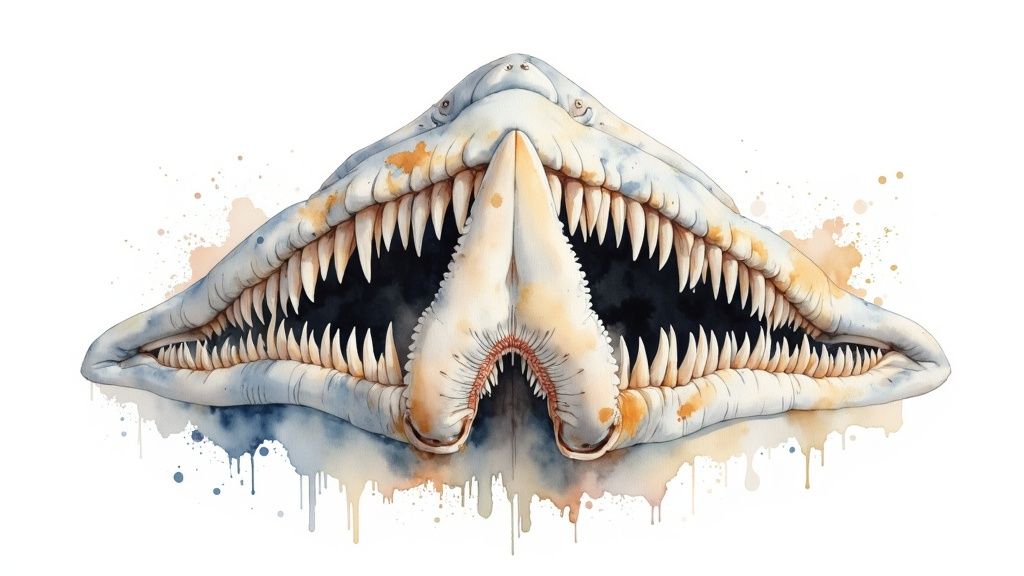
While a single massive tooth is enough to capture anyone's imagination, the true power of the megalodon was in its entire dental setup. This wasn't just a mouth full of big, scary teeth; it was a perfectly engineered killing machine, far more complex than anything we see in modern sharks. Think of it as a conveyor belt of serrated blades, constantly replaced and always ready for action.
Based on fossil evidence, paleontologists have pieced together its dental formula (2.1.7.4/3.0.8.4), revealing that a single megalodon could have over 250 teeth at any given time, arranged in five rows. If a tooth in the front row snapped off during a violent hunt—say, while crushing the bones of a whale—another one from the row behind would simply shift forward to take its place. This system ensured the megalodon was never unarmed.
A Specialized Toolkit for a Giant Hunter
Not all of megalodon's teeth were created equal. Each one had a specific job, much like a mechanic's toolkit where every wrench and socket is designed for a particular task. This specialization is what made it such an efficient and successful predator.
The jaw was lined with several distinct types of teeth, each positioned for maximum effect:
Anterior Teeth: These are the big ones. Found right at the front of the jaw, they were the largest and most symmetrical teeth, acting like daggers to pierce flesh and get a solid grip on enormous prey. It's no surprise that the largest megalodon shark tooth specimens are almost always anteriors.
Lateral Teeth: Set along the sides of the jaw, these teeth were broader and more angled. Their role was to slice and shear through thick muscle and blubber, carving away huge chunks of flesh with terrifying ease.
This dental setup reveals an incredibly calculated predator. The megalodon didn't just bite; it executed a multi-stage attack, using different parts of its jaw to immobilize, grip, and ultimately dismember its prey with brutal precision.
Putting Its Arsenal into Perspective
To truly grasp the megalodon's dominance, just compare its dental hardware to today's top ocean predator, the great white shark. A great white is a formidable hunter, no doubt, but its teeth look almost like miniatures next to a megalodon's.
In fact, the largest great white shark tooth ever found measures only about 3 inches (76 mm) long. A fully grown megalodon had anterior teeth that could easily be more than double that size. This staggering difference in weaponry highlights the sheer scale and power that separated the ancient king from any shark swimming in our oceans today. This all paints a vivid picture of a mouth that remains one of the most powerful and effective weapons in the history of life on Earth.
Hunting for Your Own Prehistoric Treasure
Inspired by tales of these giant fossils, it’s no surprise that people dream of finding their own slice of prehistory. And here's the good news: megalodon teeth are scattered all over the world. This turns ordinary riverbeds, coastlines, and even construction sites into potential treasure troves.
With the right knowledge and a bit of luck, you can absolutely join the hunt.
The key to a successful search is knowing where to focus your energy. Megalodon teeth are most often found in sedimentary rock layers from the Miocene and Pliocene epochs, dating back roughly 5 to 23 million years ago. These areas were once shallow, warm seas where megalodons lived, hunted, and shed an unbelievable number of teeth over the millennia.
Top Fossil Hunting Hotspots
Some locations have earned legendary status among collectors for their incredibly rich fossil beds. These are the places that consistently produce high-quality teeth, including some truly massive specimens. They represent the perfect storm of ancient marine life and the ideal geological conditions for preservation.
Here are a few of the most productive hunting grounds out there:
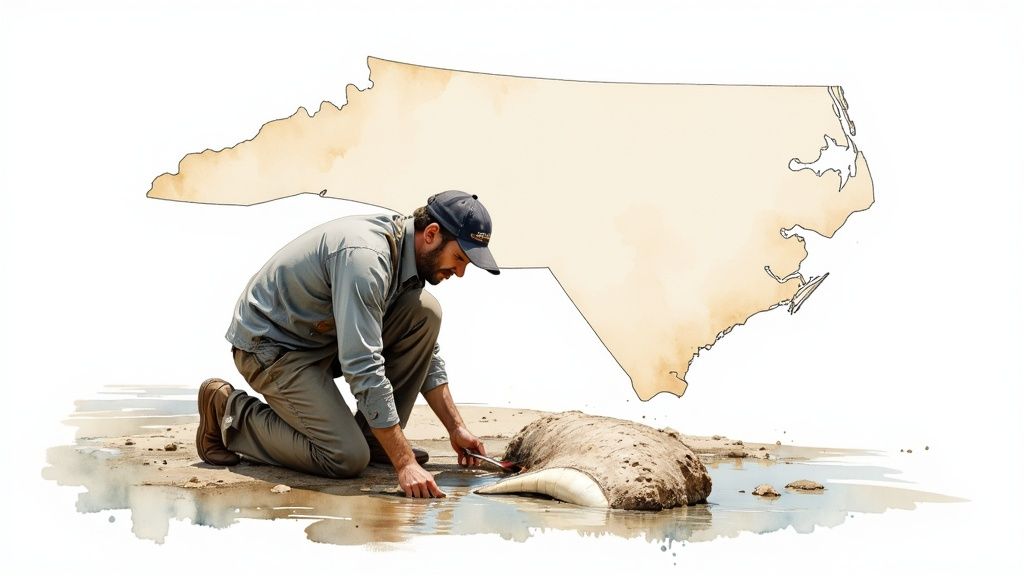
The Carolinas, USA: The coastal rivers and beaches of North and South Carolina are world-famous for their dark, beautifully preserved megalodon teeth. Waterways like the Cooper River and Morgan River are constantly eroding ancient fossil layers, washing these teeth right onto sandbars and shorelines for hunters to find.
Florida, USA: Known as the "Bone Valley," central Florida's phosphate mines are another prime source. The mining operations dig up massive deposits of marine fossils, turning spoil piles into gold mines for collectors. Venice Beach is also famous for the sheer quantity of (usually smaller) teeth found right on the shore.
While these sites are incredible, the thrill of discovery can happen almost anywhere with the right geological history. Understanding what to look for is your most important tool, whether you're sifting through gravel in a Florida creek or exploring a coastal cliffside.
Global Sites and Local Regulations
Beyond the United States, places like Peru were once legendary for producing the largest megalodon shark tooth specimens ever found—including the current record-holder. It’s crucial to understand, however, that many international sites now have strict regulations. Peru, for instance, has banned the export of its fossils to protect its paleontological heritage.
Before you plan any expedition, always research and respect the local laws. Some areas require permits, while others might be on private land or designated as protected sites where collecting is completely forbidden. For a great starting point on doing this the right way, check out this guide on things to look for when collecting fossils.
Responsible hunting ensures these incredible pieces of natural history can be enjoyed for generations to come.
How to Authenticate a Giant Megalodon Tooth
When you're dealing with fossils that can command serious money, like a giant megalodon tooth, you absolutely have to know what you’re looking at. The market is swimming with fakes, composites, and heavily restored teeth being passed off as pristine artifacts. Learning to spot the tell-tale signs of a genuine tooth versus a doctored one is the most important skill any collector can develop.
Authenticating a tooth isn’t about one single feature; it's about looking at the entire piece and seeing if its story holds up. A genuine, high-quality tooth tells a consistent story through its color, texture, and structure. With a bit of practice, you can learn to read that story and save yourself from a bad investment.
Key Features of an Authentic Tooth
An untouched megalodon tooth has several distinct characteristics that are incredibly difficult to fake well. These are the first things you should be zeroing in on when you inspect a potential purchase.
Bourlette: Look for the thin, dark band of enamel that separates the root from the blade. On a real tooth, this bourlette should be glossy, distinct, and look like it belongs with the rest of the tooth's enamel. Replicated bourlettes often have a dull, painted-on look or just lack that natural luster.
Serrations: The serrated edges should be sharp and uniform, with each little serration clearly defined. While some natural wear and tear from millions of years in the ground is normal, fake serrations often look too perfect, chunky, or unevenly carved—betraying the touch of a modern tool.
Enamel and Luster: Authentic enamel has a deep, natural gloss that catches the light. Be very wary of teeth that look like they've been slathered in varnish or lacquer. This often creates an unnatural, glassy shine that's used to hide repairs.
A truly authentic tooth just feels right. The weight in your hand, the subtle imperfections from its time underground, and the way the enamel plays with the light—it all comes together to create a sense of genuine antiquity. Alterations, no matter how skillful, almost always disrupt this natural harmony.
Spotting Common Repairs and Fakes
Restoration isn't always a deal-breaker, but undisclosed repairs are. A dishonest seller might try to pass off a heavily altered tooth as a perfect specimen, jacking up its price way beyond its actual value. Knowing what to look for can save you from a very costly mistake.
One of the most common issues is root repair. The root is the most fragile part of the tooth and often gets damaged. Repairs usually involve using epoxy or resin mixed with crushed rock to rebuild the missing chunks. Look for sudden changes in texture, color, or porosity between the blade and the root—that’s a huge red flag for restoration.
Another major problem is the composite tooth. This is when a seller takes broken pieces from multiple different teeth and glues them together to create one "complete" fossil. Look for unnatural seams, mismatched colors on the blade, or serrations that just don't line up right. These Frankenstein fossils are completely deceptive and have little to no real value to a collector.
To help you get a feel for what to look for, here's a quick checklist to run through when you're examining a potential giant.
Authentication Checklist for a Giant Megalodon Tooth
Feature to Inspect
Signs of Authenticity
Red Flags (Potential Restoration/Fake)
Overall Shape & Symmetry
Natural, slightly imperfect symmetry. Proportions feel right for the size.
Too perfect or oddly misshapen. Unnatural angles or curves.
Enamel Luster
Deep, natural gloss that reflects light. Consistent across the blade.
Overly glassy, wet look (varnish). Dull or artificially polished spots.
Bourlette
Distinct, glossy band with color consistent with the enamel.
Looks painted on. Different texture or color from the blade enamel.
Serrations
Sharp, individually defined, and uniform. Minor wear is expected.
Chunky, uneven, or "carved" look. Too perfect with no wear at all.
Root Texture & Color
Porous, slightly rougher texture than the blade. Color is consistent.
Smooth, non-porous patches. Abrupt color or texture changes from blade to root.
Weight & Feel
Feels heavy and dense, like a rock. Cool to the touch.
Feels unusually light for its size (resin/epoxy).
Seams & Cracks
Natural fractures may exist, but no unnatural glue lines.
Thin, straight lines across the blade or root. Mismatched color on either side of a seam.
This checklist is a great starting point, but experience is the best teacher. Handling genuine teeth helps you build an instinct for what's real and what's not. For those looking to start their collection with a guaranteed genuine piece, consider a professionally curated megalodon tooth in a collector's box, which provides a trusted baseline for quality and helps you train your eye.
Valuing a Giant Piece of Natural History
What turns a fascinating megalodon tooth from a cool fossil into a five-figure investment? The market for these massive prehistoric artifacts is surprisingly complex, and what might seem like a tiny imperfection can cause a huge swing in price. It’s not just about finding a big tooth; it’s about finding the right big tooth.
The biggest driver of value is, of course, size. But here’s the thing: the price doesn't just creep up inch by inch. It jumps exponentially. A 6-inch tooth isn't just a little more valuable than a 5-inch one—it can be worth several times more because each extra inch represents a massive leap in rarity. Once a tooth breaks that coveted 6-inch barrier, it enters a whole new league for serious collectors, and prices start to climb fast.
The Anatomy of a High-Value Tooth
Beyond just its length, several other factors all play a part in determining a tooth's final price tag. A truly top-tier specimen has to hit the mark in multiple categories, creating that perfect storm of rarity and visual appeal that collectors are willing to pay a premium for.
These key value factors include:
Condition: You're looking for pristine, razor-sharp serrations, a perfect and unbroken tip, and a complete, undamaged root. Anything less starts to chip away at the value.
Color and Luster: The minerals in the soil where the tooth fossilized give it its unique color, sometimes creating incredible patterns. A deep, glossy enamel with rich, vibrant colors is always in high demand.
Provenance: Knowing exactly where a tooth was found adds to its story and its value, especially if it comes from a famous—or now inaccessible—collecting site.
When a tooth combines massive size—getting close to that legendary 7-inch mark—with flawless condition and stunning coloration, its value can absolutely skyrocket into the tens of thousands of dollars. These are the holy grails of natural history collecting.
Restoration and Its Impact
Finally, you have to consider restoration. While a minor, professionally done repair that's fully disclosed might be acceptable, heavy restoration will cause a tooth's value to plummet. A "composite" tooth glued together from multiple broken pieces is basically worthless to a serious collector. Authenticity and natural preservation are everything.
Understanding what makes a rare artifact valuable can be complex. For a deeper look into the broader principles of valuation, the art world offers some great parallel lessons on rarity, condition, and provenance.
Once you’ve acquired a piece you love, protecting that investment is the next step. You can learn more about how to best preserve and show off your finds in our guide to choosing a high-quality rock collection display case. It’s the best way to ensure your giant piece of natural history stays a stunning centerpiece for years to come.
Common Questions About Megalodon Teeth
Let's tackle a few of the questions we hear all the time. When you're dealing with fossils of this scale, there's always a healthy dose of curiosity—and a few myths to clear up.
What's the Real Record for the Largest Megalodon Tooth?
The biggest megalodon tooth that has been scientifically verified and documented comes in at a staggering 7.48 inches. This incredible specimen was found in Peru, a well-known hotspot for exceptionally preserved fossils.
While you'll hear whispers and see online claims of even larger teeth, the 7.48-inch tooth is the one that holds up to serious scrutiny in paleontological circles. It’s the undisputed heavyweight champion and the benchmark every collector dreams of.
How Can I Spot a Repaired Megalodon Tooth?
Spotting a repair is a crucial skill for any serious collector. Start by running your fingers and eyes over the tooth, looking for any abrupt changes in color, texture, or even the glossiness of the enamel, especially where the blade meets the root.
A blacklight is your best friend here. Most modern glues and filling resins will glow unnaturally under UV light, revealing any restoration work instantly. Another dead giveaway is a crack that looks just a little too perfect or feels unnaturally smooth to the touch—that's often a sign it has been filled and polished.
It’s worth remembering that only the largest, most mature megalodons grew teeth over 6 inches long. These were the true titans of the sea, making up a tiny fraction of the overall population. That’s why their teeth are so exceptionally rare and prized today.