Stones are everywhere, lining garden paths, forming mountains, and adorning jewelry. But beyond their silent, static appearance lies a world of dynamic processes, astonishing properties, and incredible histories. Many assume stones are simple, unchanging objects, yet they can move, grow, hold extraterrestrial secrets, and even 'bleed'. These seemingly inert objects are foundational to both our planet and human civilization, influencing everything from construction techniques to the development of early tools.
This article uncovers 10 of the most interesting facts about stones, revealing the hidden science and surprising truths that make these geological wonders so compelling. We will explore how volcanic glass can be sharper than surgical steel, why certain building stones appear to weep in the rain, and how some rocks can float on water for years. Each fact is supported by research from reputable sources, offering a deeper appreciation for the materials often taken for granted. Prepare to see the world of minerals and rocks in a completely new light, discovering the extraordinary capabilities packed within these common materials.
1. Stones Can Grow and Move Underground
While we often think of stones as immobile and unchanging, one of the most interesting facts about stones is their ability to move and even seemingly "grow" right out of the ground. This phenomenon, long observed by farmers, is not a form of biological growth but a result of powerful geological and environmental processes. Over time, stones buried deep within the soil can gradually migrate to the surface.
The primary driver behind this stony migration is a process called frost heave. In colder climates, water in the soil freezes and expands, forming ice lenses beneath stones. This expansion pushes the stones upward. When the ground thaws, smaller soil particles and sediment fill the void left below the stone, preventing it from settling back to its original position. This freeze-thaw cycle, repeated over many years, effectively ratchets the stones toward the surface.
Real-World Examples of Stone Migration
This process is not just a geological curiosity; it has tangible effects observed worldwide.
New England's "Stone Harvest": Farmers in the northeastern United States have been clearing their fields of stones for centuries, only to find a new "crop" of them appearing each spring. This is a classic example of frost heave continuously bringing buried glacial till to the surface.
Ancient Stone Circles: Some researchers suggest that the gradual upward movement of ancient megaliths in the UK could be partly attributed to long-term frost heave, lifting them slightly over millennia.
Practical Tips for Managing "Growing" Stones
Understanding this process has practical applications, especially for landowners and builders.
Property Maintenance: If you clear stones from a garden or field in a cold climate, be prepared to repeat the task every few years as new stones emerge.
Construction Planning: For foundations, footings, or underground pipes, engineers must account for frost heave to prevent structural damage. Foundations are typically placed below the frost line-the depth to which the ground freezes-to avoid being shifted by this powerful force.
2. Obsidian Glass Sharper Than Surgical Steel
While metal alloys represent the pinnacle of modern cutting tools, one of the most interesting facts about stones is that a natural volcanic glass can achieve an edge far sharper than even the finest surgical steel. Obsidian, formed from rapidly cooled lava, fractures in a unique way known as a conchoidal fracture. This process allows it to break into pieces with edges that are just a few nanometers thick, essentially one molecule wide at their finest point.
The incredible sharpness of obsidian comes from its amorphous, non-crystalline structure. Unlike metal, which has a granular crystal structure that limits sharpness, obsidian breaks cleanly along a single plane. This produces an edge that is significantly finer and smoother than a steel blade, resulting in less tissue damage and faster healing when used for incisions. Research from institutions like the University of Bradford confirms its superiority for delicate procedures.
Real-World Examples of Obsidian's Sharpness
The use of obsidian for cutting tools is not a new discovery; it spans from ancient civilizations to modern specialized medicine.
Ancient Surgery: Archaeological evidence shows that civilizations like the Aztecs used obsidian blades, known as itzli, for ritual and surgical purposes. Their incredible sharpness allowed for precise incisions long before the invention of metal scalpels.
Modern Medicine: Today, obsidian scalpels are used in specialized surgeries, particularly in ophthalmology and delicate cosmetic procedures, where minimizing scarring and cellular damage is critical.
Practical Tips for Handling Obsidian
Given its extreme sharpness, obsidian requires special consideration and handling.
Property Maintenance: Always handle obsidian with extreme care, as its edges are notoriously brittle and can break, creating microscopic shards. Protective gloves are recommended.
Construction Planning: For practical use, such as in surgery or scientific research, source high-quality obsidian from reputable suppliers to ensure it is free from internal stresses that could cause it to shatter unpredictably. Secure storage with a protective covering is essential to prevent accidental injury.
3. Granite Releases Radon Gas Over Time
While prized for its durability and beauty, one of the more surprising facts about stones like granite is its potential to release radon gas. This occurs because granite, an igneous rock, naturally contains trace amounts of uranium and radium. As these elements undergo radioactive decay, they produce radon, a colorless, odorless, and tasteless radioactive gas that can seep from the stone into the surrounding air.
The primary concern arises when granite is used in enclosed spaces, such as for countertops, floor tiles, or building foundations. Without proper ventilation, the released radon can accumulate to levels that pose a health risk, as it is a leading cause of lung cancer among non-smokers. While the U.S. Environmental Protection Agency (EPA) notes that most granite countertops emit very low levels of radon, it is wise to be aware of the potential.
Real-World Examples of Radon Concerns
This natural emission is a known phenomenon with documented instances and public health considerations.
EPA Assessments: The EPA has identified certain granite countertops as a potential source of radon in homes, though they emphasize that the risk is generally low compared to radon from soil gas.
Geological Hotspots: Regions with granite-heavy geology, such as parts of Scandinavia and the northeastern United States, have higher background radon levels and established public awareness programs.
Practical Tips for Managing Radon from Granite
Understanding this risk allows homeowners to take simple, effective steps to ensure a safe living environment.
Test Your Home: The only way to know your home's radon level is to test it. The EPA recommends testing all homes below the third floor. Inexpensive, do-it-yourself radon detection kits are widely available.
Improve Ventilation: Regularly opening windows and using exhaust fans in kitchens and bathrooms can help reduce radon accumulation from any source.
Consider Mitigation: If tests reveal high radon levels (above 4 picocuries per liter), a professional radon mitigation system can be installed to vent the gas safely outdoors.
Seal Granite Surfaces: Applying a sealant to granite countertops can help reduce the amount of radon gas that escapes from the stone's surface.
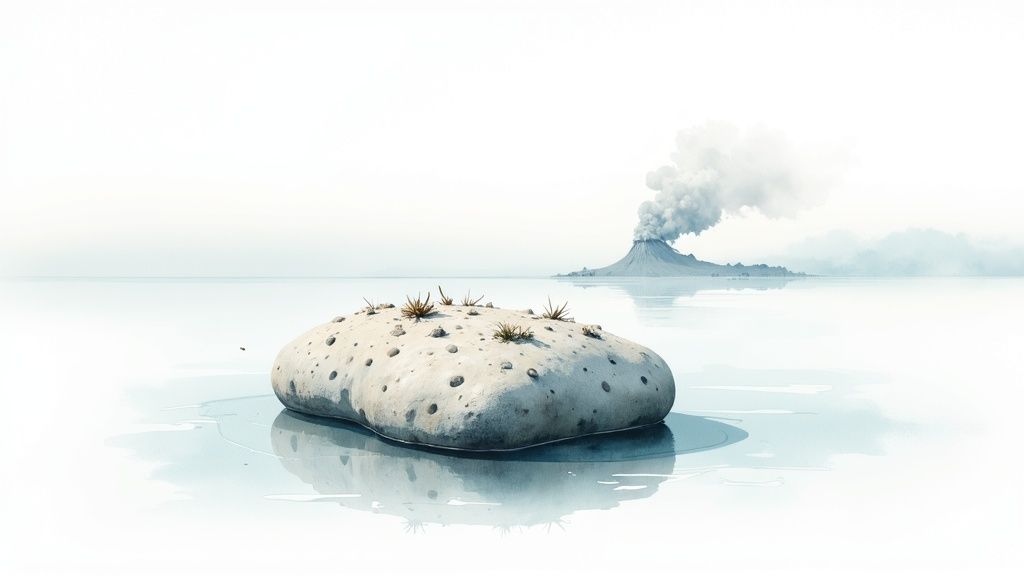
4. Pumice Stone Can Float on Water for Years
One of the most astonishing facts about stones is that some can float. Pumice is a type of volcanic rock so filled with air pockets and gas bubbles that its density is lower than water, allowing it to remain buoyant for extended periods. This unique property means that following a volcanic eruption, vast "rafts" of pumice can travel thousands of kilometers across oceans, acting as natural vessels.
This floating phenomenon occurs when super-heated, highly pressurized magma is violently ejected from a volcano. As the lava cools rapidly, the dissolved gases exsolve, creating a frothy, bubble-rich texture. The rock solidifies around these pockets, trapping the air and creating its lightweight structure. These pumice rafts can persist for years, dispersing marine organisms and even seeds to new ecosystems.
Real-World Examples of Floating Pumice
Scientists, including researchers from institutions like NASA, have tracked massive pumice rafts to study ocean currents and biological dispersal.
Tonga to Australia: After a 2006 volcanic eruption in Tonga, a massive pumice raft traveled over 15,000 kilometers, eventually reaching the coast of Australia, carrying a diverse community of marine life.
Havre Seamount Eruption: The 2012 eruption of the Havre underwater volcano created a pumice raft the size of Belgium. Scientific studies published in journals like Science Advances have detailed how these events can transport life across vast ocean basins.
Practical Applications for Pumice
Beyond its geological significance, pumice has direct uses for consumers and citizen scientists.
Scientific Contribution: Beachcombers can contribute to science by documenting pumice findings. Note the location, date, and size, and report unusual discoveries to geological institutions.
Personal Care: Once water-logged and collected, pumice stones are widely used as a natural, gentle abrasive for exfoliating skin, particularly for foot care.
5. Meteorite Stones Contain Extraterrestrial Material
Among the most captivating and interesting facts about stones is that some of them are not from Earth at all. Meteorites are fragments of rock or metal that have journeyed through space from asteroids, comets, or even other planets like Mars and the Moon, eventually landing on our planet's surface. These extraterrestrial stones are essentially time capsules, containing pristine material from the formation of our solar system over 4.5 billion years ago.
These celestial visitors provide invaluable scientific data that is unobtainable from terrestrial rocks. By studying their composition, scientists can understand the building blocks of planets, the origins of water, and even the complex organic molecules necessary for life. Unlike Earth rocks, which have been altered by billions of years of geological activity, meteorites offer a direct glimpse into the universe's past. For a deeper dive into their composition, you can learn more about what meteorites are made of.
Real-World Examples of Significant Meteorites
The study of meteorites, supported by institutions like the Smithsonian and NASA, has led to groundbreaking discoveries.
Murchison Meteorite: This meteorite, which fell in Australia in 1969, was found to contain over 100 different amino acids, the building blocks of proteins, providing strong evidence that life's ingredients could have been delivered to Earth from space.
Allan Hills 84001: Discovered in Antarctica, this Martian meteorite made headlines when scientists announced it might contain evidence of ancient microscopic fossils, sparking a global debate about life on Mars.
Chelyabinsk Meteorite: In 2013, a large meteor exploded over Chelyabinsk, Russia, creating a powerful shockwave and scattering thousands of meteorite fragments, offering a rare opportunity to study a freshly fallen space rock.
Practical Tips for Identifying Meteorites
If you think you've found a stone from space, here are some tips for identification and verification.
Test with a Magnet: Many meteorites, especially iron-nickel types, are magnetic and will attract a simple magnet.
Check the Density: Meteorites are often much heavier and denser than terrestrial rocks of the same size due to their high metal content.
Consult Experts: Document the discovery location and have the sample analyzed by a university geology department or a reputable meteorite expert to confirm its extraterrestrial origin.
6. Diamonds Can Be Created in Laboratories
While natural diamonds are famed for their billion-year formation deep within the Earth's mantle, one of the most revolutionary facts about stones is that we can now create them in a lab. These lab-grown diamonds are not imitations; they are physically, chemically, and optically identical to their mined counterparts, grown in a matter of weeks instead of eons. The advancements in science allow us to recreate the conditions necessary for diamond formation.
This incredible feat is primarily achieved through two methods. The High Pressure High Temperature (HPHT) method mimics the natural diamond-growing environment by subjecting a carbon seed to immense pressure and heat. Alternatively, the Chemical Vapor Deposition (CVD) technique "grows" a diamond layer by layer from a carbon-rich gas in a vacuum chamber. For an in-depth look, explore what are lab grown diamonds.
Real-World Examples of Lab-Grown Diamonds
The impact of this technology is widespread, appearing in both luxury and industrial sectors.
Commercial Jewelry: Major brands like Pandora and De Beers' Lightbox have embraced lab-grown diamonds, offering consumers an alternative to mined stones. Retailers like Brilliant Earth have built their business model around these ethical and sustainable options.
Industrial Applications: The hardness and thermal conductivity of diamonds are invaluable. Tech companies and manufacturers utilize lab-grown diamonds for precision machining and in advanced electronics.
Practical Tips for Choosing Lab-Grown Diamonds
Understanding these man-made gems can help you make an informed choice for your next jewelry purchase. To explore more about diamonds and other precious stones, check out our guide on the best gemstones for jewelry.
Verify Certification: Always look for a grading report from a reputable gemological lab, such as the GIA or IGI, which validates the diamond's quality and confirms its laboratory origin.
Confirm Disclosure: Reputable jewelers will clearly state that a diamond is lab-grown. Ensure this is documented on your receipt and appraisal paperwork.
7. Marble Changes Color and Properties Over Time
Marble's reputation as a timeless and durable material is well-deserved, but one of the more surprising facts about stones is that it is not immune to change. As a metamorphic rock formed from limestone, marble undergoes continuous chemical and physical alterations when exposed to environmental conditions. This slow transformation can alter its color, texture, and structural integrity over time, making it a dynamic rather than static material.
The primary agents of change are atmospheric pollutants and moisture. Acid rain, which contains sulfuric and nitric acids, reacts with the calcium carbonate in marble, causing it to dissolve and form a crust that can flake off. Similarly, air pollution and water exposure can lead to discoloration and surface erosion, gradually weathering even the most magnificent structures.
Real-World Examples of Marble Alteration
This process of change is visible in many of the world's most famous historical monuments.
The Parthenon: The iconic marble sculptures of the Parthenon in Athens show significant degradation and surface loss directly linked to decades of exposure to acid rain.
The Taj Mahal: The brilliant white marble of the Taj Mahal has been yellowing over time, a change attributed to high levels of air pollution from nearby industry and traffic.
The Lincoln Memorial: In Washington, D.C., the marble of the Lincoln Memorial has exhibited surface deterioration and sugaring (granular disintegration) due to environmental weathering.
Practical Tips for Preserving Marble
Understanding marble's vulnerability is key to its long-term preservation, especially for homeowners and designers. You can learn more about how this material forms by reading up on what metamorphic rock is on astrowest.com.
Seal Surfaces: Regularly apply a quality sealant to marble countertops, floors, and outdoor features to protect them from moisture and staining.
Use pH-Neutral Cleaners: Always clean marble with pH-neutral solutions. Avoid acidic substances like vinegar or lemon juice, which can etch the surface.
Professional Maintenance: For significant outdoor installations or historical pieces, schedule regular professional inspections to identify and address weathering before it becomes severe.
8. Mohs Hardness Scale Defines Stone Durability
One of the most foundational facts about stones is how we measure their durability, and for that, we turn to a simple yet ingenious system. The Mohs Hardness Scale, developed in 1812 by German geologist Friedrich Mohs, is a qualitative scale that ranks minerals based on their relative scratch resistance. This tool is fundamental for anyone working with stones, from geologists to jewelers, as it dictates how a mineral will stand up to daily wear and tear.
The scale ranges from 1 (the softest) to 10 (the hardest). A mineral can scratch any other mineral with a lower number on the scale. For example, a diamond, which scores a perfect 10, can scratch quartz (7), but quartz cannot scratch a diamond. This principle allows for quick identification and practical application, determining a stone's suitability for everything from jewelry to industrial abrasives.
Real-World Examples of the Mohs Scale in Action
The Mohs scale is not just an academic tool; it has direct and practical implications across various industries.
Durable Countertops: Quartz, with a hardness of 7, is a popular choice for kitchen countertops because it resists scratches from common household items like steel knives (which have a hardness of about 5.5).
Gemstone Selection: Jewelers use the scale to advise customers. A durable stone like a sapphire (9) is excellent for an engagement ring, while a softer stone like opal (5.5-6.5) is better suited for less frequently worn items like pendants.
Industrial Applications: Talc, at the bottom of the scale with a hardness of 1, is ground into a soft powder. In contrast, diamond (10) is used on cutting tools and grinding wheels for its unparalleled hardness.
Practical Tips for Using the Mohs Scale
Understanding hardness is key to proper stone care and selection. Here are a few tips for applying this knowledge.
Proper Storage: Store softer gemstones separately from harder ones to prevent scratching. A diamond ring can easily damage pearls or opals if they are stored together.
Informed Purchases: When buying stone products, from flooring to jewelry, ask about the Mohs hardness to ensure it fits your lifestyle and intended use.
Identification: A basic scratch test is a classic identification method. You can learn more about this and other techniques in a crystal identification guide. Find out more in this guide.
9. Limestone Buildings 'Bleed' When It Rains
While stones seem impervious, certain types, like limestone, have a dynamic relationship with water. One of the more poetic yet factual interesting facts about stones is that limestone buildings appear to "bleed" or weep when it rains. This phenomenon is not just a visual curiosity; it’s a slow, chemical process that visibly chronicles a building's history with the elements. Over time, these mineral-laden trickles create distinct streaks and patinas on the facade.
This "bleeding" occurs because limestone and other carbonate rocks are porous and can absorb rainwater. As slightly acidic rain seeps into the stone, it dissolves calcium carbonate and other minerals. When the stone becomes saturated, this mineral-rich water leaches out onto the surface, evaporating and leaving behind calcite deposits. This process, known as efflorescence, forms the weeping patterns that darken or lighten the stone over decades.
Real-World Examples of Stone Weeping
This natural process can be observed on historic structures all over the world, offering a visual record of their endurance.
Notre-Dame Cathedral: The famous Parisian landmark exhibits centuries of weeping patterns, where rainwater runoff has left behind dark streaks, particularly visible on its gargoyles and buttresses.
Westminster Abbey: The intricate stonework of this London icon shows significant weathering and mineral streaking, a testament to its long exposure to England's damp climate.
Practical Tips for Managing Limestone Weeping
Understanding this process is crucial for the preservation of historic buildings and modern limestone structures.
Proper Drainage: Install and maintain effective drainage systems, like gutters and downspouts, to direct rainwater away from stone surfaces and minimize saturation.
Use Hydrophobic Sealants: Applying a breathable, water-repellent sealant can reduce water absorption without trapping moisture inside the stone, which could cause further damage.
Consult Professionals: Before attempting any cleaning, consult a building conservator. Improper cleaning methods can be abrasive and may cause more harm than the natural weeping itself.
10. Stones Store and Release Heat (Thermal Mass)
Among the many interesting facts about stones, their natural ability to act as a thermal battery is one of the most practical. Dense stones like granite, soapstone, and limestone possess high thermal mass, meaning they can absorb, store, and slowly release significant amounts of heat. This property allows stone to moderate indoor temperatures naturally, a principle leveraged in architecture for millennia. During the day, the stone absorbs solar heat, and at night, it gradually radiates that warmth back into the space, reducing the need for artificial heating and cooling.
 thick.
Comparison of 10 Interesting Stone Facts
Title
🔄 Complexity
⚡ Resource requirements
⭐ Expected outcome
📊 Typical impact
💡 Ideal use cases / tips
Stones Can Grow and Move Underground
Low–Moderate (natural soil/freeze–thaw processes)
Low (natural process; long-term monitoring)
Slow upward migration (mm/yr) and occasional size gain
Local field stone emergence; agriculture disturbance
Repeat clearance, document locations, plan for frost-heave in construction
Collect and report for research, beware invasive species
From the Ground Up: A New Appreciation for Stones
As our journey through the world of geology concludes, it’s clear that the ground beneath our feet is anything but ordinary. We’ve uncovered how seemingly inanimate objects are, in fact, dynamic and full of surprises. From the otherworldly origins of meteorite stones containing cosmic secrets to the practical wonder of pumice, a rock so light it can float on water for years, our exploration reveals a hidden narrative in every pebble and boulder.
The interesting facts about stones we've covered demonstrate their active role in our world. Consider how granite, a common countertop material, subtly releases radon gas, or how limestone buildings appear to "bleed" rust-colored streaks after a rainstorm. These phenomena remind us that stones are not static; they interact with their environment in complex and often unexpected ways. Even a material as ancient as obsidian possesses a cutting edge sharper than modern surgical steel, blending primordial history with cutting-edge performance.
From Knowledge to Action: Engaging with Stones
This newfound appreciation can easily extend beyond simple admiration. Understanding the properties of stones has profound practical implications for our daily lives. Knowing about thermal mass, the ability of stones to store and release heat, can influence architectural design, leading to more energy-efficient homes. Similarly, comprehending the Mohs Hardness Scale is not just academic; it’s essential for anyone choosing a durable gem for jewelry or selecting materials for construction.
For those who bring these natural elements into their homes, understanding their composition is key to their upkeep. As we learn about the fascinating world of stones, it's also worth appreciating their practical aspects, such as how to properly maintain them to preserve their beauty and integrity. A detailed guide on how to clean stone floors can be an invaluable resource, ensuring that your marble, granite, or limestone surfaces remain pristine for years to come. This practical knowledge connects the grand geological story to the tangible reality of our living spaces.
A Deeper Connection to Our Planet
Ultimately, learning these interesting facts about stones fosters a deeper connection to our planet’s history and its ongoing processes. Each stone, whether a lab-grown diamond mimicking eons of pressure or a piece of marble slowly changing its color and texture, tells a story of time, pressure, and transformation. They are tangible records of geological events, cultural milestones, and even celestial journeys.
By looking closer, we move from seeing stones as mere background elements to recognizing them as archives of natural history and cornerstones of human civilization. This perspective invites us to continue exploring, questioning, and appreciating the incredible, intricate world of geology that is, quite literally, all around us.
Ready to hold a piece of this incredible story in your own hands? Explore the curated collection at Astro West to discover authentic, ethically sourced minerals, fossils, and meteorites. Whether you're a novice collector or a seasoned enthusiast, you can find a genuine piece of Earth’s (and the cosmos’) history at Astro West.