Ichthyosaur Secrets: The Mesozoic’s Great Ocean Giants Unveiled
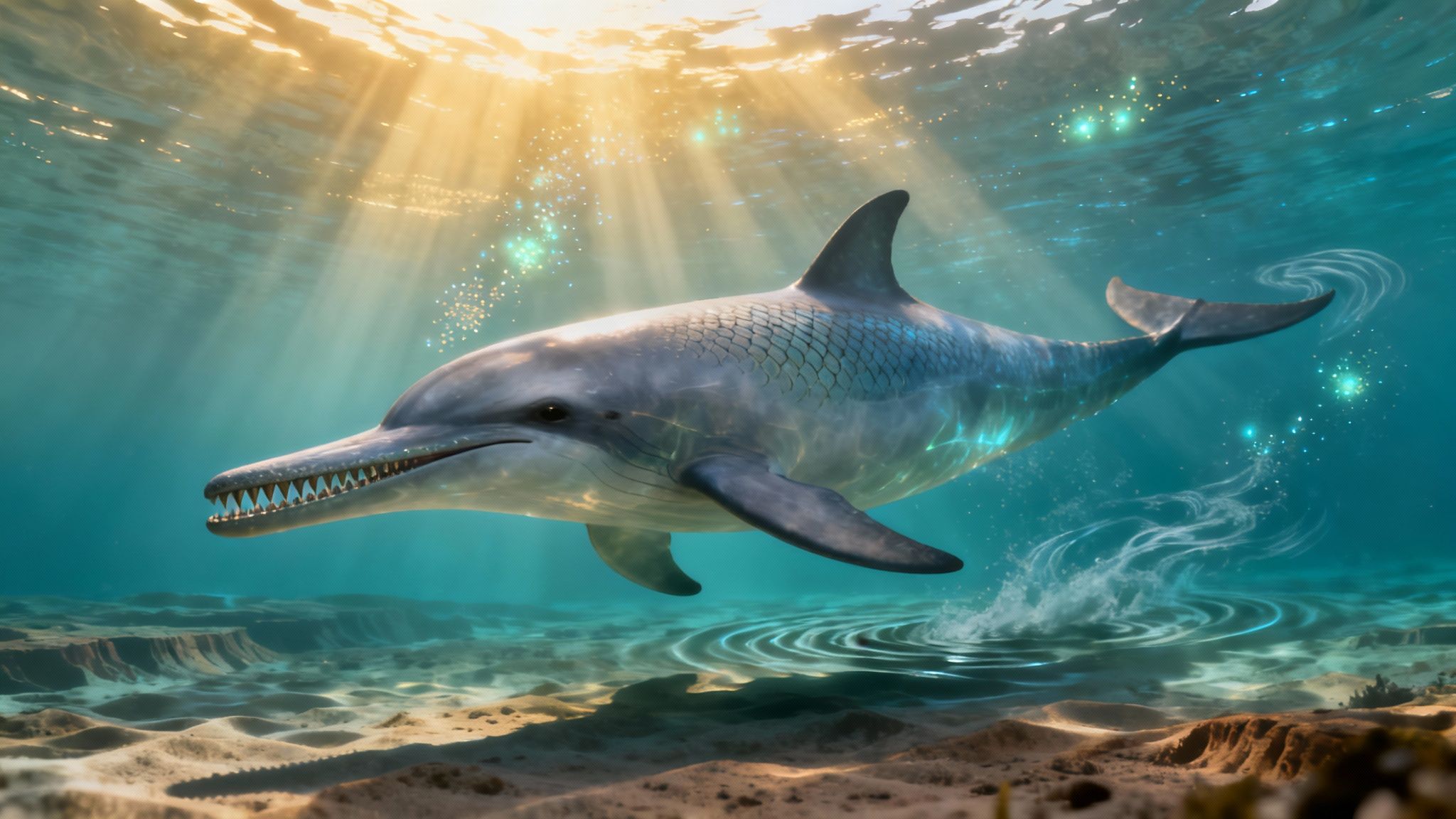
Picture a predator with the streamlined body of a dolphin and the fearsome jaws of a shark. You’ve just imagined an ichthyosaur, one of the most dominant marine reptiles of the Mesozoic Era. These incredible animals ruled the oceans for over 150 million years, yet they weren’t dinosaurs. Instead, they were a completely distinct group of sea-dwelling reptiles that took aquatic adaptation to an evolutionary extreme.
Meet the Masters of the Mesozoic Seas
Long before whales and dolphins claimed the oceans, the ichthyosaurs reigned supreme. Their name, meaning "fish-lizard" in Greek, is a perfect fit. Though they evolved from land-based reptiles, they returned to the water and perfected a body plan so efficient it’s a classic example of convergent evolution—when unrelated species independently develop similar traits. This ancient lineage is a remarkable chapter in Earth’s history, a testament to how life adapts and conquers new frontiers.
These creatures weren't just a single species but a diverse order of animals that varied wildly in size and shape. Some were small, agile hunters darting through the shallows, while others grew to colossal sizes that would rival today’s largest whales. Fossils found on every continent confirm their global dominance, painting a picture of a successful and widespread group of apex predators.
From Prehistoric Predator to Timeless Art
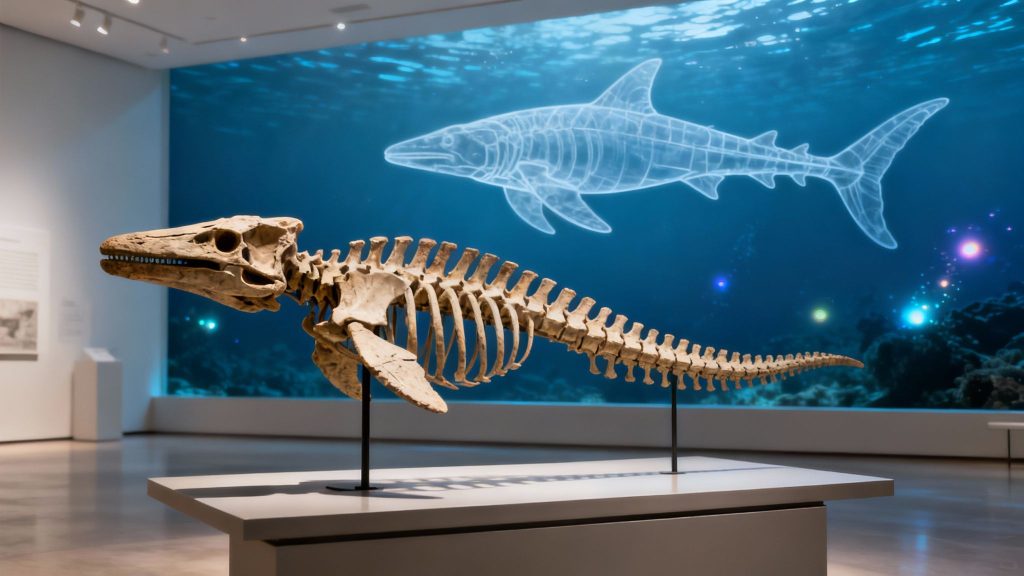
Today, the legacy of the ichthyosaur lives on through its fossils. These aren't just stones; they're tangible connections to a lost world. For collectors and designers, a genuine ichthyosaur fossil is a piece of natural history transformed into a work of art. The intricate preservation of a single vertebra or the delicate bones of a paddle offers a direct, humbling link to the deep past.
Integrating an ichthyosaur fossil into your home means acquiring an object with an unparalleled story. It speaks of survival, adaptation, and the immense timescale of our planet. These fossils serve as powerful focal points in any space, grounding modern décor with an element of profound, timeless history. While we're exploring ancient "Ocean Giants," you can also discover modern ocean giants and appreciate their majestic presence in today's seas.
Why Ichthyosaurs Fascinate Us
The allure of the ichthyosaur extends far beyond its impressive biology. Their story connects us to a vibrant, ancient ecosystem teeming with creatures that challenge our imagination. They remind us that our planet has hosted other dominant life forms, and that its history is literally written in the stone beneath our feet.
Another fascinating marine reptile, the Keichousaurus, offers another window into this prehistoric aquatic world. You can explore a beautifully preserved Keichousaurus fossil from the Triassic Period right here in the Astro West collection.
How Ichthyosaurs Conquered the Ancient Oceans
The story of the ichthyosaur is a fantastic tale of evolutionary commitment. It starts with a group of land-dwelling reptiles that, in a surprising twist, turned their backs on solid ground and headed back into the sea. This wasn't just a casual paddle; it was a complete biological reinvention, a radical redesign that turned them into the ocean's perfect hunting machines.
This is a classic case of what’s called convergent evolution, and it’s why ichthyosaurs look so uncannily like modern dolphins or tuna, even though they aren't related at all. The laws of physics in water are strict—if you want to be fast, you need an efficient shape. Nature simply arrived at the same torpedo-like solution multiple times. For the ichthyosaur, this meant evolving a body that cut through the water with minimal drag, allowing them to chase down speedy prey like fish and belemnites.
Built for Speed and Stealth
Their secret to dominating the oceans was a whole suite of incredible adaptations. The most obvious was that powerful tail. Unlike their ancestors on land, ichthyosaurs developed a massive, crescent-shaped tail fluke, almost identical to a modern tuna's. This structure gave them immense power, propelling them through the water with the kind of speed and agility needed to catch anything they set their sights on.
Their limbs also went through a profound change. Fingers and toes fused together and stretched out, transforming into stiff, paddle-like flippers. These weren't for pushing through the water, but for steering and stability—acting just like the hydroplanes on a submarine. This combination of a powerful engine (the tail) and precision steering (the flippers) made them brutally effective predators in a very competitive marine world.
The ichthyosaur's body was a masterpiece of biological engineering. Every single element, from its hydrodynamic skin to its rigid torso, was fine-tuned for a life spent entirely at sea—a commitment so complete they even gave birth to live young in the water.
Masters of the Deep Hunt
Perhaps their most striking feature, though, was their enormous eyes. Some ichthyosaur species had eyes larger than any other animal we've ever found, living or extinct. These massive eyeballs were supported by a bony ring called a sclerotic ring, which helped the eye keep its shape under the crushing pressure of deep water.
Eyes that big weren't just for show. They were powerful light-gathering organs, allowing ichthyosaurs to hunt in the dim, deep waters where their prey often tried to hide. This gave them a huge advantage, opening up a hunting ground far below the sunny surface where few other predators could operate. This ability to hunt at different depths made them incredibly versatile and successful.
Their reign as masters of the ocean was a long one, stretching all the way from the Early Triassic to the Late Cretaceous. They thrived for over 160 million years, adapting and diversifying through massive environmental shifts.
Rethinking Their Origins
The evolutionary jump from land back to the sea happened remarkably fast. A groundbreaking discovery on the Arctic island of Spitsbergen unearthed the earliest known ichthyosaur fossil, dated to 252 million years ago. This fossil popped up just two million years after the catastrophic end-Permian extinction, an event that wiped out about 96 percent of all marine life.
What's so incredible is that this early ichthyosaur was already fully adapted for an aquatic life, showing no "in-between" features. This find strongly suggests their origins lie even further back, deep in the Permian Period, completely rewriting what we thought we knew about their evolutionary timeline.
Visualizing the Scale of Ichthyosaur Diversity
When you hear the word "ichthyosaur," you probably picture a single, dolphin-like reptile. But that's just one branch of a massive and wonderfully diverse family tree. Ichthyosaurs weren't all built the same; they exploded into a wild variety of shapes and sizes to conquer nearly every niche in the Mesozoic oceans.
Some were nimble hunters, no bigger than a porpoise, zipping through coastal waters chasing fish. Others became true sea monsters, giants that dwarfed almost everything else alive. This incredible range is a testament to their evolutionary success and is exactly what makes their fossils so thrilling to collect. Each specimen tells a different part of their epic, ocean-spanning story.
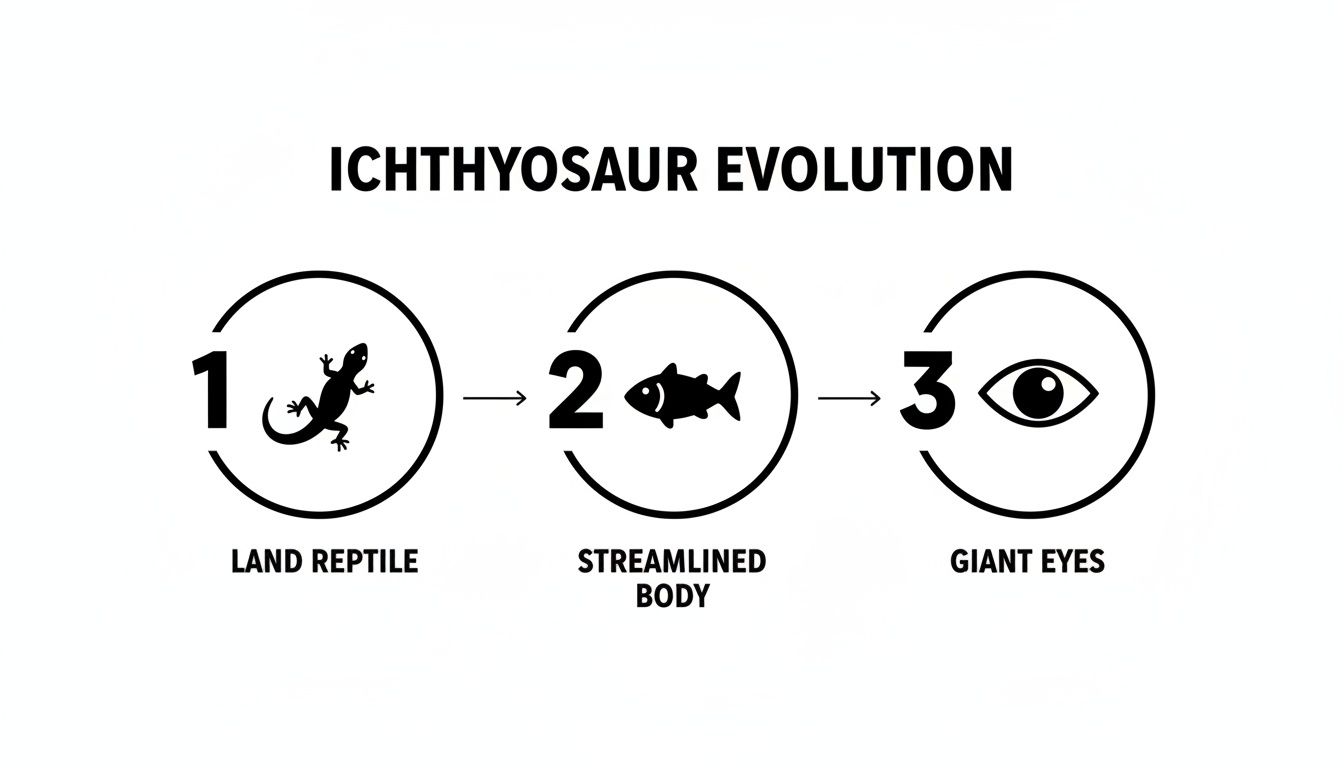
This infographic breaks down the key evolutionary leaps that fueled their long reign.
From land-dwelling ancestors to hyper-specialized marine predators, these adaptations were their ticket to ruling the seas for millions of years.
The True Giants of the Triassic
At the absolute peak of the size chart are the shastasaurids, a family of giants that reached mind-boggling sizes during the Triassic Period. The undisputed king is Shonisaurus sikanniensis, a colossal creature found near the Sikanni Chief River in British Columbia. This beast measured an estimated 21 meters (69 feet) long—firmly in blue whale territory.
Even more staggering, fragmentary bones from the UK suggest some individuals might have stretched to 25-26 meters. And it gets better. In 1928, paleontologists in Nevada stumbled upon a mass graveyard of around 40 gigantic skeletons, a whole pod of titans that grew over 17 meters long.
These weren't just the biggest ichthyosaurs; they were some of the largest animals to have ever lived, period. Just trying to picture a reptile that big gives you a new appreciation for the sheer majesty of prehistoric oceans.
Reconstructing Titans From Fragments
So, how do paleontologists figure out the size of an animal from a few bones that are over 200 million years old? It’s a fascinating bit of anatomical detective work, and it often starts with just a single piece, like a vertebra or a jaw fragment.
The key technique is comparative anatomy. Scientists take the fossil piece and compare it to the complete skeletons of smaller, well-documented ichthyosaur species. If a single vertebra is twice the size of the same bone in a known 10-meter-long specimen, they can confidently infer the new animal was likely around 20 meters long.
This work isn't just guesswork; it's grounded in solid principles:
Known Anatomical Ratios: Paleontologists have a solid grasp of how different body parts scale up in marine reptiles.
Reference Specimens: Complete fossils act as the "blueprint" for estimating the size of their larger, more mysterious relatives.
Mathematical Modeling: Modern software helps create digital models to test these estimates and make sure they’re biologically sound.
This painstaking process brings these ancient giants back to life, at least in our imagination. While ichthyosaurs were the masters of the ancient seas, you can also explore the wonder of other fascinating prehistoric creatures that roamed during the Mesozoic.
Comparing Ichthyosaur Sizes to Modern Marine Animals
To truly grasp the scale of these Triassic titans, it helps to see how they stack up against the giants in our oceans today. This table provides a quick visual comparison.
Creature
Era
Estimated Maximum Length (Meters)
Shonisaurus sikanniensis
Triassic
21 (possibly up to 26)
Blue Whale
Modern
29.9
Fin Whale
Modern
27.3
Sperm Whale
Modern
20.7
Humpback Whale
Modern
16
As you can see, the largest ichthyosaurs were playing in the same league as the biggest whales, making them true contenders for the largest marine animals of all time.
A Piece of a Giant as Natural Sculpture
The immense scale of these creatures opens up incredible possibilities for collectors and designers. You don’t need a full skeleton to make a statement. A single, massive fossilized bone from a giant ichthyosaur can be a breathtaking piece of natural art.
Imagine a large vertebra, its complex structure and sheer size telling the story of an animal of almost mythic proportions. Mounted on a custom stand, it’s no longer just a fossil—it becomes a sculpture that demands attention and sparks conversation. It’s a tangible link to deep time, evolution, and the staggering scale of life.
A piece like this can anchor an entire room, creating a focal point that is both intellectually stimulating and visually stunning. It’s a design element that carries a story that few other objects can ever hope to match.
How an Apex Predator Becomes a Timeless Treasure
The journey from a living, breathing predator to a stunning fossil is an incredibly improbable one. For every ichthyosaur that sliced through the Mesozoic seas, only a tiny fraction was ever destined to become a fossil. The whole process hinges on a perfect storm of geological events that transform fleeting organic matter into a permanent record etched in stone.
It all starts with a quick, gentle burial. After an ichthyosaur died and its body settled on the ocean floor, it was a race against time. If left exposed, scavengers and natural decay would quickly break it down. But if it was swiftly covered by layers of fine sediment—silt, mud, or volcanic ash—the process of preservation could kick off. This rapid burial is the single most critical step.
The Science of Preservation
Once entombed in sediment, the soft tissues decay, leaving behind the hard parts like bones and teeth. Over millions of years, the immense pressure of the overlying layers compacts everything into solid rock. At the same time, groundwater loaded with dissolved minerals like calcite or silica slowly trickles through the porous bone.
This mineral-rich water begins a process called permineralization. The minerals crystallize inside the bone's microscopic voids, essentially turning it to stone from the inside out. This slow, quiet transformation is a molecular-level replacement that preserves intricate anatomical details with stunning fidelity. It’s what creates the durable, beautiful fossils we see today—an echo of life made tangible.
The quality of a fossil is a direct reflection of its burial history. The faster and more complete the burial in a low-oxygen environment, the more exquisitely detailed the final specimen will be—preserving not just bone, but sometimes even the ghost of soft tissues.
Uncovering Fossil Graveyards
Certain spots around the globe offer a unique window into these ancient ecosystems thanks to their extraordinary preservation conditions. These special sites are known as Lagerstätten, a German term meaning "storage place." A Lagerstätte is a sedimentary deposit that yields fossils of exceptional richness and quality, often preserving soft tissues that almost never survive.
These sites are geological treasures, giving paleontologists priceless snapshots of entire ancient communities. For collectors, fossils from a world-renowned Lagerstätte carry a special significance and value. They’re simply the best of the best.
One incredible example was found in 2009 near the Tyndall Glacier in Chile's Torres del Paine National Park. The site yielded dozens of ichthyosaur specimens, including the first complete one from the country, Myobradypterygius hauthali. Scientists figured out that an underwater landslide likely smothered an entire pod in wet sand, which later became sandstone. The preservation was so clear that it even included a mother with her unborn baby. You can learn more about this astounding ichthyosaur graveyard and the dramatic story it tells.
What Determines a Fossil's Value
The journey from seabed to showroom ultimately shapes a fossil’s desirability as both a collectible and a piece of natural art. Several key factors come into play, each adding to its unique story and aesthetic appeal:
Completeness: An articulated skeleton, where the bones are still connected as they were in life, is far rarer and more valuable than a jumble of individual bones.
Preservation Quality: The level of detail is everything. Fossils showing fine textures, sharp tooth serrations, or no signs of being crushed by geological pressure are highly prized.
Provenance: Knowing where a fossil was found and its ownership history is vital. A documented provenance adds to its authenticity and scientific weight.
Aesthetics: The color of the bone, the contrast with the surrounding matrix (the rock it's embedded in), and its overall visual impact are huge for a piece meant for display.
In the end, the transformation of an ichthyosaur from a living creature into a fossil is a story of chance, chemistry, and immense spans of time. Each specimen that survives this journey is a rare masterpiece—a collaboration between biology and geology that results in a timeless work of natural art.
A Guide to Collecting Ichthyosaur Fossils
Bringing an ichthyosaur fossil into your collection is more than just a purchase—it’s an act of custodianship. These remarkable specimens are a physical bridge to the ancient past, blending natural history with tangible art. For new enthusiasts and serious collectors alike, knowing how to spot a quality piece is everything.
The first step is simply understanding what you’re looking at. Ichthyosaur fossils don’t just come as complete skeletons. You’ll find individual teeth, vertebrae, or even the delicate bones from a paddle. Each type tells a unique part of the animal's story. An isolated vertebra speaks to the power of its spine, while a perfectly preserved paddle showcases the intricate engineering of its fins.
Evaluating Specimen Quality
When you’re assessing an ichthyosaur fossil, a few key factors separate a good piece from a great one. A top-tier specimen will have crisp anatomical detail, with minimal crushing or distortion from geological pressure over the millennia. The bone itself should have good color and density, creating a beautiful contrast against the matrix—the stone it’s embedded in.
Keep an eye out for these quality markers:
Vertebrae: Look for vertebrae with a distinct, solid shape. The central part (the centrum) should be robust, and the bony projections (processes) should be as intact as possible.
Paddles and Limbs: Articulated paddles, where all the tiny bones are still arranged in their natural position, are incredibly rare and highly sought after. Clear separation between each bone is a huge plus.
Teeth: A great ichthyosaur tooth will be complete, with both the crown and root. Small details, like the texture of the enamel or signs of wear on the tip from feeding, add tremendous character.
Spotting Restoration and Ensuring Authenticity
Honest restoration is a normal and often essential part of preparing a fossil for display. The key is transparency. A reputable dealer will always be upfront about what is original bone and what has been restored, which could be anything from filling in cracks to reconstructing a missing fragment.
Provenance—the documented history of a fossil’s discovery and ownership—is non-negotiable for any serious collection. It’s your guarantee of the specimen’s scientific and historical integrity.
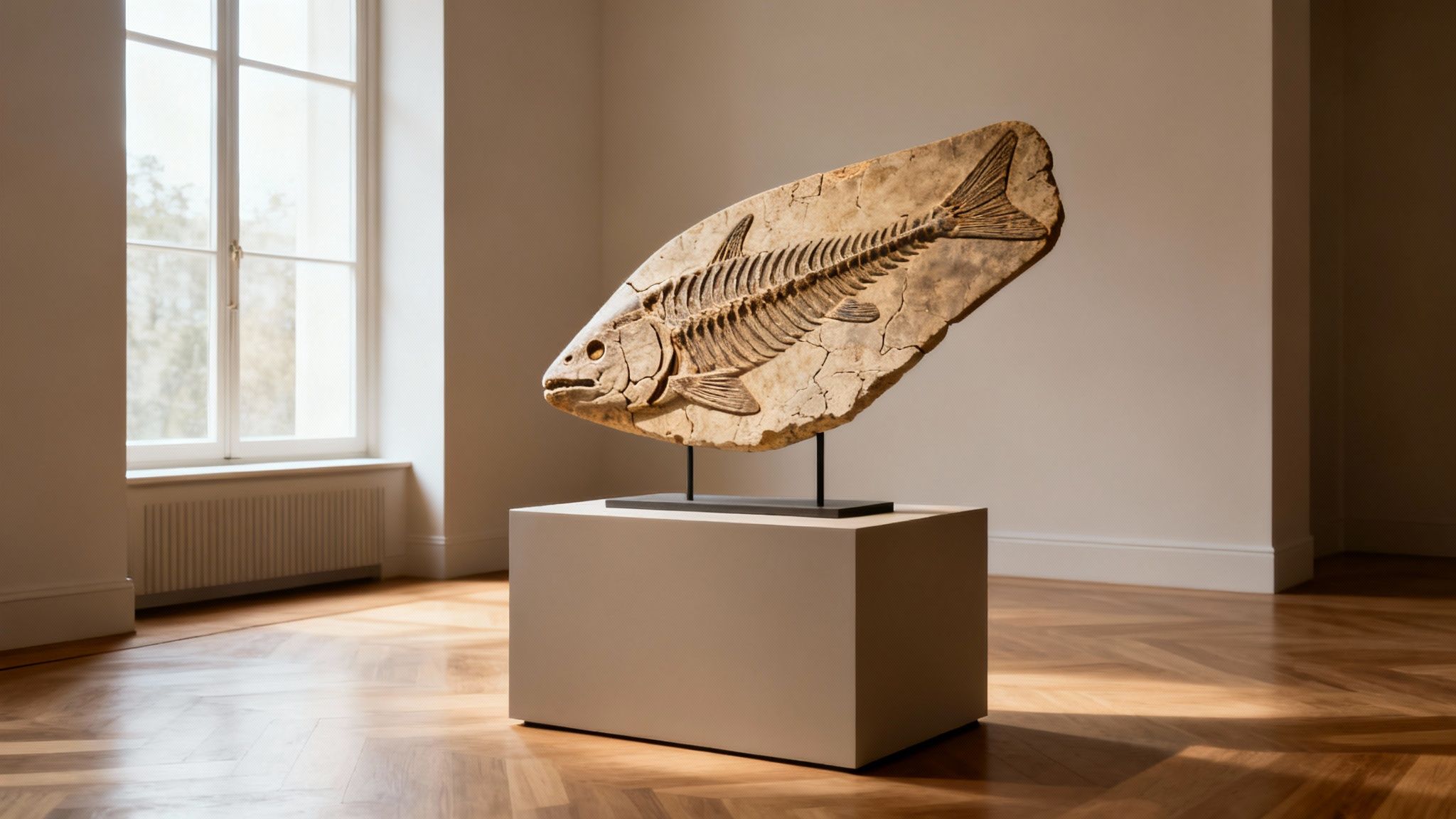
Ethical sourcing is just as crucial. Fossils must be collected legally, respecting both the land and scientific protocols. This protects important paleontological sites and ensures your piece is a legitimate artifact, not something from the black market. The same principles of careful excavation and provenance apply to all marine fossils, like this beautifully preserved fossilized fish from Lebanon.
Integrating Fossils into Luxury Design
Beyond their scientific importance, ichthyosaur fossils are stunning sculptural elements that can completely anchor a room's design. They aren't just decorations; they are conversation starters, powerful centerpieces that demand attention and lend a sense of deep time to any space.
Imagine the impact of a fossilized ichthyosaur paddle, mounted on a custom stand in an entryway or a study. Its ancient, organic form creates a breathtaking contrast with modern materials like steel, glass, or polished wood. This fusion of the primeval and the contemporary tells a story that is both visually striking and intellectually engaging—a story that began millions of years ago in a lost Mesozoic sea.
Caring for Your Piece of Prehistory
When you bring an ichthyosaur fossil into your home, you become the custodian of an irreplaceable piece of Earth’s deep history. It’s more than just an investment or a decorative object—it's a story millions of years old, and proper care is about preserving that story for the future. These ancient relics can be surprisingly sensitive, so a thoughtful approach to their environment and handling is crucial.
The single most important factor in preserving any fossil is a stable environment. Fossils are incredibly vulnerable to sudden shifts in temperature and humidity. These changes can cause the rock matrix to expand and contract, which can lead to heartbreaking cracks and damage. To prevent this, always display your ichthyosaur specimen away from direct sunlight, heating vents, air conditioners, or drafty windows.
Best Practices for Handling and Cleaning
Whenever you need to move your fossil, make sure your hands are clean and dry. Always support the specimen from its most stable point, which is usually its base. For larger pieces, especially those still embedded in their original matrix, never lift them by a protruding bone or a fragile edge. The fossilized bone might seem hard as a rock, but it can often be far more brittle than the stone surrounding it.
When it comes to cleaning, less is always more. A gentle dusting with a soft, dry brush—think of a makeup brush or a camera lens brush—is typically all that’s needed to keep your fossil looking its best.
Avoid using any liquids, solvents, or chemical cleaners. Ever. Moisture can reactivate minerals inside the fossil or the matrix, causing discoloration, flaking, or serious deterioration over time. Sticking to a dry, gentle dusting is the safest bet.
Display and Mounting for Long-Term Stability
How you display your ichthyosaur fossil is just as critical as where you display it. A secure, professional mount isn't just for looks; it’s essential for the safety and long-term stability of the piece. The mount should be custom-fitted to the specimen, distributing its weight evenly and preventing stress on any potential weak points.
Keep these key elements in mind for a secure and beautiful display:
A Solid Base: The stand needs to be heavy and stable enough to prevent any risk of tipping, particularly if it’s in a higher-traffic area of your home.
Supportive Structure: For articulated skeletons or long sections, the mount must support the entire piece along its length, not just at one or two points.
Protective Padding: Any part of the mount that makes direct contact with the fossil should be padded with an inert material like felt to prevent scratches and abrasion.
By following these simple guidelines, you can ensure your piece of prehistory remains a stunning and stable centerpiece. This careful stewardship allows the incredible story of the ichthyosaur to inspire awe for generations to come, transforming your collection into a true legacy.
A Few Common Questions About Ichthyosaur Fossils
As we wrap up our deep dive into the world of these ancient sea dragons, let's tackle some of the questions that pop up most often. These insights should help round out your understanding, whether you're a seasoned collector or just starting to get hooked.
Weren't Ichthyosaurs Just Swimming Dinosaurs?
Absolutely not, and it’s a common misconception. Though they shared the Mesozoic Era with dinosaurs on land, ichthyosaurs belong to a completely separate evolutionary group.
Think of it as a classic case of convergent evolution. Just like modern dolphins evolved a fish-like body to thrive in the ocean, ichthyosaurs did the same thing millions of years earlier. They arrived at a similar solution for a similar problem, but their family tree is entirely distinct from the land-based archosaurs we know as dinosaurs.
How Can You Tell Ichthyosaurs Apart from Other Marine Reptiles?
When you’re looking at Mesozoic marine reptiles, it all comes down to body plan. Telling an ichthyosaur apart from a plesiosaur or mosasaur is surprisingly straightforward once you know the key features.
Ichthyosaurs: These were the torpedoes of the ancient seas. Look for a streamlined, dolphin-like body and a powerful, crescent-shaped tail that moved side-to-side like a fish's.
Plesiosaurs: Picture the Loch Ness Monster. These creatures are famous for their broad, turtle-like bodies, incredibly long necks, and four huge, paddle-like flippers they used to "fly" through the water.
Mosasaurs: Imagine a giant, aquatic Komodo dragon. Mosasaurs had long, serpentine bodies, massive jaws full of sharp teeth, and a flattened tail for propulsion. They were the apex predators of the late Cretaceous seas.
The ichthyosaur’s entire anatomy was a masterclass in speed and efficiency, perfectly adapted for life in the open ocean.
Did All Ichthyosaurs Have an Overbite?
While most ichthyosaurs had jaws that met neatly, one particularly famous group, Eurhinosaurus, took things to an extreme with its pronounced "overbite."
Much like a modern swordfish, its upper jaw shot out far beyond the lower one, creating a long, bony rostrum. Paleontologists believe this specialized snout was a weapon, used to slash through dense schools of fish or to probe the soft seabed for hidden prey. This unique feature makes fossils from the Eurhinosaurus genus instantly recognizable and a fascinating study in prehistoric adaptation.
One of the most incredible things we know about ichthyosaurs comes from a fossil so well-preserved it captured a mother dying in childbirth. This and other specimens confirm that ichthyosaurs gave birth to live young, tail-first, just like modern whales and dolphins. It was a crucial adaptation that freed them completely from needing to return to land.
Are Ichthyosaur Fossils Common?
Ichthyosaurs were around for millions of years, but finding a high-quality, complete fossil is another story entirely. They’re relatively rare.
For a skeleton to survive, it needed to be buried quickly in an environment with very little oxygen to prevent scavenging and decay. That specific set of circumstances didn't happen often. This is why articulated skeletons or complete paddles are highly prized by museums and collectors.
More common finds include individual vertebrae and teeth, which offer a fantastic and accessible way to start your own collection. But whether it’s a single bone or a full skeleton, every ichthyosaur fossil is a stunning testament to their long and successful reign in Earth's ancient oceans.
At Astro West, we believe every fossil tells a profound story of Earth's history. Our curated collection offers a direct connection to these ancient worlds, transforming natural history into timeless art. Explore our collection of fossils and other natural wonders at Astro West.