How to Tell Gold from Pyrite A Practical Field Guide
The key to telling gold from pyrite isn't some complex chemical analysis—it's about knowing their fundamental physical differences. Gold is soft, dense, and leaves a golden-yellow streak, while pyrite is hard, brittle, and leaves a greenish-black one. These simple, hands-on tests are far more reliable than just trusting your eyes, as pyrite’s flashy, brassy look has been fooling people for centuries.
The Prospector's Dilemma: Why Looks Can Deceive
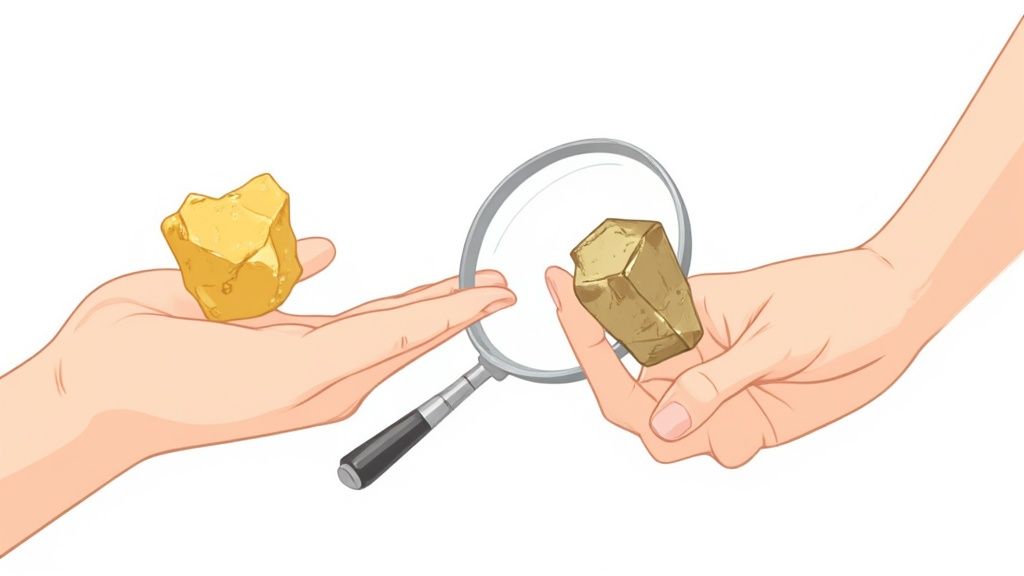
That heart-pounding moment when you spot a shiny, yellow mineral in the wild almost always sparks the same question: is it the real deal, or just pyrite? This classic prospector's dilemma is as old as mining itself, thanks to the uncanny visual similarities between the two. To make things even trickier, they often form in the same geological environments—sometimes right next to each other.
This is exactly how pyrite earned its infamous nickname, "Fool's Gold." One of the most legendary blunders in history involved the English explorer Martin Frobisher back in 1576. Convinced he’d struck it rich, he hauled roughly 1,400 tons of what he thought was gold ore all the way from the Canadian Arctic back to England. The crushing reality? It was all worthless pyrite.
Key Differences at a Glance
Relying on looks alone is a recipe for disappointment. Real gold has a deep, buttery yellow color with a soft metallic luster that looks the same from every angle. Pyrite, on the other hand, is a pale, brassy yellow with a glittery shine that often changes as you turn it in the light. Getting a feel for these basic visual cues is the first step before you start testing.
The core difference comes down to physical properties, not just appearance. Gold is a soft, malleable, and incredibly dense precious metal, whereas pyrite is a hard, brittle iron sulfide mineral.
To help you quickly spot the differences, here’s a simple side-by-side comparison of their most important traits.
Gold vs Pyrite Quick Comparison
Property
Real Gold
Pyrite (Fool's Gold)
Color
Deep, buttery yellow.
Pale, brassy yellow.
Hardness (Mohs)
2.5-3 (Soft, can be scratched with a copper penny).
6-6.5 (Hard, can scratch glass).
Streak
Golden-yellow.
Greenish-black or brownish-black.
Density
19.3 g/cm³ (Extremely heavy for its size).
4.9-5.2 g/cm³ (Noticeably lighter than gold).
Malleability
Very malleable; can be hammered into thin sheets.
Brittle; shatters or powders when struck.
Luster
Soft metallic sheen.
Bright, flashy metallic glitter.
Crystal Shape
Irregular flakes, nuggets, or grains.
Often forms sharp, cubic or octahedral crystals.
This table is a great starting point, but the real proof comes from the physical tests we'll cover next. If you're also dealing with jewelry and want to broaden your knowledge, check out this guide on how to tell if your gold is real. Mastering these simple identification methods is what separates the seasoned prospector from the hopeful amateur.
Mastering the First Glance: Visual Clues
Before you reach for any tools, your eyes can tell you a surprising amount. The very first clue in telling gold from pyrite comes down to their fundamental shapes and structures, and they couldn't be more different.
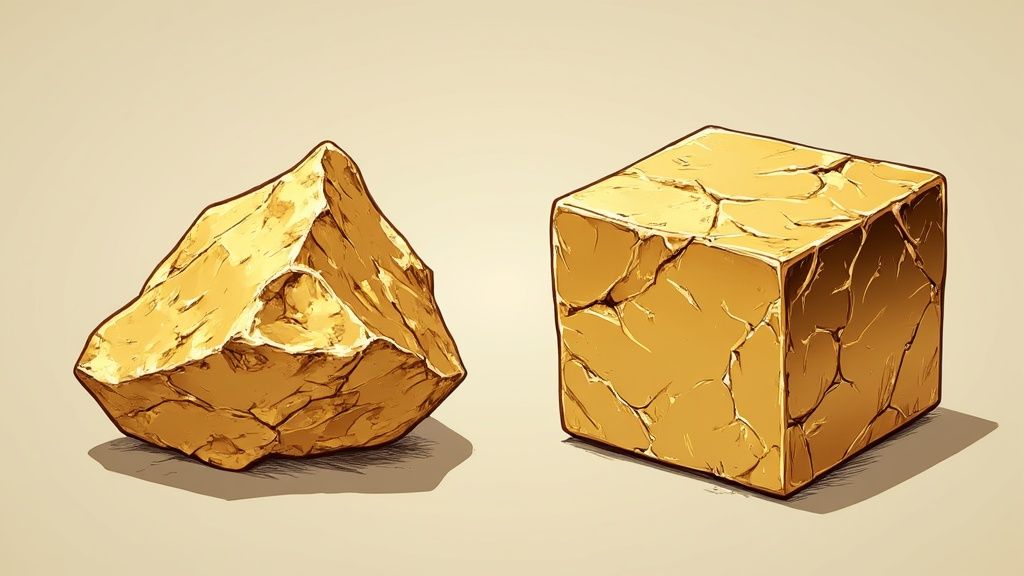
Gold is a soft, pliable metal. Because of this, it almost never forms sharp, perfect crystals out in the wild. You’ll find it as soft-edged, rounded nuggets, delicate flakes, or thin, wire-like threads running through a host rock like quartz. Think organic and irregular.
Pyrite, on the other hand, is all about sharp geometry. As an iron sulfide mineral, it loves to grow into distinct, well-defined crystals. You'll often see it as nearly perfect cubes with sharp corners or as multi-faceted structures called pyritohedrons. Those perfect geometric forms are a massive visual red flag.
Color and Luster Under Light
The next immediate giveaway is how the mineral plays with light. Real gold has a rich, buttery yellow color and a soft metallic luster. The key here is consistency—that warm glow stays the same whether you’re looking at it in direct sun or in the shade. It doesn’t flash or change as you turn it.
Pyrite is much brassier, with an almost harsh yellow hue. Its luster is more of a glittery, mirror-like shine that "flashes" brightly when light hits its flat crystal faces. If you rotate a piece of pyrite, you'll see its surfaces flicker, going from bright flashes to darker spots. Gold's sheen is a constant, deep glow.
Here's a tip I've picked up from old-timers: cup your hands around the specimen to cast a shadow over it. If that yellow glow vanishes or dulls dramatically, you're almost certainly looking at pyrite. Real gold holds onto its rich color, even with less light.
Getting a feel for these visual cues is your fastest method for a field ID. For instance, if you stumble upon specimens with exceptionally sharp, nearly flawless shapes—like these stunning pyrite cubes from Navajún, Spain—you can immediately recognize their geometric perfection as a classic hallmark of pyrite, not gold.
Getting Your Hands Dirty: Field Tests You Can Trust
When just looking at a specimen isn't enough to settle the debate, it's time to get your hands dirty. A few classic field tests, trusted by prospectors for generations, can give you a much clearer answer. These methods work because they expose the fundamental physical differences between gold and pyrite—things you just can't see with your eyes alone.
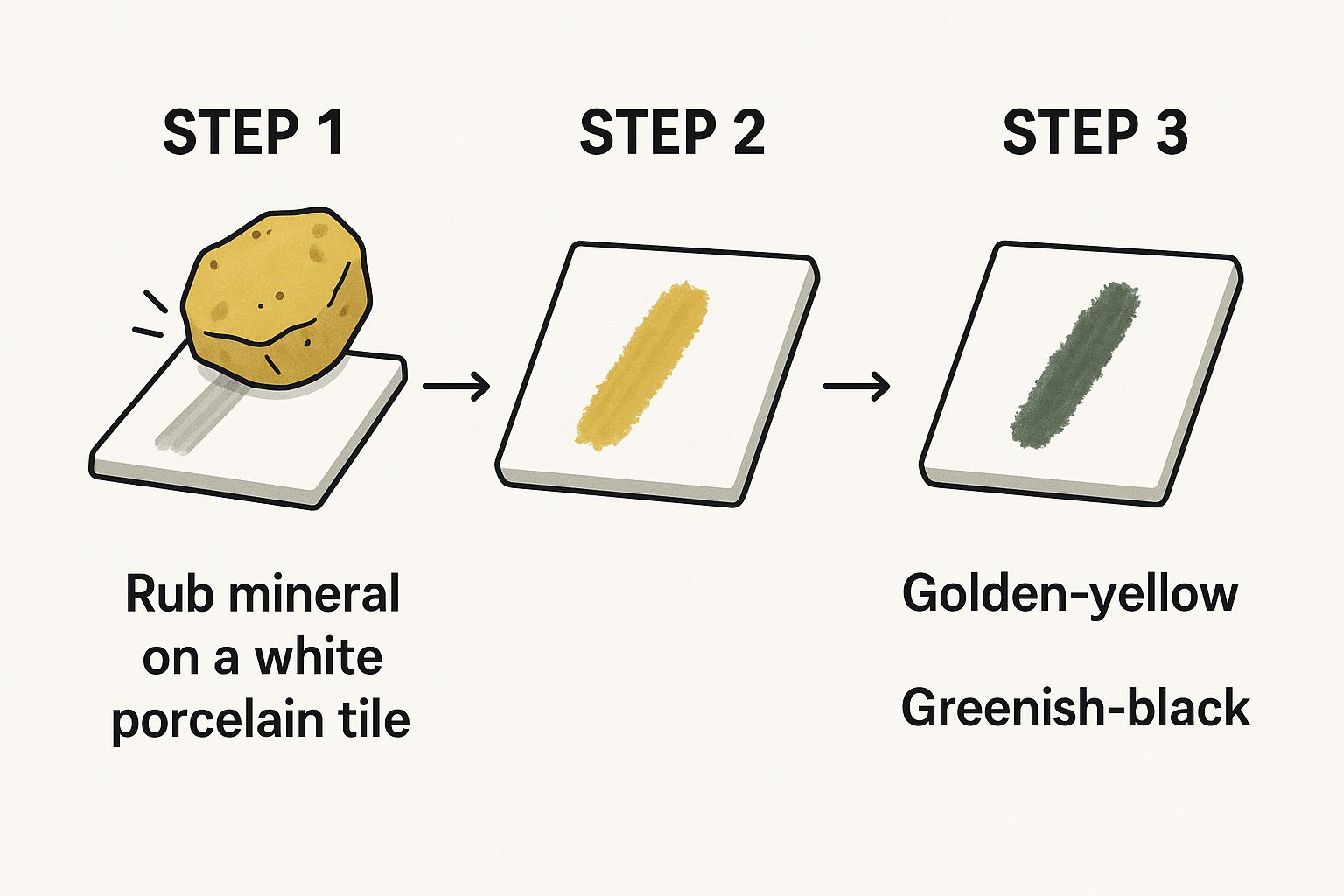
One of the most telling is the streak test. This is a simple but powerful technique where you drag your mineral across an unglazed ceramic surface, like the back of a bathroom tile. What you're doing is powdering a tiny bit of the mineral, which reveals its true, unadulterated color. This is called its "streak."
You can see here just how rubbing a mineral on a porcelain plate leaves behind its true color as a streak.
The result is almost always a dead giveaway. Real gold always leaves a brilliant, golden-yellow streak. Pyrite, on the other hand, leaves a very different greenish-black or brownish-black mark. It's a cornerstone test in mineral identification for a good reason—it works.
The Hardness and Malleability Test
Next up, let's talk about hardness and malleability. These two properties are like two sides of the same coin when you're trying to separate gold from pyrite. Gold is famously soft, while pyrite is surprisingly hard and brittle. You don’t need any fancy lab equipment for this; a few common items will do the trick.
Try scratching your find with a copper coin. On the Mohs scale of hardness, gold is only about a 2.5, while a copper penny sits around a 3. That means the copper is harder and will leave a scratch on the surface of gold. Pyrite, however, is much tougher, ranking between 6 and 6.5. It will easily shrug off a scratch from a copper coin.
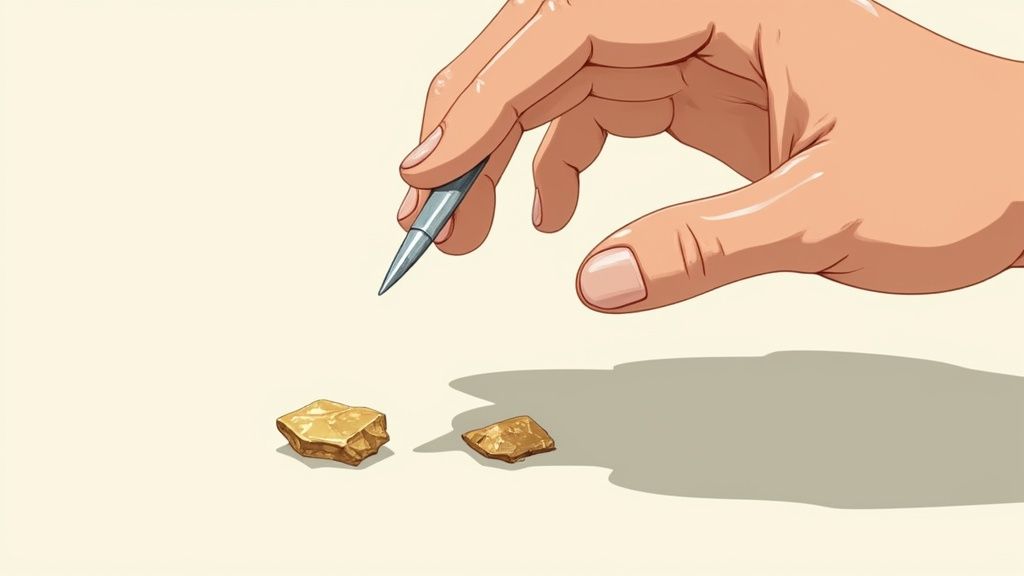
For the malleability test, place your mineral on a hard surface and give it a gentle tap with a small hammer or even the back of a steel tool.
Gold is malleable, so it will simply flatten out or deform under the blow, almost like a piece of soft putty. It won't break.
Pyrite is brittle. A solid tap will cause it to shatter into smaller pieces or even crumble into dust.
This difference in how they react to pressure is one of the most conclusive ways to tell gold from pyrite. Gold bends; pyrite breaks. It's a simple rule of thumb that has saved many a prospector from a day of disappointment.
These physical tests are the foundation of practical mineralogy. If you enjoy this kind of hands-on identification and want to expand your skills, learning more about mineral identification can help you apply these same principles to all sorts of other interesting specimens. And once you're confident you've found the real deal, a guide on how to test gold purity can help you take the next step.
The Undeniable Difference in Density and Weight
Looks can be deceiving, but weight never lies. Beyond just looking at the surface, one of the most immediate and foolproof ways to distinguish gold from pyrite is by simply feeling its weight. This all comes down to density, which is just a fancy way of saying how heavy something is for its size.
And let me tell you, the difference between these two isn't small—it's dramatic.
Gold is an incredibly dense metal, clocking in with a specific gravity of around 19.3 g/cm³. Pyrite, on the other hand, is a lightweight at just 5.0 g/cm³. That means if you had a piece of gold and a piece of pyrite of the exact same size, the gold would feel nearly four times heavier.
The Simple "Heft Test"
This massive weight difference is exactly why seasoned prospectors put so much faith in the simple “heft test.”
If you’ve ever held a lead fishing weight, you know that surprisingly heavy feeling for such a small object. That’s what a real gold nugget feels like in your hand. A piece of pyrite the same size will feel much lighter, more like an ordinary rock you'd pick up anywhere.
The feeling is unmistakable once you've experienced it. Gold has a dense, substantial feel that regular minerals just don't possess. If your find feels unusually light for its size, your suspicions should immediately turn toward pyrite.
Now, if you want to get more precise than just going by feel, you can run a basic density test right at home. All you need is a digital scale and a cup of water. It's a great way to get some hard numbers to confirm what the heft test is telling you. Building these practical skills is a core part of the hobby, and you can explore even more techniques in our guides on mineral identification.
When Pyrite Can Still Lead to Gold
While all the classic field tests are designed to help you tell gold and pyrite apart, the real story out in the field is sometimes a lot more complicated. In certain types of ore bodies, finding a pocket of pyrite doesn't always mean you've struck out. It just means the gold might not be visible to the naked eye.
This is where things get really interesting for serious prospectors.
Sometimes, microscopic particles of gold can get trapped right inside the crystal structure of pyrite as it forms. Geologists often call this "invisible gold" or refractory gold. It’s the reason large-scale commercial mines will process thousands of tons of pyrite-rich ore—they know how to extract the incredibly valuable metal hidden within.
The Science of Invisible Gold
This isn't just an old prospector's tale, either. Modern mineralogical analysis has confirmed that gold can be structurally bonded within pyrite crystals, especially when other trace elements like arsenic are hanging around. This science is exactly what informs modern mining strategies.
So what does this mean for you? It means a pyrite find, especially if you're in a known gold-bearing region, could be a much bigger clue than it seems. The presence of pyrite can act as a geological signpost, pointing you toward areas where gold might be concentrated.
For the hobbyist looking to go beyond the basics, this knowledge completely changes the game. Pyrite is no longer just a shiny imposter; it's a potential clue in a much larger treasure map.
While a single pyrite cube you find in a stream probably isn't gold, it might be part of a much larger geological system that is rich in gold. Understanding this connection is what separates the casual panner from those looking for significant finds, like beautiful specimens where you can see visible gold in its quartz matrix.
Even after you’ve got a handle on the basic tests, a few common questions always seem to pop up when you're trying to separate real gold from fool's gold. Getting these sorted out can save you from a simple mistake in the field and give you a bit more confidence.
Let’s dig into some of the most frequent ones.
Can I Use a Magnet to Tell Gold from Pyrite?
It's a logical thought. Pyrite is an iron sulfide, and iron is magnetic, so a magnet should stick to it, right?
The short answer is no, a magnet is not a reliable test. Here’s the catch: pure gold isn't magnetic, but neither is pure pyrite. While you might occasionally find pyrite mixed with other weakly magnetic minerals, a magnet that doesn't react tells you absolutely nothing. It could be gold, or it could be pyrite. It’s better to stick with the tests that give you a definite answer, like the streak, hardness, and density checks.
What Is the Acid Test and Should I Use It?
You’ve probably heard of the acid test as the ultimate way to prove you’ve got real gold. It involves putting a drop of nitric acid on a small, out-of-the-way spot on your specimen. If it’s real gold, nothing happens. Pyrite, on the other hand, will start to bubble or even dissolve.
While this test is effective, it’s also highly dangerous for amateurs.
Nitric acid is incredibly corrosive and can cause severe burns. This is a test best left to professionals who have the right safety gear and a controlled lab environment. For hobbyists and collectors, the hands-on physical tests are much safer and just as effective.
Does Gold Found in Rivers Look Different from Gold in Rocks?
Absolutely. Where you find a specimen tells a big part of its story, and gold is no exception. Its appearance can change dramatically depending on the journey it has taken.
Placer Gold: This is the gold you find in rivers and streams. It's been tumbling around with rocks, sand, and water for thousands, maybe millions, of years. All that movement smooths it down, giving you rounded, soft-edged nuggets, tiny flakes, or fine grains.
Lode Gold: This is gold that’s still in its original home, typically embedded in a rock vein (often quartz). Because it hasn't been battered by the elements, it’s usually much more angular and can even show its original crystalline shapes.
At Astro West, we believe that understanding the story behind each specimen is part of the magic. Whether you're a seasoned collector or just starting your journey, explore our curated collection of fine minerals, fossils, and natural treasures at https://astrowest.com.