How Can You Tell Gold from Pyrite? A Collector’s Guide to Identification
For millennia, gold has captivated the human imagination, a symbol of immense wealth, enduring power, and pure natural beauty. Yet, nature has a clever look-alike: pyrite, better known as 'Fool's Gold.' Knowing how can you tell gold from pyrite is a fundamental skill for any collector, designer, or enthusiast. The good news? The key differences are revealed through a few simple, hands-on tests that separate the authentic treasure from its convincing imposter.
The Enduring Allure of Gold and Its Deceptive Twin
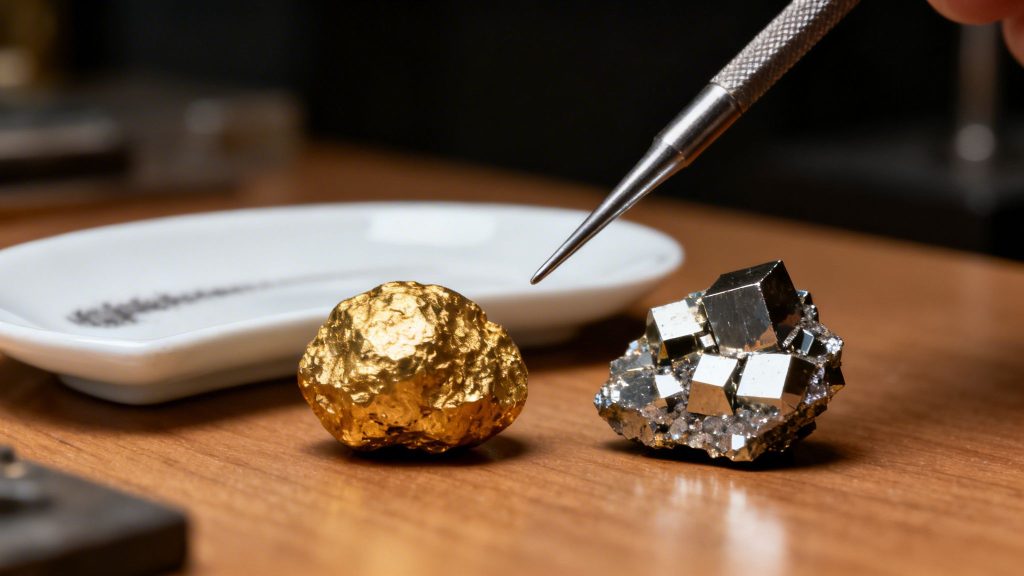
The challenge of distinguishing these two minerals is a story as old as prospecting itself. At first glance, the brassy-yellow shine of a pyrite crystal can mimic the rich gleam of gold, making the heart of any amateur collector race. This uncanny resemblance is precisely how pyrite earned its nickname during historic gold rushes, fooling countless eager prospectors.
But for the discerning eye, that resemblance is only superficial.
For serious collectors and interior designers, telling them apart is about more than the price tag. It’s about appreciating each mineral for its unique geological story and aesthetic qualities. Gold is a noble element (Au), valued for its incredible rarity, density, and softness. Pyrite, an iron sulfide mineral (FeS₂), is celebrated for its own distinct beauty—often forming in stunning, mirror-bright geometric crystals that are sculptures in their own right.
Why Identification Matters
Authenticity is the cornerstone of any respectable collection, whether you are gathering specimens for study or sourcing a unique piece of natural art for a luxury interior. A misidentification can lead to disappointment and devalues a carefully curated collection.
More importantly, learning to spot the distinct characteristics of each specimen deepens your connection to the natural world and elevates your appreciation for fine minerals.
Knowing the defining traits of gold and pyrite transforms a simple glance into an act of educated observation. You begin to see beyond the surface gleam to understand the mineral's true character, its formation, and its place in the grand geological story.
Here at Astro West, we see these distinctions every day, sourcing authentic gold specimens from miners who rely on these exact techniques. You can see a perfect example of pyrite's own unique, sharp beauty in specimens of quartz growing on cubic pyrite from Peru, where its metallic cubes create a striking natural sculpture.
Of course, when authenticating finished precious metal pieces, the story gets even deeper. Learning to interpret authentic gold marks adds another layer of verification beyond raw mineralogy. This guide will give you that same expert confidence, turning confusion into clarity. We'll walk through the hands-on methods used by miners and gemologists in the field, from the classic streak test to simply observing how the crystals formed.
The Streak Test: Uncovering a Mineral's True Colors
When determining if you have real gold or pyrite, one of the most trusted and definitive methods in any prospector's toolkit is the streak test. This classic mineralogical technique reveals the true color of a mineral’s powder—a property that’s often surprisingly different from its shiny surface.
It's a refreshingly simple test that cuts right through any visual deception.
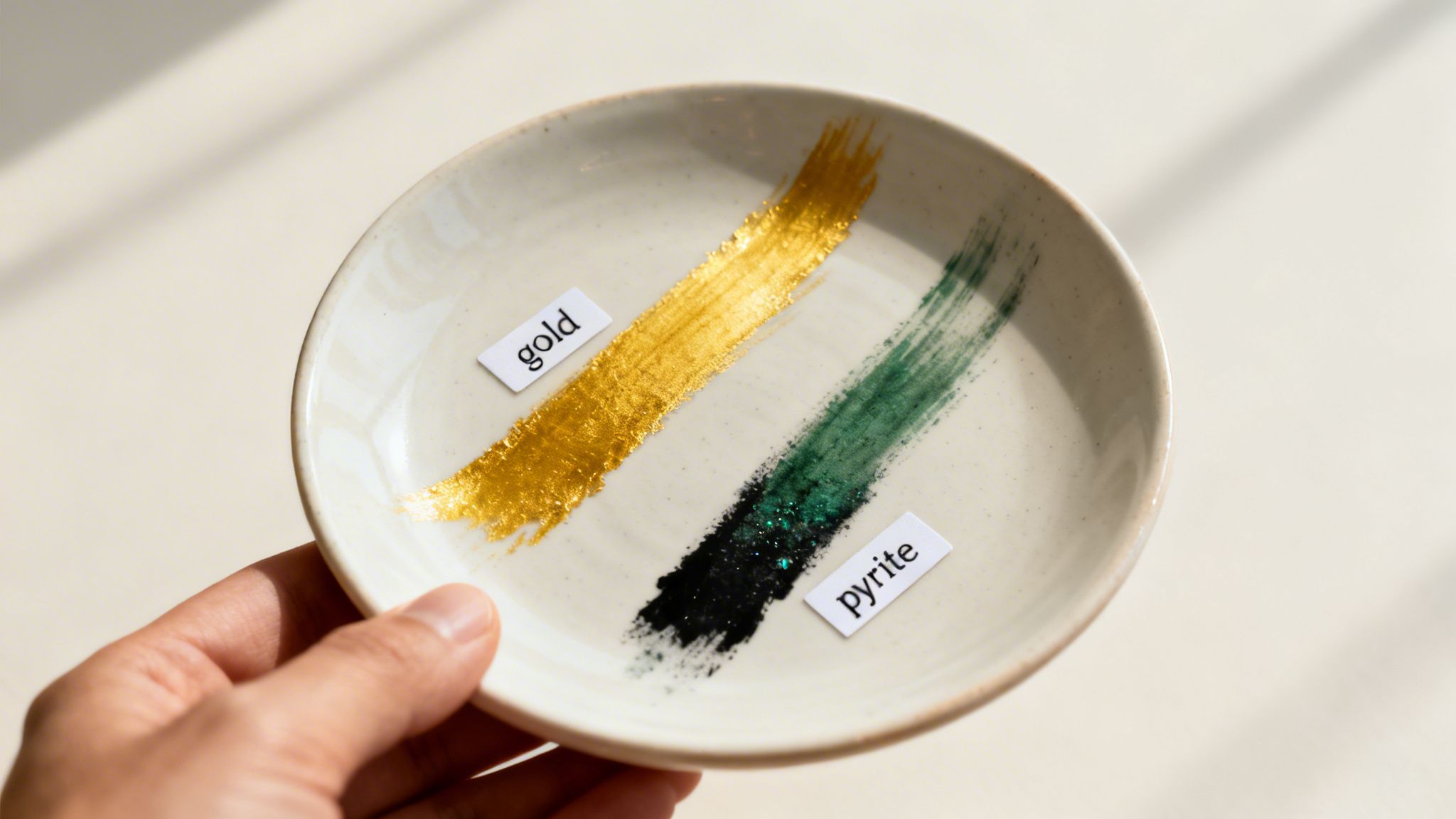
To perform the test, you need a piece of unglazed porcelain, often called a streak plate. Gently but firmly, rub an inconspicuous edge of your mineral across the plate's rough surface. The colored powder it leaves behind is the mineral’s "streak," and it tells you everything you need to know.
What the Results Tell You
The outcome is both immediate and conclusive, showcasing a fundamental difference between the two minerals. It’s the moment of truth.
Real Gold: When you test genuine gold, it leaves behind a rich, buttery, golden-yellow streak. Critically, the color of the streak perfectly matches the color of the mineral itself. What you see is what you get.
Pyrite (Fool's Gold): Despite its brassy-yellow shine, pyrite leaves a shockingly different mark. Its streak is a distinctive greenish-black or brownish-black. This dramatic mismatch is the dead giveaway that you're holding fool's gold.
This simple test is so reliable because a mineral’s streak is a far more consistent property than its external color, which can be affected by tarnish or small impurities. It’s a quick and decisive way to reveal their true identities.
Best Practices for an Accurate Streak Test
While the test is straightforward, a little care ensures you get an accurate result without damaging what could be a valuable specimen. We always recommend using a light touch—you only need a tiny amount of powder to see the color.
If you have a delicate or particularly well-formed crystal, find a discrete spot on the base or an already broken edge to perform the test. You want to get an answer, not mar a beautiful piece.
The streak test is more than just a scientific procedure; it's like having a conversation with the mineral. The color it leaves behind is its honest answer, revealing its true composition despite any surface-level disguise.
At Astro West, the miners and experts we partner with use this very technique in the field to verify their finds. It's a foundational skill that ensures only authentic specimens make it into our collections.
And while the test exposes pyrite's deception, the mineral itself is stunning. The sharp, lustrous cubes seen in high-quality Peruvian Pyrite specimens are prized by collectors for their remarkable geometric perfection—a beauty that needs no disguise. This fundamental test allows you to appreciate both minerals for what they truly are.
Testing Hardness and Malleability to Reveal Character
Beyond color, the way a mineral responds to physical pressure tells a compelling—and often definitive—story. This is where the fundamental characters of gold and pyrite completely diverge. Putting a specimen's hardness and malleability to the test is a classic, hands-on method that reveals its true nature with remarkable clarity.
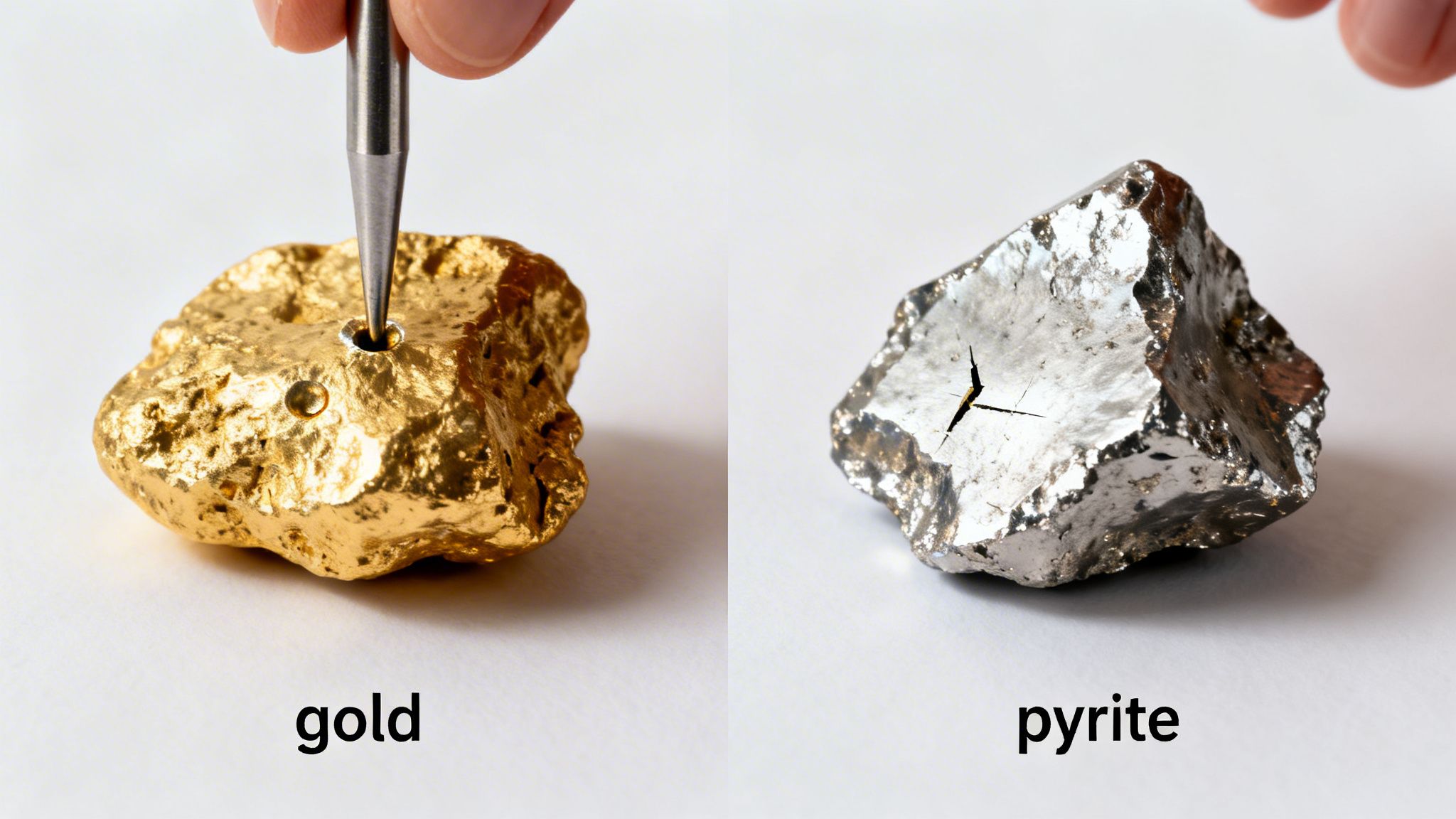
Gold is famously soft and malleable, meaning it will bend, dent, or deform under pressure instead of breaking. This physical trait is why it has been the metal of choice for jewelers for millennia. Pyrite, on the other hand, is hard and brittle; it shatters or crumbles when struck.
The Simple Hardness Test
You can quickly get a feel for this difference with a simple hardness test based on the Mohs scale, the standard scale for ranking mineral hardness from 1 (softest) to 10 (hardest). The gap between gold and pyrite here is significant.
Gold has a Mohs hardness of just 2.5 to 3. It’s so soft that a copper penny (hardness of 3.5) can scratch it.
Pyrite scores a much higher 6 to 6.5 on the Mohs scale. It’s harder than a steel nail and can easily scratch glass.
A careful way to test this in the field is by pressing the tip of a steel pin into a small, inconspicuous spot on your specimen. If it’s real gold, the pin will leave a small dent or indentation. Try the same with pyrite, and the brittle mineral will resist or fracture.
This fundamental difference isn't just a test; it's the very essence of their utility and value. Gold’s malleability makes it workable art, while pyrite’s rigid crystalline structure makes it a natural sculpture.
The physical difference between these minerals has been known and utilized for ages. Gold bends, while pyrite shatters. This simple fact has separated fortunes from failures in gold fields worldwide. During the peak gold production in South Africa's Witwatersrand Basin in the 1970s, for instance, this very trait helped miners separate treasure from waste, ultimately yielding 40% of the world's gold at the time. You can read more about what makes fool's gold so distinct on the USGS website.
This inherent softness is beautifully displayed in natural specimens of gold in quartz from our collection, where you can often see its fluid, organic forms nestled within the harder host rock. These pieces tell a story not just of color, but of character under pressure. The tactile difference is immediate and undeniable, giving you one of the most reliable ways to distinguish the real treasure from its convincing imposter.
Observing Crystal Shape and Natural Form
Developing a collector's eye means learning to recognize a mineral's natural growth pattern, or its crystal "habit." This skill alone is often enough to tell gold from pyrite at a glance, providing a powerful identification tool before you even pick up a specimen.
When it comes to their natural geometry, the two minerals could not be more different.
Real gold rarely forms distinct, sharp-edged crystals. Its soft, malleable nature means it typically solidifies in more organic, fluid-looking shapes.
The Natural Forms of Gold
When you encounter gold in its native state, you're likely to see it in a few common forms, each reflecting its gentle, non-crystalline personality.
Nuggets and Pickers: These are the classic forms—smooth, rounded chunks that have been weathered and tumbled by water over eons in placer deposits.
Flakes and Grains: Often, you'll find tiny, flattened pieces of gold sprinkled through a host rock like quartz or mixed in with river sediment.
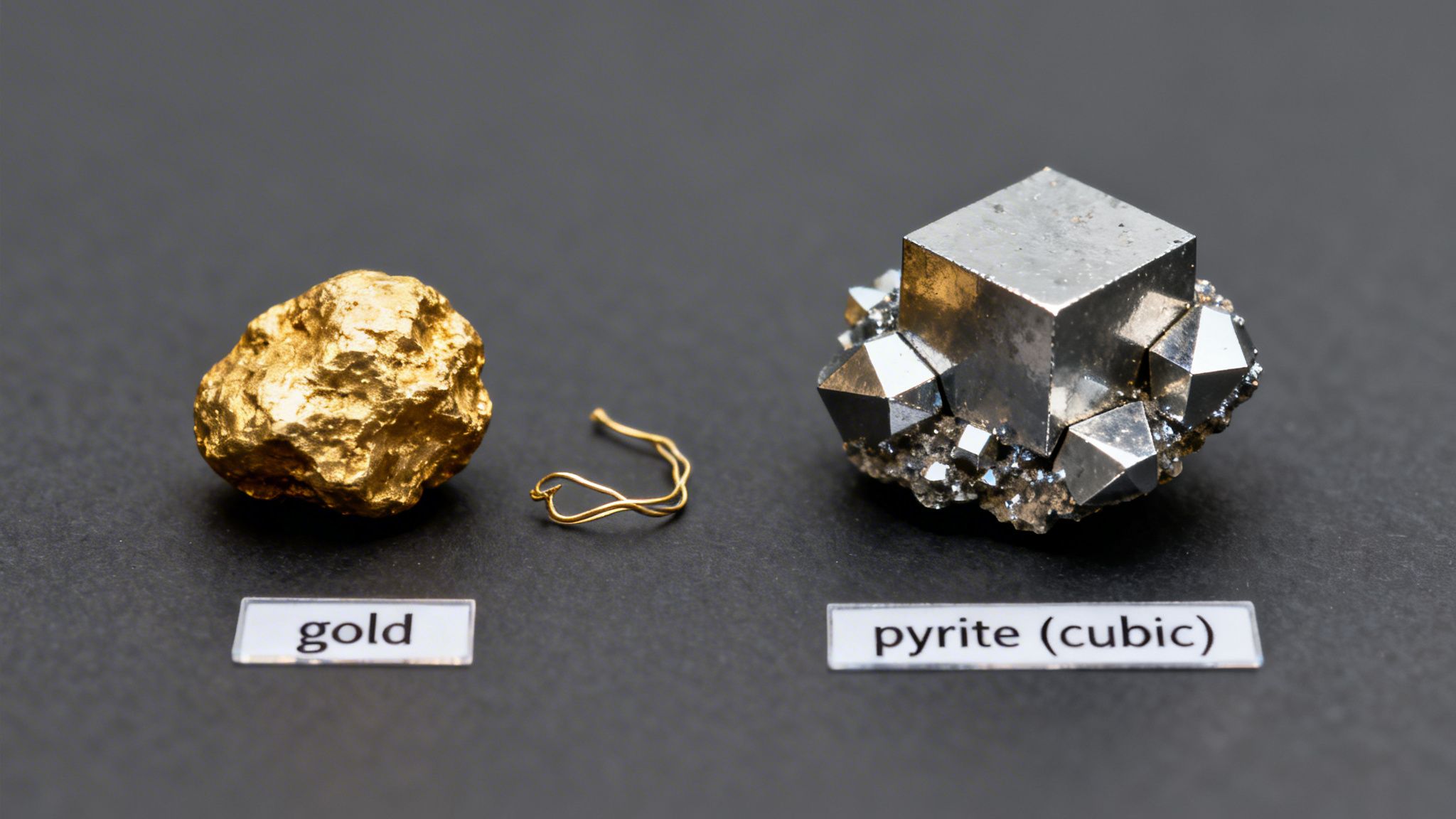
Wire Gold: In rare and highly sought-after instances, gold can grow into delicate, tangled, wire-like structures that look like miniature abstract sculptures.
Dendritic Forms: This habit creates stunning, tree-like or fern-like growths that branch out. Collectors prize these for their natural artistry and rarity.
The common thread is that the edges are almost always soft and irregular. They flow and curve instead of forming hard, geometric lines. This organic appearance is one of your biggest visual clues.
Pyrite: The Master of Geometry
Pyrite, conversely, is a master of geometric perfection. As an iron sulfide, it crystallizes in the isometric system, allowing it to form some of the most striking and perfect shapes in the mineral kingdom. Its hard, brittle nature helps it maintain these crisp forms.
Pyrite's perfect cubes are a lesson in natural geometry. They grow with such precision that they often appear machine-made, yet they are entirely the work of geological processes. This perfect structure is pyrite’s signature, a visual fingerprint that instantly separates it from the soft, irregular forms of gold.
The most iconic shape for pyrite is the perfect cube, which often displays fine parallel lines, called striations, across its faces. It also forms other complex, multi-sided shapes like pyritohedrons (a twelve-sided form with five-sided faces) and octahedrons.
When you see a brilliant specimen of sharp-edged pyrite cubes from Navajún, Spain, the crisp angles and metallic luster are absolutely unmistakable. The stark contrast between this rigid geometry and the soft, flowing nature of gold is one of the most reliable visual tests available. It’s how you can tell gold from pyrite with just a glance.
Feeling the Difference: Density and Geologic Clues
Once you've examined the color, shape, and streak, it's time to explore deeper properties. Two of the most reliable ways to separate real gold from pyrite involve characteristics you can't always see: density and the geological context of the find. These methods offer some of the most definitive proof you can get outside of a professional lab.
Let's start with specific gravity—the scientific term for density.
Gold Is Heavy. Really Heavy.
This is where gold leaves pyrite far behind. Gold is one of the densest minerals on Earth, with a specific gravity of around 19.3. Pyrite is a lightweight by comparison, clocking in at a mere 5.0.
That difference is so dramatic you can feel it in the palm of your hand.
If you were to hold a real gold nugget and a piece of pyrite of the exact same size, the gold would feel unnaturally, almost shockingly, heavy. This is the classic "heft test" that prospectors have sworn by for centuries.
The heft of gold is one of its most defining and legendary characteristics. This isn't just a minor difference; gold is nearly four times denser than pyrite. The sensation is immediate and unmistakable once you've experienced it.
You don't need any special equipment for this initial test—just a sensitive hand and a point of comparison. It's a low-tech but incredibly effective trick of the trade.
Reading the Geologic Story
The other major clue lies in understanding the company a mineral keeps. Minerals are a product of their environment. Knowing where your specimen was found provides crucial context that can instantly tip the scales. Think of yourself as a geological detective examining the scene.
Where Gold Likes to Hide: Gold is famously found in two main types of deposits. You'll see it in hydrothermal quartz veins, often visibly embedded in the white quartz matrix. It also concentrates in placer deposits—heavy minerals that have eroded out of veins and settled in riverbeds and streams.
Pyrite Is Everywhere: Pyrite, on the other hand, is far less picky. As one of the most common sulfide minerals on Earth, it forms in a vast range of geologic settings: igneous, metamorphic, and sedimentary rocks. It's especially common in coal beds and even as a replacement mineral in fossils.
So, what does this mean for you?
While you can find pyrite and gold together, finding a glittery mineral in a chunk of shale or coal is a huge red flag for it being fool's gold. If your specimen came from a sedimentary rock bed far from any known gold-bearing veins, the odds are overwhelmingly in favor of pyrite. This geological context is a final check that helps you build a complete and accurate picture of your find.
Trusting Your Skills and Consulting an Expert
With these field tests—streak, hardness, shape, and density—you now have a robust toolkit for telling real gold from pyrite. For most collectors and rockhounds, these practical methods are more than enough to make an accurate identification in the field.
But what if you have a potentially significant find, or a piece that could be quite valuable? That's when professional verification provides the final, definitive word. If your initial tests are inconclusive, consider sending a small sample to a specialized mineral lab for professional analysis. It's the best way to get absolute certainty for truly important discoveries.
Making the Final Call
Here at Astro West, we are more than just a gallery—we are a resource for collectors at every stage of their journey. We always encourage enthusiasts to visit our gallery to see and feel these crucial differences firsthand.
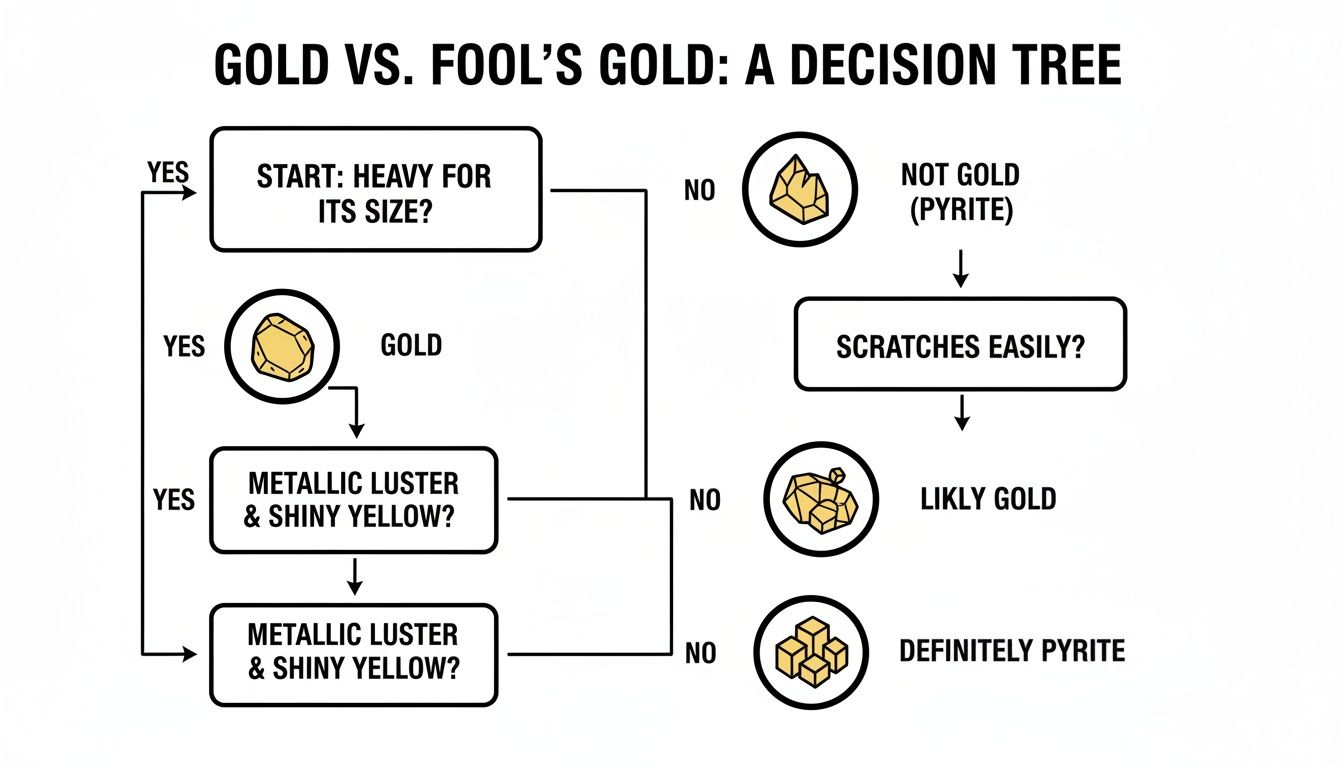
To simplify things, the decision tree below boils the process down to one of the most immediate and reliable tests you can perform.
This chart puts the focus squarely on density, which is one of the most reliable giveaways. However, there's no substitute for hands-on experience. Holding a verified California gold nugget in one hand and a pristine Spanish pyrite cluster in the other solidifies this knowledge in a way no article or video ever could.
Ultimately, the real joy of collecting comes from this blend of personal discovery, hands-on testing, and trusted expertise. You have the skills—now go put them to use.
Common Questions About Gold and Pyrite
Even after running a few tests, it’s natural to have questions. Nature loves to present a curveball now and then. Here are answers to the most common queries when learning how to tell gold from pyrite.
Can Gold and Pyrite Be Found Together?
Yes, they absolutely can, which is why knowing the difference is so crucial. Both minerals often form in the same hydrothermal environments, especially within quartz veins. It's not uncommon to find a single specimen with brilliant flakes of real gold nestled right beside perfectly formed pyrite crystals.
When you find a piece like this, you must test different spots on the stone. Run the streak and hardness tests on both the flaky yellow material and the cubic metallic crystals to get a full picture of what you’re holding.
Does Pyrite Ever Contain Real Gold?
This is an excellent question with a complex answer. Sometimes, pyrite is "auriferous," meaning it contains microscopic gold particles locked within its crystal structure. This isn't gold you can see with the naked eye—it's sub-microscopically trapped within the pyrite itself.
Extracting this gold requires complex chemical processes like cyanidation. So while a chunk of auriferous pyrite might be valuable for its hidden gold content, it's a world away from finding a specimen of visible, native gold. For collectors, the thrill is in the gold you can actually see.
The fact that pyrite can host microscopic gold is a fascinating geological quirk. For visual collectors and designers, though, this hidden value is distinct from the immediate, tangible beauty of a visible gold specimen.
Is There Any Value in Pyrite?
Absolutely. While it lacks the commodity value of gold, high-quality pyrite is treasured by mineral collectors for its sheer aesthetic appeal. The sharp, metallic, perfectly formed cubes from famous locales like Navajún, Spain, are true mineralogical classics.
These specimens are celebrated for their incredible natural geometry and sculptural beauty. They make stunning decorative objects and are essential additions to any serious mineral collection. True collectors appreciate pyrite for its own unique character, not because it imitates something else.
At Astro West, we believe that understanding the story behind each mineral deepens its beauty and value. Explore our curated collections of fine minerals, fossils, and natural art to find an authentic piece with its own unique history. Visit our gallery or browse the collection online.