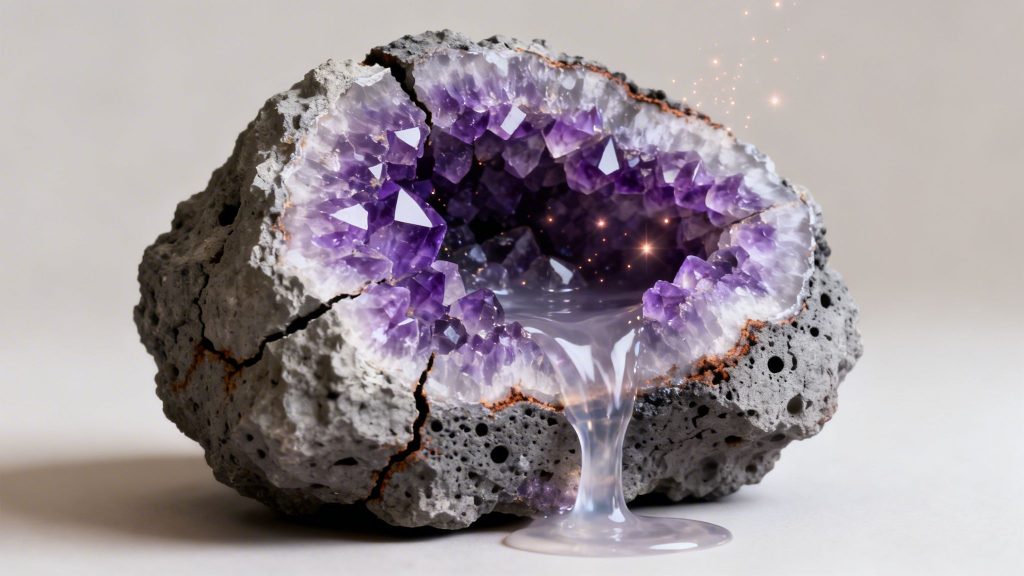
How Amethyst is Formed: A Guide to Rarity, Value, and Investment
The vibrant purple of amethyst is the final result of a precise geological process. This process requires silica-rich fluids, iron traces, and natural radiation. Understanding this formation is not just a scientific curiosity. It is the blueprint that dictates a specimen's rarity and, therefore, its market value. For collectors, knowing how these forces align is the first step toward genuine connoisseurship.
How Formation Dictates Amethyst Value
Amethyst is far more than a simple purple quartz. Its origin story is written directly into its crystal structure. That story separates a common stone from an investment-grade asset. Collectors and designers who can read this geological narrative understand why certain amethysts command high prices. Consequently, the question "how is amethyst formed?" becomes a practical tool for valuation.
The journey begins with basic ingredients. Superheated, silica-rich water must enter a protected cavity, usually within volcanic rock. There, it requires time and stability to grow crystals. However, the true transformation from clear quartz to amethyst occurs in two subsequent steps. First, trace iron impurities are introduced, followed by slow exposure to natural gamma radiation from the host rock. This powerful combination creates the "color centers" that produce its famous violet hue.
The specific conditions during formation—temperature, pressure, and fluid purity—directly control the final quality. A slow, stable crystallization process, for example, produces larger, flawless crystals with the deep, uniform color prized by collectors and designers.
This geological narrative explains why amethyst quality varies so dramatically by location. Key factors locked in during formation include:
Color Saturation: The intensity of the purple depends on the amount of available iron and the duration of irradiation. Therefore, deeper, more vibrant hues are much rarer and more valuable.
Crystal Size and Clarity: A stable growth environment determines the final size and internal clarity of the crystals. As a result, large, clean, well-formed points are always in high demand.
Geode Formation: The original gas bubble's size and shape in the volcanic rock dictate the geode's scale. Massive, intact "cathedral" geodes are prized for their dramatic presence and command premium prices.
By connecting these tangible qualities to their scientific origins, a collector moves beyond simple admiration. You begin to see the stone not just for its beauty, but for the incredible journey it took. This guide explains each step, reframing mineralogy as the foundation for intelligent acquisition.
The Geological Blueprint for Amethyst Creation
The story of amethyst begins deep within the Earth, involving fire, pressure, and immense patience. The finest specimens form in volcanic rock, where ancient lava flows created perfect underground nurseries. As molten rock cooled, sometimes billions of years ago, gas bubbles became trapped, forming hollow voids within the hardening basalt.
These cavities became nature’s protected chambers. They patiently awaited the next stage of geological development.
Over millions of years, these empty pockets filled with hydrothermal fluids. This is essentially superheated water saturated with dissolved silica, the building block of quartz. As these mineral-rich solutions seeped into the volcanic cavities, the change in pressure and temperature forced the silica to precipitate.
This initiated the slow construction of quartz crystals. The crystals grew layer by layer on the inner walls of the cavity. If you have ever seen a geode, you have witnessed the result of this incredible process. You can learn more about these fascinating formations in our guide explaining what is a geode.
This infographic illustrates how geological origins translate directly into market value.
As you can see, the initial geology directly dictates a specimen's qualities, which in turn determine its ultimate value as a collectible asset.
The Significance of Provenance
This foundational environment is key to understanding why certain regions produce world-class amethyst. Locations like Brazil and Uruguay are legendary for their massive, high-quality geodes. Their geological history involved extensive volcanic activity that created these ideal crystal-forming voids.
The host rock and hydrothermal fluids determine everything from crystal size to clarity. For this reason, knowing an amethyst’s provenance provides critical insight into its formation. It is often a reliable indicator of its potential quality and rarity.
An amethyst’s value is fundamentally tied to its geological context. The volcanic rock is not just a host; it is the crucible that shaped the gem's size, structure, and potential for vibrant color—all key factors in its market appraisal.
This process lays the scientific foundation for an amethyst’s journey. It transforms a simple mineral solution into a prized gem. For collectors, understanding this geological blueprint elevates a purchase into an appreciation for a remarkable natural event. This just sets the stage, however, as the next step introduces the specific elements that give amethyst its signature color.
The Science of Amethyst's Royal Purple Color
A quartz crystal begins its life perfectly clear. Its stunning transformation into the deep, royal purple of amethyst involves a two-step process of geology and physics. This journey from a common mineral to a collector’s prize hinges on specific ingredients and precise natural conditions.
First, as the quartz crystal grows, trace amounts of iron must integrate into its structure. These iron ions replace a few silicon atoms within the crystal lattice. At this stage, however, the iron does not affect the color. The quartz remains perfectly colorless.
The second step is the catalyst. Over millions of years, the host rock emits a steady, low-level dose of natural gamma radiation. This gentle but constant energy bath is the key that unlocks the purple hue.
The energy from this natural radiation alters the electronic state of the iron atoms, creating what mineralogists call a ‘color center.’ This new structure absorbs specific light wavelengths, primarily yellow, while allowing violet and red light to pass through. Our eyes perceive that combination as purple.
From Radiation to Rarity
The intensity of the purple color directly records the duration and strength of the irradiation process. A longer or more intense exposure to gamma rays results in a deeper, more saturated hue. This is why specimens with rich, uniform color are much rarer and, consequently, more valuable.
This geological story also explains why color is the single most important factor in amethyst's value. The finest examples, often called "Siberian" grade, display a deep purple with secondary red or blue flashes. That premium color certifies a complete and ideal formation history. Lighter stones tell a different story of a shorter or less intense exposure, which is why they are more common. You can explore these color variations in our guide to purple crystal stones.
This table illustrates how color saturation directly relates to market value.
Amethyst Color Saturation and Market Value
This guide explains how an amethyst's color—a direct result of its formation—translates into its desirability and price.
Color Grade
Description
Rarity
Market Value
Siberian (AAA)
Deep, vibrant purple with red and blue flashes.
Extremely Rare
Highest
Deep Russian (AA)
Rich, uniform deep purple without strong zoning.
Very Rare
High
Standard (A)
Medium to light purple, often with noticeable color zoning.
Common
Moderate
Pale/Lavender (B)
Light, pale violet or lavender tones.
Very Common
Commercial/Low
Simply put, a deeper color is not just an aesthetic preference. It is a testament to a more complete and intense geological process, making the stone a rarer asset. For a collector, this scientific backstory offers a clear framework for judging a specimen. A deep purple color is tangible proof of a specific and prolonged natural event, transforming a common mineral into something truly exceptional.
How Temperature Influences Amethyst Quality
The temperature at which amethyst forms is a critical part of its history. It provides collectors with vital clues about its origin and overall quality. For years, geologists believed most amethyst grew in high-heat environments, between 100 and 250 degrees Celsius. However, improved science has revealed a more complex and interesting story.
This knowledge adds another layer to appreciating a fine specimen. When you understand the thermal history locked inside a crystal, you can differentiate between a stone born in intense volcanic heat and one that grew patiently under cooler conditions.
The Spectrum of Formation
Temperature directly influences crystal growth, color saturation, and even the inclusions trapped inside. Amethyst formation is not a single event but a spectrum of geological pathways. Each pathway leaves a unique signature on the final crystal. This is precisely why you see such a wide range of quality and value on the market.
Early geological studies found crystallization temperatures ranging from 100 to 246 degrees Celsius in volcanic deposits. Some unique types required environments hotter than 400 degrees Celsius. You can read more about these findings on amethyst formation temperatures. The main takeaway is that amethyst has multiple formation pathways—a discovery that continues to shape our understanding of the mineral.
Heat and its Effect on Value
Heat also plays a critical role after an amethyst has formed. Heating natural amethyst to high temperatures, typically above 470°C, reconfigures its iron impurities. This process permanently shifts its color from purple to a warm yellow or orange. This is how the vast majority of citrine on the market is created.
When you see citrine within an amethyst geode, it indicates a later geothermal event. While beautiful, heat-treated amethyst—often sold as citrine—is valued very differently from natural amethyst or the exceptionally rare natural citrine. Our article on this stunning citrine gemstone tree provides a deeper look at this thermal transformation.
An amethyst's formation temperature is a key part of its provenance. It dictates the crystal's structure and aesthetic appeal, directly connecting its geological past to its present-day market value.
This thermal history is what separates good specimens from truly great ones. For example, the world’s most sought-after amethyst, like the deep purple material from Uruguay, actually formed under surprisingly cool conditions. As we will explore next, that low-temperature process is the secret behind the deep saturation that makes these pieces investment-grade assets.
Why Provenance Separates Good from Great
Not all amethyst is created equal. Its origin—its provenance—is one of the most important factors in its value. An amethyst from Uruguay tells a different geological story than one from Zambia. That story is etched into its very crystals. For a serious collector, knowing a stone's origin is a reliable shortcut to understanding its quality and rarity.
There is a reason the market places the highest premium on Uruguayan amethyst. These coveted geodes have a deep, saturated purple that is the global standard for excellence. This exceptional quality is not an accident. It is a direct result of their unique, low-temperature formation.
The Uruguayan Difference
While many amethysts form in hot volcanic environments, recent scientific breakthroughs confirm that Uruguayan amethyst crystallized under surprisingly cool conditions. These spectacular geodes were born around 134 million years ago as the supercontinent Gondwana began to separate.
For millions of years, groundwater trickled through volcanic cavities. It slowly deposited silica at temperatures between just 15 to 60 degrees Celsius. You can read more about these groundbreaking findings on low-temperature formation.
This slow-and-low crystallization process is the secret to their superiority. It allows for the growth of pristine, perfectly shaped crystals with incredible clarity and that signature, deep purple. In contrast, higher-temperature formations often lead to faster, less stable growth, resulting in color zoning, inclusions, or a lighter hue.
A specimen's provenance is its geological résumé. An amethyst from Uruguay’s Artigas region, therefore, signifies a specific and highly desirable heritage. This heritage is defined by slow, cool, and stable crystallization—conditions that produce investment-grade quality.
This is why provenance is not just a label. It is a direct indicator of the conditions that shaped an amethyst’s beauty and structural integrity.
Comparing Key Localities
Different origins produce amethyst with distinct characteristics. Each is valued for different reasons by collectors and designers.
Uruguay: Famous for the deepest, most saturated purple hues and flawless crystal formations. It is the benchmark for color quality and commands the highest prices.
Brazil: The world’s largest producer by volume, often yielding massive geodes. The color is typically lighter, from pale lavender to medium purple, making it popular for large decorative objects.
Siberia, Russia: Historically, this region produced the most prized "Siberian" color—a rich purple with red and blue flashes. These mines are now depleted, making authentic Siberian specimens exceptionally rare and valuable.
Ultimately, an amethyst's geographic source tells the story of its creation. That story of slow, patient formation separates a good stone from a great one. It transforms a beautiful mineral into a tangible and valuable piece of Earth’s history.
Evaluating Investment-Grade Amethyst
Understanding how amethyst forms is one skill. Using that knowledge to select an exceptional piece is another. It involves seeing beyond the sparkle to identify qualities that signal a perfect creation process. These details indicate true rarity and lasting value.
The most important factor is a deep, uniform color saturation. A rich, vibrant purple that is consistent throughout the crystal indicates ideal formation conditions. It had just the right amount of iron and a long, slow bath of natural radiation. That "grape jelly" purple in top-tier Uruguayan amethyst is the direct result of its unique, low-temperature birth.
Key Value Drivers
Exceptional clarity and perfectly formed crystal points are equally crucial. These traits signal that the amethyst grew slowly in a stable environment. For this reason, collectors seek specimens with minimal internal fractures and sharp, complete terminations. They pass over stones with cloudy or damaged crystals.
When evaluating a piece, keep these primary criteria in mind:
Color Saturation: Look for a deep, even purple without distracting color zoning (patches of lighter quartz).
Crystal Clarity: The best pieces have incredible transparency, allowing light to pass through without being blocked.
Aesthetic Balance: The overall composition should be visually harmonious, with well-proportioned crystals.
Authenticity: Ensure the amethyst is natural and has not been heat-treated. Heat treatment permanently alters the stone and reduces its investment potential.
A truly investment-grade amethyst is more than a mineral; it is a pristine geological artifact. Its value lies in the perfect execution of a complex natural process, resulting in a combination of color, clarity, and form that is exceptionally rare.
Making an Informed Acquisition
Ultimately, these factors separate a pretty rock from a sound investment. A specimen with world-class color, flawless crystals, and a strong provenance can be a fantastic store of value. It can appreciate similarly to fine art or luxury watches.
To see how these qualities translate into market figures, learn more about the factors influencing amethyst price per carat in our detailed guide. A smart acquisition depends on recognizing the signs of a superior geological history.
Further Collector Inquiries
As you delve deeper into the world of amethyst, you will find that the science of its formation connects directly to its beauty and value. Let's address some common questions that arise for collectors. This practical knowledge helps you appreciate every specimen.
Does Formation Speed Affect Quality?
Absolutely. The speed at which an amethyst crystal grows is a major factor in its final quality. Slow and stable growth conditions, like those in the low-temperature geodes of Uruguay, allow for massive, perfectly formed crystals. This unhurried process gives the crystal lattice time to align flawlessly and lets the color saturate deeply.
In contrast, rapid crystallization often leads to smaller, fractured crystals or uneven, splotchy color. For this reason, a slow geological journey is almost always behind the highest-value, investment-grade amethyst.
Why Are Some Amethyst Geodes So Large?
An amethyst geode's size depends on the size of the original gas bubble. Millions of years ago, enormous gas bubbles were trapped inside cooling lava flows. These events created vast, hollow chambers within the rock. These voids became the perfect natural cathedrals for silica-rich fluids to deposit quartz crystals over millennia.
The massive "cathedral" geodes you see come from regions where geological conditions were right to create these gigantic voids. The chambers also had to remain stable long enough to fill with crystals. It is a remarkable accident of volcanic history.
For a comprehensive overview of this fascinating gemstone, you can find a helpful guide on All About Amethyst which covers many foundational topics for collectors.
Can Amethyst Lose Its Color?
Yes, this is a known vulnerability. An amethyst’s purple color can fade with overexposure to direct sunlight or intense heat. The color comes from "color centers" created by naturally irradiated iron impurities deep within the Earth.
Unfortunately, prolonged exposure to harsh UV radiation or high temperatures can destabilize these color centers. This causes the vibrant purple to slowly wash out. This is why it is critical to display fine amethyst specimens away from a sunny window to preserve their color and protect their long-term value.
At Astro West, we believe understanding the story behind each specimen is essential for building a world-class collection. Explore our curated selection of fine, ethically sourced amethyst, chosen for its exceptional formation history and aesthetic brilliance. Visit https://astrowest.com to acquire a piece of natural history.