Elmwood fluorite isn't just another mineral specimen; it's a world-class collectible known for its shockingly deep purple colors and nearly flawless cubic crystals. Coming from one single, now-legendary American location, these pieces are true geological masterpieces and a holy grail for serious mineral enthusiasts.
They represent a perfect storm of vibrant color, sharp geometry, and fascinating mineral pairings that tell a rich story of their formation.
What Makes Elmwood Fluorite So Prized by Collectors
In the world of fine minerals, some locations become famous, producing specimens so distinct they set a global standard. The Elmwood Mine in Tennessee is one of those places. It has gifted the world a type of fluorite that is instantly recognizable and fiercely sought after.
Its appeal isn't just about being a pretty purple stone. It's about a rare combination of geological conditions that came together to create pure, natural art. This mine has long been known as a top source for high-quality fluorite, famous for its rich purple and lavender shades.
These incredible colors come from trace elements, like yttrium, that worked their way into the crystal structure as it grew millions of years ago. This specific chemistry is what gives Elmwood fluorite its signature look.
Signature Crystal Formations
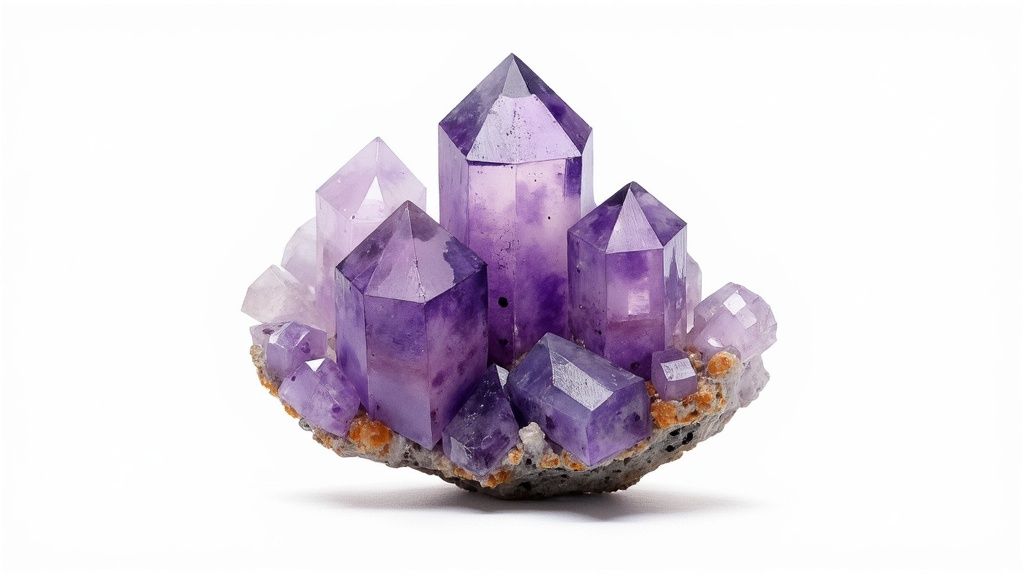
One of the first things you'll notice about Elmwood fluorite is its iconic crystal shape. The crystals are almost always perfect, razor-sharp cubes. Just picture tiny, translucent purple building blocks crafted by nature, often with glassy, reflective surfaces that catch the light beautifully.
This geometric perfection is a huge reason collectors are so drawn to these specimens. It offers a tangible glimpse into the precise, orderly way minerals form deep within the Earth.
The Perfect Mineral Pairings
Elmwood fluorite rarely shows up alone. It's often found sitting on a matrix with other minerals, creating stunning combination pieces that are true natural sculptures.
The most classic associations include:
Sphalerite: Lustrous, metallic black crystals of sphalerite create a dramatic contrast against the deep purple fluorite.
Calcite: Honey-colored or white calcite crystals, often in sharp, pointed forms, add another layer of texture and color.
Barite: Creamy white blades of barite can form beautiful, rosette-like clusters alongside the fluorite cubes.
These natural arrangements elevate a simple crystal into something more—a balanced, aesthetically pleasing masterpiece. For those looking to curate a fine mineral collection with Astro West, understanding these associations is key to appreciating the unique story each specimen has to tell.
The Geological Story of Tennessee's Purple Gems
The stunning purple cubes of Elmwood fluorite weren't born from some violent volcanic event. Far from it. Their creation story is one of incredible patience, a slow-simmering process that unfolded deep within the Earth over millions of years.
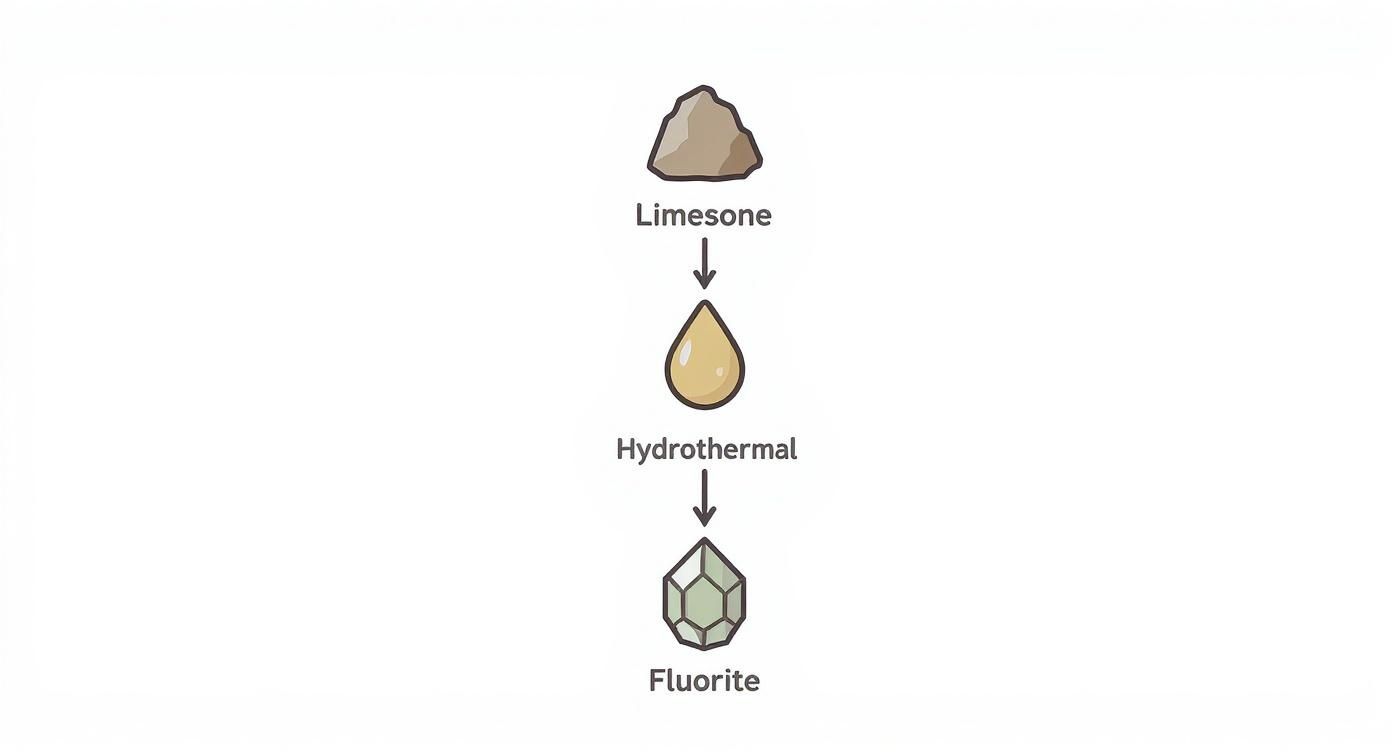
It all started with ancient limestone bedrock, full of tiny pockets and voids. Over immense spans of time, warm, mineral-rich brines—think of them as salty, super-concentrated mineral soups—were pushed up from deep within the Earth's crust. These fluids weren't rushing; they were seeping, slowly making their way through the porous limestone.
Geologists call this specific environment a Mississippi-Valley Type (MVT) deposit. This low-temperature hydrothermal process is the secret sauce behind Elmwood's magic. It created the perfect, stable conditions for crystals to grow with exceptional slowness and perfection.
The Perfect Crystal-Growing Environment
As these mineral-rich fluids filled the empty cavities in the limestone, the conditions became just right for crystallization. The brines were loaded with dissolved elements, including fluorine, calcium, zinc, and sulfur. When the temperature and pressure dropped just a bit inside these pockets, the elements had no choice but to start linking up, forming solid minerals.
It’s a bit like making rock candy at home. You dissolve a ton of sugar in hot water, and as that water cools, perfect sugar crystals start forming on a string. The formation of Elmwood fluorite followed the same basic principle, but the ingredients were dissolved minerals, and the "kitchen" was a limestone pocket deep underground.
The slow and steady nature of this process is what allowed the fluorite crystals to grow into their signature, razor-sharp cubic shapes. Faster, more chaotic growth often results in less defined or jumbled crystal masses.
Why It Grew with Friends
Those same hydrothermal fluids didn't just carry the ingredients for fluorite. They also had the building blocks for other minerals, which is why Elmwood fluorite is almost always found with its famous friends: sphalerite and calcite. Each mineral simply crystallized at slightly different times or under slightly different conditions within the very same pockets.
Often, the glittering, dark sphalerite formed first, followed by the iconic purple fluorite. Finally, calcite or barite crystals would grow over the top. This shared origin story is what creates the breathtaking combination specimens that collectors go absolutely wild for. Each piece is a perfect snapshot of a unique geological moment.
To get a better sense of this legendary spot, you can discover more about the Elmwood Mine and its treasures and really understand what makes this locality a true icon in the mineral world.
How to Identify Authentic Elmwood Fluorite
For any serious collector, being able to tell a true Elmwood specimen from the rest of the pack is a vital skill. It takes a keen eye to spot the subtle details that separate an authentic piece from a lookalike, from its signature deep purple color to the specific minerals it grew alongside. Once you learn these identifiers, you can confidently build a collection of these Tennessee treasures.
Fortunately, Elmwood fluorite has several distinct characteristics that act like a geological fingerprint. By learning what to look for, you can spot the genuine article and truly appreciate what makes these specimens so coveted.
Color and Crystal Habit
The first and most obvious clue is the color. Authentic Elmwood fluorite is famous for its deep, saturated purple hue, which can look almost black in certain lighting. While some lighter lavender pieces exist, they almost never show the pale sea-green or light blue tones common in fluorite from places like Illinois or China.
Next, you'll want to look at the crystal's shape, or what collectors call its "habit." Elmwood fluorite is iconic for its razor-sharp cubic form. The crystals often have a glassy, almost wet-looking luster and exceptionally flat faces. One of the coolest features to look for is "hoppered" growth—this is where the edges of the cubes grew faster than the faces, creating stunning indented, skeletal-like patterns.
This diagram gives you a great visual of how these incredible crystals come to be, showing the slow, hydrothermal process that transforms limestone into these perfect structures.
The Company It Keeps
One of the strongest indicators of an Elmwood origin is the presence of specific associated minerals. Think of them as the fluorite’s geological "friends." Elmwood fluorite is almost always found on a matrix with honey-colored calcite or a lustrous, metallic-black sphalerite.
The classic, high-quality Elmwood look is a cluster of deep purple fluorite cubes nestled against sharp, amber calcite crystals or glittering sphalerite. This trio of minerals tells a clear story of its origin.
Elmwood Mine specimens are world-renowned for their exceptional quality. Their cubic crystals typically range from 1 to 8 cm across and are almost always found with either calcite or sphalerite, adding to their beauty and geological story.
If you're just getting started with mineral identification, our comprehensive crystal identification guide is a great resource for learning the foundational traits to look for.
Comparing Elmwood to Other Localities
To really sharpen your eye, it helps to know what else is out there. Fluorite from other famous mines can look similar at a glance, but the differences become obvious once you know what to spot. For instance, Illinois fluorite often has a lighter purple or blue color and frequently shows color zoning in phantom layers—a feature that’s quite rare in Elmwood specimens.
This table gives you a quick reference for telling them apart.
Elmwood Fluorite vs Other Localities
Characteristic
Elmwood Fluorite (Tennessee, USA)
Illinois-Kentucky Fluorite (USA)
Yaogangxian Fluorite (China)
Primary Color
Deep, saturated purple to lavender.
Light purple, blue, yellow; often zoned.
Colorless, light purple, green, blue.
Crystal Habit
Sharp, well-defined cubes; often hoppered.
Cubes, often with modified edges.
Complex cubes, octahedrons, dodecahedrons.
Associations
Sphalerite (black), Calcite (honey).
Calcite (white), Galena.
Quartz, Wolframite, Scheelite.
Clarity
Often translucent with good clarity.
Can be transparent with color phantoms.
Often exceptionally transparent.
By keeping these key differences in mind—color, crystal shape, and mineral associations—you'll be able to quickly distinguish a true Tennessee Elmwood from its international cousins.
Understanding the Value of Elmwood Fluorite
What separates an Elmwood fluorite specimen you might pick up for a few hundred dollars from one that commands a price in the thousands? It really comes down to a handful of key factors that seasoned collectors use to judge quality and desirability.
Think of it like grading a diamond. Evaluating Elmwood fluorite requires a keen eye for specific traits that determine its place in the market. It’s not just about size, either—a smaller, flawless specimen can easily outvalue a larger one with even minor imperfections. The key is finding that perfect storm of features that come together to create a true work of natural art.
The Four Cs of Elmwood Value
To make things simpler, collectors often zero in on four main characteristics, which you could call the "Four Cs" of Elmwood fluorite. Each one plays a critical role in a specimen's rarity and overall appeal.
Color Saturation: The absolute best specimens boast a deep, vibrant, and uniform purple. Pieces with that rich, grape-jelly saturation are prized far more than those with lighter lavender tones or patchy coloration.
Crystal Perfection: This is all about the sharpness and integrity of the cubic crystals. You want to see razor-sharp edges, perfectly flat faces, and a distinct lack of damage. Even a tiny chip or a cleaved corner—a common fracture that follows fluorite’s natural cleavage planes—can dramatically reduce a specimen's value.
Clarity: Clarity describes how translucent the crystals are. While Elmwood fluorite is almost never transparent like glass, top-tier pieces have a wonderful translucency. This quality allows light to penetrate, illuminating that deep internal color.
Composition: This is where the artistry comes in. Composition refers to how the fluorite crystals are arranged on the matrix and how they interact with other minerals. A well-balanced piece, where the fluorite is beautifully complemented by sparkling sphalerite or honey-colored calcite, is far more sought after than a jumbled or poorly presented cluster.
Damage and Matrix: The Deal Breakers
Damage is the single biggest factor that can tank a specimen's value. A "perfect" cube with a noticeable cleave on one corner just isn't perfect anymore. Scratches, abrasions, or internal fractures will all have a negative impact on the price, which is why collectors scrutinize every edge and surface before buying.
The matrix, or host rock, is just as important. A specimen needs to feel balanced and stable. A small, perfect crystal on a huge, uninteresting piece of rock is far less desirable than a cluster of crystals on a matrix that’s well-proportioned and complementary. The ultimate goal is aesthetic harmony.
The most prized Elmwood fluorite specimens are those that present a complete, undamaged, and beautifully balanced snapshot of the pocket they grew in. These pieces combine top-tier color, pristine crystals, and a pleasing arrangement with associated minerals.
To get a broader perspective on how material properties influence desirability, you might find it interesting to read about the differences in stone materials and their perceived value. This kind of context helps you appreciate why certain natural attributes are so highly valued, whether in minerals or other fields. By mastering these evaluation criteria, you can confidently spot exceptional specimens and build a collection of lasting beauty and worth.
How to Properly Care For and Display Your Specimens
Owning a piece of Elmwood fluorite is a real privilege, and treating it right is the key to protecting your investment. With a Mohs hardness of only 4, fluorite is quite soft. It can be easily scratched by things as common as a steel knife blade or even gritty household dust.
On top of that, its perfect cleavage means it can split cleanly along internal planes if it's dropped or shocked by a sudden temperature change. Gentle handling is the first and most important rule. Always try to hold your specimen by its matrix, not the fluorite crystals themselves. This simple habit goes a long way in preventing accidental damage and keeps skin oils from dulling that gorgeous, glassy luster.
Safe Cleaning Techniques
Over time, a bit of dust is inevitable. Cleaning Elmwood fluorite requires a delicate touch to avoid doing more harm than good.
Here’s a safe, step-by-step way to get it clean:
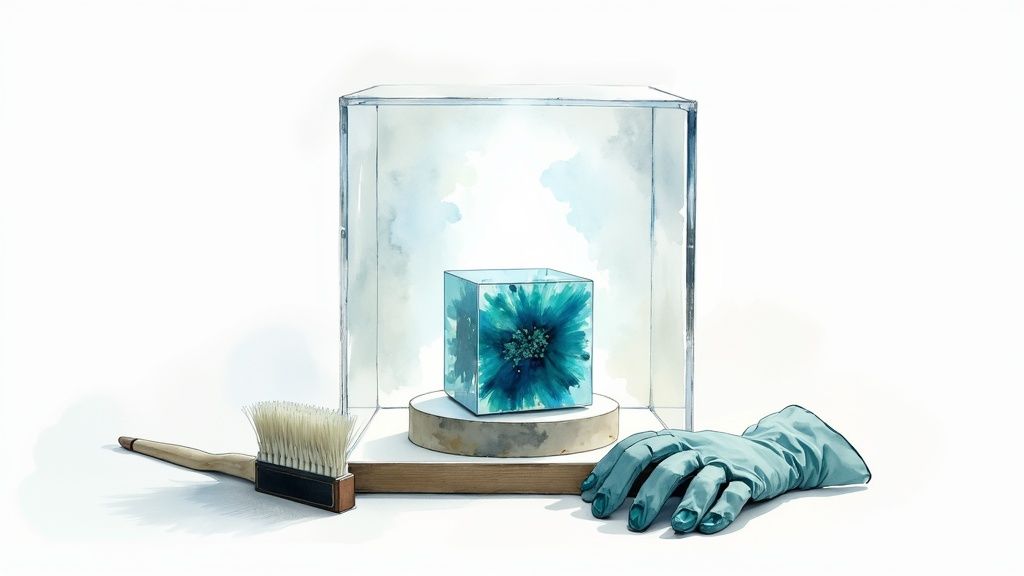
Dust First: Start by using a soft, dry artist's brush or a can of compressed air (held at a distance) to gently blow away any loose dust from the crystals and matrix.
Wash Gently: If it needs more, mix lukewarm distilled water with a tiny drop of mild, phosphate-free soap. Dab the crystals gently with a very soft brush—never scrub.
Rinse Well: It’s crucial to rinse the specimen completely with more distilled water to get rid of any soap film. Using tap water can leave behind ugly mineral spots.
Air Dry: Let the piece air dry completely on a soft cloth, placing it somewhere with good circulation.
Crucial Warning: Never, ever use ultrasonic cleaners or harsh chemicals like ammonia or acid-based products. These aggressive methods can cause internal fractures or permanently etch the crystal faces, destroying their beauty and value in an instant.
Smart and Safe Display Strategies
Displaying your Elmwood fluorite properly is about more than just showing it off; it's about protecting it. The biggest threat is prolonged exposure to direct sunlight. The UV rays can cause that iconic deep purple color to fade over time in a process called photodegradation.
To keep your specimens safe and vibrant, an enclosed display case is your best bet. It protects them from dust, accidental bumps, and the curiosity of guests. For some great ideas on how to set up your collection, check out our guide on choosing the right rock collection display case.
A pro tip is to use cool-running LED lights inside your case. They're perfect for illuminating your fluorite without generating heat or harmful UV radiation, ensuring its color stays brilliant for a lifetime.
Your Elmwood Fluorite Questions, Answered
When you're dealing with a mineral as unique as Elmwood fluorite, a few questions always seem to pop up. Getting to know these details is part of what makes collecting so rewarding—it adds a whole new layer of appreciation for these Tennessee treasures. Let's dive into some of the most common ones.
Is Elmwood Fluorite Fluorescent?
Yes, and spectacularly so! This is one of the classic questions. Many Elmwood specimens put on a dazzling show under long-wave ultraviolet (UV) light, glowing a strong blue to deep violet. It's a hidden feature that can completely transform the look of a crystal.
Why Did the Elmwood Mine Close?
This question comes up a lot, and the answer lies in economics, not geology. The Elmwood Mine’s main gig was never mineral specimens; it was an industrial operation to extract zinc. The fluorite, calcite, and sphalerite crystals prized by collectors were really just a stunning byproduct.
The mine's fate has always been tied to the global price of zinc. When the market price drops too low, running the mine simply isn't profitable, forcing it to shut down.
So, while collectors might see a treasure trove of world-class minerals, the mine operators see a balance sheet. The fluorite specimens were just the beautiful "leftovers" of a massive industrial process.
Can You Wear It as Jewelry?
While the deep purple color is certainly gem-worthy, Elmwood fluorite is best left out of your jewelry box. It's simply too soft and delicate for everyday wear.
With a Mohs hardness of only 4, it can be scratched by something as common as a steel nail. Add in its perfect cleavage—meaning it can split cleanly along internal planes—and you have a mineral that chips and breaks far too easily to survive as a ring or pendant.
This is a mineral that truly shines as a display piece, where its incredible natural architecture can be admired safely for generations.
Ready to add a piece of American mineral history to your collection? Astro West offers a curated selection of fine minerals, including authentic Elmwood fluorite. Explore the collection at Astro West.