Difference between minerals and rocks: A clear, expert guide for collectors
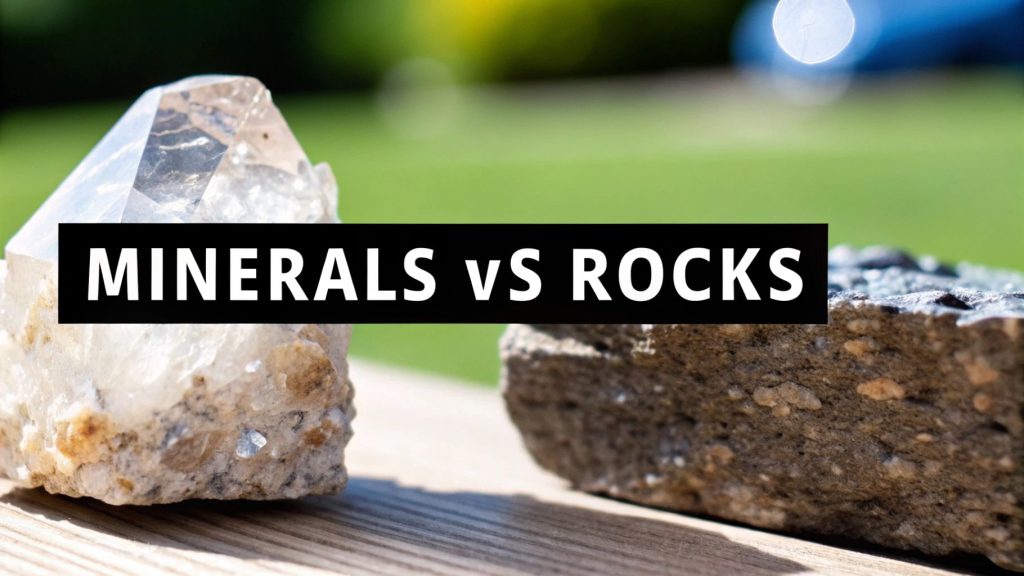
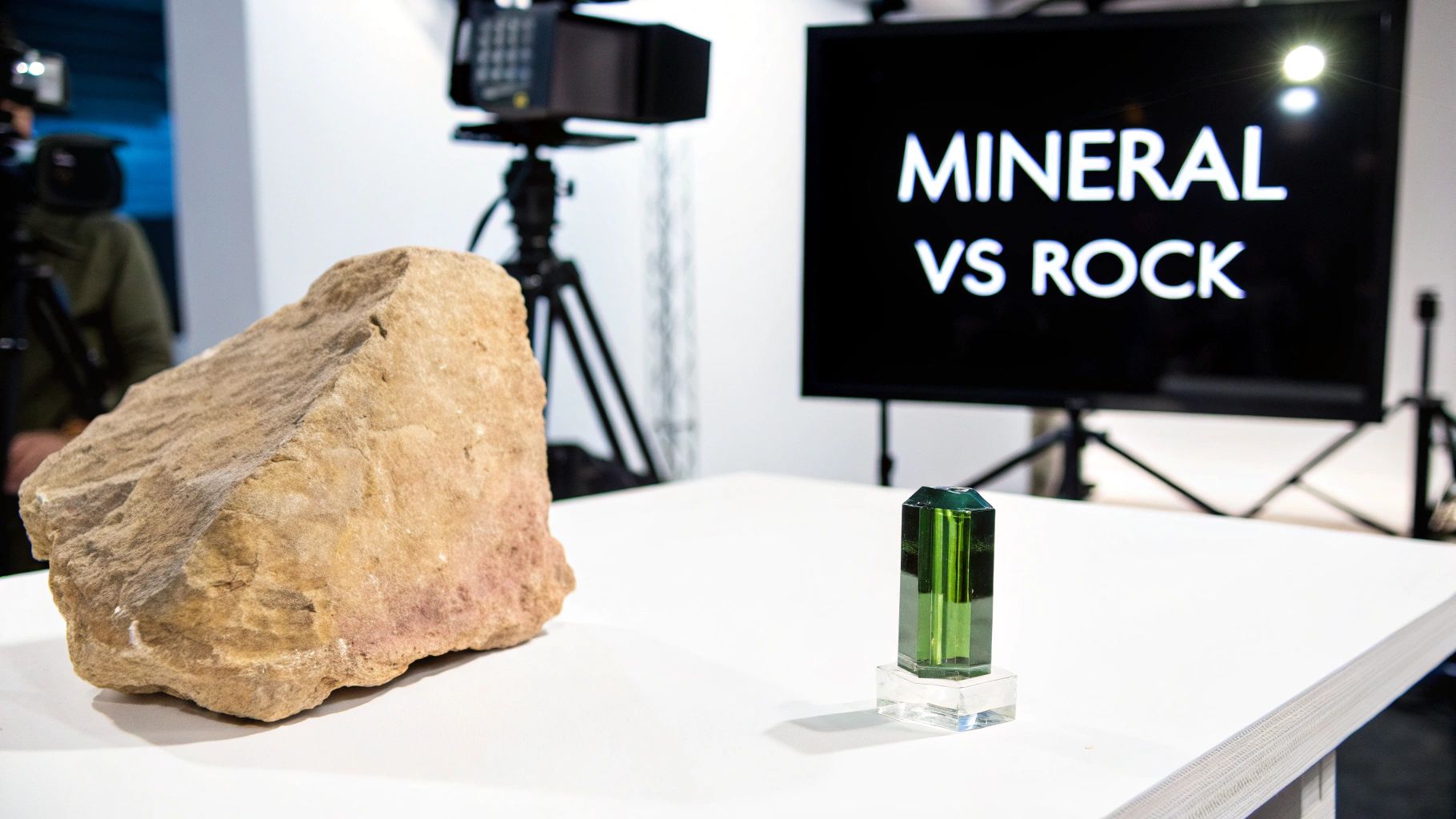
It's one of the first questions every new collector asks: what’s the real difference between minerals and rocks? The simplest way to think about it is purity versus mixture. A mineral is a single, naturally occurring, inorganic substance with a distinct chemical recipe and a perfectly ordered internal structure. A rock, on the other hand, is an aggregate—a mashup of one or more minerals, sometimes with other organic bits mixed in, all physically cemented together.
Unlocking The Core Distinction
At first glance, the sheer variety of specimens pulled from the Earth’s crust can be overwhelming. But for a collector or an interior designer, grasping this fundamental difference is the key to appreciating the unique story and aesthetic role of every piece. It’s the difference between a pure, essential ingredient and a complex, finished dish.
Picture a flawless Quartz crystal from our gallery at Astro West. You're holding a mineral. Its sharp, geometric faces and glassy luster are the outward expression of an internal, repeating atomic pattern. It's a pure, inorganic solid with a specific chemical formula—in this case, SiO₂—that formed molecule by molecule over millions of years.
Now, imagine picking up a heavy, speckled slab of Granite. You're holding a rock. It’s a composite, a geological mosaic forged from different minerals that were fused together under intense heat and pressure. You can see the individual components: grains of milky Quartz (typically 20-60%), crystals of pink or white Feldspar (often 10-65%), and flecks of black Mica. This is what defines a rock—it’s a team, not a soloist.
Minerals: The Building Blocks of Natural Art
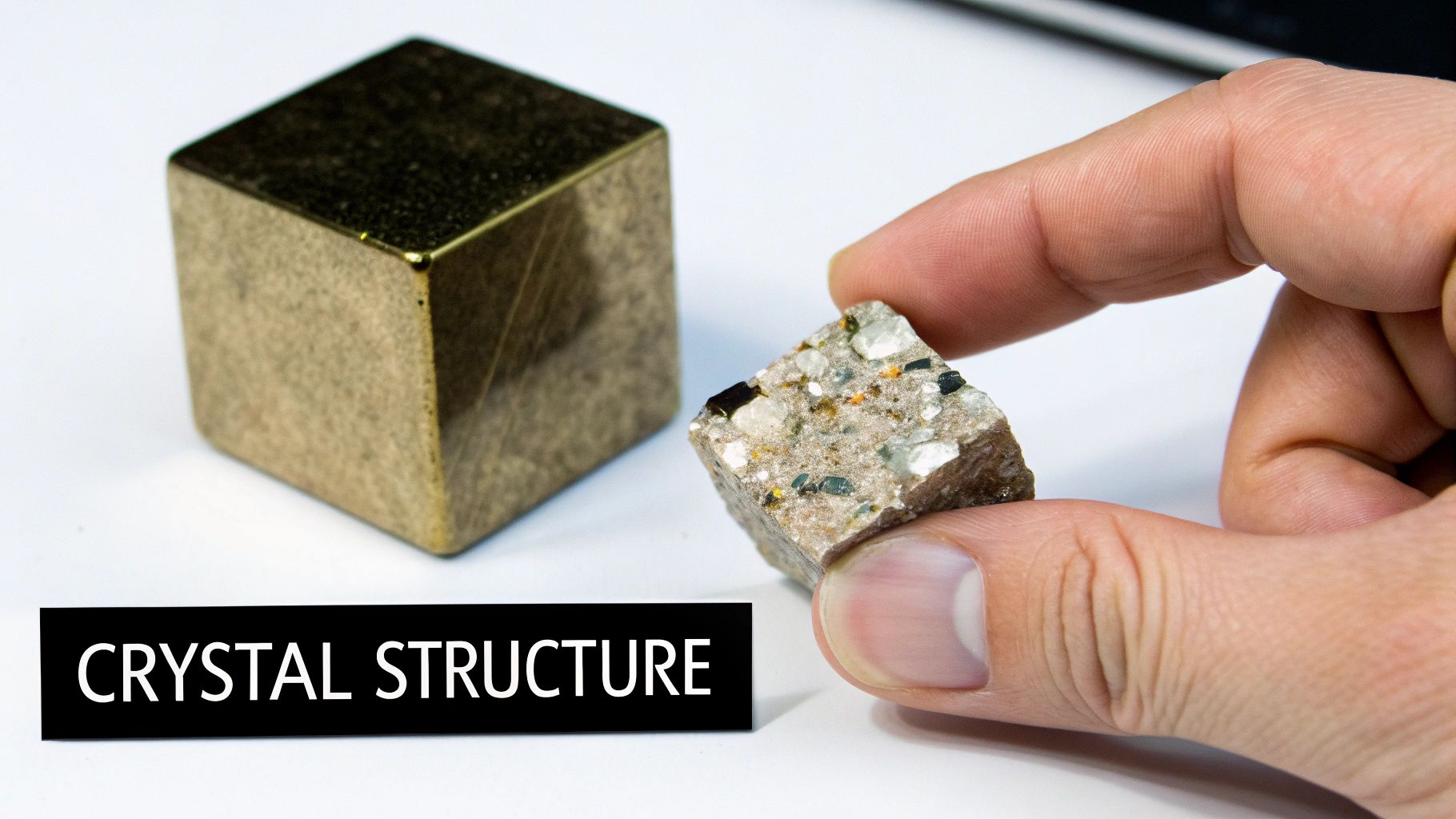
A mineral’s identity is locked down by its chemistry and crystal structure. Think of a perfect, brassy Pyrite cube or a vibrant, striated Tourmaline crystal. Every part of that specimen has the same repeating atomic arrangement, which gives it predictable physical properties like hardness, luster, and cleavage.
This underlying purity is why understanding the true nature of gemstones like diamonds is so crucial for collectors. The consistency and singularity of a mineral are what make a well-formed specimen so desirable, turning it into a piece of natural sculpture.
Rocks: The Geological Composite
Rocks, on the other hand, tell a story of process and place. Their identity comes from what they're made of and how they were formed. Take a piece of sandstone, for example. It's a sedimentary rock created from countless tiny sand grains—often the mineral Quartz—that were compressed and cemented together over millennia.
Its character comes from this very amalgamation, creating textures, layers, and patterns you’d never find in a single mineral. You can see this beautifully in pieces like a striking Vanadinite on Sandstone Matrix, where each layer tells a story of an ancient riverbed or windswept dune.
To make this even clearer, here's a simple breakdown of the key differences you'll want to remember.
Comparison At a Glance: Minerals vs. Rocks
Characteristic
Minerals
Rocks
Composition
A single, pure substance with a definite chemical formula.
An aggregate of one or more minerals or mineraloids.
No specific atomic structure; composition can vary.
Identification
Based on physical properties: hardness, luster, cleavage, color.
Based on mineral content and texture (grain size/arrangement).
Homogeneity
Chemically and structurally uniform throughout.
Heterogeneous; composed of different parts.
Astro West Example
A single, perfectly formed Vanadinite crystal.
A slab of Pegmatite containing Tourmaline, Quartz, and Feldspar.
Ultimately, whether you're drawn to the pristine geometry of a single mineral or the rich, complex narrative of a rock, understanding what makes them different is the first step in building a truly exceptional collection.
Exploring the Science of Their Composition
To really get the difference between minerals and rocks, you have to look past their surface beauty and into their atomic architecture. What makes a mineral a mineral is a level of internal order that’s incredibly precise—a characteristic that sets it apart from the beautiful but jumbled world of rocks.
The Crystalline Perfection of Minerals
At the heart of every single mineral is a crystal lattice. Think of it as a highly organized, three-dimensional pattern of atoms repeating in perfect symmetry. This internal blueprint is non-negotiable; it's what defines the mineral. It’s like a flawlessly executed architectural plan where every atom knows exactly where it belongs.
This ordered structure isn’t just a microscopic detail, either. It dictates the mineral’s entire physical presence. The sharp, flat faces of a crystal, its predictable angles, and the way it breaks along clean, flat planes (cleavage) are all outward expressions of this internal perfection.
A spectacular specimen of Spanish Pyrite from our collection is a perfect example. Its sharp, metallic cubes didn't form by chance; they are the direct result of iron and sulfur atoms methodically aligning themselves in a cubic crystal lattice over millennia. The same principle gives us the beautiful rhombohedral cleavage of Calcite or the octahedral form of Fluorite—their visible geometry is a window straight into their atomic soul.
Key Takeaway: A mineral’s identity is locked in by two unchanging characteristics: a specific chemical formula and an ordered internal crystal structure. This consistency makes a mineral a pure, homogenous substance.
The Mineral Recipe of Rocks
Rocks, on the other hand, aren’t defined by a strict chemical formula but by their mineral recipe. They are aggregates—a physical mashup of different mineral grains, and sometimes other materials like volcanic glass or organic matter, all cemented together into a solid mass.
A rock simply doesn't have a repeating atomic structure because it's a composite of different minerals, each with its own unique lattice. Imagine a chef creating a dish; the final product is defined by the ingredients and how much of each you use, not by a single, uniform molecular structure.
This is where the artistry of geology really comes alive. Take Granite, a classic igneous rock. Its identity is based on its typical mineral trio:
Quartz: Usually shows up as glassy, grayish grains.
Feldspar: Often provides the pink, white, or gray tones.
Mica (like Biotite): Adds the dark, flaky specks.
The specific percentage of these minerals can vary wildly, creating an endless variety of patterns and colors. One piece of granite might have a higher concentration of pink Feldspar, giving it a warm hue, while another might be dominated by dark Biotite for a dramatic, speckled look. It’s this variation in the mineral recipe that makes every slab of granite used in luxury décor a one-of-a-kind piece of natural art.
This concept holds true for all rock types. A piece of Limestone is mostly made of the mineral Calcite. Lapis Lazuli, a prized metamorphic rock, gets its stunning blue color from a mixture of Lazurite, Calcite, and Pyrite. You can explore the beauty of individual mineral components, like those in this stunning Brazilian Quartz Cluster, to better appreciate how they come together to form the larger tapestry of a rock. Ultimately, the difference is clear: one is the pure pigment, and the other is the finished painting.
How Time and Pressure Forge Minerals and Rocks
Every specimen in our gallery tells a story of intense creation, a narrative written over millennia by Earth’s most fundamental forces. The difference between a mineral and a rock isn't just about what they're made of; it's about their entirely distinct origin stories. When you understand how they're forged, you see why a single, perfect crystal is an icon of purity, while a complex rock slab is a testament to geological recycling.
Minerals are born from processes that allow atoms to organize themselves into perfect, repeating structures. They don't just get mashed together; they grow, molecule by molecule, when conditions are just right. Their creation is a story of purity and order.
Rocks, on the other hand, are the products of a grand, chaotic, and unending cycle of transformation. They are assembled, broken down, and reassembled from pre-existing materials. Their formation is a story of aggregation and metamorphosis.
The Birth of Mineral Perfection
Minerals come into being in a few key ways, each a unique geological event that encourages the growth of crystalline structures. These processes don’t just mix ingredients—they allow a single, pure substance to crystallize into its natural, breathtaking form.
There are three primary pathways for mineral formation:
Crystallization from Magma: As molten rock from deep within the Earth cools, atoms slow down and begin to bond. Given enough time and space, they arrange themselves into orderly crystal lattices, forming minerals like Quartz, Feldspar, and Mica.
Precipitation from Solution (Hydrothermal): When superheated, mineral-rich water flows through cracks in the Earth’s crust and begins to cool, the dissolved elements can no longer stay in solution. They precipitate out, forming beautiful crystals on the surrounding rock walls.
Metamorphism and Recrystallization: Under immense heat and pressure, the atoms within an existing mineral can rearrange themselves. This process doesn't melt the material but transforms its crystal structure, creating entirely new minerals without ever becoming a liquid.
A stunning Apophyllite cluster from India is a perfect example of that second process. These clear, pyramidal crystals grew slowly as hot, silica-rich fluids filled volcanic rock cavities, creating a natural sculpture that captures a single moment of geological creation.
The Endless Journey of the Rock Cycle
While minerals have distinct birth events, rocks are participants in a continuous loop of creation and destruction known as the rock cycle. This is what explains how the three main types of rocks—igneous, sedimentary, and metamorphic—are formed and perpetually transformed into one another. It's recycling on a planetary scale.
Imagine a simple sedimentary rock like Limestone, composed almost entirely of the mineral Calcite, often from the shells of ancient marine life. Over millions of years, this rock might be buried deeper and deeper, subjected to crushing pressure and intense heat from nearby magma.
This transformative journey doesn’t create a new mineral from scratch. Instead, it rearranges the existing Calcite crystals within the Limestone, causing them to recrystallize into a denser, more interlocking structure. The rock has been fundamentally altered.
This very process of metamorphism is what turns humble Limestone into luxurious Marble. The original sedimentary layers are erased, replaced by the elegant veining and crystalline texture prized by designers and collectors. A piece of Marble in a sophisticated interior isn't just a stone; it’s the final chapter in a geological story that began on an ancient ocean floor.
This cycle continues endlessly. That same piece of Marble could be exposed to the surface, weathered into tiny grains, and washed into the sea to become a new sedimentary rock. Or, it could be pushed so deep it melts back into magma, eventually cooling to form an igneous rock. This constant reinvention is the essence of what makes a rock a rock. It also explains how organic matter becomes mineralized, a journey beautifully captured in pieces like this petrified wood slab from Arizona, where minerals have replaced ancient wood fiber by fiber.
A Collector's Guide to Identification
Learning to tell minerals and rocks apart, whether you're out in the field or browsing a gallery, really comes down to a shift in perspective. When you're looking at a mineral, you're searching for purity and signs of an ordered internal structure. With a rock, you're reading a story—a history of different materials coming together through intense geological processes. This guide will give you the foundational know-how to identify specimens with the sharp eye of a seasoned collector.
Identifying Minerals: The Four Core Properties
Pinpointing a mineral is like forensic science. You're testing for specific, predictable physical traits that come directly from its fixed chemical recipe and crystal lattice. For any collector, mastering these four key properties is essential.
Hardness: This is simply a mineral’s resistance to being scratched. The standard is the Mohs scale, which runs from 1 (Talc, the softest) to 10 (Diamond, the hardest). A piece of Quartz (hardness 7) will always scratch Calcite (hardness 3). It’s a reliable test.
Luster: This describes how light bounces off a mineral's surface. Does it shine like polished metal? That’s a metallic luster, as seen in Pyrite. Is it glassy and clear? That’s a vitreous luster, beautifully showcased in a high-quality Tourmaline crystal.
Cleavage vs. Fracture: When a mineral breaks, it follows the path of least resistance along its atomic planes. Cleavage is a clean break along smooth, flat surfaces, perfectly reflecting its internal structure. Fracture, on the other hand, is an irregular or curved break that happens when its atomic bonds are equally strong in all directions, like the shell-shaped conchoidal fracture of Quartz.
Crystal Habit: This is the signature external shape a mineral forms when it grows without any constraints. Pyrite is famous for its perfect cubes, while Tourmaline often grows in long, striated prisms. This shape is a direct outward expression of its inner atomic arrangement.
Key Takeaway: Mineral identification is detective work. By testing for consistent properties like hardness and observing features like luster and cleavage, you are uncovering direct clues about the specimen's fundamental atomic structure and chemical identity.
Identifying Rocks: Texture and Composition
Identifying rocks is less about running tests and more about a visual analysis of its components and overall structure. Since rocks are aggregates, you’re looking at the relationship between the minerals inside them, not the properties of a single substance.
The key is to observe two main features: texture (the size, shape, and arrangement of the grains) and the visible mineral composition. Can you see large, interlocking crystals with the naked eye? That’s typical of an intrusive igneous rock like Granite. Or is it made of fine, compressed layers, which points to a sedimentary rock like Shale?
Structural features are also huge clues. A metamorphic rock like Gneiss, for instance, is instantly recognizable by its distinct banding—alternating stripes of light and dark minerals that separated under immense pressure. The story of a rock's formation is written all over it. A fantastic example of this geological storytelling can be seen in the complex patterns of a polished Septarian Nodule, which beautifully combines sedimentary rock with later mineral-filled cracks.
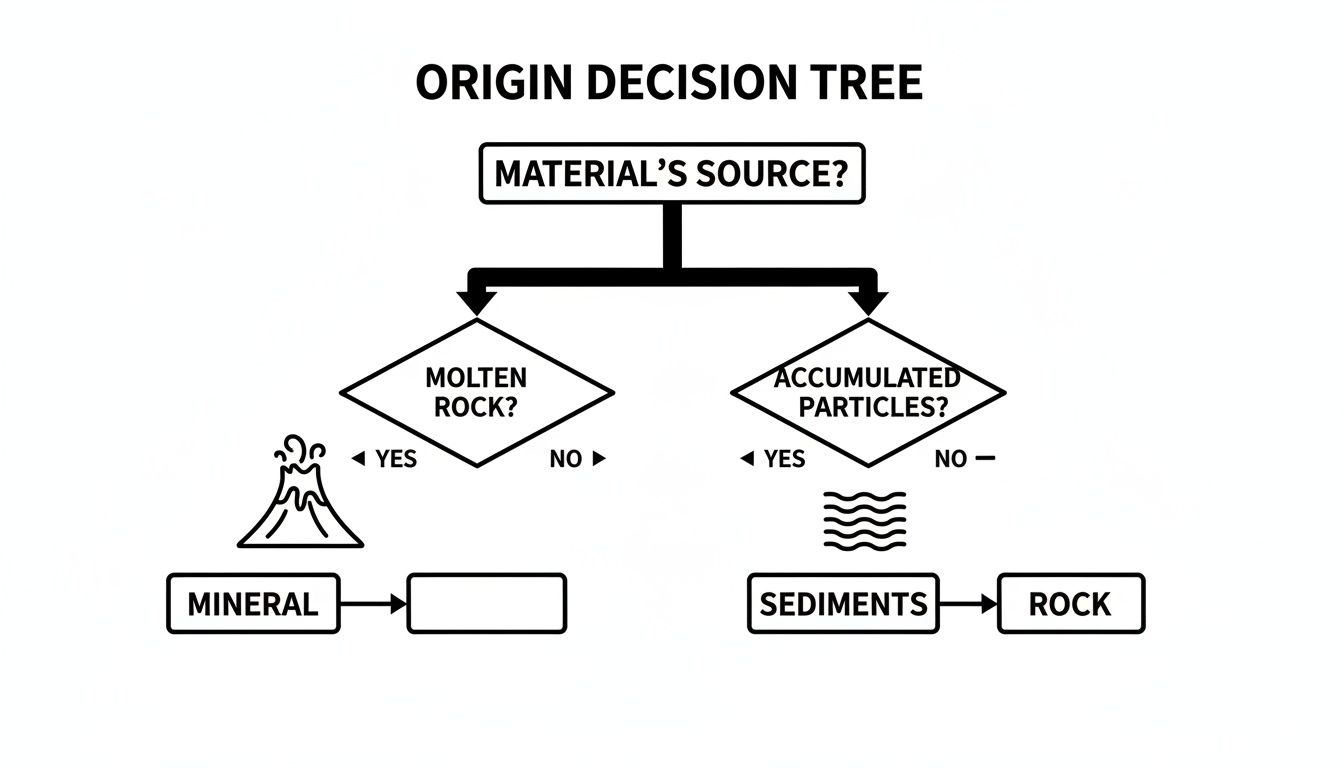
This decision tree helps simplify the basic distinction between how many minerals and rocks get their start.
As the visual shows, minerals often crystallize from a single, pure source like magma, while rocks are usually formed from the accumulation of other materials.
While there are over 4,000 known minerals—with up to 100 new ones discovered each year—only a few hundred are actually common. These common minerals are the building blocks for the vast majority of rocks you’ll ever see.
Using Minerals and Rocks in Luxury Design
The fundamental difference between minerals and rocks isn't just a geological curiosity—it directly shapes how they bring sophistication and meaning to an interior. In the world of luxury design, think of minerals as the soloists, celebrated for their pure, sculptural forms. Rocks, on the other hand, are the full orchestra, valued for their complex textures and sweeping patterns.
Grasping this distinction is the key to choosing natural art that truly elevates a space.
Minerals as Sculptural Statements
Minerals are pure, single substances with an ordered internal structure, which is why they often form such stunning, geometric crystals. Designers leverage this natural perfection by showcasing them as standalone objets d'art. A mineral specimen is treated just like a fine sculpture, becoming a powerful focal point that commands attention and invites a closer look.
Imagine a large, museum-grade Vanadinite specimen from Morocco. Its vibrant red, hexagonal crystals create a breathtaking display of natural geometry. When placed on a custom stand in a minimalist living room or a private study, it does more than just decorate; it injects a dose of pure, raw, and ancient beauty.
Likewise, a lustrous, deep purple Fluorite cluster or a delicate spray of Apophyllite crystals can anchor a collection on a bookshelf or console. Their role is to be singular and spectacular. They are prized for their unique crystal habit and vibrant color—qualities that stem directly from their pure, homogenous composition.
Rocks as Functional Art
Rocks, as aggregates of multiple minerals, tell a completely different design story. Their value is found in their durability, rich textures, and the intricate patterns born from their composite nature. Instead of being isolated for purity, rocks are used in larger, more integrated applications where their complex visual narrative can unfold across a surface.
A polished slab of Petrified Wood, for example, makes an unparalleled dining table or countertop. This is a rock where minerals have replaced organic matter, preserving ancient wood grain in stone. Every single piece is a unique mosaic of earthy tones and historic patterns, turning a functional object into a piece of natural history.
This same principle applies to countless other decorative stones:
Marble: This metamorphic rock, born from limestone, is celebrated for the elegant veins that trace its geologic transformation—impurities that tell its story.
Lapis Lazuli: A vibrant blue metamorphic rock whose beauty comes from a combination of Lazurite, Calcite, and shimmering Pyrite flecks.
Granite: This igneous rock’s speckled pattern is the direct result of interlocking crystals of Quartz, Feldspar, and Mica.
In design, a rock’s strength is its heterogeneity. The interplay between its mineral components creates depth, color variation, and texture that make it ideal for architectural and large-scale decorative use.
Beyond their intrinsic value, minerals and rocks are often incorporated into broader aesthetic designs. For creative outdoor applications, consider exploring these 10 Inspiring Garden Rock Ideas.
Whether you choose the focused brilliance of a single mineral crystal or the sweeping grandeur of a unique rock slab, you are bringing a piece of the Earth’s story into your home. At Astro West, we curate both—offering premier examples of natural art for the most discerning collectors and designers, ensuring every piece serves as a timeless statement of organic elegance.
How to Build a Meaningful Collection
Starting a collection of natural art, whether you're drawn to the pure geometry of minerals or the layered story of rocks, is a deeply personal journey. Building a collection that truly means something goes way beyond just buying cool-looking specimens. It's about curating with intent, passion, and a sharp eye. The real goal is to bring together not just objects, but tangible stories from the Earth that connect with you.
This is where understanding the difference between minerals and rocks will shape your entire collecting strategy. Ask yourself: am I captivated by the clean, crystalline perfection of a single substance? Or does the rich, jumbled history of a unique rock formation speak to me more? Your answer will give you focus.
Curating with Quality and Authenticity
The first rule of any great collection is an absolute commitment to quality. This means hunting for specimens that aren't just good examples of their kind, but exceptional ones. For minerals, that translates to a few key attributes you should always have on your checklist:
Exceptional Crystal Form: Look for well-defined, sharp, and undamaged crystals. The closer to pristine its natural crystal habit is, the more valuable and impressive the specimen.
Vibrant Color and Luster: Seek out minerals with deep, saturated color and a brilliant luster. Think of the dazzling metallic sheen of Pyrite or the glassy glow of a fine Tourmaline.
Aesthetic Composition: A truly great specimen is a sculpture carved by nature. You're looking for a balanced, visually compelling arrangement of crystals on their matrix.
When it comes to rocks, quality is judged a bit differently. You're searching for unique patterns, interesting textures, and a composition that tells a fascinating geological story. A slab of Gneiss with dramatic, contrasting bands or a Septarian Nodule with a striking, crystal-filled interior are perfect examples of what to look for.
A Collector’s Insight: The most rewarding collections are built on a bedrock of authenticity and provenance. Knowing exactly where a specimen came from and that its story is genuine transforms a beautiful object into a priceless piece of natural history. At Astro West, every piece we offer is thoroughly vetted for authenticity, ensuring your investment is both real and meaningful.
Balancing Your Collection
A truly standout collection often has a thoughtful balance. This doesn't mean you need one of everything, but you should think about how different pieces play off one another. You might decide to focus on a specific mineral family, like collecting Tourmalines from different localities around the world to showcase the incredible diversity within a single species.
Another approach is to build a collection that contrasts the purity of minerals with the complexity of rocks. Imagine pairing a flawless, gem-quality Aquamarine crystal with a piece of its host rock, a Pegmatite. Displaying them together tells the complete story of its formation, creating a much richer narrative and a deeper appreciation for the geological forces that connect them.
Ultimately, whether you're starting with your very first crystal or adding a museum-grade fossil to a seasoned collection, the key is to acquire pieces that you genuinely connect with. Look at each acquisition not just as a purchase, but as an investment in natural artistry. By focusing on quality, authenticity, and that personal spark, you’ll build a collection that brings you joy and holds its value for generations to come. Explore the curated collections at Astro West to find the next exceptional piece for your story.
Common Questions from Collectors
As you dive into the world of natural art, it's normal to have questions that pop up along the way. We get them all the time from collectors and designers who are curious about the finer points. Here are a few of the most common ones we hear, along with some straightforward answers from our experts.
Can a Rock Be Made of Just One Mineral?
Yes, absolutely. When a rock is made up of just one type of mineral, we call it a monomineralic rock. While many rocks, like granite, are famously a jumble of different minerals, these single-mineral stones are actually quite common and beautiful.
A classic example is limestone, which is a sedimentary rock composed almost entirely of the mineral calcite. Another is quartzite, a tough metamorphic rock that starts its life as quartz-rich sandstone. In the design world, the most famous monomineralic rock is easily marble—it’s just metamorphosed limestone, celebrated for its pure composition and timeless beauty.
Is a Fossil a Rock or a Mineral?
This is a great question, and the answer is that a fossil is really in a league of its own. It starts out as something organic, like a bone, shell, or even wood. Over millions of years, it undergoes a transformation called permineralization, where mineral-rich water seeps in and replaces the original organic material, bit by bit.
So, a fossil is made of minerals (like calcite or quartz) and is almost always found inside rock, but it isn't strictly a mineral or a rock because of its organic blueprint. At Astro West, we classify fossils separately, honoring them as incredible mineralized records of ancient life.
Which Is More Valuable—a Mineral or a Rock?
Value isn't about whether something is a rock or a mineral. It comes down to rarity, quality, size, and what collectors are looking for. An incredible specimen of either can be extremely valuable.
For instance, a flawless, gem-quality tourmaline crystal (a mineral) can be worth a small fortune. At the same time, a rock can be just as prized—think of a rare Pallasite meteorite shot through with olivine crystals, a slab of luxury Portoro marble with its dramatic veining, or a rock containing a perfectly preserved dinosaur tooth. Common minerals and rocks have little commercial value, but the extraordinary examples of either are truly priceless treasures.
At Astro West, our passion is connecting collectors and designers with authentic, high-quality specimens that tell a powerful story. Explore our curated collections to find a genuine piece of natural history that speaks to you. Discover our gallery at https://astrowest.com.