Difference Between Minerals and Crystals Explained for Collectors
It’s one of the most common questions we hear, and the answer is simple but profound: every mineral is a crystal, but not every crystal is a mineral. Whether you're drawn to a mesmerizing tourmaline slice or a dramatic Celestite crystal cluster, understanding this difference elevates your appreciation.
At first glance, the terms seem interchangeable. Collectors, designers, and enthusiasts often use them to describe the beautiful, geometric forms we find in nature. But for anyone who truly values authenticity, natural history, and the unique story embedded in every specimen, the distinction is everything.
Defining Minerals and Crystals
Understanding the difference is the first step toward appreciating the true value of a natural piece of art. The core of the distinction boils down to origin and composition.
To earn the name mineral, a specimen has to meet four strict geological criteria: it must be a naturally occurring, inorganic solid with a definite chemical composition and an ordered internal structure. In short, it’s a crystal that Mother Nature made.
A crystal, on the other hand, is defined purely by its structure—it's any solid material with an orderly, repeating internal lattice of atoms. This means crystals can be formed in a lab or even organically. The sugar in your kitchen? That’s a crystal.
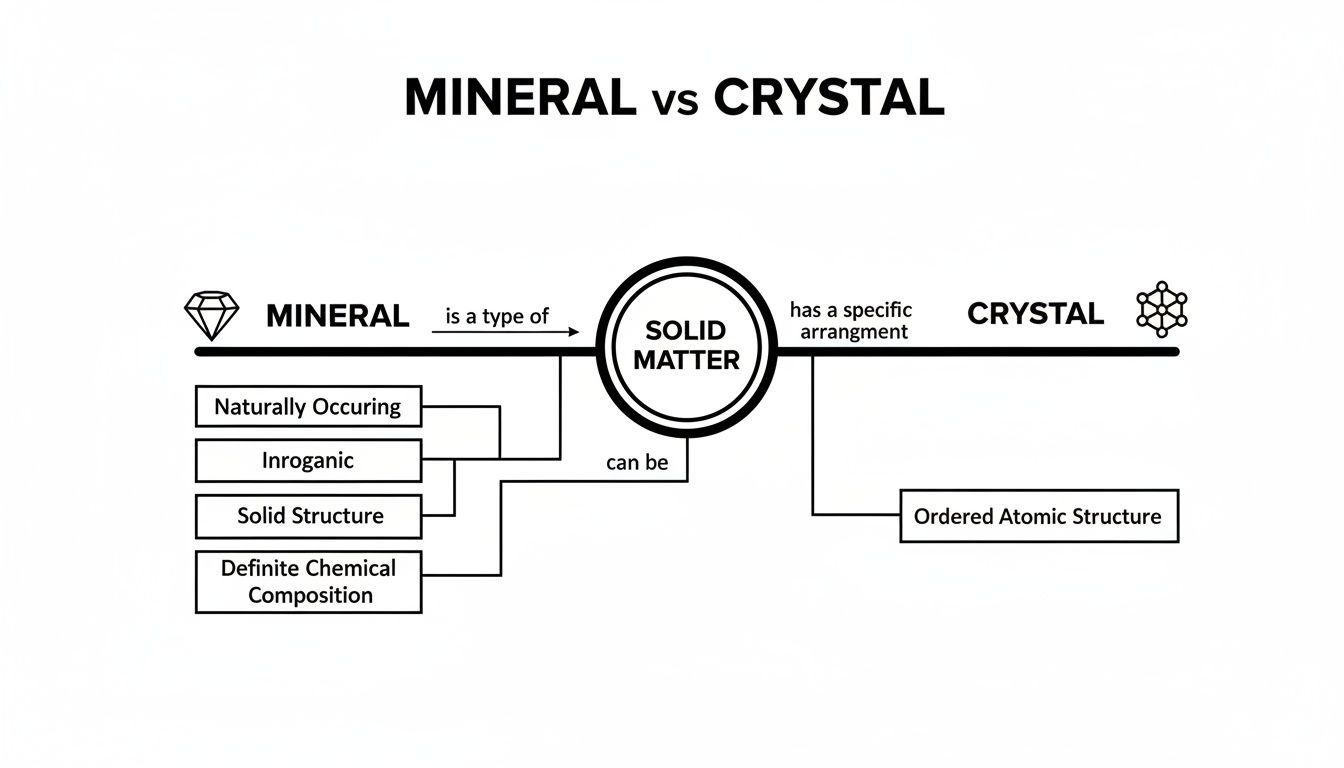
This diagram helps visualize the key criteria that separate a true mineral from other crystalline forms.
As you can see, a mineral has to pass four specific tests, while a crystal is defined by just one structural property. For collectors, these rules are what separate a genuine geological treasure from a man-made lookalike.
Key Differences at a Glance: Mineral vs. Crystal
To put it into practice, think of a stunning, naturally formed specimen like an Arkansas Quartz cluster. It’s a mineral because it meets all four requirements. A lab-grown bismuth "crystal," while beautiful with its iridescent, stair-stepped structure, is not a mineral because it's man-made.
Here’s a quick table to break down the core differences that matter most.
Attribute
Mineral
Crystal
Origin
Must be naturally occurring
Can be natural, synthetic, or organic
Composition
Defined, consistent chemical formula
Variable; defined by structure only
Formation
Inorganic geological processes
Can be inorganic or organic
Structure
Always has an ordered internal structure
Has an ordered internal structure
This distinction is what gives natural minerals their soul. Each one is a snapshot of Earth's history, a unique artifact shaped by immense pressure, heat, and time—a story that can never be replicated in a lab. Collectors might compare a museum-grade Smithsonite specimen to a lab-grown quartz, appreciating the former's unique provenance.
Understanding How Minerals and Crystals Form
The fundamental difference between minerals and crystals is etched into their origins. Every authentic mineral is a product of Earth’s immense and chaotic laboratory, forged by geological forces over millions of years. This natural history—its unique geological story—is what separates a treasured collectible from a simple crystalline object.
Minerals are born from specific, often extreme, environmental conditions deep within the planet. These formation processes are slow, complex, and entirely natural, resulting in specimens that are truly one-of-a-kind.
The Geological Forge
Mineral formation is driven by a combination of intense heat, immense pressure, and the presence of specific chemical elements. There are several key environments where these incredible transformations occur:
Igneous Formation: This happens as molten rock (magma or lava) cools. As it solidifies, atoms arrange themselves into orderly patterns, forming minerals like Tourmaline within formations known as pegmatites.
Hydrothermal Formation: Superheated, mineral-rich water circulating through cracks in the Earth's crust deposits dissolved elements that crystallize as the water cools. This process is responsible for creating stunning Pyrite cubes in hydrothermal veins.
Metamorphic Formation: When existing rocks are subjected to new extremes of heat and pressure, their mineral content recrystallizes and transforms into new minerals without melting. The vivid banding in Malachite specimens often reflects these metamorphic processes.
These geological narratives are embedded in every specimen. For example, the exceptional clarity of some quartz specimens reveals a stable and pure growth environment, a story beautifully told by pieces like this Herkimer Diamond with Calcite. Its unique formation history is what makes it a coveted piece for collectors.
Synthetic and Organic Crystal Formation
In stark contrast, other crystals form under controlled and predictable conditions. Their creation lacks the spontaneous artistry of nature.
For a collector or designer, the distinction is paramount. A mineral's value is intrinsically tied to its provenance—the millions of years of natural history it represents. A synthetic crystal, however beautiful, is a product of human intention, not geological time.
Synthetic crystals, such as lab-grown quartz or bismuth, are created in laboratories where temperature, pressure, and chemical ingredients are meticulously managed. The process is fast, repeatable, and designed for uniformity. Similarly, organic crystals like sugar or salt form through simple evaporation or cooling in everyday environments.
While these materials possess a crystal lattice, they lack the geological soul of a mineral. They don't carry the history of a volcanic eruption, a shifting continent, or an ancient, mineral-rich sea. For those who seek objects of true rarity and significance, the difference lies not just in the material, but in the epic journey it took to become what it is today.
Analyzing Chemical Composition and Internal Structure
To really understand the difference between minerals and crystals, you have to get past what you see on the surface and look at what they're made of. A mineral’s identity is locked in by its precise chemical formula—a non-negotiable recipe that defines what it is.
For example, Quartz is alwaysSiO₂. That means every molecule is made of one silicon atom bonded to two oxygen atoms. Likewise, the vibrant blue of Azurite comes from its consistent formula, Cu₃(CO₃)₂(OH)₂. Rare species such as Vanadinite or Smithsonite illustrate how slight chemical shifts yield entirely different minerals. If you change the formula, you have a completely different mineral. It’s as simple as that.
The word ‘crystal,’ on the other hand, doesn’t really care about the chemical makeup. It's all about internal order. A crystal is defined by its crystal lattice—a highly organized, repeating, three-dimensional pattern of atoms.
The Crystal Lattice: The Blueprint of Beauty
This internal structure is the hidden architecture behind everything we admire in a specimen. It’s why minerals have such predictable and consistent physical properties, turning a set of scientific rules into something you can hold in your hand.
You can think of the crystal lattice as the mineral’s DNA. This specific atomic arrangement dictates everything about it:
Crystal Habit: This is the signature external shape a mineral grows into, like the perfect cubes of Fluorite or the hexagonal columns of Beryl.
Cleavage: This describes how a mineral breaks along flat, smooth planes where the atomic bonds are weakest. It’s the reason mica peels apart in perfect sheets.
Hardness: The strength of the atomic bonds determines how resistant a mineral is to scratching, which we measure on the Mohs scale.
This internal perfection is exactly what creates the stunning visual appeal that collectors and designers go after. Those sharp geometric faces and clean terminations you see on a high-quality specimen aren't carved by a person; they are the direct, physical expression of a perfectly ordered atomic structure.
A mineral's external form is a direct reflection of its internal perfection. The stunning geometry we admire is the macroscopic expression of its microscopic, repeating atomic lattice. This is where geology and art become one.
The beautiful rhombic shape of a perfectly terminated Calcite crystal is a classic example of this principle in action. Its shape isn't an accident—it's the inevitable result of its internal lattice. This predictable geometry is the hallmark of a true mineral, bridging the gap between its fundamental chemistry and its breathtaking appearance.
Why This Distinction Matters to Collectors and Designers
Forgetting the geology for a moment, the real difference between a natural mineral and a synthetic crystal comes down to one thing: its story. This distinction is the bedrock of value, rarity, and the soul a piece brings to a collection or a designed space. It's what separates a timeless artifact of the Earth from a beautiful but mass-produced object.
The value of a true mineral is intrinsically tied to its provenance—its unique geological history. The journey a specimen takes, from its slow formation deep within the Earth to its eventual discovery, gives it a narrative that simply cannot be manufactured. That story is what makes it irreplaceable.
From majestic Celestite crystal clusters that serve as sculptural décor to the rare elegance of a tourmaline slice framed in a modern interior, each mineral's journey informs its character and value.
For the Discerning Collector
Any serious collector will tell you the appeal lies in acquiring a tangible piece of natural history. A synthetic crystal, however perfectly formed, has no geological story to tell. It was born in a lab, often in just a few days or weeks. A natural mineral, on the other hand, is a snapshot from a specific moment in Earth’s timeline.
For a collector, a mineral's desirability is magnified by factors like:
Unique Formation History: Was it created by a rare volcanic event or in an unusual hydrothermal vein?
Locality: Does it come from a classic, long-closed mine that produces nothing new?
Inclusions and Associations: Does it host other minerals that paint a more complex picture of its environment?
These are questions you can't even ask of a synthetic piece. This is why authentic minerals will always be the superior choice for a collection built on significance and rarity. Understanding this is also key to appreciating the value of pieces in historical collections, such as those found in antique jewelry collections.
For the Visionary Designer
Interior designers and architects look for pieces that create an atmosphere and anchor a space with meaning. A large, sculptural Calcite specimen from a specific quarry in Mexico does more than fill a corner; it becomes a focal point that speaks of time and place. It introduces an element of the raw, powerful, and sublime into a home.
True luxury isn’t just about aesthetic beauty. It's about the millions of years of natural artistry that an authentic mineral represents. It’s an investment in a story that will never be told the same way twice.
Choosing a natural mineral over a synthetic look-alike is a commitment to absolute uniqueness. It guarantees that a design element is genuinely one-of-a-kind, grounding a contemporary space with an artifact of immense age and organic elegance. It’s a choice that reflects a deep appreciation for materials with soul.
A Practical Guide to Identifying Minerals
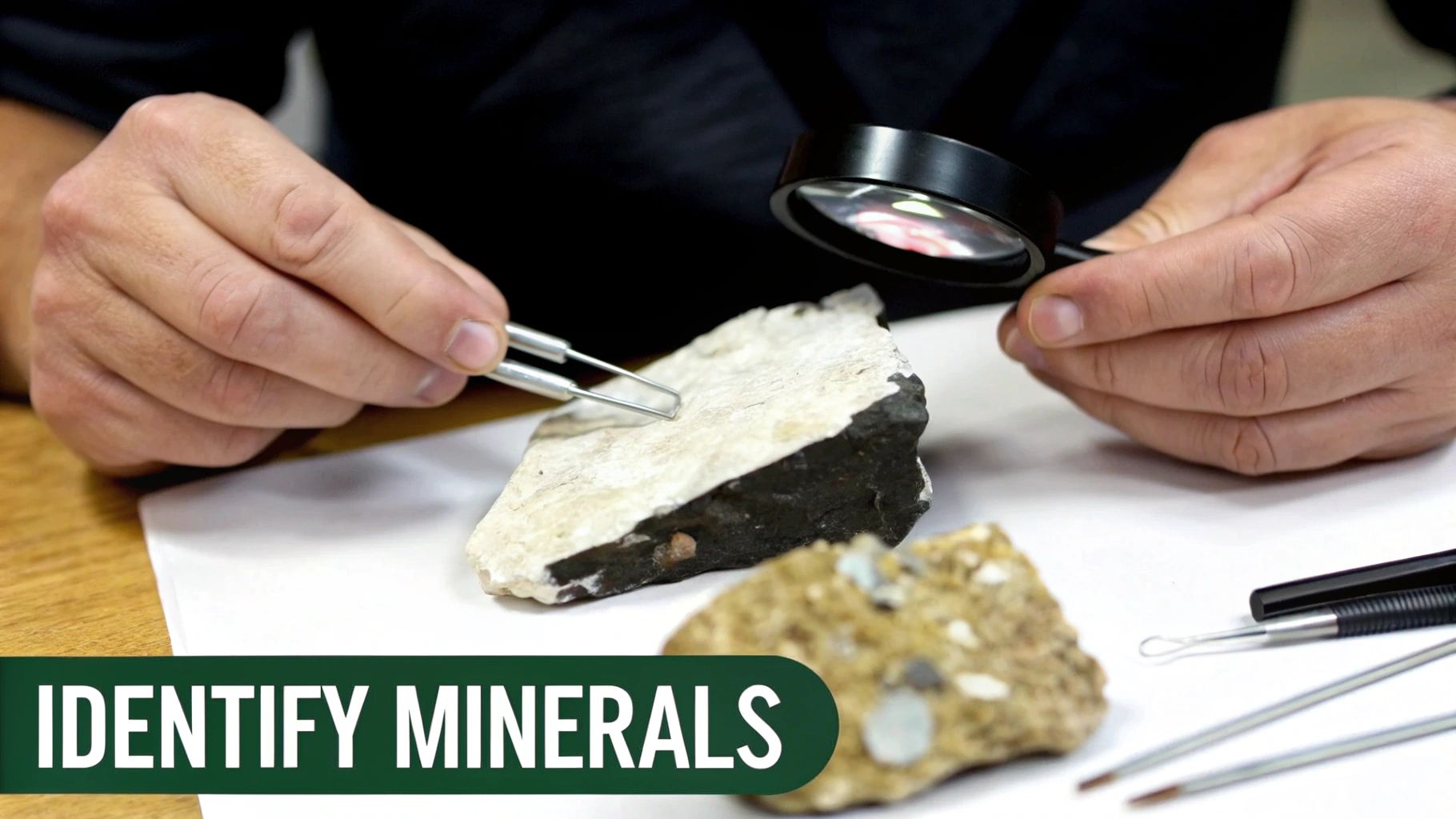
Understanding the theory behind minerals is one thing, but getting your hands on a specimen and figuring out what it is? That’s where the real fun begins. For collectors, learning to read a piece's physical characteristics is a rewarding skill that connects you directly to its deep geological journey. The best part is, you don’t need a high-tech lab—just a keen eye and a few simple tests.
Every mineral has a set of diagnostic properties that act like its own unique fingerprint. By systematically observing these traits, you can start to tell one species from another and learn the hallmarks of a quality find.
Core Properties for Identification
When you first pick up a potential mineral, start with its most fundamental characteristics. These visual and physical clues are the very same ones mineralogists rely on for quick identification in the field.
Luster: This is all about how light bounces off the mineral's surface. Does it shine like a piece of polished metal? That's a metallic luster, the signature look of minerals like Pyrite. If it has a glassy, transparent sheen, you're seeing a vitreous luster, which many Apophyllite specimens show off beautifully. Other lusters you might encounter are pearly, greasy, silky, or just plain dull.
Hardness: A mineral’s hardness is simply its resistance to being scratched. We measure this using the Mohs scale, which ranks common minerals from 1 (Talc, the softest) to 10 (Diamond, the hardest). You can do a basic scratch test with everyday items: a fingernail has a hardness of about 2.5, a copper penny is 3.5, and a steel nail is around 5.5. So, if a penny scratches your specimen, you know it's softer than 3.5. For example, Calcite (hardness of 3) can be scratched by a penny, but Fluorite (hardness of 4) can't.
Color and Streak: Color is the first thing we notice, but it can be tricky. A single mineral type can come in a rainbow of hues due to tiny impurities. That's why streak is often a more reliable clue. This refers to the color of the mineral’s powder when you scrape it against a piece of unglazed porcelain (a streak plate). Hematite might look black, silver, or red, but its streak is always a distinctive reddish-brown.
Advanced Observational Clues
Once you've covered the basics, you can look for more subtle clues hidden in the mineral's structure. These properties are a direct reflection of its internal crystal lattice.
Cleavage and Fracture:Cleavage is how a mineral breaks along flat, smooth planes where its atomic bonds are weakest. Think of how mica peels into perfect, thin sheets or how Halite breaks into little cubes. Fracture, on the other hand, describes a break that isn't flat, like the beautiful curved (conchoidal) fracture you see in a piece of Quartz.
Crystal Habit: This is the characteristic shape a mineral naturally forms when it has enough space to grow without obstruction. These habits have descriptive names, like cubic for Pyrite, hexagonal prisms for Beryl, or the distinctive bladed look of a mineral like Celestite.
To give you a handy reference for your next find, here's a checklist you can use to walk through the identification process.
Practical Identification Checklist
Property to Observe
What to Look For
Example (from Astro West)
Luster
Is it metallic, glassy, pearly, or dull?
Pyrite has a brilliant metallic luster.
Hardness Test
Can it be scratched by a fingernail (2.5) or a penny (3.5)?
Calcite (hardness 3) will be scratched by a penny.
Color
Note the main color, but be aware it can vary.
The iconic purple of Amethyst is a great starting point.
Streak
Scrape it on unglazed porcelain. What color powder is left?
Hematite always leaves a reddish-brown streak.
Cleavage
Does it break along flat planes?
Mica peels into perfect, paper-thin sheets.
Fracture
If it doesn't cleave, how does it break? Curved, jagged, uneven?
Quartz famously has a conchoidal (curved) fracture.
Crystal Habit
What is the natural, external shape of the crystals?
Fluorite often grows in perfect cubic shapes.
By working through these properties step-by-step, you can move from simple admiration to informed identification. That distinct green of a Malachite specimen combined with its bubbly, botryoidal habit is a dead giveaway. This hands-on analysis connects you directly to the mineral’s atomic makeup and geologic past, turning every piece in your collection into a puzzle waiting to be solved.
Curating Your Collection with Authentic Natural Art
Understanding the difference between minerals and crystals is what elevates you from a casual admirer to a true collector. It’s the kind of knowledge that separates a geological artifact from a simple decorative object, grounding your appreciation in the incredible story of our planet.
This distinction is the heart of the Astro West philosophy. We curate our collections not just for their beauty, but for their provenance. Each specimen is a piece of natural art, shaped by immense forces over millions of years, and this geological narrative transforms a mineral into a powerful statement piece for any interior. Whether it's the swirling greens of a Malachite specimen or the ethereal blue of a Celestite cluster, our collection celebrates both geological artistry and timeless luxury.
Transforming Spaces with Natural Art
For interior designers and serious collectors, this understanding is crucial. A large, sculptural mineral introduces a raw, authentic energy that simply can't be replicated. It tells a story of time and pressure, becoming a focal point that anchors a room in meaning and history.
Even polished specimens honor this natural origin. A perfectly shaped clear quartz sphere from Brazil—for example—isn't just a crystal ball; it's a window into a mineral's pure, stable growth environment, meticulously crafted to reveal its flawless internal structure.
When you choose an authentic mineral, you are acquiring more than an object. You are becoming the custodian of a story that is millions of years old—a timeless piece of the Earth itself.
Your journey into the world of fine natural collectibles is an investment in authenticity. Armed with this knowledge, you can now explore collections with a curator's eye, seeking out pieces that resonate with a genuine geological soul.
Your Questions, Answered
When you start exploring the world of minerals and crystals, a few common questions always pop up. Let's clear up some of the most frequent ones so you can build your collection with confidence.
Is Diamond a Mineral or a Crystal?
Simply put, a diamond is both. It ticks all the boxes to be a mineral: it's a naturally occurring, inorganic solid made of pure carbon with a specific chemical formula.
That perfect internal structure—the highly ordered arrangement of its atoms—is what also makes it a crystal. To get specific, diamond falls into the cubic (or isometric) crystal system, which gives it its signature strength and brilliance.
Are All Gemstones Minerals?
Most of the famous ones are, but not all. While classic gemstones like tourmaline, emerald, and sapphire are definitely minerals, the term "gemstone" is really defined by beauty, rarity, and durability—not its origin story.
Some beloved gemstones are actually organic. Think of amber, which is fossilized tree resin, or pearls, which form inside a mollusk. Even some rocks, like the stunning deep blue lapis lazuli, are considered gemstones even though they're made up of several different minerals pressed together.
Can a Mineral Specimen Have Multiple Types of Crystals?
Absolutely, and these are often the most exciting pieces to find. It's quite common for different minerals to grow together, creating what collectors call an "association."
You might find a specimen with sharp, metallic Pyrite cubes nestled in a bed of clear Quartz crystals, for instance. These combination pieces are highly sought after because they offer a beautiful and dynamic snapshot of the complex geological conditions that created them.
At Astro West, we believe that learning the science behind each piece only deepens the appreciation for its natural artistry. Explore our curated collections of fine minerals and sculptural stones to find an authentic piece of Earth’s history for your own space. Discover the collection at https://astrowest.com.