When collectors talk about minerals with deep, rich colors and fascinating crystal structures, Descloizite is a name that always comes up. It's a lead zinc vanadate hydroxide mineral, prized not just for its beauty but for the story it tells about its formation.
What Is Descloizite, Really?
Think of Descloizite as the result of a very specific geological recipe. It doesn't just pop up anywhere. Instead, it forms slowly over millennia in the oxidized zones of ore deposits. This is where primary ores containing lead, zinc, and vanadium get exposed to oxygen-rich groundwater, creating the perfect conditions for something new and beautiful to grow.
Its chemical formula, PbZn(VO₄)(OH), is the key to everything that makes it special. Let's break down what each part does:
Pb (Lead): This is what gives Descloizite its surprising weight and density. Pick one up, and you'll immediately notice the "heft."
Zn (Zinc): An essential building block for its unique crystal structure.
VO₄ (Vanadate): The star of the show. This combination of vanadium and oxygen is responsible for its incredible range of vibrant colors, from deep reddish-brown to bright orange and near-black.
OH (Hydroxide): This tells us that water was a crucial ingredient in its crystal formation.
From Earth's Laboratory to a Collector's Cabinet
The journey of a Descloizite specimen is a fascinating one. It begins deep underground in the upper, weathered parts of ore deposits—areas that act like nature's own chemistry lab. Here, the elements are transformed, creating secondary minerals like Descloizite.
This unique composition gives geologists important clues. A typical Descloizite specimen contains around 55.3% lead oxide (PbO) and 19.2% zinc oxide (ZnO), which can help pinpoint promising new ore deposits. If you want to dive deeper into the technical specs, the Handbook of Mineralogy has all the detailed data. This intricate process is why every single specimen is different, telling its own distinct geological story.
For a collector, Descloizite is so much more than its chemical makeup. It's a tangible piece of Earth's history, valued for its raw beauty, its relative rarity, and the incredible story of how it came to be.
Whether it shows up as a sparkling druzy crust coating a rock or as sharp, well-defined individual crystals, each piece is a testament to the complex and beautiful processes happening just beneath our feet.
Before we dig into its specific physical traits, it's helpful to have a quick reference guide. This table breaks down the key identifiers that collectors and geologists use to spot Descloizite in the field.
Descloizite Key Identifiers at a Glance
Property
Description
Chemical Formula
PbZn(VO₄)(OH)
Crystal System
Orthorhombic
Hardness
3.5 on the Mohs scale
Specific Gravity
5.9 to 6.2 (very dense)
Color
Reddish-brown, brownish-black, orange-red, dark brown
Streak
Orange-yellow to reddish-brown
Luster
Greasy to vitreous (glassy)
Cleavage
None observed
Fracture
Conchoidal to uneven
Transparency
Translucent to opaque
This summary gives you a great starting point for identification. Now, let's explore these properties in more detail and learn what they mean for you as a collector.
How to Identify a Genuine Descloizite Specimen
Telling a real descloizite apart from other minerals is all about training your eye to spot a few key physical traits. While its chemical formula is the recipe, its appearance tells its story. The first and most obvious clue is its distinctive color—a beautiful spectrum of rich, earthy tones.
Most often, you'll find descloizite in shades of deep reddish-brown, dark brown, or even nearly black. Some pieces pop with a vibrant, almost fiery orange-red. These colors aren't random; they're a direct result of the specific balance of lead, zinc, and vanadium that was present as the crystal grew. Think of it as a geological fingerprint.
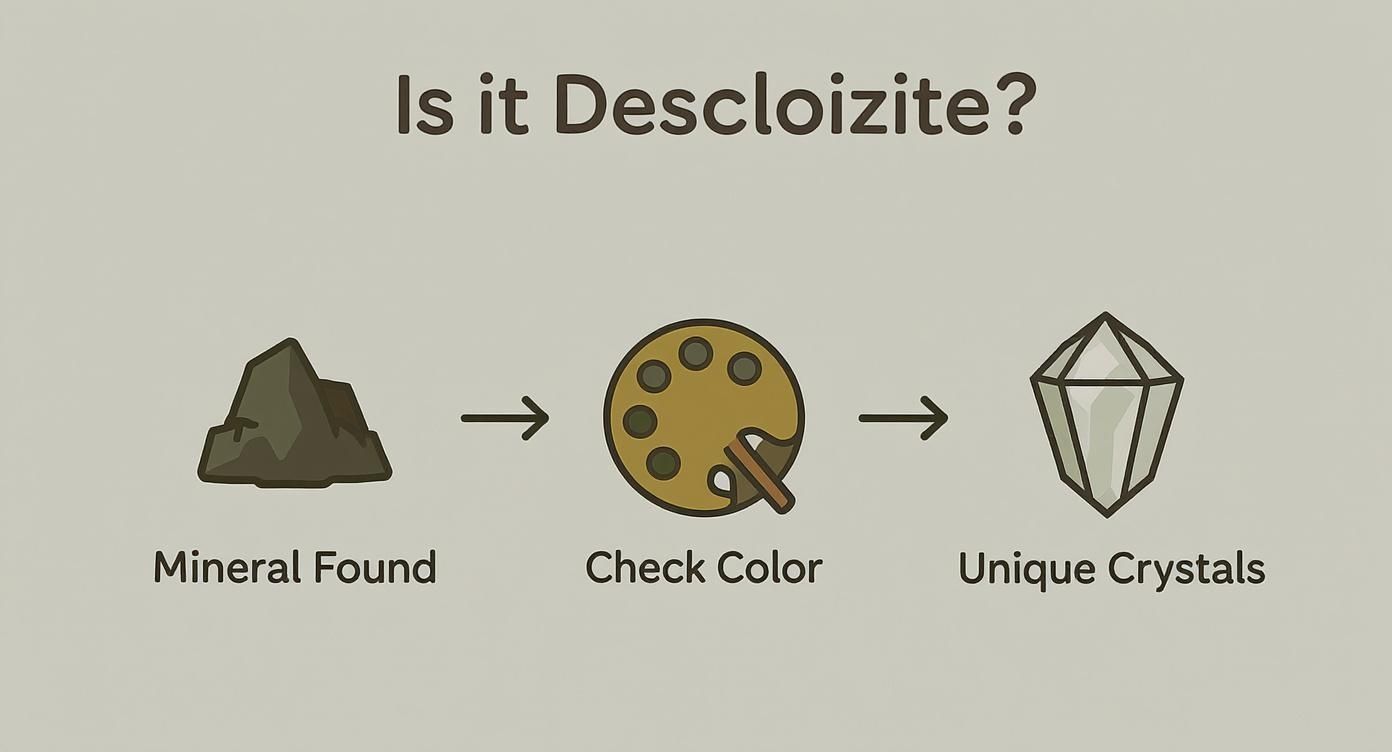
This simple decision tree is a great visual guide for identifying a potential descloizite specimen out in the field.
As the flowchart shows, color and crystal shape are your most immediate and reliable visual clues. Following this path helps collectors quickly narrow down the possibilities and get closer to a positive ID.
Observing Crystal Habits and Luster
Beyond its color, the way descloizite crystals grow—what collectors call their habit—is a dead giveaway. It rarely forms big, chunky, isolated crystals like you see with quartz. Instead, it usually appears in one of two distinct forms:
Drusy Crusts: Picture a layer of fine, sparkling sugar sprinkled across a rock. Descloizite often forms a "drusy" coating of countless tiny, brilliant crystals that create a shimmering, textured surface.
Wedge-Shaped Crystals: When you can see individual crystals, they often grow into sharp, wedge-like or tiny pyramidal shapes. This is a classic look for its orthorhombic crystal system.
Another telling feature is its luster, which is just how the surface bounces light back at you. Descloizite typically has a greasy luster. It looks almost as if it's coated in a thin layer of oil. This subtle sheen is completely different from the flashy metallic shine of pyrite or the glassy look of quartz. For a deeper dive, our comprehensive crystal identification guide offers more tips for spotting these nuances.
Simple Field Tests for Confirmation
You don't need a high-tech lab to feel confident about what you've found. A couple of simple field tests can easily confirm your hunch. The first is the classic streak test.
When you scrape a piece of descloizite across an unglazed porcelain plate, it leaves behind a colored powder. That powder will be a distinct orange-yellow to reddish-brown. This streak color is often much lighter and more vibrant than the mineral itself and is a very reliable indicator.
Another powerful clue is its surprising weight. Thanks to all that lead in its structure, descloizite has a very high specific gravity. A small piece will feel unusually heavy for its size in your hand—a dead giveaway that immediately sets it apart from many other minerals that might look similar.
Exploring Famous Descloizite Mining Locations
The story of a descloizite specimen is deeply tied to its home. Much like a fine wine reflects its terroir, a mineral carries the unique geological signature of where it was formed. Digging into these famous localities reveals why some descloizite specimens are so much more coveted than others, adding a rich layer of history to any collection.
For collectors, certain places are legendary. They're known for producing specimens with distinct personalities—be it jaw-dropping crystal size, unbelievably vibrant color, or a stunning association with other rare minerals. Understanding these differences is the key to truly appreciating the full story of a piece.
Namibia: The Gold Standard for Descloizite
When seasoned collectors talk about the best descloizite, one name always comes up: Namibia. This southern African nation is home to two of the most iconic mineral-producing mines in history, Tsumeb and Berg Aukas. Both set the standard for what a world-class descloizite should be.
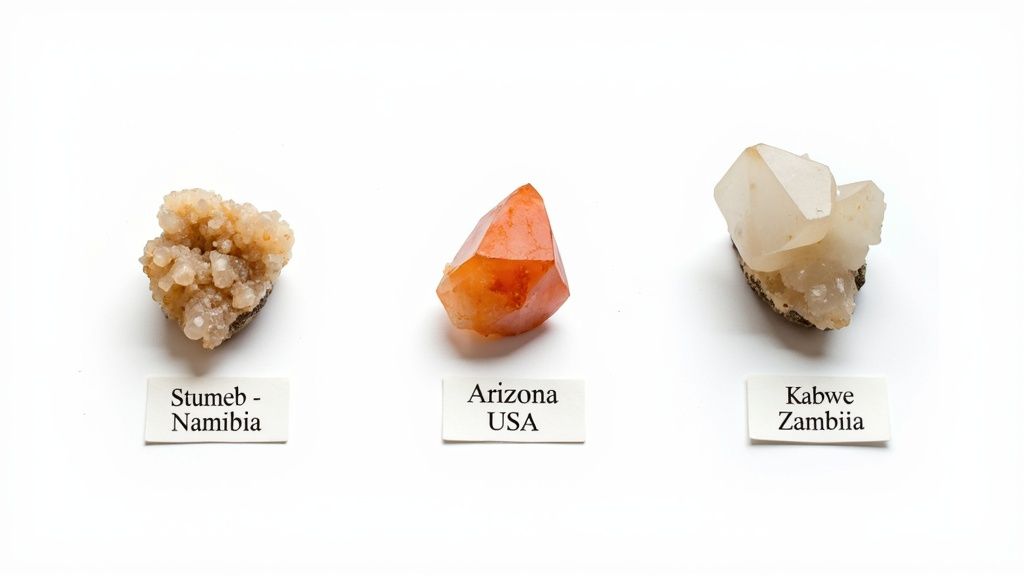
The Tsumeb Mine is often called a "mineralogical paradise," and for good reason. It's famous for an incredible diversity and quality of specimens that are simply unmatched. Descloizite from Tsumeb is celebrated for its large, sharp, and perfectly formed wedge-shaped crystals. Many pieces show off a desirable dark brown to reddish-black color with a superb, almost greasy luster. To get a sense of this iconic mine's legacy, you can explore other Tsumeb specimens like this exceptional leadhillite from the Tsumeb Mine, Namibia.
Just nearby, the Berg Aukas Mine produced equally impressive descloizite. These often appeared as sparkling drusy crusts with a distinct reddish-brown hue. Since these Namibian mines are now closed, specimens from these localities are highly prized and command a premium on the market. Their historical significance and exceptional quality make them true collector's items.
Important Localities Across the Globe
While Namibia holds a special place in the hearts of collectors, other regions have produced noteworthy descloizite, each with its own character. Knowing these locales helps you appreciate just how widespread this fascinating mineral really is.
United States (Arizona and New Mexico): American descloizite, especially from mines like the Old Yuma Mine in Arizona, often appears as bright orange-red drusy coatings. These specimens offer a vibrant splash of color that stands in beautiful contrast to their darker Namibian cousins.
Mexico: Localities in Mexico, such as Los Lamentos, are known for producing fine descloizite specimens. You'll sometimes find them associated with other vanadate minerals like vanadinite and wulfenite, creating gorgeous combination pieces.
Zambia (Kabwe Mine): The historic Kabwe Mine was a major source of base metals and, as a wonderful byproduct, excellent descloizite.
The Kabwe Mine, which ran from 1906 to 1994, was a powerhouse for lead and zinc production. Descloizite was an important secondary mineral found in its oxidized zones. Over its nearly 90-year history, the mine churned out roughly 1.8 million tonnes of zinc and 0.8 million tonnes of lead, along with valuable vanadium byproducts extracted from minerals like descloizite.
Knowing a specimen's locality is like knowing its birthplace. It provides crucial context about its formation, potential mineral associations, and its place in the broader history of mineral collecting. This provenance adds an intangible but deeply meaningful value to any piece in your collection.
Understanding the Value of a Descloizite Specimen
Figuring out what a descloizite specimen is worth involves looking at much more than just its size. For a serious collector, the real value is in a mix of specific visual and contextual details that separate a common rock from a prized cabinet piece. Getting a handle on these key attributes is crucial for building a quality collection and making smart purchases.
Think of it like grading a diamond—evaluating descloizite starts with its visual pop. The most coveted specimens show off a rich, deeply saturated color. While the shades can range from a rusty reddish-brown to nearly black, pieces with a vibrant, consistent color are always more sought-after than those that look pale or washed out.
Crystal Formation and Luster
Right after color, the quality of the crystal formation is everything. Top-tier descloizite will have sharp, well-defined crystals with distinct shapes, whether they're tiny pyramids or crisp, wedge-like blades. For a "druzy" specimen, where the surface is coated in a carpet of tiny crystals, you're looking for the brilliance and completeness of that coverage.
Luster—how a mineral's surface plays with light—is another huge factor. A specimen with a bright, almost greasy luster that really sparkles will always command a higher price than one with a dull, matte finish. This lively quality brings the piece to life and shows off the complexity of its crystal structure.
Condition and Mineral Association
The physical condition of a specimen is a deal-breaker. Any obvious damage like chips, bruises, or broken crystals will tank its value. Collectors are hunting for pristine pieces that look just as they did when they came out of the ground.
What the descloizite is sitting on—its matrix—can also dramatically boost its appeal and price. A specimen featuring vibrant descloizite crystals perched on a contrasting, undamaged matrix rock is simply more beautiful. Even better are association specimens, where descloizite is found growing alongside other minerals like wulfenite or calcite, creating a stunning little geological scene.
Here's a key takeaway for collectors: a specimen's overall aesthetic balance often trumps the size of the descloizite itself. A small, perfect crystal on a beautiful contrasting matrix can easily be worth more than a larger, damaged crystal on a clunky, unappealing rock base.
The factors that drive descloizite's price are similar to those for other vanadate minerals. For comparison, you can check out our detailed guide on vanadinite price and value factors to see these same principles at play.
To help clarify these points, here’s a breakdown of what to look for when evaluating a descloizite specimen.
Descloizite Valuation Factors
Valuation Factor
Low Value Indicator
High Value Indicator
Color
Dull, pale, or uneven coloration
Rich, deeply saturated, and uniform color
Crystal Quality
Poorly formed, rounded, or indistinct crystals
Sharp, well-defined, and distinct crystal shapes
Luster
Matte, dull, or non-reflective surface
Bright, greasy, or vitreous luster that sparkles
Condition
Visible chips, fractures, or broken crystals
Pristine condition with no noticeable damage
Matrix
Clumsy, damaged, or unappealing base rock
Clean, contrasting, and undamaged matrix
Association
Single mineral specimen
Found with other complementary minerals (e.g., Wulfenite)
Provenance
Common or unknown locality
From a classic, historic, or now-closed mine
Understanding these factors helps you develop an eye for quality, ensuring that you're not just buying a rock, but a true piece of natural art.
Finally, a specimen’s provenance, or its origin, adds another important layer of value. Pieces from classic, historically significant mines that are now closed—like the legendary Tsumeb mine in Namibia—carry a major premium. Owning a descloizite from a place like that is like owning a piece of mineralogical history, making it highly coveted on the collector market.
How Descloizite Powers Modern Industry
While collectors hunt for descloizite for its rich, earthy colors and fascinating crystal habits, this mineral leads a double life. Away from the display cabinet, it’s a surprisingly crucial, if unsung, hero in modern manufacturing. The secret to its industrial power lies in its chemical makeup—specifically, as a valuable source of the element vanadium.
Vanadium is the magic ingredient that gives steel its incredible strength and toughness. Think of it like a super-vitamin for metal. When you add just a tiny amount of vanadium to steel, you create what’s known as a high-strength, low-alloy (HSLA) steel. This new alloy is dramatically tougher, more resistant to wear, and lighter than its conventional counterpart. This is where descloizite's journey from a collector's curiosity to an industrial powerhouse begins.
From Ore to Alloy
The process starts where all minerals do: in the ground. Miners extract vanadate ores like descloizite, which are then crushed and processed to isolate the vanadium. This refined vanadium is then introduced into molten steel, forging alloys that are absolutely essential for any application that demands both extreme strength and long-term durability.
You can find these powerful steel alloys forming the backbone of our world, often hidden in plain sight:
Construction: The reinforcing bars (rebar) inside concrete buildings, bridges, and tunnels, helping them withstand immense stress and strain.
Aerospace: Critical components for aircraft and spacecraft that need to be as light as possible without sacrificing an ounce of strength.
Automotive: Heavy-duty parts like engine components, axles, and vehicle frames that have to endure constant vibration and punishment.
Tool Manufacturing: High-speed tools that keep their hard, sharp edges even when subjected to the intense heat of friction.
This industrial connection adds a whole new dimension for collectors. That beautiful specimen sitting on your shelf isn’t just a piece of natural art; it’s a direct link to the very materials that build and secure our modern world.
Historically, vanadate ores were a vital source for this element. Between the early 20th century and 1971, global vanadium production hit around 270,000 short tons. Of that massive figure, approximately 35,000 tons—more than 10% of the world's supply—came from vanadate ores mined in places like Namibia, Zambia, and the United States. You can dig deeper into the numbers with this comprehensive USGS report on vanadium sources.
Every time you drive across a modern bridge or look up at a skyscraper, you’re witnessing the industrial legacy of minerals like descloizite. Its contribution is usually invisible, but it's absolutely essential to the strength and safety of our infrastructure.
So, the next time you hold a piece of descloizite, take a moment to appreciate its dual identity. It’s not just a beautiful geological artifact—it’s a small piece of the powerful material science that keeps our world running.
Proper Care and Display of Your Descloizite
A beautiful descloizite specimen is a little piece of natural history. With the right care, it can remain a stunning part of your collection for generations to come. Its relative softness, however, means it needs a gentle touch to preserve those delicate crystal structures and that signature greasy luster.
The most important rule? Handle with care. With a hardness of only 3.5 on the Mohs scale, descloizite is easily scratched by harder minerals like quartz, or even common household objects. To prevent accidental bumps and abrasions from tougher stones, it's always best to store specimens separately or in padded containers.
Gentle Cleaning Techniques
When your descloizite needs a light cleaning, remember that less is always more. Getting too aggressive can cause irreversible damage to the crystal formations.
Avoid Ultrasonic Cleaners: The vibrations from these devices are simply too harsh. They can easily fracture the delicate crystals or even separate them from their matrix.
Use Soft Tools: A soft-bristled brush, like a makeup or artist's brush, is perfect for gently whisking away any loose dust without scratching the surface.
Simple Water Rinse: For more stubborn grime, a quick rinse under lukewarm distilled water is usually all you need. Stay away from harsh chemicals or soaps.
Air Dry Completely: After rinsing, just let the specimen air dry thoroughly in a well-ventilated spot, away from direct heat or intense light.
Protecting your descloizite also means being mindful of its environment. Prolonged exposure to direct sunlight can cause its deep, rich colors to fade over time. To keep your pieces looking vibrant, display them in a location where they are shielded from constant, harsh UV light.
Choosing the right way to showcase your collection is part of the fun. While descloizite has specific needs, anyone interested in maintaining the brilliance of their treasured pieces might also find these general jewelry cleaning tips helpful.
Answering Your Descloizite Questions
As you get more familiar with this fascinating mineral, a few common questions always seem to pop up. Let's tackle some of the things new collectors and enthusiasts often ask.
Is Descloizite Safe to Handle?
Yes, handling descloizite is generally considered safe for collectors. That said, it is a lead-bearing mineral, so a little common sense goes a long way.
The best practice is simply to wash your hands thoroughly after touching any specimen. You'll also want to avoid creating or inhaling any dust from the mineral, and it should never be ingested. Following these basic precautions allows you to enjoy and display your pieces without any worry.
How Can I Tell Descloizite from Vanadinite?
This is a classic question! While they can share those beautiful reddish-brown colors, the easiest way to tell descloizite and vanadinite apart is to look at their crystal shapes. They have completely different architectural plans.
Vanadinite: Almost always forms sharp, distinct hexagonal (six-sided) crystals. You'll often see them as little tabular prisms or barrel shapes.
Descloizite: Typically forms orthorhombic crystals, which show up as wedge-shaped blades, tiny pyramids, or those bubbly, sparkling drusy crusts.
Focusing on the crystal habit is the most reliable visual trick for a collector. The difference in their fundamental crystal structure is a dead giveaway once you know what to look for.
Think of it this way: Vanadinite loves building in sixes, creating those classic hexagonal shapes. Descloizite prefers a different blueprint, resulting in its characteristic wedges or drusy coatings.
What’s the Difference Between Descloizite and Mottramite?
Descloizite and mottramite are like mineral siblings—they're part of the same chemical series and can look identical. The key difference is just one specific element hiding inside their structure.
Descloizite is the zinc-dominant member of the family, with the formula PbZn(VO₄)(OH). Mottramite, on the other hand, is the copper-dominant member, with the formula PbCu(VO₄)(OH).
To make things even more interesting, many specimens contain a mix of both zinc and copper, landing them somewhere in between the two pure end-members. Because they can look so alike, a definitive, 100% certain identification often requires professional chemical analysis.
At Astro West, we believe every specimen tells a unique story of our planet's history. From brilliant descloizite to sparkling fluorite and ancient fossils, our curated collection offers authentic, ethically sourced treasures for every level of enthusiast. Explore our gallery and find the next centerpiece for your collection at https://astrowest.com.