When you think of Mexico's natural resources, silver and gold are probably the first things that come to mind. But beyond the precious metals, the country is a true geological treasure chest, hiding an equally impressive world of vibrant, powerful crystals. It's a premier source for high-vibration stones like the sought-after Vera Cruz Amethyst and the fiery, iridescent Fire Agate.
These natural wonders are born from the country's unique volcanic and tectonic history, a dramatic past that forged some of the most beautiful mineral specimens on the planet. This makes crystals from Mexico prized by seasoned collectors and spiritual practitioners alike.
Discovering Mexico's Crystal Heritage
This guide is your journey into that world. We'll move beyond the surface-level talk of silver veins and gold deposits to uncover the stories behind Mexico's most stunning crystals. It's an exploration that reveals why this region has become a global hotspot for unique crystalline structures.
We'll dig into the geological forces that created these treasures and introduce you to the real stars of the show—the specific gems that make Mexico so incredibly special in the mineral world.
What Makes Mexican Crystals Unique
The magic of Mexican crystals lies in their incredible variety and exceptional quality. Formed over millennia by intense volcanic activity and mineral-rich hydrothermal fluids, each specimen tells a vivid story of the earth's raw power.
This geological drama results in crystals known for their:
Exceptional Clarity and Luster: Many specimens, like Danburite and Vera Cruz Amethyst, are famous for their almost water-clear transparency and brilliant, glassy shine.
Vibrant and Unique Colors: The color palette is just extraordinary. You'll find everything from the deep, electric blues of specimens like this Milpillas Azurite to the mesmerizing rainbow flashes dancing within Fire Agate.
Deep Cultural Roots: Long before modern collecting, minerals like obsidian and turquoise were sacred to ancient Mesoamerican civilizations. They were used in everything from practical tools to powerful ceremonial objects.
This rich combination of geological perfection and historical significance is what elevates Mexican minerals. They are not just stones; they are artifacts of natural history and human culture, holding stories of both the planet and its people.
For those inspired to discover these natural treasures firsthand, planning your journey can be part of the adventure. A great place to start is by exploring various Mexico All Inclusive travel options.
Whether you're a seasoned collector, a spiritual seeker, or simply someone who appreciates profound natural beauty, the world of Mexican crystals offers a deep sense of connection to the earth. Join us as we begin to unearth these hidden gems.
To really get why crystals from Mexico are so special, you have to look deep underground. The country's dramatic geological history, full of fire and pressure, is the ultimate artist. It’s a story of immense forces shaping tiny, perfect crystalline structures over millions of years.
Mexico sits at a fascinating geological crossroads, perched right on top of three of the Earth's massive tectonic plates. The constant shifting, grinding, and colliding of these plates has fueled intense volcanic activity for eons. This powerful movement is the engine that drives crystal creation, making the land incredibly rich in mineral diversity.
Think of all that volcanic activity as nature’s furnace. As magma—molten rock—pushed its way toward the surface, it superheated the surrounding rock and groundwater. This created what geologists call hydrothermal solutions, which is basically a fancy term for mineral-rich hot water. This "creative soup" is where the magic begins.
The Role of Hydrothermal Veins
This superheated, mineral-infused water is the lifeblood of crystal formation. It forces its way into cracks, fissures, and empty pockets within the host rock. As this potent liquid starts to cool down—a process that can take thousands or even millions of years—the dissolved minerals can no longer stay in their liquid state.
Slowly, atom by atom, they begin to solidify, arranging themselves into the precise, repeating geometric patterns that define a crystal. The specific minerals present in the water, along with the exact temperature and pressure, determine what kind of crystal will grow, from the deep purple of an amethyst to the glassy clarity of Danburite.
This geological activity is also what makes Mexico a global powerhouse in mining. The country is famous as the world's largest producer of silver, but its mineral wealth extends far beyond precious metals.
According to data from the U.S. Geological Survey, Mexico is a top global producer of not just silver, but also fluorite, celestite, and bismuth. The country's mining sector is a significant economic driver, underscoring the vastness of its geological gifts.
It turns out that the same processes that create rich silver veins also form the perfect pockets for stunning quartz, fluorite, and calcite to grow.
From Volcanic Bubbles to Crystal Caves
This crystal-forming process can play out in a few different ways, each one creating its own unique geological marvel.
Geodes: Sometimes, gas bubbles get trapped inside cooling volcanic lava. Over time, that mineral-rich hydrothermal water seeps into these hollow spheres. The slow crystallization process coats the inner walls, creating the sparkling, treasure-filled geodes that everyone loves. You can learn more about these incredible natural formations in our detailed guide on what is a geode.
Veins and Seams: In other cases, the mineral-rich fluids fill long cracks in the rock. As they cool, they deposit layers of crystals, forming veins that miners follow to find prized specimens.
Vugs: These are small- to medium-sized cavities within rock that are often lined with beautifully formed crystals. They're like miniature crystal caves, offering a perfect glimpse of sharp, terminated points and gorgeous clusters.
This intense and varied geological past is exactly why crystals from Mexico are so sought-after. Each specimen, whether it's a piece of fiery agate or a delicate Vera Cruz amethyst, is a direct artifact of the country's volcanic soul. It’s a tangible piece of natural history, forged in fire and patiently grown in the quiet darkness of the earth.
Mexico's Most Celebrated Crystal Varieties
Mexico's incredible geology gives birth to a stunning variety of mineral specimens, each with its own unique story and feel. While the country is a source for countless different crystals, a handful stand out for their exceptional quality, beauty, and reputation among collectors worldwide. These are truly the crown jewels of Mexico’s mineral kingdom.
From the delicate, ethereal points of Vera Cruz Amethyst to the smoldering depths of Fire Agate, these celebrated varieties showcase the very best of what the country has to offer. Getting to know these specific types is the first real step toward appreciating the unique portfolio of crystals from Mexico. Think of this as a field guide to its most iconic treasures.
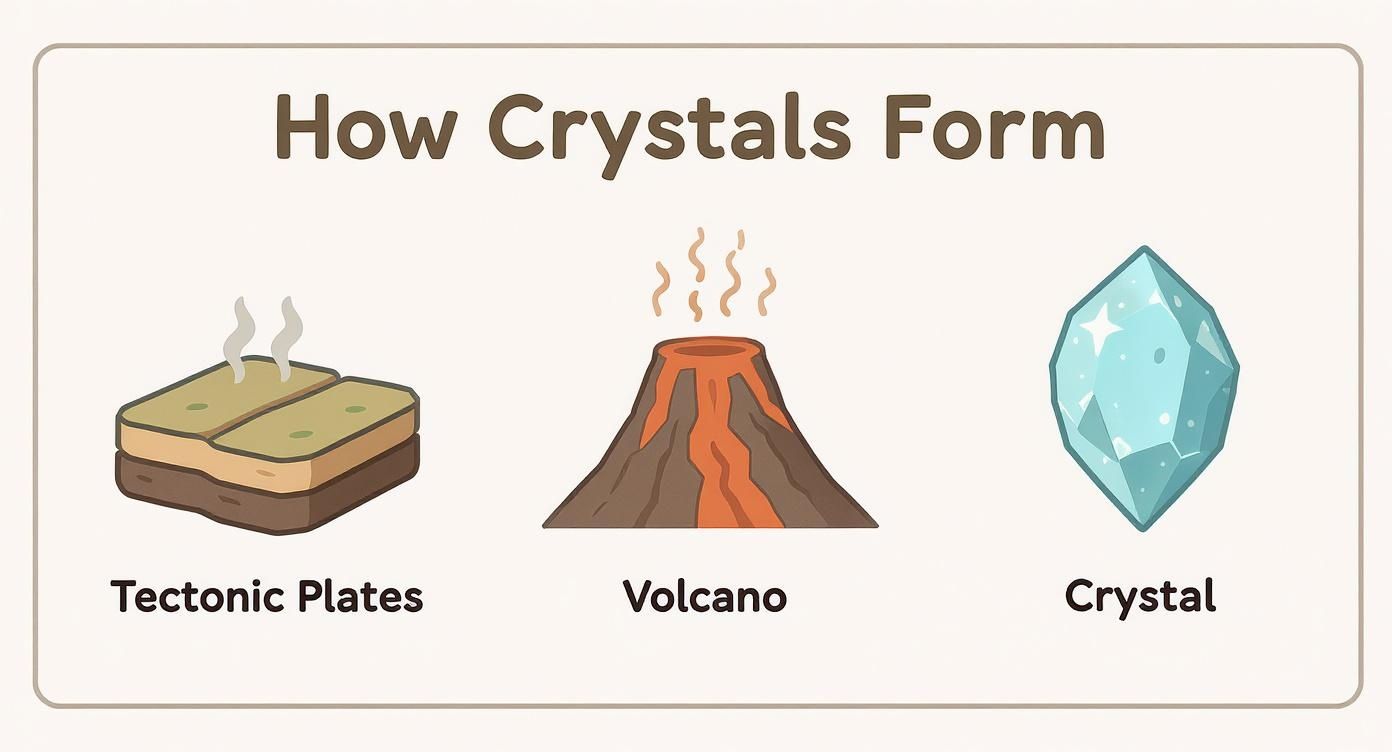
The infographic below shows how massive geological forces, like tectonic plate movement and volcanic activity, are the true artists behind every beautiful specimen we admire.
It’s a powerful visual reminder of the immense earthly processes that create these natural works of art.
The Brilliant Danburite of Charcas
Though first discovered in Danbury, Connecticut, the mineral Danburite found its most famous and abundant source in Charcas, San Luis Potosí. Mexican Danburite is prized for its diamond-like brilliance and clarity, often forming in prismatic, chisel-tipped crystals that look like pure, frozen light.
While they can appear in soft shades of pink or yellow, the water-clear, colorless specimens are the most sought-after. In the metaphysical world, Danburite is revered for its high, pure vibration, believed to connect the heart and crown chakras and open channels for angelic communication. Aesthetically, its superb luster makes it a stunning display piece that plays beautifully with light.
The Ethereal Vera Cruz Amethyst
Not all amethyst is created equal, and Vera Cruz Amethyst is the perfect example. Sourced from the state of Veracruz, these crystals are a world away from their more common Brazilian or Uruguayan cousins. They're known for their exceptionally pale, delicate lilac color and remarkable clarity.
Their growth habit is also unique, often forming as slender, laser-like points, sometimes in gorgeous, radiating clusters. Metaphysically, Vera Cruz Amethyst is considered a high-frequency stone that aids in meditation, spiritual growth, and achieving higher states of consciousness. Their delicate form and refined energy make them a true collector's favorite.
The Mesmerizing Fire Agate
Fire Agate is one of nature's most spectacular creations, and Mexico is a premier source for top-quality specimens. This type of chalcedony contains micro-layers of iron oxide that create a stunning iridescence known as the "schiller" effect.
When light hits the stone just right, it seems to shimmer with an internal fire of reds, golds, greens, and oranges—like looking into a pool of liquid color. Mined primarily in states like Aguascalientes and San Luis Potosí, this gem is believed to be a stone of courage, protection, and grounding. For jewelry and décor, its hypnotic play-of-color makes it an undeniable showstopper.
Each of these crystals is a direct product of Mexico's specific mineralogical conditions. They are not just beautiful stones; they are geological ambassadors, each telling a unique story about its specific corner of the country.
This mineral diversity is also what fuels Mexico’s robust mining industry. Beyond just precious metals, the country's output of industrial minerals like fluorite is globally significant. As detailed in this overview of Mexico’s impressive mining sector on identecsolutions.com, fluorite producers have seen increased profits as the mineral becomes more critical for batteries and electrification. It’s a great example of how Mexico’s geological wealth ranges from collector specimens to vital industrial materials.
The Vibrant Rainbow Fluorite
While Fluorite is found all over the world, Mexico yields some of the most striking and colorful varieties. The mines in Muzquiz, Coahuila, are particularly famous for producing "Rainbow Fluorite," which displays incredible bands of deep purple, vibrant green, and sometimes blue all in a single specimen.
These crystals often form in sharp, well-defined cubic structures, creating visually stunning geometric clusters. Metaphysically, Fluorite is known as the "genius stone," believed to clear mental fog, enhance focus, and absorb negative energy. In home décor, a large piece of Mexican Rainbow Fluorite serves as a breathtaking natural sculpture.
The Giant Selenite of Naica
No discussion of Mexican crystals would be complete without mentioning the legendary Cave of Crystals at the Naica Mine in Chihuahua. This geological wonder contains the largest Selenite (a variety of gypsum) crystals ever discovered on Earth, some reaching over 39 feet (12 meters) in length.
While these giants remain protected deep underground, smaller Selenite specimens from Mexico are widely available. Known for its milky, pearlescent luster, Selenite often forms in wands, slabs, or delicate "fishtail" twins. It’s a staple in spiritual practices, used for cleansing other crystals, purifying spaces, and promoting a sense of deep peace. Its soft, ethereal glow makes it a popular choice for ambient lighting and serene home décor.
A Snapshot of Popular Crystals from Mexico
To bring it all together, here is a quick-reference table summarizing some of the most sought-after crystals found in Mexico.
Crystal Name
Primary Mexican Location(s)
Key Visual Characteristic
Common Use
Danburite
Charcas, San Luis Potosí
Diamond-like brilliance, prismatic clear points
High-vibration energy work, collector specimens
Vera Cruz Amethyst
Veracruz
Pale lilac color, slender laser-like points
Meditation, spiritual connection, fine minerals
Fire Agate
Aguascalientes, San Luis Potosí
Iridescent "fire" of red, gold, and green
Jewelry, grounding and protection, décor
Rainbow Fluorite
Muzquiz, Coahuila
Bands of purple and green in cubic crystals
Mental clarity, focus, natural art pieces
Selenite
Naica, Chihuahua (and others)
Pearly white luster, often in wand shapes
Cleansing spaces and crystals, calming décor
This table just scratches the surface, but it highlights the distinct beauty and origin of the crystals that have put Mexico on the map for collectors and enthusiasts everywhere.
The Spiritual and Cultural Meaning of Mexican Gems
There's more to crystals from Mexico than their incredible beauty. These stones are steeped in layers of spiritual and cultural history, seen for centuries as far more than just pretty rocks. They've been powerful tools for healing, protection, and connection, woven into both ancient traditions and modern metaphysical practices.
Each crystal is thought to have its own unique energetic vibe, a kind of "personality" that clicks with different parts of our lives. This belief gives these natural treasures a purpose that goes way beyond their surface appearance.
Metaphysical Properties of Key Mexican Crystals
Modern crystal healers and spiritual practitioners have their favorites when it comes to Mexican minerals, connecting their physical forms to specific energetic jobs. The high-vibration energy of these stones makes them a top choice for anyone working on meditation and personal growth.
Take the delicate, high-frequency points of Vera Cruz Amethyst. These beauties are thought to activate the higher mind, opening up a clearer channel to intuition and spiritual awareness. Their gentle lilac color is often associated with quieting mental chatter and opening the crown chakra. If you're curious to learn more about this variety of quartz, there's a great deep-dive on the meaning and uses of amethyst crystals.
Then you have the fiery shimmer of Fire Agate. It's believed to forge a powerful shield around your aura, bouncing negativity right back where it came from. It’s seen as a stone of pure courage and vitality, with a warm energy that grounds you through the lower chakras, making you feel safe and secure.
A crystal’s perceived power is often connected to its origin story. Formed in volcanic fire, a stone like Fire Agate naturally carries an association with passion, protection, and the life force of the earth itself.
This intuitive link between how a crystal looks and the energy it puts out is really the heart of metaphysical practice. It gives us a tangible way to connect with the planet's story.
Echoes from the Ancient World
This reverence for stones is nothing new. Long before the modern spiritual scene, ancient Mesoamerican cultures like the Aztecs and Maya held minerals like obsidian and turquoise in the highest regard. These weren't just for decoration; they were essential to ceremony, status, and even survival.
Obsidian: This volcanic glass was a game-changer for civilizations like the Aztecs and Maya. Its razor-sharp edges made it indispensable for crafting tools, arrowheads, and ceremonial blades. On a spiritual level, its dark, reflective surface was considered a gateway to the spirit world, used for scrying and seeing into the future.
Turquoise: Valued for its breathtaking blue-green hue, turquoise was linked to gods, water, and the sky. It was inlaid into the ceremonial masks, shields, and jewelry of powerful rulers and priests, acting as a symbol of immense wealth, power, and a direct line to the divine.
These ancient applications give a rich historical context to our modern love for crystals from Mexico. They remind us that people have always been captivated by these earthly treasures, seeing a power in them that goes far beyond the physical.
This enduring legacy adds another layer of meaning to any piece you might own. When you hold a piece of Mexican Fire Agate or Danburite, you’re not just holding a stone. You're connecting to a story that’s both geological and deeply human—a tale of volcanic fire meeting centuries of spiritual admiration.
How to Buy Authentic Mexican Crystals
Navigating the market for authentic crystals from Mexico can feel like a treasure hunt. With so many sellers and stunning specimens out there, knowing how to make a confident and ethical purchase is everything. Think of this as your practical roadmap to sourcing genuine, high-quality minerals you can trust.
First, it helps to understand the market itself, which is directly tied to what's happening in Mexico's mines. The country's mineral output can shift dramatically. For instance, total production hit 157,369,503 metric tons in December 2022, a far cry from its all-time high of 239,584,211 metric tons back in 2013.
This kind of volatility directly impacts the availability and price of certain crystals. A great dealer understands these dynamics and will share that context with you, helping you appreciate why finding a specific, high-quality piece sometimes depends on factors far beyond the showroom floor. You can see more about Mexico's mineral production trends on ceicdata.com.
Identifying Reputable Dealers
Finding a seller you trust is the most critical part of building a genuine collection. Whether you're shopping online or in person, look for dealers who are passionate, knowledgeable, and totally transparent about where their crystals come from.
A great dealer is more than just a salesperson—they're an educator. They should be able to tell you the story behind the stone, and I don't just mean its metaphysical properties. They should know its geological origin.
Here are the key signs of a reputable crystal seller:
They provide locality information: A good dealer will proudly tell you a Danburite specimen is from Charcas or that an Amethyst is a classic from Veracruz. Specificity is a huge mark of authenticity.
They answer questions confidently: Go ahead and ask about their sourcing, how they verify a piece is natural, and if any treatments have been applied. Vague or evasive answers are a major red flag.
They have a solid reputation: Look for positive reviews, a long-standing presence in the community, and connections to mineralogical societies or big gem shows.
They offer clear policies: A transparent return policy shows they stand behind the quality and authenticity of their specimens.
The relationship with your dealer is foundational. A trustworthy source will not only sell you authentic crystals but will also help you learn, grow your collection wisely, and deepen your appreciation for these natural wonders.
Spotting Fakes and Treated Stones
As the crystal market has grown, so has the number of fakes, imitations, and undisclosed treatments. Your best defense is empowering yourself with some basic identification knowledge. While identifying minerals with 100% certainty can be complex, you can build a solid foundation by exploring a comprehensive crystal identification guide that covers key traits like hardness, luster, and cleavage.
Here are some common red flags to watch for:
Unnaturally Vibrant Colors: Sure, Mexican Fluorite is colorful, but be wary of stones with shockingly uniform or electric colors. Dyes are often used to "enhance" low-grade stones like agate or quartz.
Perfectly Clear and Flawless: Most natural crystals have some internal fractures, inclusions, or growth lines. If you see a very large, perfectly clear piece of quartz selling for a low price, it's more likely to be glass.
Suspiciously Low Prices: If a deal seems too good to be true, it almost always is. A large, high-quality Fire Agate or Vera Cruz Amethyst specimen has significant value. Rock-bottom prices often point to a fake or misrepresented item.
Misleading Names: Be cautious of marketing terms like "Aqua Aura" or "Titanium Aura" quartz. These are natural quartz crystals that have been artificially coated with metals to create an iridescent sheen. A good seller will always disclose these treatments upfront.
By combining your own growing knowledge with the expertise of a dealer you trust, you can confidently invest in authentic crystals from Mexico and ensure your collection is filled with genuine treasures straight from the earth.
Caring For Your Mexican Crystal Collection
Bringing a beautiful crystal home from Mexico is really just the start of the adventure. To keep these natural treasures looking their best and feeling vibrant, a bit of proper care is essential. Think of it like looking after a rare orchid; each variety has its own specific needs to truly thrive.
You wouldn't drown a cactus, right? The same logic applies here. Not every crystal can handle a simple water cleaning. Some of the most stunning Mexican minerals are surprisingly sensitive. That gorgeous, pearly Selenite from the Naica mine, for instance, is water-soluble. Let it sit in water for too long, and you'll watch it start to dissolve, losing its incredible luster forever.
Gentle Cleaning Techniques
Keeping your crystals physically clean lets their natural sparkle shine through, but the right method is everything. It all comes down to the mineral's hardness and chemical makeup. A one-size-fits-all approach is a recipe for causing irreversible damage.
For most of the harder crystals from Mexico, like a classic Vera Cruz Amethyst or a brilliant Danburite (which clock in at 7 and 7-7.5 on the Mohs hardness scale), a gentle touch is still the best policy.
Dry Cleaning: A soft, clean paintbrush is your best friend here. It's perfect for flicking dust out of delicate clusters and intricate formations without any risk. A can of compressed air works wonders, too.
Minimal Water: For tougher, non-friable stones, a quick rinse under lukewarm water is usually fine. The key is to dry it immediately with a soft cloth. And whatever you do, steer clear of harsh soaps or chemicals.
The golden rule of crystal care is simple: always research your specific stone before you clean it. If you’re ever in doubt, stick with a dry method. It's always the safest bet.
Safe Storage Solutions
Good storage is about more than just tidiness; it’s about protecting your collection from accidental chips, scratches, and the fading that comes from too much sun. A harder crystal like quartz can easily scratch up a softer one like Fluorite, which is only a 4 on the Mohs scale.
To keep everything pristine, try storing specimens individually in soft cloth bags or padded boxes. If you're putting them on display, make sure they’re on stable surfaces and out of direct, harsh sunlight. That intense sun is notorious for bleaching the vibrant colors in stones like Amethyst over time. Giving them a little space to breathe also prevents them from knocking into each other.
Energetic Cleansing and Charging
Beyond just wiping off dust, many collectors like to practice energetic cleansing to refresh their crystals. This is all about clearing away any stagnant or heavy energy the stone might have picked up.
Fortunately, there are several gentle, non-invasive methods that are safe for all your crystals from Mexico:
Selenite Charging: Placing your crystals on a Selenite charging plate or just near a larger piece is a super popular and safe way to cleanse them. Selenite is believed to purify other stones without ever needing to be cleansed itself.
Sound Bath: The vibrations from a singing bowl, tingshas, or even a tuning fork can effectively shake loose any energetic buildup. Just let the sound waves wash over your collection for a few minutes.
Moonlight: You can't go wrong with the gentle energy of the full moon. It's a favorite method for charging crystals for a reason. Just set them on a windowsill overnight to soak in the lunar rays. This technique is completely safe for every single variety.
Got questions about Mexican crystals? You're not alone. When you dive into this fascinating world, a few common queries always seem to surface. We hear them all the time from collectors, so let's tackle them head-on.
Think of this as your quick-reference guide to help round out your knowledge and build your confidence.
What Is the Rarest Crystal Found in Mexico?
Defining "rarest" is always a bit tricky in the mineral world because it can come down to specific formations, clarity, or unique features. That said, most collectors would agree that Danburite from its original discovery spot in Charcas, San Luis Potosí, is a top contender. It’s truly one of Mexico's most significant contributions to the mineral kingdom.
Finding high-quality, gem-clear Danburite crystals is the goal for serious collectors worldwide. But we also have to mention top-grade Fire Agate. When you find a piece with that vivid, multi-colored play-of-color, you’re looking at something genuinely rare and valuable—a true collector's gem.
Are Crystals from Mexico Sourced Ethically?
This is a fantastic and important question for any conscious collector. While Mexico certainly has its share of large, industrial mining operations, a huge number of the beautiful and unique mineral specimens you see on the market actually come from smaller, often family-run mines.
The real key to ethical sourcing is to buy from reputable dealers who are open and honest about where their crystals come from. Never be afraid to ask sellers about the specific mine or region their pieces are from and what kind of relationship they have with the miners on the ground. When you support dealers who prioritize fair labor, you ensure your collection has a positive story behind it.
A transparent seller won't see these questions as an accusation. They'll see it as a chance to share the stone's journey and prove their commitment to doing things right. It's one of the best signs you've found a source you can trust.
Can I Visit Crystal Mines in Mexico?
For the most part, visiting an active, operational mine is nearly impossible for the public. These are serious industrial sites with strict safety rules and corporate policies, not tourist spots. Access is tightly controlled, and for very good reason.
But that doesn't mean you can't get close to the action! Many of Mexico’s historic mining regions, like Zacatecas or Guanajuato, have incredible tours of old, decommissioned mines that are now fascinating museums. Plus, visiting the local markets in these towns or checking out the mineral shops in cities like San Miguel de Allende is a fantastic way to buy gorgeous crystals from Mexico directly from local vendors.
At Astro West, we believe every crystal tells a story—a story of geological time and cultural history. As a family-run gallery, we're dedicated to bringing you ethically sourced, authentic minerals from Mexico and all over the globe, with every piece personally vetted by our in-house experts. Explore our curated collection of fine minerals, fossils, and natural art at https://astrowest.com and discover a timeless treasure for your own collection.