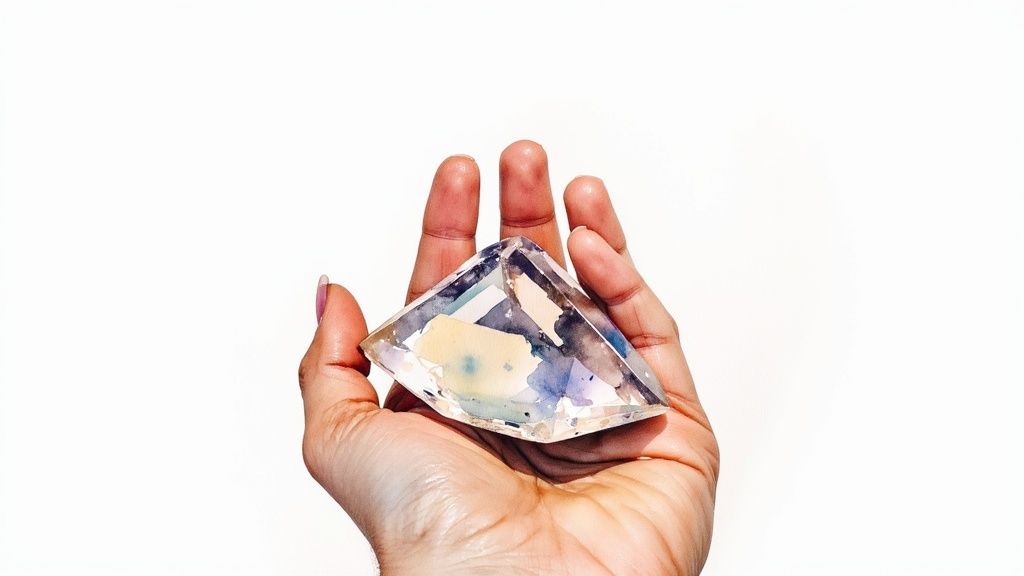
Learning to identify crystals properly turns mineral collecting from a guessing game into a solvable puzzle. The key is knowing how to systematically observe a few core physical properties—color, luster, hardness, streak, and cleavage—which together act as a unique fingerprint for each specimen.
By learning how to test for these five characteristics, you can start identifying minerals in your own collection with real confidence.
Welcome to the art of mineral detection. Identifying a crystal can feel like learning a new language, but it’s far more accessible than you might think. Instead of memorizing a dictionary of facts, you just need to learn how to ask the right questions and let the stone give you the answers.
Think of yourself as a detective investigating a mystery. Every crystal holds a set of clues within its physical structure, and your job is to uncover them one by one. This guide will walk you through the five foundational properties you'll use to start reading the story every stone has to tell.
The 5 Foundational Properties for Crystal Identification
To get started, we'll focus on the basics. These five simple tests form the bedrock of mineral identification, giving you the most reliable information without needing any fancy lab equipment—just a curious eye and a few common household items.
Here's a quick rundown of what you'll be looking for:
Property
What It Reveals
Simple Analogy
Color
The most obvious—but often most deceptive—initial clue.
A person's hair color. It's the first thing you notice, but it doesn't tell the whole story.
Luster
How a mineral's surface reflects light.
The finish on a car. Is it glossy, metallic, or dull and matte?
Hardness
How well a mineral resists being scratched.
The durability of a phone screen. Some scratch easily, others are incredibly tough.
Streak
The color of the mineral's powder.
The color of chalk dust. The outside color might be different from the true color inside.
Cleavage & Fracture
How a mineral breaks under stress.
Breaking a cracker versus tearing bread. One splits cleanly, the other breaks irregularly.
These properties work together like a checklist. While one mineral might share a single trait with another—say, both are green—the unique combination of all five characteristics will almost always point you to a positive ID.
A mineral might share one or two traits with another, but the unique combination of all five will almost always lead you to a positive identification.
Developing an eye for these details is a skill that helps in all sorts of collecting hobbies. In fact, learning the principles of identifying antiques like an expert can really sharpen your observation skills. The same methods of careful inspection and cross-referencing apply whether you're looking at a gemstone or a piece of furniture.
Alright, now that we've covered the basics, it’s time to get our hands dirty. We're moving on to two of the most trusted tests in any mineral collector’s playbook: hardness and streak. These methods are reliable, don't require fancy equipment, and can slash your list of possibilities in minutes. Unlike color, which can be a total chameleon, these properties are consistent and get right to the heart of a mineral’s identity.
Think of hardness as a mineral's toughness—its ability to resist a scratch. This whole concept was neatly organized back in 1812 by German mineralogist Friedrich Mohs. He came up with a brilliantly simple 1-to-10 scale that we still use today.
The Mohs Hardness Scale isn’t about smashing rocks together; it’s a game of comparison. A harder mineral will always scratch a softer one. It’s that simple. Diamond, sitting at a perfect 10, can scratch anything below it, while Talc, the softie at 1, can be scratched by pretty much everything else.
Assembling Your Practical Hardness Toolkit
You don't need to buy an expensive set of professional mineral picks to get started. In fact, you can build a surprisingly effective little toolkit with common items you probably have lying around the house. It’s a great way to make the Mohs scale feel less abstract and more hands-on.
Here’s your basic field kit:
Your Fingernail: Clocks in at about a 2.5. It's perfect for scratching super-soft minerals like Gypsum but won't make a dent in Calcite.
A Copper Penny: With a hardness of 3.5, it’ll scratch Calcite but not Fluorite.
A Steel Knife or Nail: This is your mid-range workhorse, with a hardness around 5.5. It's great for testing minerals like Apatite.
A Piece of Quartz: If you have a confirmed piece of Quartz, its hardness of 7 is a fantastic benchmark. It will easily leave a mark on glass and steel.
Safety First: When you do a scratch test, pick a smooth, hidden spot on your specimen. Use firm but gentle pressure. You’re just trying to create a fine line, not gouge a chunk out of your crystal.
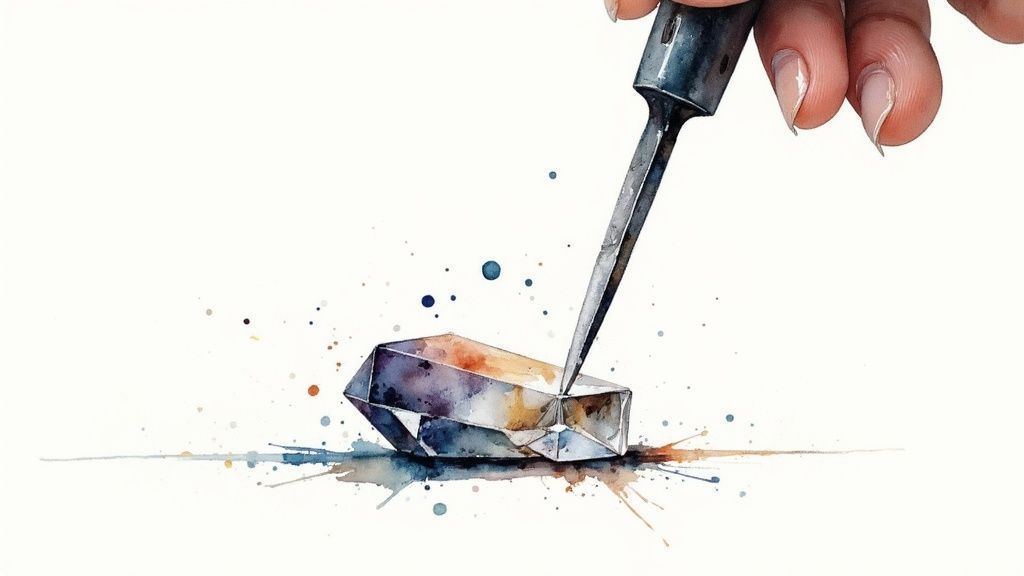
To run the test, just take one of your tools and try to scratch the mineral. If your fingernail (2.5) leaves a mark, you've got a very soft mineral. If it doesn’t, but the copper penny (3.5) does, you've narrowed it down to somewhere between 2.5 and 3.5. By working your way up the scale with your tools, you can pinpoint the hardness with impressive accuracy.
The Truth Revealed in the Streak Test
While hardness tells you about a mineral's durability, the streak test reveals its true colors—literally. The streak is the color of a mineral when it’s ground into a powder, and it’s often completely different from how the crystal looks on the outside. This is one of the most dependable tests out there because a mineral's streak is almost always the same, no matter how much its surface color varies.
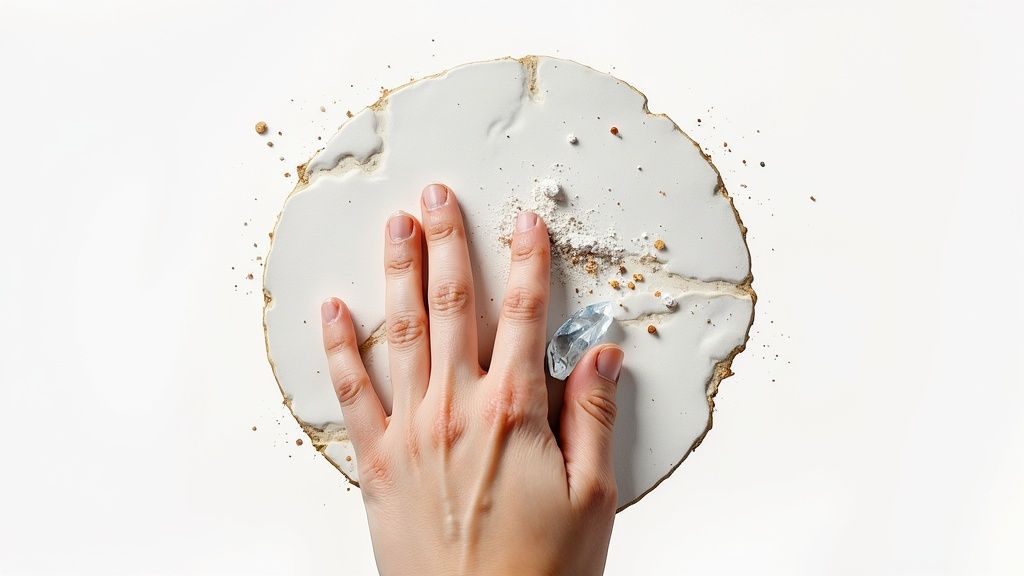
To do a streak test, you’ll need an unglazed porcelain tile, which we call a streak plate. Just drag the mineral firmly across the plate's surface like you’re drawing with a crayon. That colored line it leaves behind? That's the streak.
Hematite is the classic example here. It can be a shiny, metallic silver or a dull, earthy black, but it always leaves a tell-tale reddish-brown streak. That one test immediately separates it from something like Galena, which looks similar but leaves a lead-gray streak.
Another great one is Pyrite, or "Fool's Gold." It has that deceptive golden shine, but its streak is a greenish-black. Real Gold? It leaves a true golden-yellow streak. It’s a simple, definitive test that has saved many collectors from a disappointing discovery.
How Light and Breakage Reveal a Crystal's Identity
Beyond hardness and streak, two of the most powerful clues are hiding in plain sight. How a mineral handles light and the way it breaks apart under stress are fundamental to its very nature. Training your eye to spot these characteristics is like learning a secret language—it instantly tells you what you're holding.
We'll start with luster, which is simply the way a mineral’s surface reflects light. It’s not about color, but the quality and intensity of its shine. Think of it as the finish on a piece of furniture—is it glossy, metallic, or matte? This is a core concept in any crystal identification guide for a reason.
Reading the Shine: A Guide to Luster
Luster can be broken down into a handful of simple, descriptive categories. You don't need a textbook here; you just need to compare what you see to surfaces you already know. This immediate, visual confirmation is often your first big clue in figuring out a mineral's identity.
Here are the most common types of luster you’ll run into:
Vitreous (Glassy): This is the most common luster, looking just like a freshly cleaned windowpane. Quartz and Fluorite are classic examples that have that glassy shine.
Metallic: This one is easy to spot—it looks like polished metal. Pyrite and Galena are unmistakably metallic, reflecting light just like a piece of steel or chrome.
Dull or Earthy: These minerals have very little to no reflection. They look a lot like a clod of dry soil or unglazed pottery. Kaolinite is a perfect example of a mineral with a dull, earthy look.
Resinous: Imagine the sticky, amber-like sheen of tree sap. Minerals like Sphalerite have this kind of luster, which is less reflective than glass but still has a distinct shine.
Waxy or Greasy: This luster makes a mineral look as though it's coated in a thin layer of wax or oil. Talc often has a greasy feel and appearance to match.
Hold your specimen under a good light source and turn it over in your hands. Watching how light plays across its surface from different angles is the absolute best way to pin down its luster.
Luster isn’t about how pretty a crystal is, but how it physically interacts with light. A metallic luster reflects almost all light back at you, while a dull luster absorbs most of it, creating a totally different visual fingerprint.
Cleavage vs. Fracture: The Way a Crystal Breaks
Now, let's talk about what happens when a mineral breaks. The internal atomic structure actually dictates how it will break, creating patterns that are incredibly consistent and easy to diagnose. The two terms you need to know are cleavage and fracture.
Cleavage is a mineral's tendency to break along flat, smooth planes where its atomic bonds are weakest. Think of it like splitting a log—it naturally wants to break along the grain. Minerals with good cleavage will produce flat, often shiny surfaces when they break. Halite (rock salt), for instance, has perfect cubic cleavage, meaning it will always break into smaller and smaller cubes.
Fracture, on the other hand, is when a mineral breaks in a direction where there is no plane of weakness. The resulting surface is irregular, uneven, or curved. It’s like shattering a dinner plate—the pieces are random and have no predictable shape.
Learning to spot the difference is a game-changer. Here’s a quick rundown:
Feature
Cleavage
Fracture
Appearance
Produces flat, smooth, reflective surfaces.
Creates irregular, uneven, or curved surfaces.
Cause
Breaks along planes of atomic weakness.
Breaks randomly where atomic bonds are strong.
Example
Mica peeling into perfect, thin sheets.
Quartz breaking with a curved, shell-like pattern.
One of the most distinctive fracture types is conchoidal fracture, which creates smooth, curved surfaces resembling the inside of a seashell. This is the hallmark of Quartz and Obsidian. If you see this pattern, you can be almost certain you're not looking at a mineral with strong cleavage.
For more insights on this iconic mineral, you can explore this detailed collector's guide to Quartz crystal clusters. By recognizing these fundamental breaks, you're one giant step closer to solving your mineral mystery.
Looking Beyond Color to Identify Minerals
When you first hold a new stone, what’s the first thing you notice? Its color. It’s the most immediate quality, the thing that catches your eye and often sparks that initial connection. But in the world of mineral identification, color can be a beautiful but notoriously unreliable guide.
Trusting color alone is one of the biggest mistakes new collectors make. The Quartz family is the perfect case study. Here you have one mineral—with the exact same chemical blueprint (silicon dioxide)—that shows up in an incredible rainbow of different shades.
This single mineral can be found as:
Amethyst: The classic purple we all recognize, created by tiny traces of iron.
Citrine: A bright, sunny yellow, also caused by iron but formed under different heat conditions.
Rose Quartz: A soft, gentle pink, which gets its hue from microscopic fibers of a dumortierite-related mineral.
The takeaway here is that color is usually just a side effect of tiny chemical impurities or quirks in the crystal structure, not a clue to the mineral’s core identity. That’s why any good crystal identification guide will urge you to look past the surface.
Color is a clue, not a conclusion. Use it as a starting point for your investigation, but always back it up with more dependable physical tests like hardness, streak, and luster.
When Color Tells a Deeper Story
While a mineral's base color can be misleading, certain optical effects are incredibly reliable for identification. These phenomena aren't just about color; they're about how light interacts with the mineral's internal architecture, creating dazzling displays that are often unique to a specific stone.
These effects are far more than just a pretty face—they're direct visual evidence of a crystal’s inner structure. Learning to spot them can help you solve identification puzzles in a heartbeat.
Here are a few fascinating optical effects to keep an eye out for:
Chatoyancy (Cat’s Eye Effect): This is a silky, shimmering band of light that glides across the stone’s surface as you turn it. It’s caused by light bouncing off parallel fibrous inclusions inside the crystal. The most famous example is Tiger’s Eye, where that cat's eye effect is impossible to miss.
Labradorescence: This is that breathtaking, iridescent flash of electric blues, greens, and golds you see in Labradorite. It isn't a surface color at all but rather the result of light interfering with and reflecting off microscopic layers within the mineral.
Aventurescence: This effect creates a glittery, spangled look, caused by tiny, plate-like mineral inclusions scattered within the stone. Aventurine (a type of quartz) and Sunstone are classic examples of this shimmering magic.
The Growing Market for Gemstones
Being able to correctly identify these properties isn't just a rewarding skill for a hobbyist; it's essential in a rapidly growing market. Proper identification is the foundation of a specimen's value and authenticity. In fact, the global gemstones market was valued at USD 33.96 billion in 2024 and is projected to climb even higher.
Getting these details right allows collectors to appreciate the unique story behind each piece, like the subtle beauty of Rose Quartz. To dive deeper into this beloved stone, you can explore the magic of Rose Quartz, the stone of unconditional love. Ultimately, looking beyond a simple color description opens up a whole new world of appreciation and accuracy in your collecting journey.
Solving Your First Mineral Mysteries
You’ve got the core principles down, you've put together a simple toolkit, and your eyes are getting trained to spot the subtle clues minerals leave behind. Now it's time to put on your detective hat and solve your first case. This is where theory gets its hands dirty, and your new knowledge starts to feel like a real skill.
We’re going to tackle a classic identification challenge: telling the difference between three common minerals that can look deceptively similar—Quartz, Calcite, and Fluorite. By creating a "case file" for each one and running our tests in a logical order, you’ll see just how powerful a systematic approach can be.
Case File 1: The Unmistakable Hardness of Quartz
Our first suspect is a clear or milky-white crystal. At a quick glance, it could easily be mistaken for Calcite or even a nice piece of Fluorite. Color alone isn't going to cut it, so we'll turn to our most trusted tests to build a solid case.
The first—and most decisive—test for Quartz is hardness. As we know, Quartz clocks in at a solid 7 on the Mohs scale. This means it should have no trouble scratching a piece of glass or a steel nail (which has a hardness of about 5.5). When you try it, you'll find that Quartz leaves a definite scratch on the steel, confirming its superior strength. Just like that, this single test has already ruled out both Calcite and Fluorite, which are significantly softer.
To gather more evidence, let’s see how it breaks. Quartz has no cleavage, which means it doesn't split along flat, predictable planes. Instead, it shows a very distinct conchoidal fracture—smooth, curved breaks that look a lot like the inside of a seashell. This unique pattern, combined with its glassy (vitreous) luster and impressive hardness, makes identifying Quartz an open-and-shut case.
The one-two punch of a hardness of 7 and a conchoidal fracture is the definitive fingerprint of Quartz. If a mineral can scratch steel and breaks in curved patterns, you can be almost certain you're holding a piece of it.
Case File 2: The Telltale Cleavage of Calcite
Next up is a mineral that also appears clear or milky white, looking a lot like our Quartz specimen. But as we dig in, its true identity quickly gives itself away through a completely different set of clues.
Let's start with hardness again. Using our steel nail, we try to scratch the mystery mineral. This time, the nail easily bites into the stone, telling us its hardness is less than 5.5. Next, we try a copper penny (hardness 3.5), and it also leaves a mark. This puts our mineral squarely in the "soft" category, probably around a 3.
Now, we examine how it breaks. Unlike the curved fracture of Quartz, this mineral breaks cleanly along flat, angled planes. It has perfect rhombohedral cleavage, meaning it splits into shapes that look like slanted boxes or rhombuses. This distinctive cleavage is a classic giveaway for Calcite. For the final confirmation, a drop of household vinegar will cause it to gently fizz as the acid reacts with the calcium carbonate. This reaction is unique to carbonate minerals and closes the case on Calcite.
Case File 3: The Perfect Cleavage of Fluorite
Our final mineral can also be clear, but it often shows up in beautiful shades of purple and green, sometimes overlapping with the colors of Amethyst (a type of Quartz). This is a perfect example of why relying on multiple tests is so critical for any crystal identification guide.
We start with the hardness test. Fluorite is harder than Calcite, so a copper penny won't scratch it. However, it's softer than Quartz, so a steel nail will scratch it. This places Fluorite at a 4 on the Mohs scale, perfectly in between our other two suspects.
The most defining feature of Fluorite, though, is its cleavage. It has perfect octahedral cleavage in four directions. What this means is that when it breaks, it naturally wants to form eight-sided, diamond-like shapes. While you might not always find a perfect octahedron, you’ll notice the cleavage planes meet at very different angles from Calcite's rhombs. That, combined with its glassy luster and intermediate hardness, seals the deal.
Once you get a feel for the basic principles, you can start applying them to solve your own mineral mysteries. For some great practical examples, you can explore a variety of common stones and crystals to see these properties in action across a wider range of materials.
Quartz vs. Calcite vs. Fluorite: A Comparative Look
Telling these three common minerals apart can feel tricky at first, but it gets much easier once you know what to look for. This table breaks down the key diagnostic properties side-by-side, giving you a quick reference for your next identification challenge. Think of it as a cheat sheet for your mineral detective work.
Property
Quartz
Calcite
Fluorite
Mohs Hardness
7 (scratches steel)
3 (scratched by steel & copper)
4 (scratched by steel, not copper)
Cleavage/Fracture
Conchoidal fracture (no cleavage)
Perfect rhombohedral cleavage (3 directions)
Perfect octahedral cleavage (4 directions)
Luster
Vitreous (glassy)
Vitreous to pearly
Vitreous (glassy)
Acid Reaction
No reaction
Fizzes in weak acid (like vinegar)
No reaction
By running through this simple checklist—testing hardness, checking for cleavage, and maybe trying a drop of vinegar—you can confidently distinguish between these lookalikes every time.
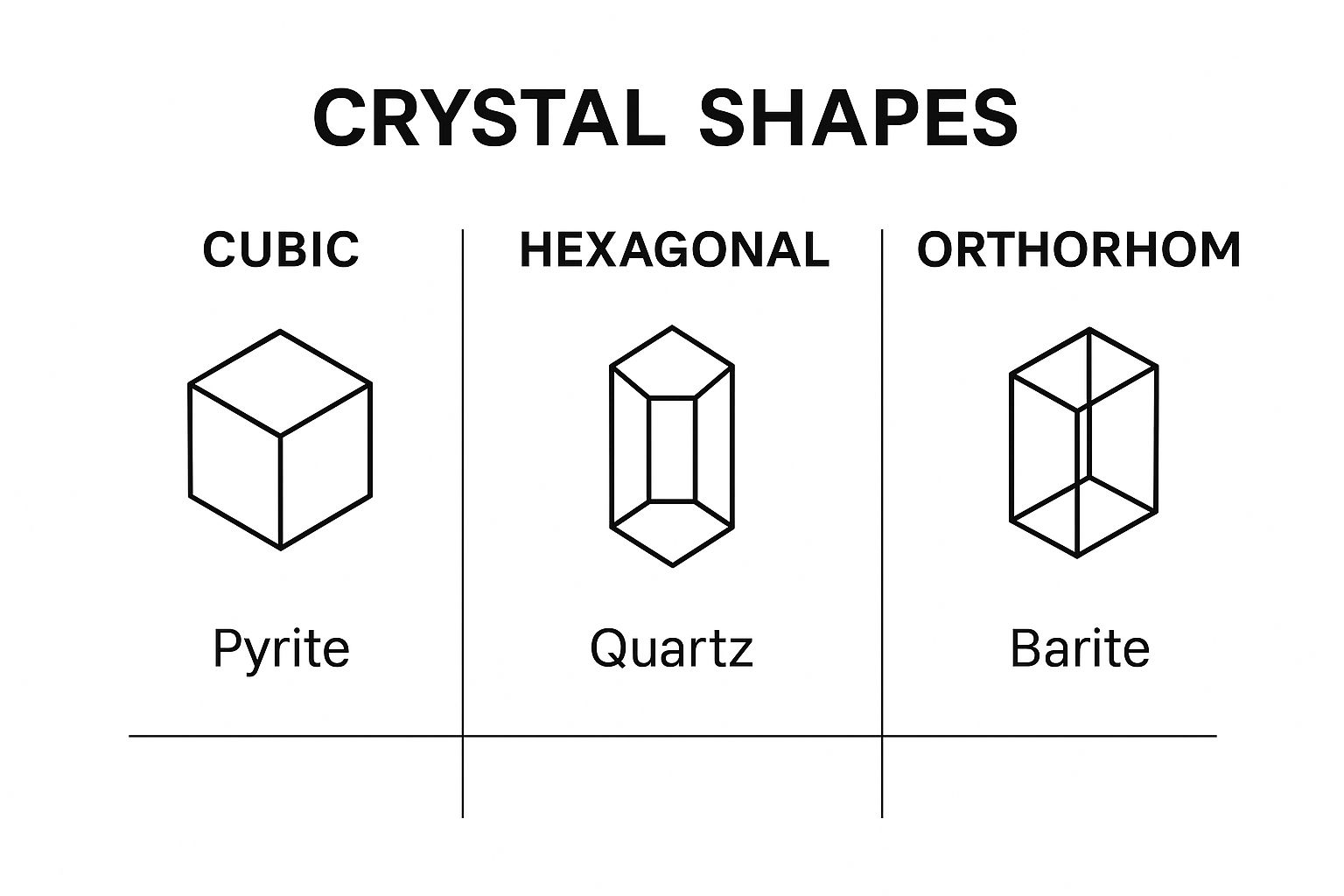
This visual guide compares three fundamental crystal systems, showcasing how a mineral's internal structure dictates its external shape.
As the infographic shows, minerals like Pyrite, Quartz, and Barite belong to different crystal systems, which directly influences properties like cleavage.
Answering Your Top Crystal Identification Questions
As you get your hands dirty in the fascinating world of mineralogy, a few questions are bound to pop up. Think of this section as your go-to troubleshooting guide, where we tackle the most common puzzles and sticking points new collectors run into.
We'll cover everything from building your first toolkit on a budget to spotting convincing fakes and solving those tricky cases where one mineral looks just like another. Let's clear up the confusion so you can build your collection with confidence.
What Basic Tools Do I Need for Crystal Identification?
You don’t need a high-tech lab to start identifying minerals. A great beginner’s toolkit is surprisingly simple, and you probably have most of the items lying around your house already. These tools are all it takes to perform the core tests we've covered.
Your starter kit should include:
A Magnifying Glass: For getting up close and personal with a crystal's structure, luster, and any tiny inclusions.
Hardness Testing Items: Your own fingernail (~2.5), a copper penny (~3.5), and a steel nail or knife blade (~5.5) give you a surprisingly reliable field scale.
An Unglazed Porcelain Tile: This is your streak plate. It’s perfect for revealing a mineral's true powdered color, which is often a dead giveaway.
Household Vinegar: A few drops are all you need to test for carbonate minerals. If you have Calcite, for example, it will fizz on contact.
With just these four items, you can accurately identify an impressive number of common minerals without spending a dime.
How Can I Tell If a Crystal Is Real or Fake?
Spotting a fake often comes down to looking for what isn't there: the natural character of a real crystal. Fakes, usually made of glass or dyed resin, often give themselves away by being a little too perfect.
First, test the hardness. This is a big one. Glass imitations just can't hold up to the minerals they're mimicking. A glass "Quartz" point, for instance, will be easily scratched by a real piece of Quartz.
Next, look for natural imperfections. Real crystals tell a story through their internal fractures, subtle color zones, or tiny specks of other minerals trapped inside. A specimen that looks flawless with an impossibly vibrant, uniform color has likely been dyed.
Finally, trust your hands. Consider the feel and weight of the stone. If it feels oddly lightweight or warm to the touch, you might be holding plastic or resin. When in doubt, the best move is always to consult a reputable dealer or a local gemologist.
A genuine crystal tells a story through its minor flaws and unique growth patterns. Fakes often appear too perfect, lacking the very character that makes each natural specimen a one-of-a-kind treasure.
What If My Crystal Looks Like Two Different Minerals?
This is an incredibly common challenge, and it’s exactly why we rely on a whole battery of tests, not just one. Plenty of minerals have look-alikes, making a single property like color a notoriously unreliable identifier.
Take the classic mix-up: Pyrite ("Fool's Gold") versus actual Gold. At a glance, they share that flashy metallic yellow luster, but that’s where the resemblance ends. Pyrite is much harder than Gold and leaves a greenish-black streak. Gold, on the other hand, is quite soft and leaves a true golden-yellow streak.
When you find yourself stuck between two possibilities, it's time to be systematic. Run through every test in your arsenal:
Check the hardness carefully.
Perform a streak test.
Examine the luster under good light.
Look for any signs of cleavage or fracture.
This process of elimination almost always breaks the tie. The unique combination of these properties will point you to the right answer, turning a confusing puzzle into a solved mystery.
The growing interest in crystals isn't just a niche hobby anymore; it’s a huge part of the wellness world. The healing crystal market was valued at an estimated USD 112.3 million in 2025, and forecasts point to strong growth as more people embrace holistic practices. You can read more about these market trends and their rapid expansion. This boom in popularity makes accurate identification more crucial than ever, ensuring you’re getting authentic, valuable specimens.
Ready to find the next treasure for your collection? At Astro West, we offer a curated selection of ethically sourced, expert-vetted minerals, fossils, and meteorites. From beginner-friendly specimens to museum-quality masterpieces, each piece tells a unique story. Explore our collections and invest in enduring natural art at https://astrowest.com.