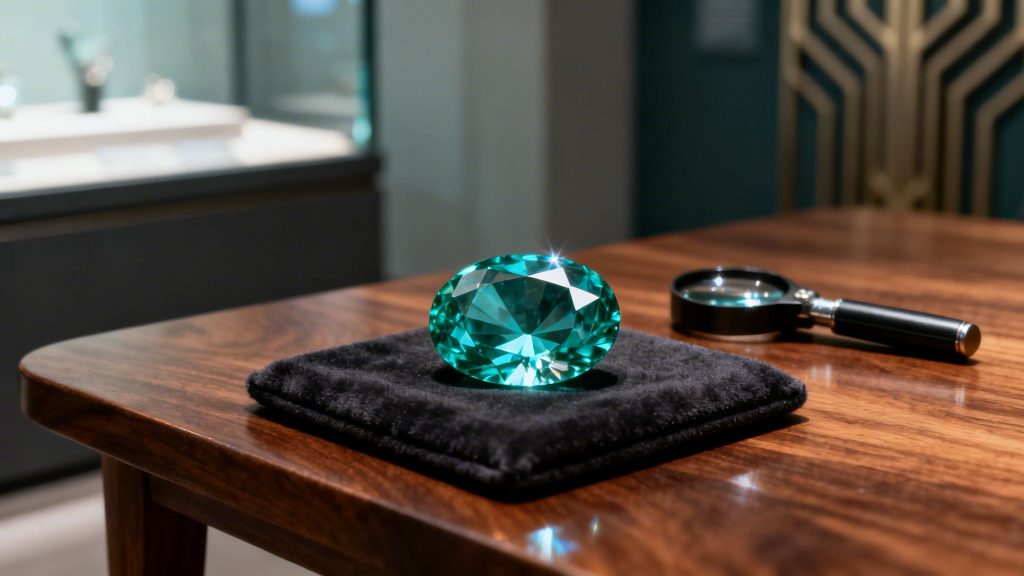
Aquamarine is far more than a beautiful gemstone. It is a hard asset with proven investment potential. Its value is driven by a classic combination of factors—color, clarity, and origin—that have cemented its desirability in the market for generations. An exceptional aquamarine, therefore, is not just a jewel; it is a piece of geological history that serves as a durable store of value.
Why Aquamarine Is a Premier Tangible Asset
While known for its serene, sea-blue color, aquamarine’s true worth extends beyond aesthetics. This gemstone holds a unique position among tangible assets, alongside fine art and luxury timepieces. Unlike stocks or bonds, a high-quality aquamarine specimen is a physical object. Its value is grounded in its natural beauty and, most importantly, its rarity. A strategic collector, therefore, acquires a durable asset with a proven track record of holding its value.
To understand its market position, one must look at its fundamental qualities. Aquamarine belongs to the beryl mineral family, the same group that includes the famously fragile and included emerald. However, aquamarine crystals often form with incredible transparency, a quality that directly translates to financial worth. This natural clarity, combined with a tough Mohs hardness of 7.5 to 8, makes it ideal for both museum-grade mineral specimens and sophisticated, wearable jewelry.
This powerful combination of traits makes high-quality aquamarine a compelling component of a diversified asset portfolio. The primary drivers behind its value are clear:
Geological Rarity: The most coveted, deeply saturated blue colors are genuinely scarce.
Market Stability: Aquamarine has demonstrated remarkably steady demand among collectors, investors, and high-end jewelry designers.
Aesthetic Versatility: It appears equally impressive in a curated display case as it does in a custom-designed jewelry piece.
Authenticity: Natural inclusions and its unique crystal structure act as geological fingerprints, verifying its natural origin.
The distinction between different gemstone types further solidifies its position. While many stones are beautiful, not all carry the same investment weight. You can learn more about how experts draw these lines in our guide to precious vs. semi-precious stones. Ultimately, when approached with an investor's mindset, an aquamarine acquisition transforms from a simple transaction into a strategic addition to a legacy collection. Astro West’s expertise guides collectors through this precise process.
How to Determine Aquamarine Value
Determining the value of an aquamarine is more than admiring its beautiful blue color. For serious collectors and investors, it is a methodical process. This process involves a disciplined analysis of what the industry calls the "Four Cs"—Color, Clarity, Cut, and Carat weight. These four factors work together to define its rarity and, therefore, its market position.
An aquamarine with exceptional qualities commands a premium because its rarity and desirability are proven. A specimen’s journey from a raw, unearthed crystal to a prized collectible is shaped by these precise metrics. Consequently, understanding this framework is the first step toward making a confident, informed acquisition.
The Decisive Factor of Color
Color is the single most important factor in determining an aquamarine's value. While all shades possess appeal, the market overwhelmingly favors a deep, saturated, pure blue. This coveted hue, known as "Santa Maria" blue, is the benchmark for top-tier aquamarine. It was originally named for the Brazilian mine that first produced this exceptional color.
Stones with this intense, pure blue are incredibly rare and, as a result, command the highest prices. In contrast, aquamarines that are very pale or have strong greenish tints are far more common and therefore considerably less valuable. A top-grade aquamarine must have a vivid, even blue without any gray or green tones interfering with its pure oceanic color.
The most valuable aquamarines possess a medium-dark to strong blue saturation. This specific color concentration is rare because the required geological conditions seldom occur, directly tying its scarcity to its high market valuation.
Clarity and Its Link to Value
Next is clarity, which refers to the absence of internal features, or inclusions. Aquamarine is a Type I gemstone, a trade term meaning it is typically "eye-clean"—free of inclusions visible to the naked eye. This high level of natural transparency is a hallmark of the beryl family and a key reason for its popularity.
Exceptional clarity tells a story of superior, undisturbed geological formation. While microscopic inclusions can act as a natural fingerprint confirming a stone’s authenticity, any flaws visible to the naked eye reduce its value. A truly top-tier aquamarine is often "loupe-clean," appearing flawless even under 10x magnification. This level of perfection is rare and directly increases its worth as a collectible.
To provide a clearer picture of how a high-quality aquamarine compares to other tangible assets, we have created the table below. It breaks down how key factors of color, clarity, and origin influence market value.
Aquamarine Value Matrix
Quality Tier
Color Description
Clarity Standard
Typical Provenance
Relative Market Value
Museum/Investment Grade
Deep, saturated "Santa Maria" blue with no green modifiers.
Strong, pure blue with minimal to no green undertones.
Eye-clean (no inclusions visible to the naked eye).
Brazil, Nigeria, Mozambique.
High
High Commercial Grade
Medium to light blue, may have slight greenish tint.
Minor inclusions, not distracting to the eye.
Pakistan, Afghanistan, various global sources.
Moderate
Standard Commercial Grade
Very light blue or noticeably greenish-blue.
Visible inclusions or cloudiness.
Widespread, including Madagascar and Zambia.
Low
This matrix illustrates why not all aquamarines are created equal. A stone's final price is a direct reflection of its rarity. The combination of exceptional color, flawless clarity, and prestigious origin is what separates a good stone from a great one.
As this infographic shows, high-quality gemstones like aquamarine are correctly positioned alongside fine art and luxury timepieces. This placement cements their status as significant, investment-grade physical assets.
The Influence of Cut and Carat Weight
A masterfully executed cut unlocks an aquamarine's brilliance. When we discuss cut, we refer not to the shape but to the precision of its facets and proportions. A well-cut stone acts like a hall of mirrors, directing light through the crystal and reflecting it back to the eye. This process creates a lively, sparkling appearance, whereas a poor cut results in a dull stone, reducing its value regardless of its color or clarity.
Carat weight also plays a crucial role. One of aquamarine's most captivating features is its tendency to form massive crystals. This geological grandeur helps keep prices relatively stable even at enormous sizes—a significant advantage for collectors. Legendary finds from Brazil perfectly illustrate this point. The "Papamel" aquamarine weighed an incredible 552,500 carats, while the "Marta Rocha" crystal yielded 57,200 carats of faceted gems. You can explore more data on aquamarine's remarkable market stability on Gemval.com.
A Collector's Look at the Aquamarine Market
For anyone looking to invest in fine gemstones, understanding the market is as critical as appreciating the stone itself. Aquamarine has carved out a solid, steadily growing niche among luxury collectibles. Its performance is not driven by fleeting trends but by consistent upward demand, supported by dedicated collectors and the fine jewelry world.
This growth, however, is not uniform. It is highly focused on specific types of aquamarine and in particular regions. While established markets in North America and Europe maintain a healthy appetite for top-tier specimens, the most exciting growth is now happening elsewhere. Astute collectors, therefore, monitor these shifts to anticipate future market movements.
Global Demand and Where It's Headed
Global demand for aquamarine is both expanding and diversifying. It has always been a staple in fine jewelry, but recent market data shows serious growth in new areas that widen its appeal. This diversification is an excellent sign of a healthy, maturing asset with multiple avenues for value appreciation.
Recent studies show the market is expanding quickly, with jewelry leading the way. The aquamarine necklace segment alone, for example, was valued at USD 150 million in 2025 and is projected to grow at a 7% compound annual growth rate (CAGR) through 2033. This steady climb could push the entire aquamarine market past USD 1 billion in the next five years. While North America and Europe remain the largest players, emerging markets in the Asia-Pacific region are growing fastest. You can read the full research on these market dynamics at Archive Market Research.
However, this growth is not limited to jewelry. There is also a strong and growing demand for large, high-quality natural aquamarine crystals as luxury décor. These incredible mineral specimens appeal to collectors who value the raw, sculptural beauty of a piece as it came from the earth. The logic parallels that of collecting fine art or large-scale sculpture; the crystal becomes the focal point of a room, a statement of pure, natural artistry.
How Different Collectors Approach Aquamarine
The aquamarine market is accessible to a wide range of collectors. It offers different but equally valid ways to build a collection of tangible assets. The investment strategy simply changes depending on whether one is drawn to a finely crafted jewel or a raw geological wonder.
Aquamarine presents a dual opportunity for investors. Fine jewelry offers liquidity and broad appeal, while large, natural crystal specimens function like unique works of art, prized for their singularity and raw geological presence.
For the jewelry investor, value is defined by the classic Four Cs, with a special emphasis on master craftsmanship. A well-cut, eye-clean aquamarine set in a timeless design by a renowned house is a highly liquid asset. Its worth is tied to the finished piece’s overall beauty and desirability.
For the mineral specimen investor, the criteria are different. Here, the key value drivers are:
Crystal Formation: A well-formed, terminated crystal with sharp, defined hexagonal prisms is far more valuable than a broken or irregularly shaped piece.
Size and Presence: Large, impactful specimens that command visual attention are highly sought after for display.
Provenance: The specific mine or locality, such as historic Brazilian or certain African sources, can add a significant premium. For example, you can learn more about notable sources in our guide to the gemstones of Colorado.
Ultimately, both paths lead to owning a durable and valuable asset. At Astro West, our collection is curated to serve both types of collectors. We offer everything from exquisite custom jewelry to museum-worthy natural crystals sourced directly from the world’s most important deposits. This ensures every piece we offer is backed by authenticity, quality, and long-term value.
How to Authenticate Investment-Grade Aquamarine
For any serious collector, verifying an aquamarine’s authenticity is the final, crucial step. It is the action that separates a beautiful stone from a genuine tangible asset. This knowledge protects you from synthetic look-alikes and ensures the stone’s quality matches its price. Authenticating a top-tier aquamarine, therefore, is a methodical process.
One must examine its internal world, understand how common treatments affect value, and insist on independent verification. At Astro West, we believe total transparency on these points is non-negotiable.
The Role of Natural Inclusions
It may seem counterintuitive, but a completely flawless aquamarine is often a red flag. Natural stones almost always have inclusions, which are tiny internal features that formed alongside the crystal millions of years ago. These geological "birthmarks" are the best proof of natural origin, distinguishing a real aquamarine from lab-grown beryl or simple glass.
These features can include:
Hollow Tubes: Long, parallel channels that are a classic indicator of the beryl family.
Liquid-Filled Inclusions: Microscopic pockets of fluid, sometimes with a tiny gas bubble trapped inside during crystal growth.
Mineral Crystals: Tiny guest crystals of other minerals, like ilmenite or apatite, that were incorporated into the aquamarine as it formed.
Even a stone graded "eye-clean" will reveal these features under a gemologist's loupe. They serve as a natural fingerprint—a unique signature that cannot be created in a lab. Their presence is one of the most reliable signs you are examining an authentic specimen.
Understanding Heat Treatment and Its Impact on Value
Heat treatment is a common, stable, and widely accepted practice in the aquamarine trade. Much of the aquamarine extracted from the earth has a slight greenish tint. Gentle heating permanently removes these secondary hues, revealing a purer, more desirable blue.
However, the use of this treatment creates a major dividing line in terms of value. An aquamarine with a naturally perfect, deep blue color that has not been heat-treated is exceptionally rare. As a result, these untreated specimens are the pinnacle of any collection and command a significant premium on the market.
An untreated aquamarine of top-tier color is a geological anomaly. Its value is comparable to that of a first-edition classic book versus a standard hardcover; both are the same story, but one’s rarity and originality make it vastly more desirable to a connoisseur.
When acquiring a high-value aquamarine, full disclosure about any treatments is therefore essential. A heated stone is still a valuable natural gem. However, an untreated stone of the same color grade will always be the superior long-term asset. This critical point can be further explored in our comprehensive crystal identification guide.
The Necessity of Gemological Certification
For any significant aquamarine purchase, a gemological certificate from a respected, independent lab is a requirement. This document is your unbiased, scientific breakdown of the gemstone's most important characteristics. It is the most powerful tool you have for verifying what you're buying.
A proper report from a lab like the Gemological Institute of America (GIA) will detail all the critical facts:
Identity: Confirmation that the stone is natural aquamarine.
Measurements & Weight: The stone’s precise dimensions and carat weight.
Color & Clarity Grade: An expert, unbiased evaluation of its quality.
Treatment Disclosure: A definitive statement on whether the stone's color is natural or has been enhanced by heat.
This third-party validation removes all guesswork. It is the gold standard for confirming a stone’s provenance and quality. At Astro West, we provide this documentation for all our significant specimens, backing our commitment to verifiable quality and collector confidence.
Strategies for Building Your Aquamarine Collection
Building a great aquamarine collection is a journey. It can be tailored to any level of ambition, whether you are a novice seeking your first specimen or a curator searching for a world-class centerpiece. The key is a clear strategy that aligns with your goals and budget. A thoughtful approach ensures every piece adds both beauty and value.
For new collectors, the focus is on education and accessible pieces. Starting with smaller, high-quality specimens is an excellent strategy. It allows you to develop a sharp eye for key value factors—color, clarity, and crystal form—without a prohibitive initial investment. For example, a well-formed crystal from Pakistan or a bright, eye-clean faceted stone is an ideal entry point. Our guide on how to start a collection of rare rocks and minerals provides the foundational knowledge for this exciting first step.
For the Serious Mineral Collector
Once you advance to serious collecting, the focus shifts to rarity and provenance. A serious collector seeks specimens that tell a compelling geological story. This means concentrating on aquamarines with exceptional features that elevate them beyond mere decoration.
These are the value drivers that matter most:
Exceptional Locality: Specimens from historically significant mines, like those in Brazil’s Minas Gerais region, carry a serious premium. A documented provenance acts like a brand name, adding prestige and market value.
Aesthetic Association: An aquamarine crystal perched on a matrix of another mineral—such as black tourmaline or muscovite—creates a natural sculpture. These combination pieces are highly prized for their unique beauty.
Unusual Crystal Habits: While the classic hexagonal prism is expected, unusual formations or twinning add another layer of rarity. These geological quirks make a specimen a true one-of-a-kind discovery.
For collectors at this level, provenance is everything. At Astro West, our direct relationships with miners give us access to these top-tier specimens. We can trace a piece from the moment it leaves the earth to its arrival in our gallery, guaranteeing its authenticity.
Pursuing Museum-Quality Acquisitions
For institutional buyers and top-tier private collectors, the criteria become even stricter. Museum-quality aquamarine is defined by a combination of world-class attributes. We seek pieces that possess a "trifecta" of greatness: outstanding size, flawless crystal form, and the coveted, deep "Santa Maria" blue color.
A museum-grade aquamarine is not just a gemstone; it is a geological masterpiece. Its value is anchored in its profound rarity, making it a stable asset class comparable to a signature piece of fine art or a Patek Philippe grand complication.
These acquisitions are long-term investments in natural history. They are pieces destined for legacy collections, and their value is driven by their irreplaceable nature. Specimens like this rarely appear on the open market and are typically acquired through specialized dealers with deep global networks. This is where Astro West’s expertise becomes indispensable, connecting discerning collectors with the planet’s finest natural treasures.
Aquamarine in Jewelry and Luxury Décor
Aquamarine’s versatility is a primary reason for its broad market appeal. It performs brilliantly in both fine jewelry and as a statement piece of luxury décor. This dual identity strengthens its position as a collectible asset. In 2026, the global aquamarine jewelry market is valued at USD 2.5 billion and is projected to surge to USD 4.3 billion by 2033, growing at a CAGR of 6.2%. You can discover more insights about this expanding market and its drivers on Verified Market Reports.
As luxury décor, large, raw aquamarine crystals bring a powerful and serene energy to an interior space. Placed on a desk or mantel, a well-formed crystal becomes a natural sculpture and a constant point of fascination. This trend has created a robust secondary market for large, aesthetic specimens, further solidifying aquamarine’s long-term value.
Caring for Your Aquamarine Investment
Properly caring for your aquamarine is about protecting a piece of natural history. Whether you own a brilliant ring or a raw mineral specimen, mindful attention ensures its beauty and value will last for generations. Think of it less as a chore and more as a vital part of stewarding your investment.
With a Mohs hardness of 7.5 to 8, aquamarine is a durable stone well-suited for regular wear. However, it is not indestructible. A hard impact or abrasion can still cause a chip or scratch. Therefore, knowing how to clean, store, and display your aquamarine is key to keeping it safe.
Routine Cleaning for Jewelry and Specimens
Over time, everyday oils and dust can build up on an aquamarine, dulling its luster. Regular cleaning is the simplest way to restore its brilliance. The process is straightforward but requires a gentle touch for both faceted gems and raw crystals.
The safest method is warm water, a few drops of mild dish soap, and a soft-bristled brush. Let the piece soak for a few moments, then gently scrub behind the stone and around the setting to lift away any grime. Finish by rinsing it completely with clean water and patting it dry with a soft, lint-free cloth.
Professional ultrasonic and steam cleaners can be an option for aquamarine. However, they should only be used if the stone is untreated and has no significant fractures or liquid inclusions. When in doubt, always stick with the simple soap-and-water method to avoid causing internal damage.
Smart Storage and Handling
How you store your aquamarine is as important as how you clean it. Many preventable scratches occur when stones are stored improperly. Because aquamarine can scratch softer gems (like opal) and be scratched by harder ones (like diamonds), keeping pieces separate is essential.
Follow these best practices to protect your collection:
Store Separately: Keep each piece of aquamarine jewelry in its own soft pouch or a fabric-lined box with dividers. This simple step prevents gems from knocking against each other.
Avoid Harsh Chemicals: Always remove aquamarine rings and bracelets before using household cleaners, bleach, or entering a chlorinated pool. These chemicals can damage the metal setting and dull the stone's surface.
Remove During Strenuous Activity: Make it a habit to remove aquamarine jewelry before gardening, exercising, or doing any activity where it might be struck.
Displaying Mineral Specimens
For raw aquamarine crystals, display is a large part of the joy of ownership. However, you need to be strategic about where you place them. While aquamarine’s color is generally stable, years of exposure to intense, direct sunlight can potentially cause some lighter-hued specimens to fade.
To display your specimen safely, pick a spot with plenty of indirect natural light or stable indoor lighting. A glass cabinet is an excellent choice, as it protects against dust and minimizes handling. This approach ensures your natural aquamarine sculpture will remain a stunning and valuable centerpiece for many years.
A Few More Things You Might Be Wondering
Diving into the world of aquamarine investing always brings up excellent questions. To provide further clarity, let's address some of the most common inquiries that arise when collectors are ready to add this incredible gem to their portfolio. This is the practical advice that helps you acquire with total confidence.
Is Aquamarine a Good Investment?
For the right pieces, yes. High-quality aquamarine can be an excellent store of value, much like fine art or a rare vintage watch. Its worth is ultimately driven by rarity, beauty, and consistent demand from collectors worldwide.
Specimens with a deep blue color, exceptional clarity, and significant carat weight have a proven track record of steady appreciation. This makes them a fantastic tangible asset to diversify a portfolio beyond traditional stocks and bonds.
What Is the Most Valuable Color of Aquamarine?
The undisputed most valuable aquamarine color is a deep, intensely saturated blue known as "Santa Maria" blue. The name originates from the Santa Maria de Itabira mine in Brazil, which first unearthed this breathtaking hue.
This vivid, pure blue is exceptionally rare. As a result, stones that earn the Santa Maria designation command a massive premium on the market. They stand worlds apart from the more common pale or greenish-blue aquamarines.
How Can I Tell if an Aquamarine Is Real?
An authentic, natural aquamarine will almost always have small internal features, or inclusions, that are visible under magnification. These are geological "birthmarks." They are definitive proof that the stone came from the earth and are a key way to distinguish it from synthetic imitations.
For any serious investment, however, the single most important step is obtaining a certificate from a top-tier gemological laboratory.
For any high-value aquamarine, a lab report from an institution like the Gemological Institute of America (GIA) is non-negotiable. It serves as unbiased, third-party verification of the stone's identity, origin, and any treatments, giving you a concrete assessment of its quality and authenticity.
Does Heat Treatment Affect Aquamarine's Value?
Heat treatment is a common and accepted practice in the gem trade. It is used to gently remove any lingering greenish tones, revealing a purer, more desirable blue. While this makes an aquamarine more marketable, it also creates a clear dividing line in value.
An aquamarine that emerges from the ground with exceptional, vibrant color without any heat treatment is far rarer. For that reason, untreated stones are significantly more valuable to serious collectors and investors. This distinction is absolutely critical when considering long-term value.
At Astro West, we believe a confident collector is an educated one. Our direct sourcing and commitment to transparency ensure every aquamarine in our gallery—from fine jewelry to museum-grade mineral specimens—is presented with the provenance and expert validation you deserve. Explore our curated collection and bring home a piece of geological history.