Alexandrite Gems: A Guide to Rarity, Value, and Investment
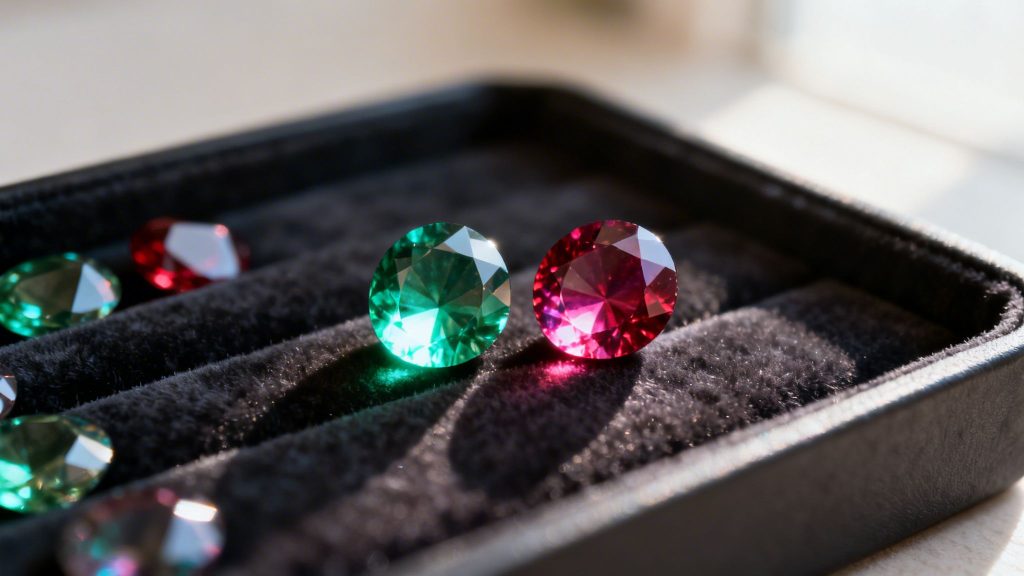
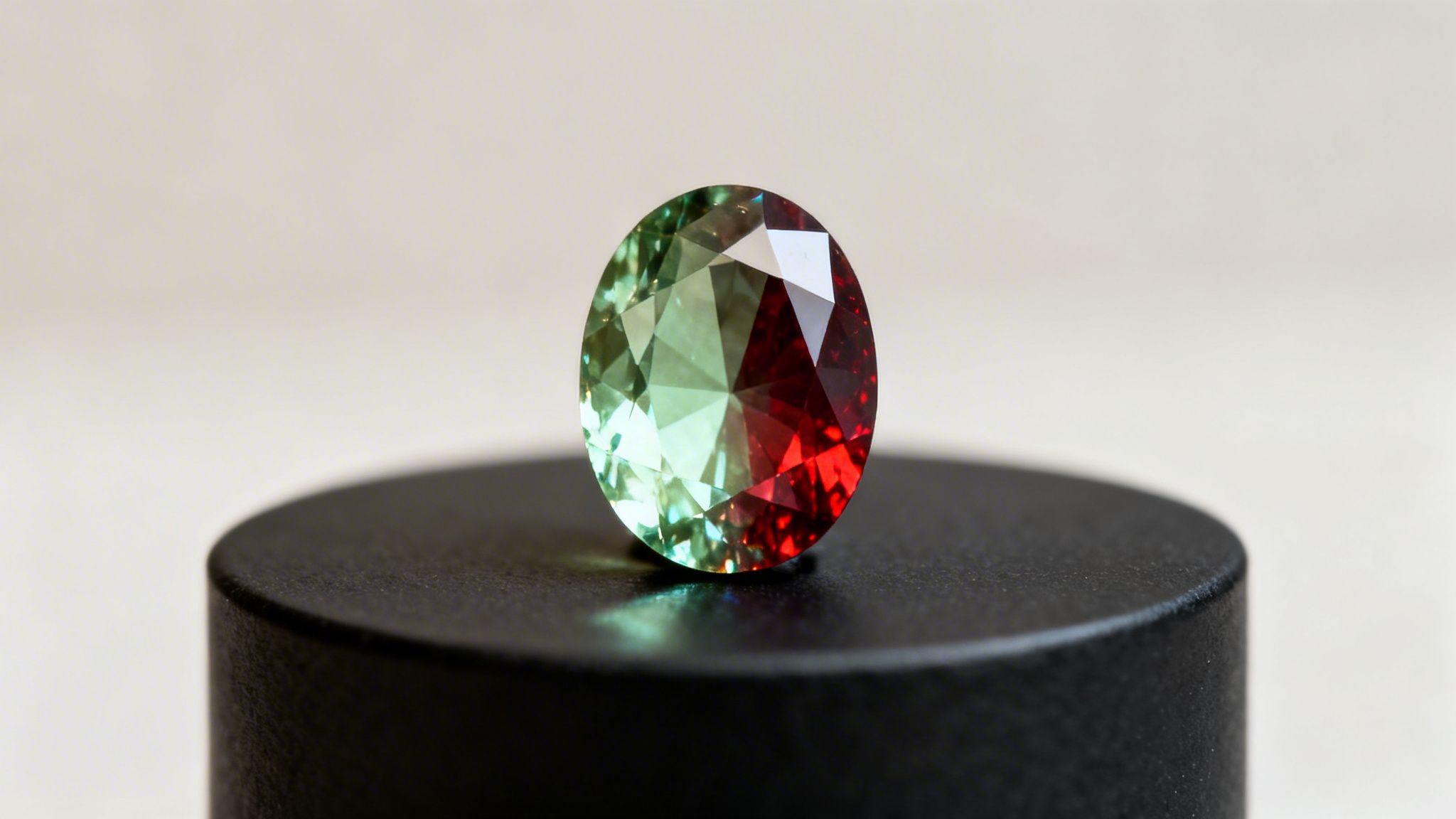
In the world of fine gemstones, some are beautiful and others are rare. A select few, however, are transformational. Alexandrite gems belong firmly in that final category. These stones exhibit one of the most dramatic phenomena in the mineral kingdom: a stunning color change from rich green in daylight to deep raspberry red under incandescent light. This chameleon-like quality makes alexandrite a dynamic piece of natural art and a premier collectible asset.
Understanding The Allure Of Alexandrite
The primary driver of alexandrite’s immense value is its ability to change color, famously described as "emerald by day, ruby by night." This is not an optical illusion. Instead, it results from the stone's unique chemical structure. Alexandrite is an exceptionally rare variety of chrysoberyl containing trace amounts of chromium, the same element that gives rubies their red and emeralds their green.
For this to occur, nature performed a near-impossible geological feat. It required beryllium, one of Earth's rarest elements, to combine with chromium under specific geological conditions. As a result, the formation of alexandrite is an event of staggering rarity. This rarity is the foundation of its market value and why the finest examples rank among the most expensive colored stones in the world.
The Collector's Perspective
For the discerning collector, alexandrite is a tangible asset with a legendary story and proven investment potential. Unlike most other gems, its value is judged almost entirely by the strength and completeness of its color change. Therefore, performance dictates price.
The gold standard for an investment-grade alexandrite is a 100% color shift from a vibrant, cool bluish-green to a warm, purplish-red. Stones that achieve this perfect transition command exponential prices. They often surpass high-quality diamonds, rubies, and emeralds on a per-carat basis.
This intense focus on performance places alexandrite in a class of its own. A large, clean alexandrite with a weak or incomplete color change will always be less valuable than a smaller stone with a dramatic, crisp transformation. In short, collectors acquire the magic of the change itself.
Key Drivers of Alexandrite Gem Value
Understanding what makes one alexandrite more valuable than another is critical for any collector or investor. The table below breaks down the core factors that drive the price and collectibility of these phenomenal gems. These attributes create a market where demand consistently outpaces supply, solidifying alexandrite's position as a top-tier collectible.
Value Factor
Description
Impact on Price
Color Change
The most critical factor. The change should be a complete 100% shift from green to red, with no brown or gray overtones.
Highest Impact. A strong, saturated change can multiply the price exponentially.
Clarity
The degree of internal flaws or inclusions. Top-tier stones are expected to be eye-clean.
High Impact. While secondary to color change, excellent clarity is required for top value.
Carat Weight
The physical weight of the stone. Natural alexandrite over one carat is exceedingly rare.
High Impact. Prices jump dramatically at the 1-carat, 3-carat, and 5-carat marks.
Origin
The geographic source of the gem. Russian stones are the historic benchmark, but Brazilian and other sources are also prized.
Significant Impact. Stones with documented Russian origin carry a major historical premium.
This dynamic solidifies alexandrite's position as a top-tier collectible asset. It is a fascinating case study in how rarity defines value. For a deeper look at how gems are classified, you can explore the distinctions between precious vs semi-precious stones and the market forces that shape their worth.
The Imperial Legacy of Russian Alexandrite
With a gemstone like alexandrite, value is tied as much to story as to geology. No story is more legendary than that of the original Russian stones. Their 1830s discovery in Russia's Ural Mountains created a perfect storm of geological rarity and imperial glamour. This immediately cemented their place as the ultimate benchmark for alexandrite gems.
The stones were famously named in honor of the young Tsarevich Alexander II. Consequently, the gem was instantly adopted by Russian nobility. Its color shift from green to red mirrored the colors of the Imperial Russian military. This made it a patriotic treasure and a staple in the jewelry of the royal court.
This imperial history is not just a charming footnote; it is a significant driver of modern-day value. A Russian alexandrite is more than a mineral. It is a tangible piece of history—an artifact from a lost imperial world. It is therefore no surprise that collectors willingly pay a massive premium for stones with confirmed Russian origin.
The Rarity of the Ural Mines
The mystique of Russian alexandrite is magnified by its extreme scarcity. The original deposits were not just rare; they were shockingly finite. For every one hundred emeralds miners extracted from those same mines, they would typically find only a single alexandrite. That 1-to-100 ratio perfectly illustrates the geological miracle of its formation.
After just a few decades of intense mining, the main veins were largely exhausted by the 1890s. This meant the world’s finest source of alexandrite vanished almost as quickly as it appeared. You can explore the science behind this scarcity by digging into the GIA's research on the geographic origin determination of alexandrite.
Why Russian Alexandrite Commands Top Prices
The market does not just prefer Russian alexandrite; it treats it as a separate and superior category. While newer sources like Brazil and Sri Lanka produce some beautiful stones, they cannot match the specific combination of color and history found in the original Uralian gems.
Several key factors secure their elite status:
Unmatched Color Quality: The best Russian specimens show a distinct bluish-green in daylight that morphs into a deep, velvety purplish-red. This exact color combination is considered the absolute ideal and is rarely seen from other locations.
Historical Premium: A direct connection to the Russian Tsars adds an intangible but very real layer of value. Owning one is like acquiring a piece of royal history, a story that resonates powerfully with high-end collectors.
Extreme Scarcity: With the original mines depleted for over a century, the supply is essentially fixed. Almost every gem-quality Russian alexandrite on the market today has been reclaimed from antique jewelry, creating a closed loop of highly sought-after assets.
For top-tier Russian alexandrite, origin can be a more significant price factor than clarity. A slightly included stone with certified Russian provenance and a strong color change will often command a higher price than a flawless stone from a less prestigious modern source.
This hierarchy is something any serious investor must understand. The "Russian" label acts as a brand in itself, guaranteeing a level of historical weight and rarity that no other alexandrite can match. These stones are not just valued as gems; they are traded as irreplaceable historical artifacts, securing their long-term appreciation.
Brazilian Alexandrite and the Modern Market
When the Russian Ural mines fell silent in the late 19th century, they left a void in the gem world. For nearly one hundred years, high-quality alexandrite was practically a ghost. The market survived on a slow trickle of stones from antique jewelry and a few minor deposits. This all changed in the 1980s when Brazil emerged, rewriting the modern story of alexandrite.
The pivotal moment arrived in 1987 with a discovery at Lavra de Hematita in Minas Gerais. This was a historic find. It unleashed a wave of alexandrite onto the market, including stones larger and cleaner than many of their legendary Russian counterparts. Fine alexandrite was suddenly available to a new generation of collectors.
However, a fascinating market dynamic occurred. One might expect more supply to lower prices, but for the finest specimens, the opposite happened. The arrival of spectacular Brazilian material only whetted the world's appetite. As a result, it drove demand and prices for top-tier stones to new heights.
The Dynamics of Brazilian Supply
Brazil's impact on the market cannot be overstated. After its emergence in the 1980s, the country now accounts for the vast majority of alexandrite production. For example, a top-quality 2-carat stone that sold for around $5,700 per carat in 1990 was commanding $8,000 per carat by 1999. You can dig deeper into alexandrite production and its wild market shifts to see these trends in action.
This price appreciation highlights a critical market truth. While Brazil produces the most alexandrite by volume, the overwhelming majority is commercial-grade. These stones have a weaker color change or noticeable inclusions, placing them in a different category from investment-grade gems. The flood of commercial material only makes exceptional stones seem that much rarer. To understand the country’s geological importance, read our exploration of remarkable Brazilian quartz specimens.
Valuing Top-Tier Brazilian Alexandrite
A fine Brazilian alexandrite is a crown jewel for any serious collection. These top-tier stones are prized for key traits that set them apart from the commercial-grade majority. These include exceptional clarity, strong color change, and significant size. The Hematita mine, for instance, became famous for producing impressive alexandrites, with some stones exceeding 10 carats.
Exceptional Clarity: Unlike the often-included Russian material, the best Brazilian alexandrites can be incredibly clean, sometimes even eye-clean or loupe-clean.
Strong Color Change: Top Brazilian gems deliver a powerful, dramatic color shift. While the colors may differ from the classic Russian ideal, the change itself is complete and undeniable.
Significant Size: The Hematita mine became famous for producing some truly impressive alexandrites, with a few stones even breaking the 10-carat mark.
It is a misconception that the flood of Brazilian material diluted the market. It actually stratified it. It created a clear pricing gap between common, commercial-grade stones and the rare gems that possess size, clarity, and a powerful color change.
Today, fine Brazilian alexandrites over three carats are incredibly rare. They command prices comparable to other elite collectibles. Those initial large discoveries are past, and new finds of that quality are practically unheard of, making these stones a finite and appreciating asset. For the sharp investor, a top-quality Brazilian alexandrite is a cornerstone acquisition.
Grading Alexandrite Gems for Value
Determining the value of an alexandrite operates by a different set of rules. With most gemstones, the classic "Four Cs"—Carat, Cut, Clarity, and Color—are weighed evenly. For alexandrite, however, one factor stands far above the others, making or breaking a stone's worth.
That single, all-important attribute is the strength and quality of its color change. This phenomenon is the very soul of the gem. It dictates whether a stone is a world-class collectible or a geological curiosity. The ultimate prize is the "emerald by day, ruby by night" effect—a full 100% shift from a cool green to a warm red, with no muddy brown or gray tones.
A weak or murky transition decimates an alexandrite's value, regardless of its size or clarity. To put it in perspective, a tiny half-carat stone with a perfect 100% color change will always be worth more than a large five-carat stone with a disappointing 30% change. Collectors and investors acquire the magic of the transformation itself.
The table below provides a clearer picture of how the percentage and quality of the color change directly impact an alexandrite's value tier.
Alexandrite Color Change Quality vs Value
Color Change Percentage
Description of Change
Relative Value Tier
80-100%
Strong, distinct shift from vivid green/bluish-green to deep red/purplish-red.
Top Investment
50-70%
Noticeable change, but one or both colors may be less saturated or have brownish tones.
Fine Jewelry
30-40%
Weak change, often appearing grayish-green to brownish-red.
Commercial Grade
<30%
Very faint change, barely perceptible to the untrained eye.
Low Commercial
As you can see, the value drop-off is steep. A stone must cross the 50% threshold to enter the fine jewelry market. Only those at the very top are considered true investment pieces.
The Four Cs in Context
While color change reigns supreme, the other traditional value factors still play a role. They help fine-tune a stone's price within the tier that its color change has already established. For any serious buyer, understanding how these elements work together is essential.
1. Color Quality and Sataturation
Beyond the change itself, the quality of the individual colors is critical. The most coveted alexandrites show a vivid bluish-green in daylight that morphs into a strong purplish-red under incandescent light. Stones that appear olive-green or yellowish-brown are far less desirable and see their value drop significantly.
2. Clarity
Clarity refers to the absence of internal flaws (inclusions) or external blemishes. While some classic Russian stones are known for their unique inclusions, the modern market expects high clarity. For any investment-grade piece, an "eye-clean" rating is the absolute minimum standard.
3. Carat Weight
Alexandrite's rarity intensifies as stones get larger. Natural alexandrites over one carat are exceptionally hard to find, and their prices increase exponentially with size. A two-carat gem is not merely double the price of a one-carat stone; it can easily be four or five times as much, assuming other quality factors are equal.
4. Cut
Cutting an alexandrite is a delicate balancing act. A master cutter must orient the rough stone to display the color change to its fullest potential. This often means sacrificing carat weight. A superior cut enhances brilliance and ensures the dramatic shift is fully appreciated. To understand valuation, it is worth exploring gem grading principles and lab-grown identification.
Market Tiers and Valuation Logic
The alexandrite market is split into sharply defined tiers. The vast majority of what is mined is commercial-grade material, suitable for mainstream jewelry but lacking investment potential. The fine and museum-quality gems that command breathtaking prices represent a tiny fraction of the overall supply.
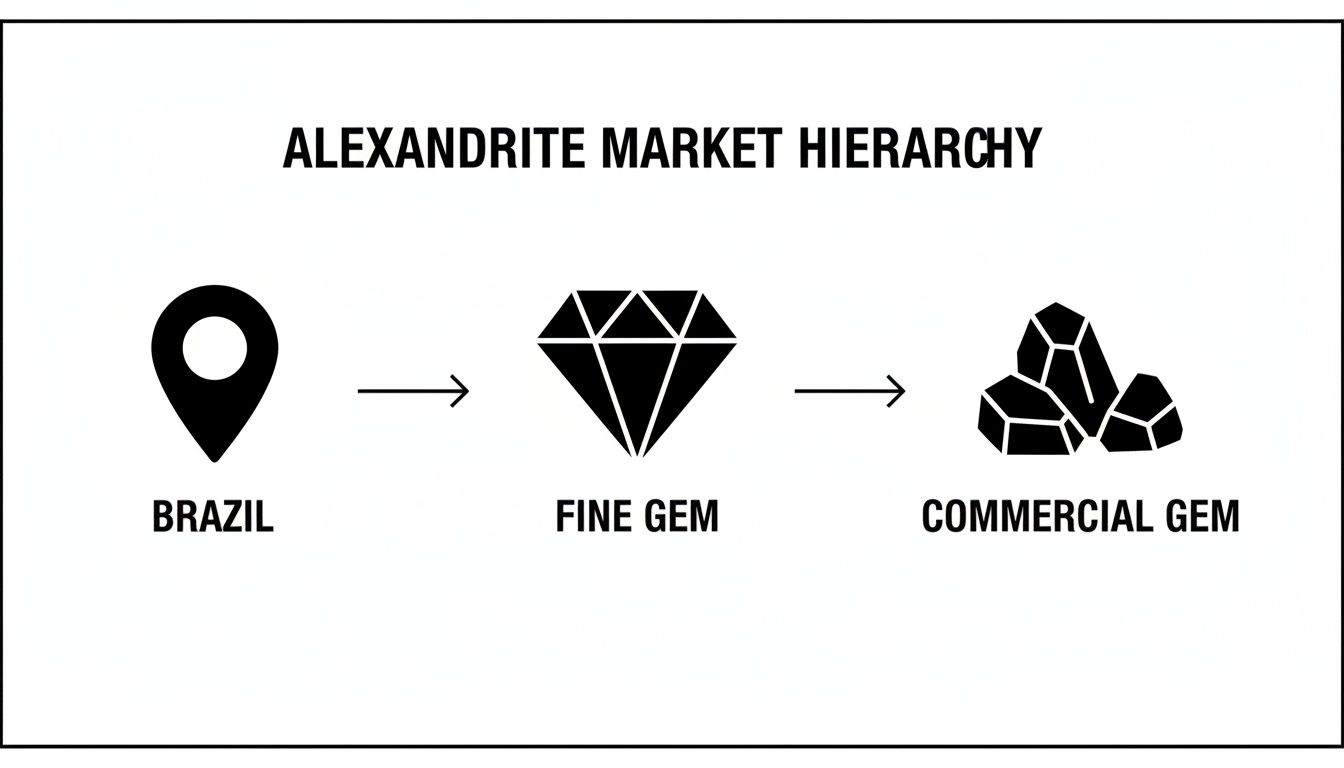
This hierarchy diagram shows how alexandrite from a major source like Brazil gets sorted into vastly different market tiers.
This visual drives home a crucial market truth: even if a location produces abundant alexandrite, only a tiny sliver will ever qualify as "fine gem" material.
The 95/5 Rule: A useful heuristic for the alexandrite market is that roughly 95% of all mined material is commercial-grade. The remaining 5% comprises the fine, gem-quality stones that fuel the high-end market and capture the attention of serious collectors.
This extreme imbalance between low-quality abundance and high-quality scarcity is the engine that drives alexandrite’s value. It is why two alexandrites of the same size can have prices that differ by a factor of one hundred. A true collector must learn to see past carat weight and focus on the performance-based details that define a genuine investment-grade gem.
Distinguishing Natural from Synthetic Alexandrite
When dealing with a gem as rare and valuable as alexandrite, the question of authenticity is paramount. The incredible prices these stones command have predictably led to a robust market for both synthetic and simulant stones. Distinguishing them is essential to protect your investment.
It is important to use correct terminology. A synthetic alexandrite is a stone grown in a laboratory with the same chemical and physical properties as its natural counterpart. A simulant, however, is a different stone, like color-change garnet, that merely mimics alexandrite's signature effect.
Understanding Synthetic Alexandrite
Most laboratory-grown alexandrite is created using either the hydrothermal process or the flux-growth method. Both mimic the intense heat and pressure deep within the Earth. The hydrothermal method, for example, dissolves ingredients in water inside a high-pressure chamber, slowly "growing" a crystal over time.
This complex process coaxes chromium atoms into the chrysoberyl crystal structure, perfectly recreating the famous color change. Because of this complexity, synthetic alexandrite is far from a cheap simulant. It helps to understand where it fits by comparing various synthetic gems. Since alexandrite became a June birthstone in 1952, demand has fueled both natural and synthetic markets. While top natural stones can exceed $70,000 per carat, even synthetic versions are among the most expensive lab-grown gems.
The Critical Role of Gemological Authentication
While a trained eye can sometimes spot red flags, visual inspection alone is never enough to confirm a stone’s origin. Modern synthetics can deceive even seasoned dealers. The only path to certainty is professional gemological testing.
A gemological laboratory report is non-negotiable for any significant alexandrite acquisition. Reputable labs like the GIA (Gemological Institute of America) use sophisticated equipment to analyze a stone's characteristics, providing a definitive conclusion on its origin.
These experts look for specific, tell-tale clues under a microscope:
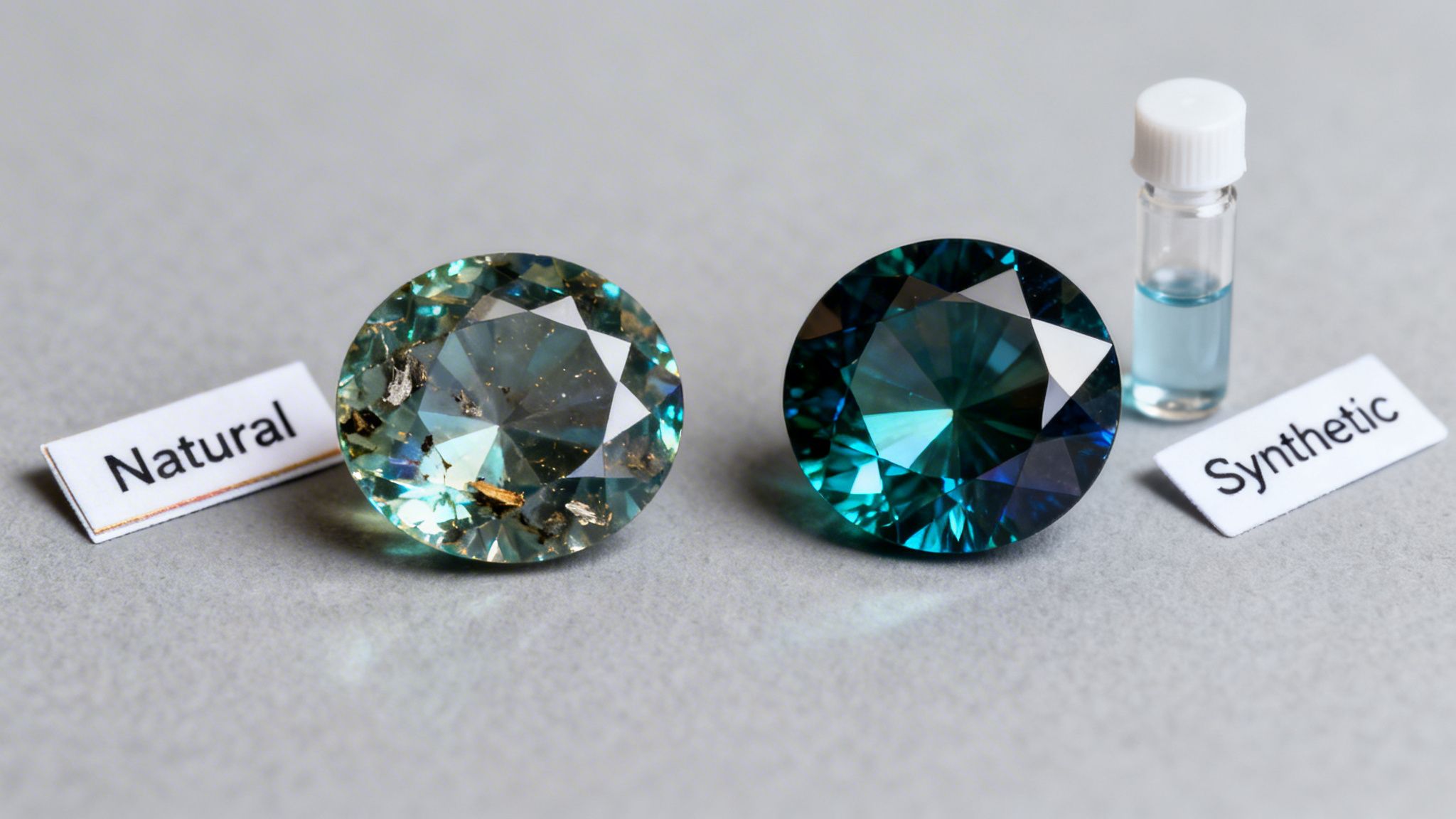
Inclusion Patterns: Natural alexandrite almost always contains microscopic mineral crystals, liquid-filled “feathers,” or fine tubes. These features act like a geological fingerprint. Synthetics are often suspiciously clean or show giveaways like leftover flux or unnatural growth lines.
Refractive Index and Spectrometry: Advanced tools measure how light behaves inside the gem and which wavelengths it absorbs. These readings provide a precise chemical profile that distinguishes the signature of natural chromium from elements used in laboratory-grown stones.
At Astro West, we believe provenance and scientific proof are the bedrock of responsible collecting. Our detailed crystal identification guide gives collectors foundational knowledge. Every alexandrite we offer is rigorously vetted and documented, ensuring you acquire a verified, tangible asset.
How to Invest in Alexandrite Gems
Moving from admiring alexandrite's color-change phenomenon to acquiring one is a significant step. This is where you shift from an admirer to a savvy investor. For a serious collector, this means focusing on the factors that make a stone a tangible, appreciating asset.
When it comes to alexandrite, one factor rules all others: the quality and strength of its color change. That single trait is the engine driving its value. Your primary goal is to find stones with a color change of 80% or greater, with clean, distinct hues free of any murky gray or brown overtones.
The Four Pillars of an Alexandrite Investment
Once you find a stone with a phenomenal color-change, a few other pillars support its value. These factors place the stone in the top tier of the market and secure its long-term investment potential. They ensure the acquisition appreciates over time.
Verifiable Origin: A stone with documented Russian origin will always command the highest prices due to historical significance and rarity. However, a top-quality Brazilian stone from a historic mine is also an elite, highly sought-after asset.
Exceptional Clarity: For any investment-grade piece, “eye-clean” is the minimum standard. Visible inclusions detract from its beauty and, therefore, its market value.
Significant Carat Weight: Size magnifies rarity. Alexandrite prices jump exponentially at key benchmarks, especially over the one-carat mark.
Expert Cut: A masterful cut is non-negotiable. It must be executed not just for sparkle, but to best display the signature color-change, even if it means sacrificing some carat weight.
Sourcing with Confidence
These strict criteria are why provenance and expert curation are so important. The market is filled with commercial-grade stones and sophisticated synthetics. This makes acquiring a stone on your own a significant risk.
Sourcing from a reputable gallery like Astro West removes that guesswork. We are not mass retailers; we are curators. We leverage our direct relationships with miners, gemologists, and specialists to source only scientifically verified specimens.
An investment in a high-caliber gemstone is an investment in rarity, beauty, and history. The gallery's role is to guarantee the authenticity and provenance of that investment, providing the collector with the confidence that their acquisition is precisely what it is claimed to be.
Every alexandrite in our collection undergoes a meticulous vetting process. We ensure its origin, quality, and natural formation are beyond question. This commitment transforms buying a gem from a transaction into a partnership built on trust and expertise, similar to our approach with tourmaline varieties and their values. For collectors who want to add a world-class alexandrite to their portfolio, our specialists are here to guide you.
A Few More Things You Might Be Wondering
To conclude, let's address some common questions about alexandrite. Think of this as practical advice from a seasoned collector. This information helps you navigate the market with confidence.
Why Is Alexandrite So Expensive?
It all comes down to a geological miracle. For alexandrite to form, two elements that rarely appear together—beryllium and chromium—must be in the same place at the same time. It is an incredible longshot.
Additionally, the original Russian mines have been depleted for over a century. Modern sources, like those in Brazil, produce very few clean, gem-quality stones over one carat. Intense collector demand chases an incredibly limited supply, keeping alexandrite positioned as one of the world's most coveted gems.
Is Alexandrite a Good Investment?
For the right pieces, absolutely. High-quality natural alexandrite has a proven history of holding and appreciating in value. It performs much like fine art or other top-tier collectibles. Its investment potential, however, is directly tied to its quality.
The key factors are the strength of its color change, its clarity, and its origin. A certified, top-tier alexandrite with a dramatic color shift is not just a gemstone. It is a tangible asset with excellent potential for long-term growth.
When it comes to alexandrite, investment potential is all about the quality of the color change. A stone with a complete, 100% shift from a vibrant green to a pure red is a world-class asset. A stone with a weak or murky change is just a mineral specimen with very little financial upside.
What Is More Important in Alexandrite: Color Change or Clarity?
The color change is king. It is, without a doubt, the single most important factor that determines an alexandrite's value. A gem with a dramatic and complete 100% color shift will be exponentially more valuable than a larger, clearer stone with only a partial or muddy change.
That said, for top investment-grade stones, both an exceptional color change and excellent clarity are expected. Once you compare two gems that both have a phenomenal color shift, clarity becomes the tiebreaker. It separates the great from the truly magnificent.
How Can I Tell if My Alexandrite Is Real?
For a stone of this value, the only way to be certain is with a full report from a respected gemological laboratory like the GIA or AGL. Their experts use advanced instruments to analyze the gem's unique chemical makeup, refractive index, and internal inclusion patterns.
These characteristics create a scientific fingerprint. They can definitively separate a natural stone from a synthetic one or any other simulant. Relying on visual inspection alone is too risky for such a high-stakes acquisition.
At Astro West, we understand that acquiring a world-class alexandrite is a significant investment in rarity and natural history. Our specialists ensure every specimen is scientifically vetted and ethically sourced, providing the authentication and provenance necessary for a confident acquisition. Explore our curated collection of fine minerals and gemstones at https://astrowest.com.