A Heartfelt Thank You: Reflections on a Year of Natural Beauty
As the festive season wraps our world in a warm, glittering glow, we at Astro West find ourselves reflecting on the year that has passed. This is a time for gratitude, and our hearts are full, thanks to you—our cherished community of collectors, admirers, and friends. This year, you’ve shared in our passion for nature's most exquisite creations, from the deep purple sparkle of amethyst to the sun-kissed warmth of citrine and the gentle blush of rose quartz.
In a world that often moves too fast, you’ve chosen to embrace the slow, deliberate beauty of the Earth. You’ve brought into your homes and lives treasures that were millions of years in the making, each a testament to the planet's silent, patient artistry. Thank you for seeing what we see: that a simple stone is never just a stone. It's a story, a piece of history, a small anchor to the natural world.
A Legacy Written in Stone
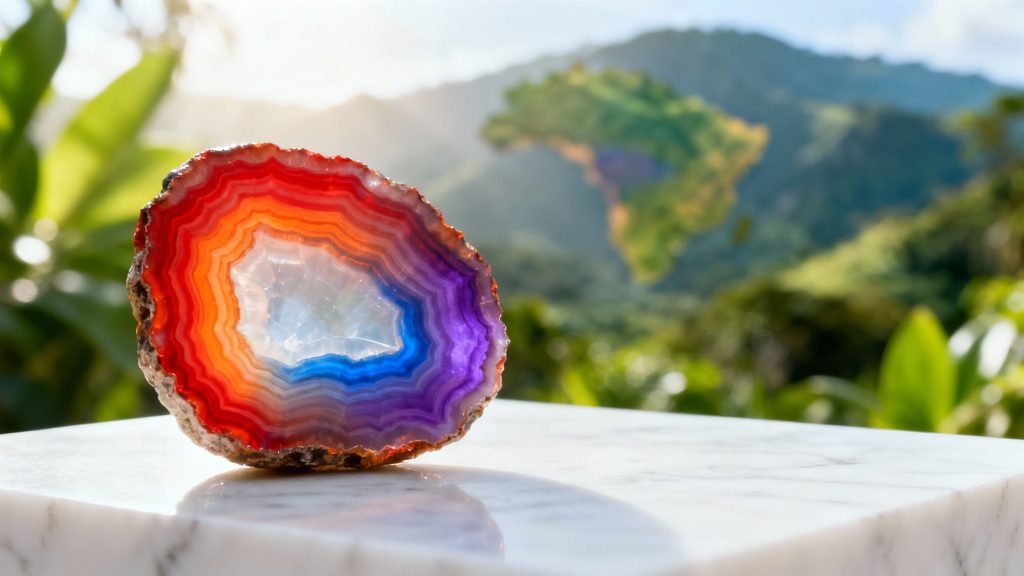
The story of nature's art is beautifully told through gems like the agate from Brazil. For nearly two centuries, the country has been the world's undisputed leader in sourcing these captivating gemstones. It's a journey that began millions of years ago, deep within the Earth.
When ancient volcanic lava cooled, it trapped gas bubbles, creating empty pockets or "vesicles" in the rock. Over eons, silica-rich groundwater slowly trickled into these cavities, depositing microscopic quartz crystals layer by painstaking layer. This gradual process, much like the rings forming on a tree, built up the intricate bands that make every single agate unique.
The Heart of Agate Country
The epicenter of this natural artistry is Brazil's southernmost state, Rio Grande do Sul. Commercial agate mining kicked off here way back in the 1830s, establishing a legacy that is still going strong today. While Rio Grande do Sul is the powerhouse, other states like Minas Gerais and Bahia also contribute their own beautiful and significant varieties to the global market.
This slow, silent formation process means that every Brazilian agate is a natural time capsule. It captures a specific moment in geological history, preserving the mineral content and environmental conditions of its birth in its unique colors and patterns.
The sheer variety of agate Brazil produces is just astounding, and it's all thanks to trace minerals that essentially "dye" the stone as it forms:
Iron Oxides: These are the artists behind the fiery reds, warm oranges, and rich golden yellows that make so many Brazilian agates pop.
Manganese: This element often lends softer hues, creating delicate pinks, lavenders, and even deep, moody purples.
Other Elements: A whole host of other minerals can introduce blues, greens, and earthy browns, resulting in an almost endless palette.
Each polished agate slice tells this incredible story, offering a direct, tangible connection to the powerful geological forces that have shaped our planet.
How Brazilian Agate Gets Its Famous Bands and Colors
The iconic, mesmerizing bands of Brazilian agate aren't the work of an artist, but the result of an incredibly slow geological performance that took place over millions of years. This process transforms a simple empty space in volcanic rock into a natural masterpiece, with each layer telling a small part of a much larger story.
It all begins with ancient volcanic activity. As molten lava flowed and cooled, it trapped pockets of gas, creating hollow cavities known as vesicles. These empty spaces, scattered throughout the hardened basalt rock, became the perfect molds for agate to form.
The Slow Drip of Creation
Over countless millennia, silica-rich water—basically groundwater carrying dissolved quartz (SiO₂)—started seeping through the porous volcanic rock. This fluid slowly percolated into the empty vesicles, carrying the building blocks of agate with it.
Think of it like a slow-motion candy maker adding one sugar layer at a time. The silica-rich solution coated the inner walls of the cavity, depositing an infinitesimally thin layer of microscopic quartz crystals, also known as chalcedony. This happened over and over again, thousands upon thousands of times, with each new pulse of fluid adding another layer.
The result is what geologists call "wall-banding" or a "fortification" pattern, where the layers perfectly follow the contours of the original cavity. Each band represents a distinct episode of deposition—a unique chapter in the stone's long formation.
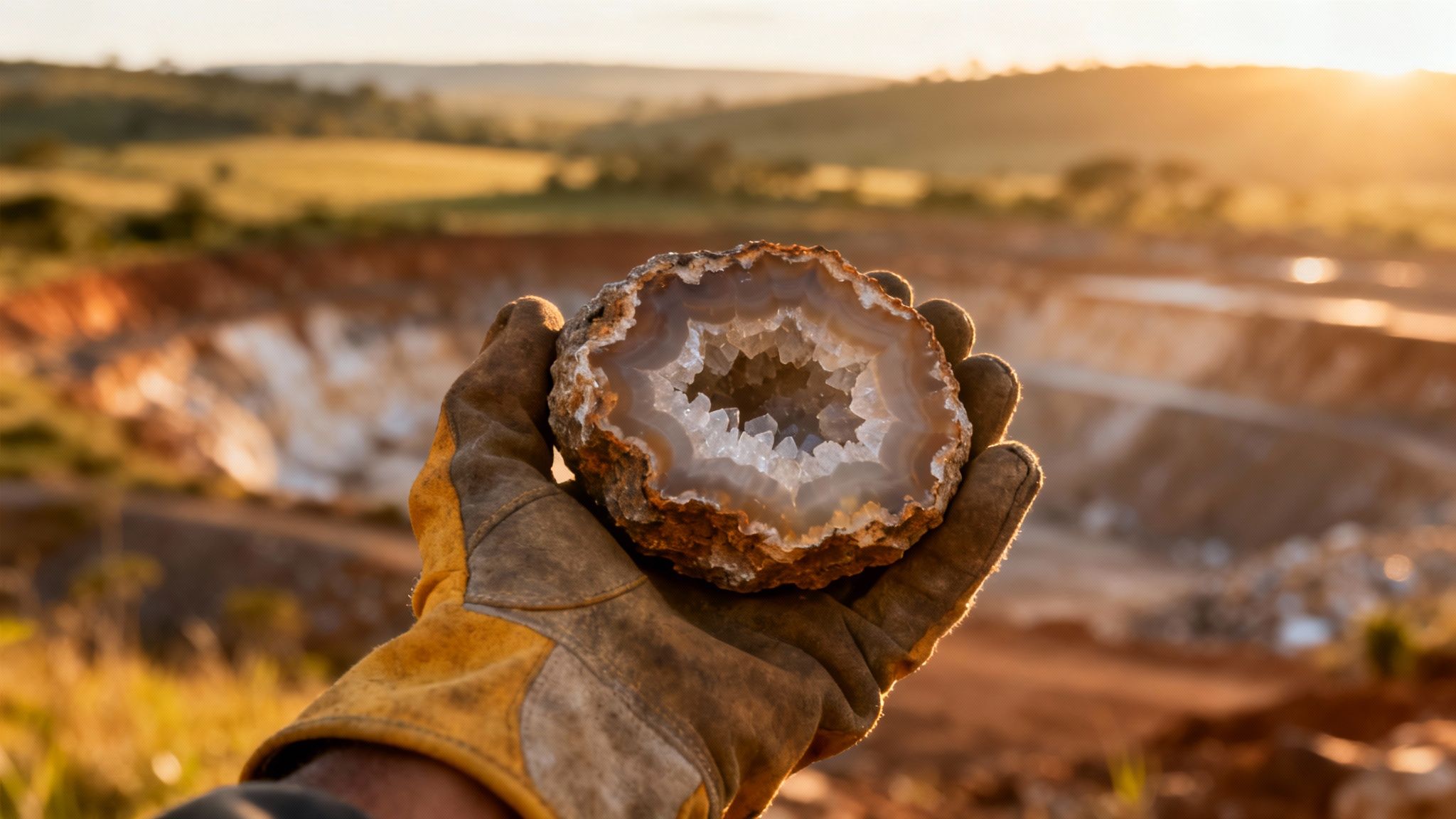
This gradual, inward-building process is why many agates have a hollow center or one filled with larger, visible quartz crystals. If the silica supply ran out before the cavity was completely filled, it often left behind a beautiful geode.
Painting with Minerals
The stunning spectrum of colors in agate Brazil comes from mineral impurities that were present in the groundwater during its formation. The chalcedony itself is naturally a grayish or milky white, but these trace elements acted as natural pigments, dyeing the stone as it grew.
The most common mineral artists include:
Iron Oxides: Responsible for the fiery reds, warm oranges, and rich yellows that give many Brazilian agates their dramatic, sunset-like appearance.
Manganese: This element tends to create softer, cooler tones, producing delicate pinks, lavenders, and even deep purples.
Other Trace Elements: A variety of other minerals, like chromium or nickel, can introduce rare greens and blues, while organic material might result in darker browns or blacks.
Because the concentration of these minerals in the water changed over time, different layers received different colors, creating the beautiful contrast and rhythm you see in the final stone. This intricate process ensures no two agates are ever exactly alike.
Each slice reveals a unique history, a fingerprint of the specific geological conditions present at its birth. The fine layers seen in a hand-polished chalcedony slice offer a clear window into this ancient and beautiful natural process.
A Visual Field Guide to Brazilian Agate
Trying to get a handle on the world of agate from Brazil is a bit like walking through a gallery of nature’s best abstract art. Every single variety has its own personality, defined by a unique mix of color, pattern, and the way it’s structured inside. Learning to spot these key types doesn't just make you a smarter buyer; it deepens your appreciation for the incredible geological story each stone has to tell.
From fiery, energetic reds to peaceful, calming blues, Brazilian agate shows up in a breathtaking range of styles. Think of this section as your visual field guide for recognizing the most beloved and common varieties you're likely to come across.
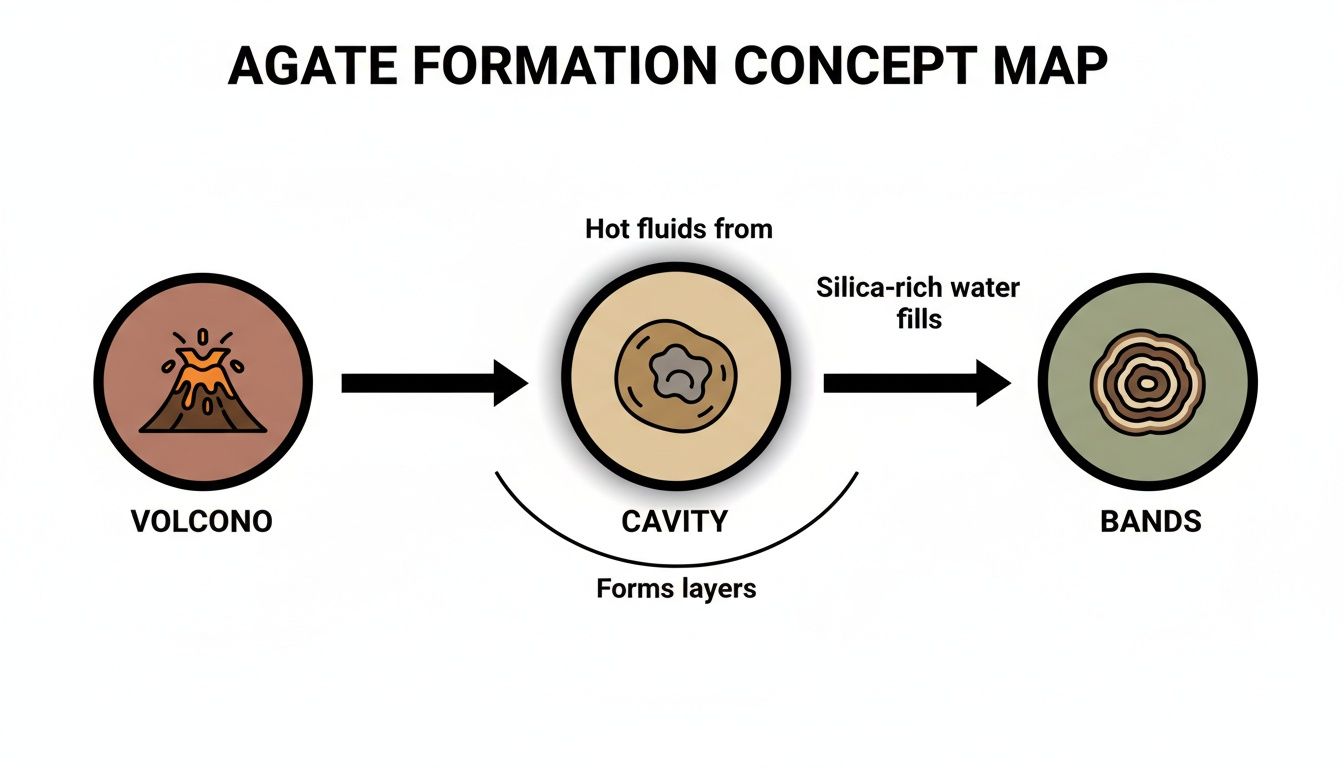
This visual map breaks down the simple yet profound journey of agate formation, from volcanic origins to its final banded beauty.
The image above shows how ancient volcanic eruptions created gas bubbles in lava. As the lava cooled, these cavities became the perfect vessels for silica-rich water to seep in, slowly depositing layer after layer to form the agates we find today.
A Quick Look at Common Varieties
Before we dive deep, it helps to have a quick reference. This table breaks down the most common types of Brazilian agate you'll encounter, giving you a starting point for identification based on their most recognizable features.
Common Brazilian Agate Varieties at a Glance
Description: A quick reference guide to identify the key visual characteristics of popular agate types found in Brazil.
Agate Variety
Classic Banded Agate
Blue Lace Agate
Carnelian Agate
Moss Agate
Oco Geodes
This table is just a snapshot, of course. The real magic is in the details of each individual stone, which we'll explore next.
Classic Banded Agate
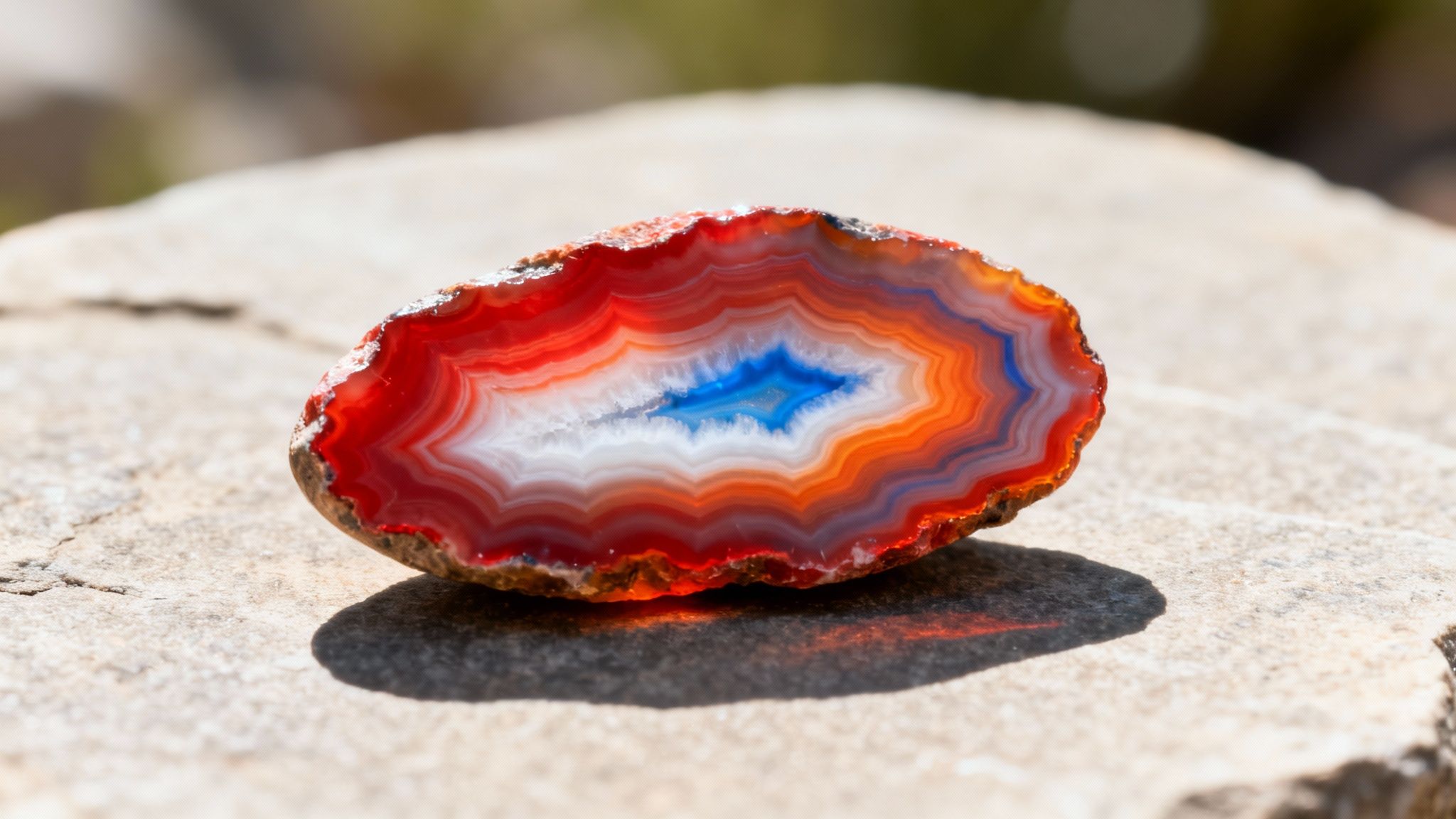
When most people hear the word "agate," this is what they picture. Banded Agate, often called Fortification Agate, is the quintessential variety. It’s defined by those elegant parallel or concentric lines that look like the walls of an old fort.
These bands are amazing because they literally trace the shape of the ancient volcanic pocket where the stone was born, creating a beautiful map of its own creation. Colors can run the gamut from earthy browns and soft grays to intense reds and oranges, all depending on which mineral impurities were present at the time. The quality markers to look for are the clarity and contrast between the bands—a great piece will have crisp, well-defined lines that create a real sense of rhythm.
Blue Lace Agate
Known for its delicate, calming vibe, Blue Lace Agate is easily one of the most sought-after varieties from Brazil. You'll recognize it by its intricate, wavy bands of pale blue, often layered with soft stripes of white or a brighter sky blue.
The pattern looks just like fine lace or gentle ripples on water, giving it an almost ethereal feel. It's this serene beauty that makes it a huge favorite for jewelry and decorative pieces meant to bring a tranquil atmosphere to a room.
Carnelian Agate
Carnelian is all about warmth and energy. This is the agate variety known for its rich, fiery colors that span from a pale, translucent orange all the way to a deep brownish-red. That beautiful color comes from iron oxide inclusions.
While it can sometimes be a solid color, many of the best Brazilian Carnelians show subtle banding or cloudy patterns that give them more depth and character. Its vibrant, sunset-like tones have made it a go-to stone for everything from ancient talismans to bold, modern jewelry.
A key trait of high-quality Carnelian is its translucence. When you hold a piece up to the light, it should almost glow from within, showing off its rich, even color and internal depth.
Moss Agate
Here's where things get really interesting. Unlike its banded cousins, Moss Agate doesn't have those concentric layers. Instead, this captivating stone is filled with dendritic inclusions of manganese or iron that create patterns resembling moss, seaweed, or even tiny landscapes trapped in stone.
The base chalcedony is usually a milky white or clear, which acts as the perfect canvas for the green, brown, or black "moss" to stand out. Every single piece is a one-of-a-kind scene painted by nature, making it a huge favorite among collectors who appreciate true natural artistry.
Oco Geodes
Also known as Ocos or Occos, these are small, hollow agate nodules that are wildly popular with collectors, and for good reason. On the outside, they look like unassuming little rocks, but when you crack one open, it reveals a dazzling world.
The outer shell is a classic banded agate, but the hollow center is lined with sparkling drusy quartz crystals. These miniature geodes are like natural treasure boxes, perfectly showcasing the two-stage process of agate formation: the slow, patient layering of the bands, followed by the growth of bigger crystals in the empty space left over. Understanding these different personalities is the first step to building a truly exceptional collection.
The Journey from Brazilian Mines to Your Home
Every polished piece of agate Brazil holds a remarkable story of discovery, sweat, and artistry. That journey starts deep within the earth, mostly in Brazil's southernmost state, Rio Grande do Sul—the undisputed heartland of the global agate industry. Here, along with other key regions like Minas Gerais, the landscape is packed with ancient volcanic basalt, the very rock that hosts these geological treasures.
Unearthing these stones is a fascinating mix of old traditions and modern grit. It ranges from huge mining operations using heavy machinery to dig into basalt flows, all the way down to small, family-run efforts where miners carefully pull nodules out by hand. These communities, often built around the agate trade for generations, have an intimate knowledge of the land, knowing exactly where to look for the most promising finds.
From Rough Stone to Polished Gem
Fresh from the earth, agates look like dull, unassuming rocks. Their incredible inner beauty is completely hidden. This is where the real magic begins, in the hands of skilled local artisans and lapidary experts. It's a meticulous process that requires a trained eye to decide the best way to slice into the stone.
That first cut is everything. An artisan has to "read" the rough stone’s shape and subtle external clues to guess the orientation of the bands inside. One perfectly placed cut can reveal a breathtaking fortification pattern, while a bad one might ruin its most beautiful features forever.
After that critical first slice, the agate goes through several stages of grinding and polishing:
Slicing and Shaping: The nodules are cut into slabs, shaped for jewelry, or prepared as decorative objects.
Grinding: Using progressively finer abrasive wheels, artisans smooth out saw marks and refine the stone's final shape.
Polishing: The final touch involves a fine polishing compound, often on a leather or felt wheel, to bring out that natural, glass-like shine. This is the moment the true vibrancy of its colors and patterns finally comes to life.
This hands-on process transforms a raw piece of the earth into a true work of art. The journey from the mine to the market is a testament to the human skill required to unlock the beauty that nature created millions of years ago.
It's a tradition with deep roots in the region. Systematic agate extraction in Rio Grande do Sul was already underway by about 1830. By the 19th and 20th centuries, Brazilian agates were fueling a massive global lapidary industry, producing everything from intricate cameos to the gorgeous decorative slabs we see today.
The result of this incredible journey is a durable, beautiful gemstone that connects us to both the planet’s ancient past and the enduring traditions of Brazilian craftsmanship. That same appreciation for natural art is what draws people to a stunning Brazilian quartz cluster, another geological wonder born from the same rich lands.
How to Judge the Quality and Value of Brazilian Agate
What makes one piece of Brazilian agate a show-stopping collector’s item while another is just a pretty rock? It’s not some hidden secret. Unlocking the real value of an agate Brazil is about learning to see the stone the way a seasoned expert does.
Once you get a feel for a few key factors—color, pattern, clarity, size, and the final polish—you’ll be able to confidently size up any piece, whether it's a small tumbled stone or a massive decorative slab. The price tag isn't just about looks; it's rooted in rarity and the skill it takes to bring out the stone's best features. A vibrant, intricately patterned agate is a product of very specific and uncommon geological conditions, making it a true natural treasure.
What to Look for in a Quality Agate
When an expert evaluates a piece of Brazilian agate, they're really focusing on four main characteristics. Think of these as the pillars holding up its overall value. If you can master these, you’ll have a solid framework for making smart buying decisions.
Color Vibrancy and Rarity: The first thing that grabs your attention is always the color. You want to see hues that are deep and rich, not dull or washed-out. Natural, vivid reds, deep blues, or unusual purples are almost always more desirable than common browns and grays. Contrast is also a huge deal—a piece with sharp, clean color changes between bands is far more valuable than one with muddy, blended tones.
Pattern Intricacy and Symmetry: The banding is an agate’s signature. Fine, delicate, and tightly packed bands, often called a "fortification" pattern, are highly prized. Symmetrical, concentric patterns that flow with the stone's shape without any weird breaks or distortions are considered top-tier. Keep an eye out for unusual features like "eyes" (perfectly circular bands) or scenic inclusions that look like tiny landscapes, as these can dramatically increase a piece's desirability.
Clarity and Translucence: A top-notch agate should let light pass through it. Hold the stone up to a lamp or window; the more it seems to glow from within, the better the quality of the chalcedony. A clear, glassy look without cloudy spots, fractures, or distracting internal flaws is a tell-tale sign of superior material.
Size and Finish: While it's not always the most critical factor, bigger pieces of high-quality agate are simply rarer and therefore more valuable. Finding a large slab with perfect banding and brilliant color is a major score. Finally, don't overlook the polish. A masterful polish gives the stone a wet, almost liquid-like shine that makes its color and depth pop. A bad polish, on the other hand, can make even a fantastic stone look flat and lifeless.
Spotting Treatments and Understanding the Market
One of the most common tricks in the agate trade is dyeing. Lower-grade agates, which tend to be porous and pale, are often soaked in dye to create unnaturally bright blues, pinks, or greens. They can be beautiful, sure, but they just don't hold the same value as naturally colored stones.
How to Spot Dyed Agate: Look for color that seems too perfect or electric. Dye has a habit of seeping into tiny cracks and fissures, creating a giveaway spiderweb of intense color that you’d never find in a natural piece. Natural color flows with the bands, while dye often looks like it's fighting against them.
It's helpful to know that authentic, high-quality agate is a big deal in the global gemstone market. This market, valued at around USD 358–369 million, is expected to keep growing. North America and the Asia-Pacific region are the biggest hubs for demand, showing a strong international love for both agate jewelry and decorative pieces. If you want to dive deeper into the numbers, you can check out this agate market research.
Understanding these market dynamics helps put things in perspective. It explains why a premium, natural agate Brazil specimen is seen as a solid investment by collectors all over the world.
Natural vs. Treated Brazilian Agate: A Value Comparison
When you're out shopping, it's crucial to know whether you're looking at a natural wonder or a man-made enhancement. The difference in market value can be enormous. This table breaks down what you need to know.
Factor
Natural Agate
Dyed Agate
Color
Subtle, earthy tones with natural variations. Vibrant colors are rare and highly prized.
Often unnaturally bright, uniform, or "electric" (hot pink, neon blue).
Pattern
Color follows the natural banding and flows seamlessly with the stone's structure.
Dye often pools in cracks, creating a "spidery" look that cuts across the bands.
Value
High, especially for rare colors and intricate patterns. Considered a collector's item and investment.
Significantly lower. Sold as decorative items, not investment pieces.
Rarity
Truly vibrant, clean pieces are exceptionally rare and command premium prices.
Common. Made from lower-grade, porous material that is widely available.
Authenticity
Prized for being a 100% natural creation, reflecting its unique geological history.
Considered an "enhanced" or "treated" stone. Must be disclosed by reputable sellers.
Ultimately, while dyed agates can be fun and affordable decorations, they live in a completely different league from their natural counterparts. For serious collectors and investors, the rarity, subtle beauty, and geological story of an untreated Brazilian agate will always be the real prize.
Starting Your Own Brazilian Agate Collection
Making the leap from simply admiring Brazilian agate to building your own collection is an incredibly rewarding journey. It’s not just about picking up the shiniest stone you see; it’s about learning to spot quality, understanding what makes a piece truly rare, and connecting with the deep geological story each agate tells.
The first, and most important, step is to find sellers you can trust. A reputable dealer is your greatest ally, giving you the real story on a stone's origin and letting you know about any treatments it might have undergone. Look for vendors who know their stuff, provide detailed descriptions, and clearly have a passion for the minerals they're selling. A good seller will always be happy to answer your questions about sourcing, quality, and the unique quirks of a specific agate Brazil specimen.
Developing a Collector's Eye
Once you've found a reliable source, the real fun begins: training your eye to see beyond just a pretty pattern. While looks are definitely part of the appeal, a true collector learns to recognize the subtle features that elevate a piece from common to exceptional.
Here’s what to start looking for:
Rare Formations: Keep an eye out for banding that breaks the mold. "Eye" agates, with their perfect concentric circles, are a classic prize. So are agates with sharp, geometric fortification patterns that look like ancient city walls.
Unique Inclusions: Moss agates are famous for their tiny, branch-like dendritic inclusions that create miniature landscapes inside the stone. Other pieces might hold feathery plumes, sprays of sagenitic needles, or even tiny pockets of trapped water (enhydros). These features can turn an ordinary agate into a collector's dream.
Historical Significance: Some agates hail from specific, well-known localities in Brazil that are now closed or mined out. Owning a piece from one of these classic locations adds a layer of history and rarity to your collection that can't be replicated.
Remember, the most valuable collections are built on knowledge, not just budget. A small but exceptional agate with a rare inclusion can be a more significant find than a much larger, more common piece.
Displaying Your Natural Treasures
Your collection is a showcase of natural art, and it deserves to be displayed in a way that does each piece justice. The right presentation not only protects your agates but turns them into stunning decorative elements that will definitely spark a few conversations.
Good lighting is everything. For translucent agate slices, backlighting is a game-changer—it makes the bands and colors glow from within, revealing their hidden depth and complexity. For solid nodules or sculptural items, like a gorgeous hand-carved agate bowl, a few focused spotlights can highlight their polished surfaces and beautiful forms.
Essential Care and Storage
Agate is a tough stone, ranking a solid 6.5 to 7 on the Mohs hardness scale. Even so, a little care will go a long way in preserving its polish and integrity for years to come. The best cleaning method is simple: a bit of mild soap, warm water, and a soft brush to gently clear away any dust.
Stay away from harsh chemicals or abrasive cleaners. It’s also a good idea to keep agates out of prolonged, direct sunlight, as this can cause dyed specimens to fade over time. When storing your collection, make sure individual pieces aren't knocking against harder gemstones like diamonds or sapphires, which could cause scratches. With these simple tips, your Brazilian agate collection will remain a source of beauty and wonder for a lifetime.
Your Agate Questions Answered
Diving into the world of Brazilian agate always sparks a bit of curiosity. Whether you're just starting your collection or have been admiring these stones for years, a few questions tend to pop up. Let's clear up some of the most common ones.
How Can You Tell if Brazilian Agate Is Real?
Authentic agate has a unique, waxy translucence. Even the darker pieces will let a little bit of light through. A great first test is to hold it up to a light source—if you see a subtle glow from within, you're likely on the right track.
Next, look for the banding. Natural agate has organic, flowing bands with slight imperfections; they tell the story of its formation. Perfectly straight lines or flawless, uniform color can be a red flag for glass or resin fakes. Real agate also feels cool and solid in your hand. And don't worry if you see a brightly colored piece—dyed agate is still real agate, just with its natural beauty enhanced.
What Is the Best Way to Clean Agate Jewelry?
The best method is often the simplest. All you need is a soft brush (like an old toothbrush), some warm water, and a bit of mild soap. Gently scrub the stone to remove any dirt, rinse it well, and pat it dry with a soft cloth.
Stay away from harsh chemicals or ultrasonic cleaners. Sudden, extreme temperature changes are also a no-go, as they can damage the polish or even cause tiny fractures inside the stone. When you’re not wearing it, store your agate away from harder gems like diamonds to keep it from getting scratched.
Is Brazilian Agate a Precious or Semi-Precious Stone?
Agate is officially classified as a semi-precious gemstone. This broad category includes a whole world of beautiful stones that are more abundant than the "big four" precious gems: diamond, ruby, sapphire, and emerald.
But honestly, its semi-precious status is part of what makes agate so special. It means that owning a genuine piece of Earth's ancient artistry is within reach for everyone, making the joy of collecting accessible to all.
Are There Ethical Concerns with Agate Mining in Brazil?
Brazil has a long-established agate mining industry, and it's a significant part of the country's economy. For collectors who prioritize ethical sourcing, the key is to buy from reputable dealers who value transparency.
Never hesitate to ask a seller about their supply chain. Supporting businesses that build direct relationships with the mines or local artisans in Brazil is the best way to ensure that responsible practices are followed and that the communities at the source are being supported fairly.
At Astro West, we believe every stone tells a story of our planet's incredible history. From the fiery bands of a Brazilian agate to the deep purple of an amethyst cluster, these natural treasures connect us to the timeless beauty of the Earth. We are deeply grateful to share this journey with you. Thank you for making this year so special. From our family to yours, we wish you a joyous holiday season and a new year filled with wonder.