The Magic of Earth in Your Hands: Natural Gifts for This Christmas
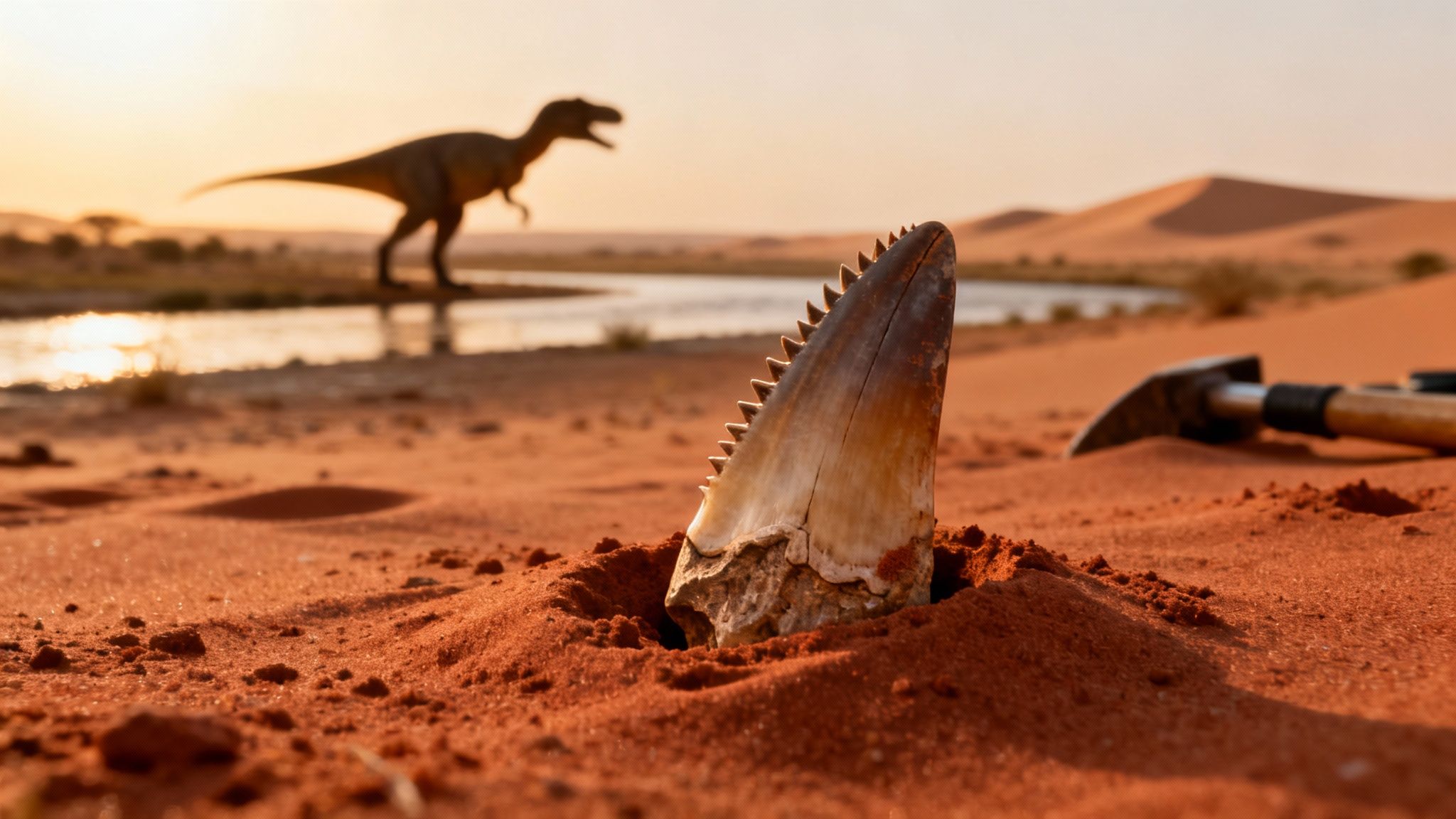
This Christmas, give a gift that transcends time. Step into a world roughly 164 million years ago, to an ancient African landscape stalked by Afrovenator abakensis—a formidable predator whose name means "African hunter." Today, its legacy, unearthed from the Sahara, offers a rare window into Earth's deep past. For the person who has everything, an Afrovenator tooth is a true prize, a piece of authentic history.
At Astro West, we believe the most magical gifts are forged by the Earth itself. An Afrovenator tooth isn't just any fossil; it’s a remnant of a key predator from the Middle Jurassic. These blade-like teeth are a testament to the raw, untamed energy of the natural world, making them an unforgettable Christmas gift.
The Saharan Hunter and Its Prized Fossil
The discovery of Afrovenator in 1993 was a landmark moment for African paleontology. A partial skeleton from Niger’s Tiourarén Formation gave scientists a vital look at the theropods that roamed Gondwana.
This was no small dinosaur. Afrovenator stretched about 8 meters (26 feet) and weighed an estimated 1 tonne. It was a megalosaurid perfectly built for the hunt.
Its teeth tell the story of its predatory power. Measuring around 5 cm (2 inches), they were sharp, serrated blades designed to slice through flesh with terrifying efficiency—a true marvel of natural engineering.
A Coveted Piece of Prehistory
For any enthusiast, holding an Afrovenator tooth is like holding a piece of a lost world. Unlike more common fossils, Afrovenator teeth are exceptionally scarce. This rarity makes every specimen a unique and valuable find, a gift that truly cannot be replicated.
These fossils don't just look impressive; they tell a gripping story of survival and predation from a time when Africa's ecosystems were completely different.
This Christmas, the appeal lies not just in the fossil itself, but in its profound connection to history and the Earth's raw energy. An Afrovenator tooth is a tangible link to the Middle Jurassic Sahara—a world of giant sauropods and the powerful carnivores that hunted them.
This guide will give you the foundational knowledge you need to appreciate this remarkable fossil. It's much like how understanding the unique anatomy of other African predators is key—you might find our curated Spinosaurus fossil box an interesting point of comparison for a fellow history lover.
Before we dive into the anatomy that makes an Afrovenator tooth identifiable, think of this as your field briefing on a true prehistoric legend, a gift of authentic history.
Anatomy of a Predator's Tooth
What makes an Afrovenator tooth such a special gift? Think of it less like a simple tooth and more like a high-performance serrated knife, perfectly engineered for a single purpose: slicing through flesh. Each tooth is a masterclass in natural design, combining an efficient shape, structure, and texture.
The first thing you’ll notice is its blade-like, or ziphodont, shape. The tooth is laterally compressed, meaning it’s much thinner from side to side than from front to back. This profile acted like a knife’s edge, letting it cut deep with minimal resistance. While common among meat-eating theropods, Afrovenator refined it with a subtle, elegant recurve—a gentle backward arc that made every bite more devastating.
The Devil in the Details
The real secret to the Afrovenator tooth’s power is in the microscopic details. Running down the front (mesial) and back (distal) edges are two sharp ridges known as carinae. These were the primary cutting surfaces.
Mounted on these carinae are the denticles, or serrations. These tiny, sharp bumps grabbed and tore flesh as the dinosaur pulled its head back, working exactly like the teeth on a saw. The size, shape, and density of these denticles are critical for identification. In Afrovenator, they are fine but distinct, which made its bite incredibly efficient for slicing. It's a feature that sets it apart.
The sheer variety in theropod dental weaponry is fascinating. To see how different predators evolved unique tools, you can explore the powerful, bone-crushing build of a Tyrannosaurus Rex tooth and compare it to the slicer design of Afrovenator.
To help you get a handle on these features, here’s a quick checklist for identifying a potential Afrovenator tooth.
Afrovenator Tooth Identification Checklist
Use this checklist to quickly assess the key characteristics of a potential Afrovenator tooth.
Feature
Description
Significance for Identification
Overall Shape
Laterally compressed (blade-like) with a distinct backward curve (recurve).
Classic ziphodont design points to a carnivorous theropod. The specific degree of recurve is key.
Carinae
Sharp ridges present on both the front (mesial) and back (distal) edges.
Confirms the tooth was used for slicing. Well-preserved carinae are a sign of a quality fossil.
Denticles
Fine, sharp serrations running along both carinae. Roughly 2-2.5 denticles per millimeter.
The size and density of serrations are crucial for distinguishing Afrovenator from other theropods.
Enamel Texture
Often has a subtly wrinkled or "crinkled" texture, not perfectly smooth.
A natural feature that helps in authentication and distinguishes it from overly restored or fake teeth.
This table isn't a substitute for expert analysis, but it gives you a solid framework for making a preliminary assessment.
Reading the Enamel
Beyond the shape and serrations, the surface of the tooth itself tells a story. The enamel on a real Afrovenator tooth is rarely perfectly smooth. It often has a wrinkled or "crinkled" texture, a subtle trait that tells us about the dinosaur’s life and how the tooth fossilized over millions of years.
A well-preserved Afrovenator tooth is more than just a fossil; it's a complete predatory tool. The combination of its compressed shape, recurved profile, and finely serrated carinae reveals the story of a hunter perfectly adapted to its environment.
Getting familiar with this anatomy is the first step to becoming a sharp-eyed collector. When you learn to spot these key features, you can confidently analyze a specimen and appreciate the prehistoric power it holds—the very essence of what makes it an extraordinary Christmas gift.
Avoiding Common Theropod Misidentifications
When you're searching for the perfect natural gift, telling one theropod tooth from another is a critical skill. An untrained eye could easily mistake an Afrovenator tooth for one of its more famous neighbors. Getting this wrong can lead to costly identification errors.
Let's break down the subtle but distinct differences between these incredible prehistoric predators. It’s the key to building a collection with confidence.
The most common mix-up happens between Afrovenator and Carcharodontosaurus. Both dinosaurs had blade-like, serrated teeth, but they operated on different scales. Carcharodontosaurus teeth are generally much larger, thicker, and more robust, built for tackling enormous prey.
An Afrovenator tooth, on the other hand, is more slender and gracile. While both have that classic ziphodont shape, Carcharodontosaurus teeth often have a straighter profile, whereas Afrovenator teeth typically feature a more noticeable recurve.
Carcharodontosaurus: The Heavyweight Contender
Often, the real giveaway is in the serrations. The denticles on a Carcharodontosaurus tooth are visibly larger and coarser. An Afrovenator tooth has much finer serrations—around 10-12 denticles per 5mm—making it more of a precision slicer.
The enamel texture can also be a helpful clue. The wrinkled enamel on an Afrovenator tooth is often more pronounced than the smoother surface you typically see on Carcharodontosaurus specimens.
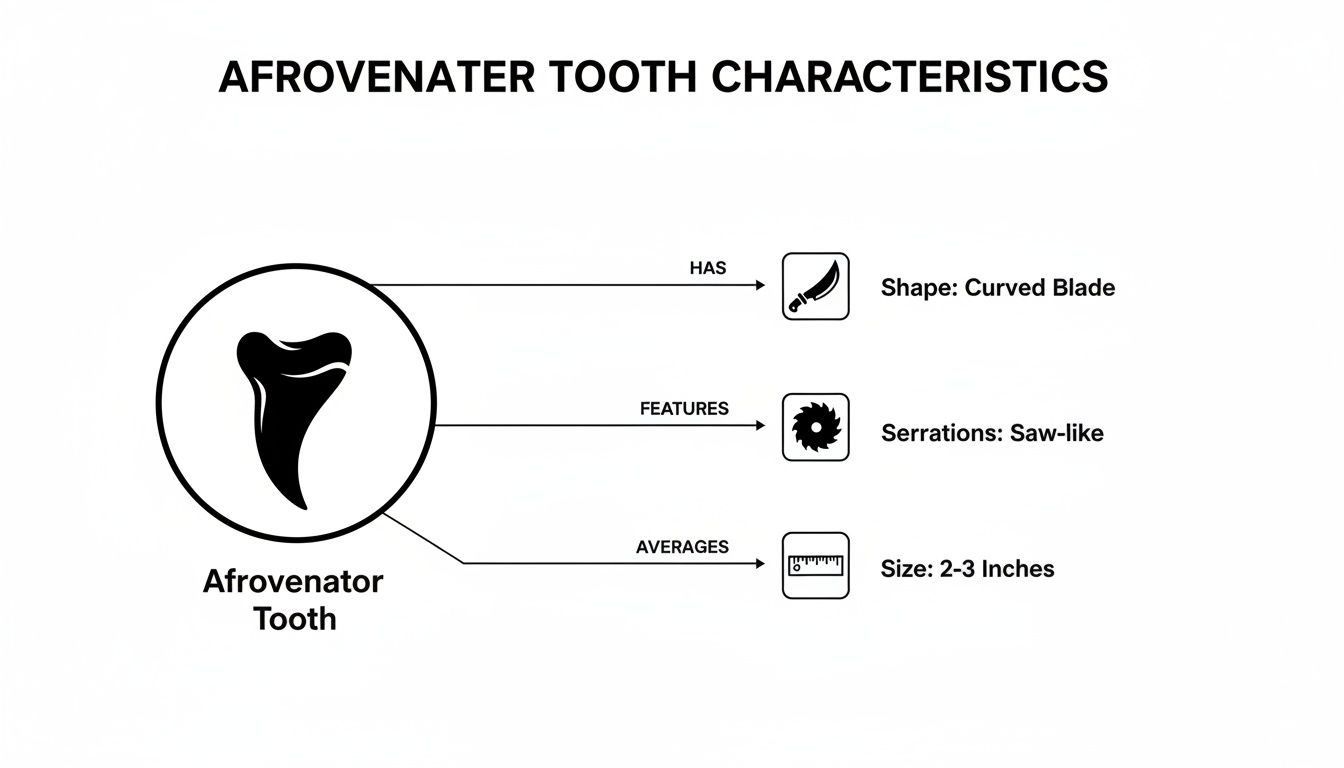
This infographic breaks down the key visual cues for spotting an Afrovenator tooth at a glance.
This quick visual guide really drives home how the combination of shape, serration density, and size creates a unique profile for the Afrovenator tooth.
Spinosaurus: An Entirely Different Beast
Another contemporary, Spinosaurus, is far easier to distinguish. Its teeth are nothing like the blade-like weapons of Afrovenator. Instead, Spinosaurus teeth are conical, almost perfectly circular in cross-section, and completely lack serrations.
This design was perfect for gripping slippery prey like fish, not for slicing flesh. A side-by-side comparison reveals two completely different hunting strategies:
Afrovenator: A laterally compressed, serrated blade for slicing.
Spinosaurus: A conical, unserrated spike for piercing and holding.
The rule of thumb is simple: if the tooth is conical and smooth-edged, it’s not an Afrovenator. This fundamental difference in form reflects a fundamental difference in function and diet.
While identifying theropod teeth can seem tricky, the same principles of comparing anatomy apply to other prehistoric giants. For example, learning to spot the distinct root structure is crucial when examining specimens like a Mosasaurus tooth in matrix, where context is everything.
By mastering these comparative skills, you can select an authentic gift with confidence, ensuring the piece in your display tells the right story.
How to Value and Authenticate Your Fossil
What separates a show-stopping, museum-quality Afrovenator tooth from just another fragment? For any serious collector, understanding what drives a fossil's value is non-negotiable. It's about so much more than size; we're talking about preservation, completeness, and a rock-solid history.
What to Look For
The single biggest factor in a tooth's value is its completeness. A top-tier specimen will have a wicked-sharp, totally intact tip. Just as important are the serrations—those steak-knife edges—which should be well-defined and run the full length of both carinae. A tooth missing its tip or with beat-up cutting edges will take a major hit in value.
Next up is the quality of the enamel. You want to see a nice, lustrous surface that still has its natural, often slightly wrinkled texture. Great enamel is a sign that the tooth was buried and preserved beautifully.
Spotting Red Flags and Outright Fakes
Like any other valuable collectible, the fossil market has its share of fakes. A classic trick is the composite tooth, where broken bits from different teeth are glued together to pass off as a single "complete" fossil. Always look closely for unnatural seams, weird changes in color or texture, or serrations that just don't line up.
Another red flag is artificial "improvement." Some sellers will try to enhance a damaged tooth by carving new serrations or even reshaping a broken tip. These repairs almost always look too perfect and uniform.
The golden rule of fossil hunting is simple: a high-quality, natural fossil with a little bit of honest wear is always worth more than a heavily restored or completely fabricated piece. Authenticity is everything.
The Power of Provenance
This might be the most important factor of all for confirming authenticity and a gift's investment potential: provenance. This is the tooth's documented backstory—where it was found, who found it, and its chain of ownership. A specimen with clear provenance from a trusted source like Astro West is proof that it was sourced legally and ethically.
Without that paper trail, you're left relying only on the tooth's physical appearance. A documented history doesn't just build confidence; it adds to the fossil's story and its long-term value.
These principles are universal. If you were sizing up a massive Megalodon tooth, you'd apply the same rules: check for completeness, enamel quality, and provenance. Once you master these basics, you can confidently assess any Afrovenator tooth and make a smart addition to your collection.
Responsible Fossil Collecting Practices
Owning a piece of prehistory like an Afrovenator tooth is a privilege that comes with responsibility. The world of fossil collecting is governed by laws, ethics, and scientific principles. Understanding your role as a collector ensures these priceless artifacts are preserved for future generations.
The first, most critical step is making sure any fossil you acquire was obtained legally. Many countries, including Niger where Afrovenator fossils are found, have strict regulations protecting their paleontological heritage.
The Importance of Provenance and Ethical Sourcing
This is where provenance becomes your best friend. A fossil with solid provenance has a documented history that traces its journey from discovery to your collection. Think of it as the fossil's passport; it’s your best assurance that the specimen was legally excavated and exported.
Always source your fossils from reputable dealers like Astro West who are transparent about where their specimens come from. A trustworthy seller won't hesitate to provide details on where and when a fossil was found.
Ethical collecting is not just about following the law; it's about supporting the scientific community. Properly documented finds add to our collective knowledge, whereas fossils collected illicitly are often stripped of their vital geological context, rendering them scientifically mute.
When you choose to buy from ethical sources, you're actively discouraging the black market and contributing to a system that respects both the law and the science.
Becoming a Steward of History
The moment you gift or receive an Afrovenator tooth, you become its temporary caretaker. Your role shifts from "owner" to "steward of paleontological history." This means committing to preserving its condition, honoring its scientific importance, and appreciating the incredible 164-million-year journey it took.
Responsible collecting ensures that these stunning relics of the ancient world can continue to inspire awe and curiosity for years to come. It transforms a simple purchase into a meaningful act of preservation.
Preserving Your Prehistoric Investment
An Afrovenator tooth survived for over 160 million years buried beneath the earth. Now that it’s in your care, preserving it is the final, crucial step in its incredible journey. Proper handling, display, and storage are essential for protecting this irreplaceable piece of natural history.
The first rule is simple: handle with care and as little as possible. The natural oils on your skin can degrade the fossil's surface over time. If you do need to move it, use clean, dry hands or, even better, cotton gloves.
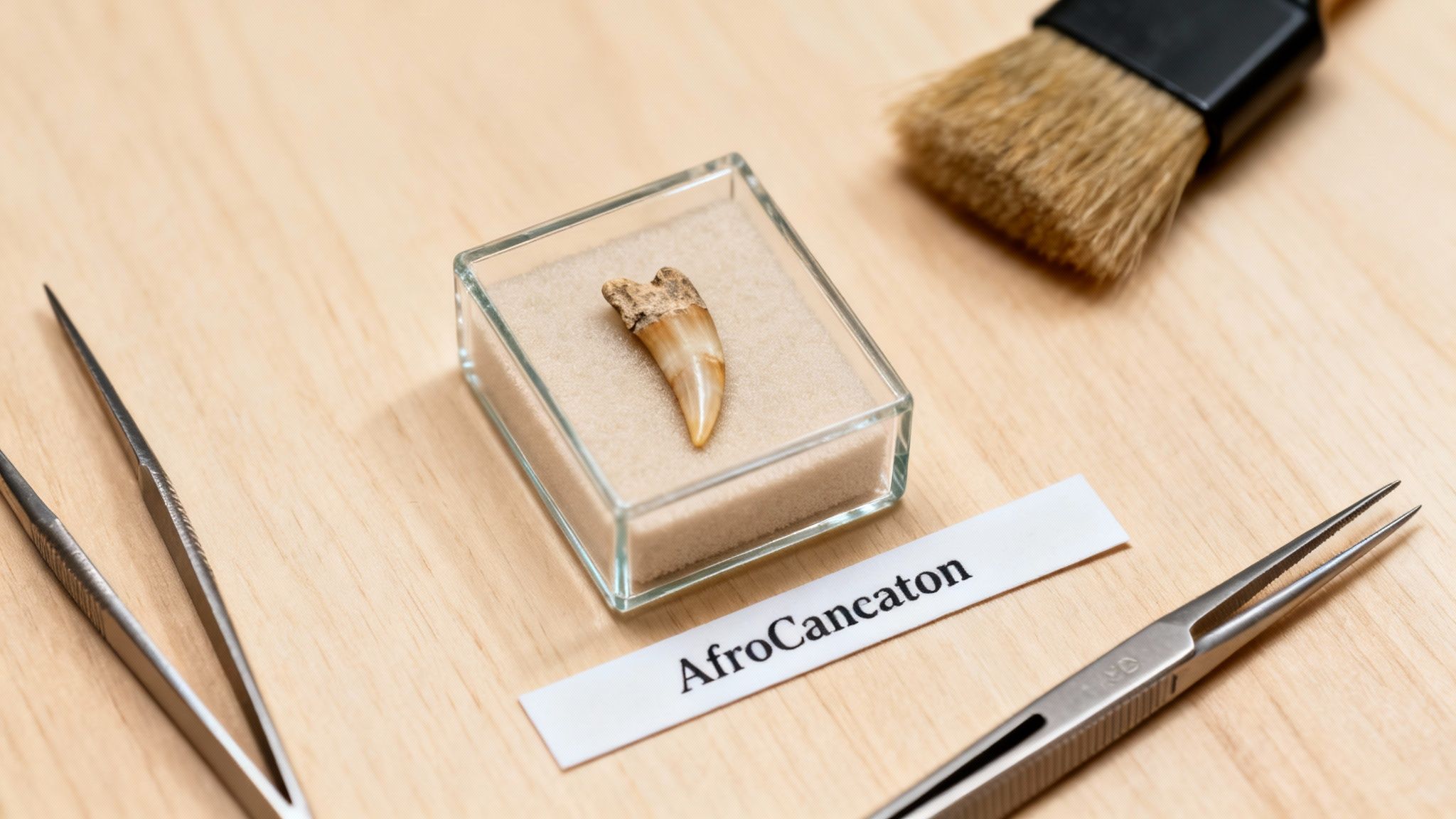
For cleaning, a soft, dry brush is usually all that’s needed to gently remove dust. Avoid water and cleaning chemicals at all costs, as they can damage the mineralized enamel.
Creating the Ideal Environment
Your fossil’s biggest enemies are environmental instability and physical shock. To keep your Afrovenator tooth safe, you need to control its surroundings with the same care a museum would.
Stable Temperature and Humidity: Keep your fossil in a location with a consistent climate. Attics and basements are poor choices due to their wild temperature and humidity swings.
Protection from Sunlight: Direct sunlight is another major threat. UV rays can fade the fossil’s natural coloration and make it brittle over time. Display it away from windows or invest in UV-protective glass.
A fossil is a long-term investment in Earth’s history. The best approach is to create a micro-environment that is as stable and protected as possible, mimicking the conditions used by professional museum curators to safeguard their collections.
Beyond physical care, it's also smart to think about protecting your investment in other ways, like looking into options for insuring items in storage if you plan to keep it off-display for long periods.
Smart Display Solutions
Choosing the right display is all about balancing visibility with protection. An acrylic case or a glass-fronted shadow box offers excellent protection from dust and accidental bumps.
For added stability, secure the tooth on an archival-safe mount. These simple measures ensure your Afrovenator tooth remains a stunning centerpiece, preserved for generations to admire.
Your Afrovenator Tooth Questions Answered
To wrap things up, let's tackle some of the most common questions that pop up among collectors and gift-givers. When you're dealing with a fossil as unique as an Afrovenator tooth, it’s natural to have a few queries.
How Rare Is an Afrovenator Tooth?
An Afrovenator tooth is very rare. It’s in a completely different league compared to the more frequently found teeth from other big North African predators like Carcharodontosaurus or Spinosaurus. This scarcity comes down to the limited number of dig sites and the hard-to-access geological formations they come from.
Getting your hands on a complete, high-quality specimen with a sharp tip and clean serrations is a major find. This makes it a truly special and memorable Christmas gift.
Can I Find an Afrovenator Tooth Myself?
For an amateur collector, finding an Afrovenator tooth in the wild is virtually impossible. These fossils are discovered deep in the Sahara Desert in Niger, often in areas that are remote and politically unstable.
Properly excavating these fossils requires official permits, specialized gear, and scientific know-how. Because of this, the only realistic and ethical way to own one is to go through a reputable fossil dealer who can provide a clear history of the specimen.
The rarity and complex excavation process mean every authentic Afrovenator tooth on the market represents a huge paleontological effort. It's a fossil that commands respect, not just for its age, but for the incredible journey it took to get here.
What Are the Signs of a Fake Afrovenator Tooth?
The most common fakes you'll run into are composite teeth, which are patch-jobs made from the broken bits of several different fossils. To spot one, keep an eye out for:
Suspicious glue lines, seams, or filled-in cracks.
Sudden changes in color, texture, or sheen along the tooth.
Serrations (denticles) that don't quite line up or match.
Then there are entirely fake teeth, often carved from modern bone or cast in resin. These usually give themselves away with serrations that look too perfect and uniform, lacking the natural wear and distinct enamel texture of a real fossil.
What Is a Typical Price for an Afrovenator Tooth?
The price for an Afrovenator tooth can swing wildly depending on its quality. You might find a small, partial tooth or a heavily worn one for a few hundred dollars.
On the other hand, a large, complete specimen with gorgeous enamel, razor-sharp serrations, and maybe even a bit of the root still attached can easily be worth several thousand dollars. As with any high-end fossil, factors like minimal repair and clear, documented provenance will always push its market value significantly higher.
At Astro West, we believe every fossil tells an incredible story of Earth's deep history. This Christmas, give the magic of the natural world. Explore our curated collection of authentic, ethically sourced minerals and fossils, and bring a piece of the ancient world into your home. Discover your next prehistoric treasure at https://astrowest.com.