A fine meteorite jewel can hold more technical verification value than many conventional luxury accessories. Its worth doesn’t depend on surface sparkle alone. It depends on whether the material is extraterrestrial, whether the structure can be authenticated, and whether the story is documented from source to setting.
That difference changes how a collector should view meteorite jewelry for women. A diamond is typically judged by familiar grading language. A meteorite pendant or ring is judged by provenance, pattern, composition, and craftsmanship. In practice, that makes the strongest pieces feel closer to fine art or collectible watches than to ordinary fashion jewelry.
Women’s meteorite jewelry also occupies a compelling niche in the alternative asset conversation. Supply is finite. No workshop can create a natural Widmanstätten pattern from scratch. No machine can manufacture actual cosmic travel history. That scarcity gives well-selected pieces a tangible logic that goes beyond adornment.
Collectors who understand this distinction usually shop differently. They ask where the meteorite was found, how the surface was etched, how the metal was protected, and whether the piece retains both beauty and scientific integrity. A display specimen such as this Muonionalusta meteorite in a collector’s display box shows the same core appeal in its purest form. The jewelry version introduces wearability to the acquisition.
An Introduction to Acquiring Celestial Assets
Meteorite jewelry for women isn’t compelling because it looks unusual. It’s compelling because it combines natural history, design, and documented scarcity in one wearable object. That mix is rare in the jewelry world.
Most luxury jewelry markets rely on controlled supply, branding, or gemstone grading. Meteorite jewelry operates differently. The supply of authentic material is by its nature limited, and each usable slice carries visible evidence of a formation process that happened far beyond Earth. Therefore, the buyer isn’t only choosing a style. She’s choosing a specimen with scientific identity.
That’s why serious collectors often approach meteorite jewelry with the same discipline they bring to fine minerals, art, or watches. They ask whether the material has traceable origin. They look for the right crystal pattern. They examine how the jeweler handled a difficult medium. Those are acquisition questions, not impulse-shopping questions.
Collector’s lens: The strongest meteorite jewel is both wearable and documentable.
The intangible value matters too. A woman wearing a meteorite pendant or ring isn’t just wearing a decorative object. She’s wearing a fragment of deep time, shaped by a designer but authored by nature. That narrative carries social value, intellectual value, and, in many cases, stronger long-term collector appeal than machine-made luxury accessories with broad availability.
In gallery practice, the most enduring demand tends to gather around pieces that satisfy both sides of the equation. They need to look elegant on the body. However, they also need to stand up to scrutiny off the body. When those conditions align, meteorite jewelry becomes more than an accessory. It becomes a curated acquisition.
Defining Value in Meteorite Jewelry
The market doesn’t price all meteorite jewelry equally, and it shouldn’t. Two necklaces may appear similar at first glance, yet one may carry far stronger collector logic because the underlying meteorite is better documented, more visually distinctive, or more skillfully integrated into the design.
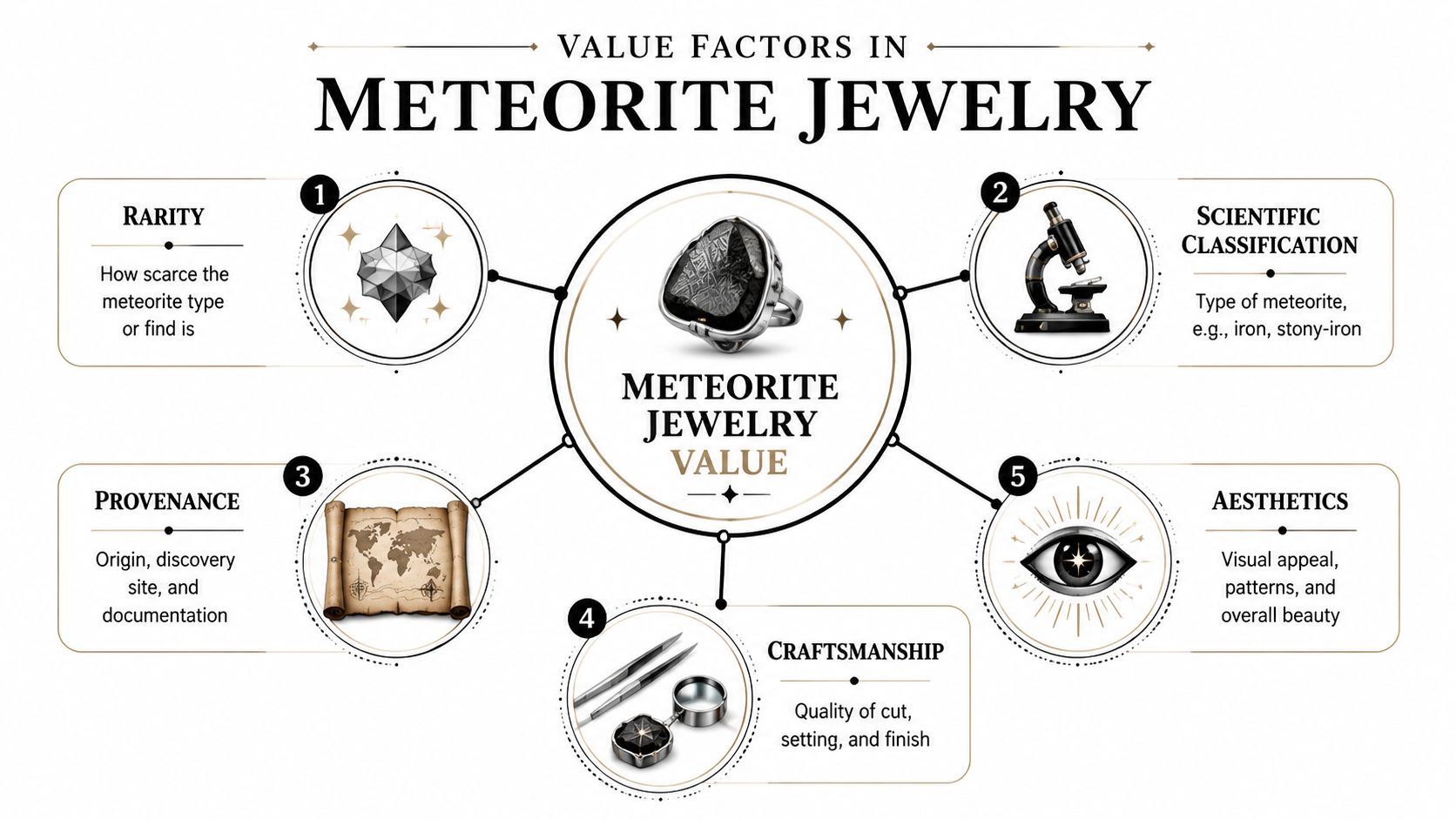
The five value drivers that matter most
At the curatorial level, value usually rests on five pillars:
Rarity of material matters first. Some meteorite sources are more available to the jewelry trade, while others are harder to secure in attractive, workable sections.
Scientific classification shapes desirability. Iron meteorites dominate the category because they are durable enough for jewelry and visually striking when finished correctly.
Provenance supports trust. A piece with documented origin carries more credibility than one with vague marketplace language.
Craftsmanship affects both beauty and longevity. Poor cutting or careless finishing can diminish a rare material.
Aesthetics still matter. Collectors respond to contrast, pattern clarity, and the harmony between setting and specimen.
That framework helps explain why meteorite jewelry can sit comfortably beside other collectible luxury objects. A buyer comparing a pendant to a watch or signed design piece is often applying the same instinct: finite supply, recognizable material, documented authenticity, and lasting visual identity. For readers who already think in those terms, even a premium Rolex Daytona for collectors offers a useful parallel because it shows how meteorite surfaces have entered the broader language of high-value acquisition.
Why provenance changes the conversation
Provenance isn’t decorative paperwork. It’s part of the value. In the collectible world, traceability separates an interesting object from a defensible one.
A meteorite jewel with clear sourcing can be discussed, insured, gifted, and resold with greater confidence. Provenance also links the wearer to a specific geological and collecting history. That adds intellectual depth that ordinary precious metal jewelry rarely delivers.
The market rewards pieces that can answer basic questions clearly. What is it, where did it come from, and how do we know?
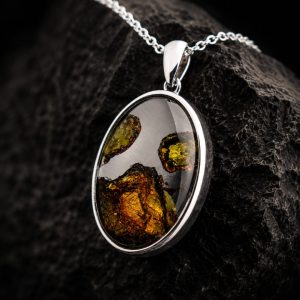
Design also influences value, but not in isolation. A beautifully mounted meteorite that preserves the specimen’s character will often hold stronger interest than a heavier piece that overwhelms the material. A genuine pallasite meteorite pendant necklace with olivine crystal illustrates that point well. The setting should frame the rarity, not obscure it.
Understanding Meteorite Types and Settings
The type of meteorite used in a jewel shapes both its visual impact and its long-term behavior as an object worth owning. In the jewelry market, iron meteorites lead because they show the clearest Widmanstätten pattern, accept precise finishing, and hold up better in rings, pendants, and earrings than many stony alternatives.
Why iron meteorites lead the market
Collectors and jewelers return to iron meteorites for the same reason. They present a recognizable structure that survives the translation from specimen to wearable design. That matters aesthetically, but it also matters economically. A material with a distinct natural pattern is easier to place within the broader market for collectible luxury goods.
Stony meteorites have scientific interest and, in some cases, unusual texture. They are often less practical for regular wear and usually offer less of the crisp geometric surface that buyers associate with meteorite jewelry. For a woman building a collection with resale discipline in mind, iron meteorite is usually the more defensible choice.
A short comparison helps:
Type
Strength in jewelry
Limitation
Iron meteorite
Distinct pattern, strong collector appeal
Needs protection from oxidation
Stony meteorite
Lighter, unusual texture
Often more fragile in jewelry use
Muonionalusta and Campo del Cielo in design
Two names appear often in finished jewelry. Muonionalusta is prized for its dramatic etched structure. Campo del Cielo is valued for its historical recognition and broad familiarity in the collector trade. Neither is automatically superior. The better acquisition depends on how the material is cut, stabilized, and presented.
As noted by Patrick Adair Designs on meteorite jewelry origin and authenticity, working meteorite for jewelry requires slow machining, diamond tooling, protective surface treatment, and careful preparation of inlays before final finishing. Those technical demands affect cost. They also affect quality in ways a buyer can see. Clean edges, consistent etching, and a stable seat inside the setting usually indicate disciplined bench work.
A strong setting does two jobs at once. It improves the design and protects a vulnerable historic material.
Gold brings warmth and contrast. Sterling silver gives a sharper, cooler look. Platinum adds mass and a more formal presence, but it can make a small piece feel heavier on the body and more expensive to produce. These are design choices, but they are also market choices. In my experience, the pieces that hold attention over time are the ones where the metal supports the meteorite rather than competing with it.
For buyers who want to understand that relationship at the specimen level, an authentic Gebel Kamil nickel iron meteorite fragment shows the raw surface character that a jeweler must preserve. That raw material is part of the appeal. The finished jewel succeeds when it keeps that geological identity intact while making the piece durable enough to wear.
How to Verify Authenticity and Provenance
Authenticity determines whether a meteorite jewel belongs in a wardrobe, a collection, or neither. In this category, beauty alone is a weak filter. A convincing surface can still hide ordinary steel, laser engraving, or vague sourcing that limits resale interest.
Read the material before you read the marketing
The first indicator is the Widmanstätten pattern. In a genuine iron meteorite, the pattern has depth, irregularity, and a crystalline logic that changes under light. In imitations, it often looks printed, overly tidy, or repeated in a way natural structure does not.
Magnetism helps, but it is only a first pass. Iron meteorites are typically ferromagnetic, yet magnetism alone does not prove provenance, and some finished pieces use enough surrounding metal to confuse a casual test. I advise buyers to treat magnetism as a screening tool, then confirm the pattern, the seller’s documentation, and the declared meteorite type.
A loupe tells you more than a poetic product page. Look closely at the etched lines. Real structure usually shows subtle variation in width and spacing. Fake material often shows pixelated edges, shallow surface treatment, or a stamped appearance.
Ask for provenance in plain language
Serious sellers should be able to name the meteorite, the source location or recognized classification, and how the material moved from specimen to finished jewel. If the description stops at “genuine space metal,” the piece may still be decorative, but it is weaker as an asset.
For women buying smaller-format jewelry, this matters even more. Studs, slim pendants, and narrow inlays offer less visible surface area, so documentation carries more weight in the buying decision. A small piece can still be important if the source is clear and the workmanship respects the material.
The visual warning signs for counterfeit or misrepresented pieces are outlined well in Jewelry by Johan’s guide to spotting fake meteorite jewelry. I agree with the practical tests they emphasize, especially the difference between a flat decorative pattern and one that shifts with the metal’s actual structure.
Verify the paper trail, not just the pattern
Collectors often pay a premium for confidence. That confidence comes from records, not adjectives. A proper chain of custody can include a certificate, a named meteorite source, specimen photographs, or a seller with a documented history in natural history material.
That is why even a standalone specimen can teach a buyer what good provenance looks like. An authentic Mars meteorite in a collector’s display box makes the documentation question easy to see. Before design enters the picture, the object already carries rarity, classification, and market context.
Style still matters, of course. If you want to define your look with a statement necklace, choose one whose materials can stand up to scrutiny as well as attention. In the long run, verified origin gives a dramatic piece more staying power than scale alone.
For a closer visual sense of what to inspect, this short video is a useful companion.
Buy the evidence, not the story. Certificates, identifiable material, and credible provenance support value better than romance copy ever will.
Care and Styling for Your Cosmic Artifact
Meteorite jewelry rewards careful ownership. It doesn’t ask for museum-level handling, but it does ask for respect. Iron content gives the material its appeal and its vulnerability.
How to protect the surface
Protective coatings matter because iron meteorites can oxidize when exposed to moisture. In well-made jewelry, the surface is usually shielded with a barrier such as rhodium, polymer, or oil. That protection helps preserve both the pattern and the finish.
Daily care should stay simple:
Keep it dry after wear, especially in humid conditions.
Avoid chemical exposure from perfume, hairspray, and cleaning products.
Store it separately so harder jewelry doesn’t scratch the setting or surface.
Seek professional refinishing if the coating dulls or the pattern loses crispness.
Owners often damage meteorite jewelry by treating it like ordinary precious metal. It isn’t. Gold can tolerate a more relaxed routine. Meteorite can’t.
How to wear it well
Meteorite jewelry for women works best when the outfit gives it room to speak. A Muonionalusta ring paired with a classic watch creates a sharp dialogue between cosmic pattern and mechanical precision. A bezel-set pendant can also lift an understated black dress, crisp shirting, or structured eveningwear without feeling theatrical.
For women refining proportions and focal points, a guide on how to define your look with a statement necklace offers useful styling context. The same principle applies here. Let one celestial piece carry the visual narrative, then keep the rest disciplined.
A few styling choices consistently work:
For professional dress choose a pendant or stud-scale design with clean metalwork.
For evening wear lean into higher contrast settings, especially gold against etched meteorite.
For collectors pair meteorite with understated diamonds or plain precious metal, not competing textures.
The best styling doesn’t try to make meteorite jewelry seem conventional. It lets the material remain unusual, then frames that quality with restraint.
Understanding Price Ranges and Market Value
Price in meteorite jewelry comes from material, design, and confidence. The material itself already sits in a different economic category than common stony meteorite. According to Meteorites for Sale on meteorite pricing by type and quality, iron meteorites typically cost between $1 and $50 per gram, with unique specimens rising over $50 per gram, while common stony meteorites range from $0.50 to $5 per gram.
Why size alone doesn’t determine value
That pricing range explains why retail jewelry values can vary sharply even when pieces look similar in scale. A larger jewel isn’t automatically the stronger acquisition. If the meteorite has poor visual structure, weak provenance, or average finishing, extra weight won’t rescue it.
By contrast, a smaller piece can justify higher interest when the pattern is clear, the source is desirable, and the mounting is thoughtful. This is the same logic collectors apply in fine art and watches. Condition, recognizability, and quality of execution often matter more than raw size.
How meteorite jewelry behaves as an alternative asset
Meteorite jewelry for women can function as an alternative asset, but only when the buyer stays disciplined. That means favoring authenticated material, well-documented origin, and design that won’t feel disposable after a season. Pieces built on those traits tend to hold collector attention better than trend-driven luxury accessories.
A simple framework helps:
Value driver
Effect on market appeal
Finite natural supply
Supports long-term scarcity logic
Documented provenance
Improves trust and resale confidence
Strong natural pattern
Increases visual distinction
High-quality setting
Protects condition and broadens desirability
Traditional luxury goods offer a useful comparison. A watch gains strength from brand, condition, papers, and reference desirability. Fine art gains strength from authorship, provenance, condition, and market recognition. Meteorite jewelry gains strength from authenticated extraterrestrial material, preserved structure, craftsmanship, and traceability. The categories differ, yet the valuation logic is surprisingly familiar.
Scarcity alone doesn’t create value. Scarcity plus proof, condition, and desirability does.
Some pieces will appreciate in collector interest. Others will not. Designs with weak documentation, compromised surfaces, or generic execution can depreciate like ordinary jewelry. The strongest examples tend to be those a knowledgeable buyer can defend in one clear sentence: authentic meteorite, identifiable source, excellent pattern, and careful mounting.
Shop Meteorite Jewelry at Astro West
Acquiring meteorite jewelry should feel more like working with a curator than browsing a mass listing. The material deserves that level of care. So does the buyer.
Astro West has spent decades building a reputation around authenticated natural history objects, from minerals and fossils to collectible meteorites and jewelry. That context matters. A gallery that already works closely with miners, worldwide suppliers, and field experts approaches traceability and classification differently than a generic accessories seller.
For women seeking meteorite jewelry with both aesthetic presence and collector logic, the key is selectivity. Choose pieces with documented provenance, sound construction, and visual character that will remain compelling over time. Some acquisitions suit daily wear. Others belong in a more deliberate collection. Both can be worthwhile when the underlying material is genuine and the presentation respects it.
Every piece should stand on two foundations. First, it should be beautiful enough to wear with conviction. Second, it should be credible enough to discuss as a real specimen. That’s where a curated source becomes important.
Shop Meteorite Jewelry at Astro West
Browse meteorite jewelry at Astro West if you’re looking for pieces that unite natural history, refined design, and collectible value. Each acquisition comes with expert authentication, documented provenance, and immediate availability online or in person. You can explore the collection at Astro West, visit the Manhattan gallery across from the American Museum of Natural History, or contact the team directly for guidance on selecting a wearable celestial asset.