Most Valuable Meteorites: A Collector’s Value Guide
Meteorite value often looks irrational at first glance. A tiny planetary fragment may carry an extraordinary per gram price, while a large display specimen commands its value for very different reasons. That apparent contradiction is exactly where serious collecting begins.
The most valuable meteorites sit at the intersection of rarity, scientific significance, and visual power; the best pieces don't function only as scientific specimens. They also operate as natural sculpture, conversation pieces, and long-term collectible assets. A strong meteorite can hold attention the way a fine mineral, a major fossil, or a well-chosen work of art does.
Discerning buyers quickly learn that meteorite collecting isn't about chasing any space rock. It's about selecting the right class, the right provenance, and the right form. Moreover, the market rewards pieces that can satisfy more than one standard at once. A specimen with documented history, stable preparation, and commanding presence will usually outperform a merely larger or cheaper object.
That is why the most valuable meteorites deserve to be judged with more discipline than novelty purchases receive. The difference between a curiosity and a cornerstone acquisition is rarely accidental.
An Introduction to Meteorite Valuation
Collectors who build exceptional meteorite holdings usually think like curators. They don't buy volume for its own sake. They acquire objects with clear significance, strong documentation, and enduring visual impact.
That approach matters because meteorites occupy a rare position in the collectible world. They are natural objects, but they also carry the authority of laboratory classification and the allure of cosmic origin. Therefore, their value extends beyond decoration. A fine specimen can serve as a research object, a design object, and a tangible store of rarity.
In practice, valuation starts with a simple question. What exactly are you buying? Sometimes the answer is a planetary fragment valued for origin and scientific scarcity. In other cases, the answer is a complete aesthetic object whose size, surface, polish, and display quality drive its appeal.
Collector principle: The strongest meteorite acquisitions combine scientific legitimacy with immediate visual presence.
High-end buyers also need to separate two markets that are often blended together in casual discussion. One market values small research-grade fragments by the gram. The other values major pieces as complete objects, often because they present beautifully in a room, a gallery, or a museum setting. Those categories overlap, but they don't behave identically.
A disciplined collector also pays attention to traceability. Provenance, classification, and preparation quality aren't administrative details. They are central to value retention. Pieces with clear history inspire confidence in future resale, gifting, and institutional interest.
Meteorites reward patience. The best ones tend to be chosen, not stumbled upon. That is why serious buyers often compare them with fine art, rare watches, and other hard assets. The comparison isn't about hype. It's about how rarity, authenticity, and connoisseurship shape demand over time.
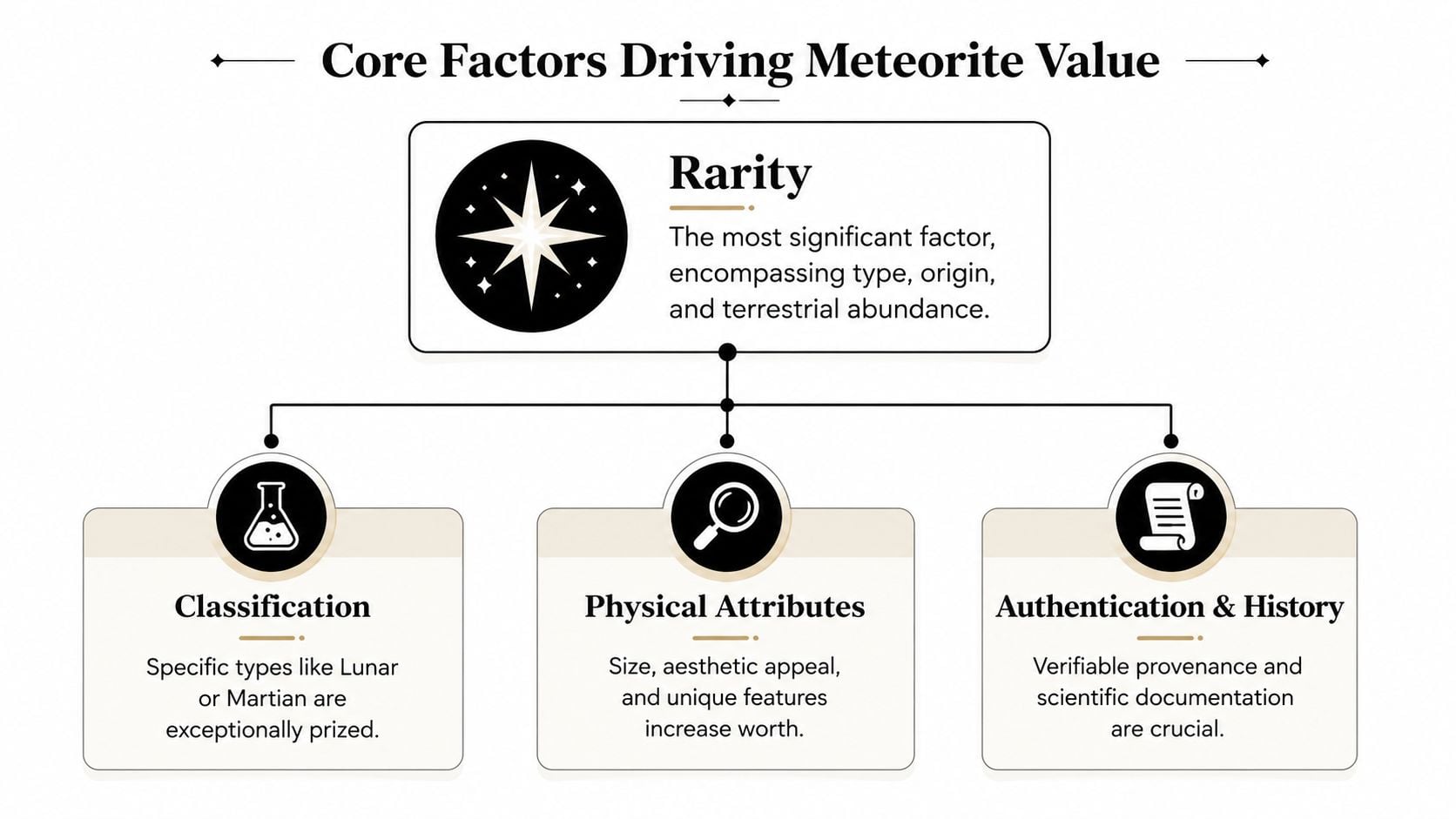
The Core Factors Driving Meteorite Value
Value in this market comes from three things working together. Rarity establishes scarcity, provenance establishes confidence, and physical presence determines how strongly a piece competes for collector attention.
The biggest pricing mistake I see is simple. New buyers hear a high per gram figure for lunar or Martian material and assume every large meteorite should be priced the same way. The market does not work like that. Small classified fragments often trade on scientific scarcity per gram. Large, aesthetic specimens are usually valued as complete objects, where form, presentation, and desirability can outweigh a strict gram calculation.
Rarity sets the ceiling
Rarity still sets the upper boundary of price. A meteorite can be attractive and historically interesting without being rare enough to command top-tier money. At the highest end, buyers compete for material that is difficult to replace, whether that means a scarce classification, a limited known supply, or an unusually fine example within a known group.
Scarcity also works on two levels. Some material is rare in scientific terms. Some is rare in market terms because few pieces survive in a size or shape that presents well. Those are different value drivers, and serious collectors should separate them before they buy.
A tiny Martian fragment may justify a strong per gram price because the origin itself is scarce. A complete sculptural iron or a museum-scale pallasite slice may command a higher total price because the object is persuasive as a whole.
Classification shapes buyer demand
Classification matters because each meteorite family serves a different collecting objective.
Stony meteorites tend to attract buyers focused on classification, source body, and scientific context. Iron meteorites draw clients who want mass, pattern, and sculptural strength. Stony-irons, especially pallasites, occupy a prized middle ground because they combine rarity with immediate visual drama.
Classification
Typical value logic
Stony meteorites
Value depends on subtype, classification, provenance, and scientific importance.
Iron meteorites
Buyers respond to weight, shape, regmaglypts, and etched pattern.
Stony-iron meteorites
Premiums often come from rarity plus strong visual contrast between metal and crystal.
Pallasites illustrate this especially well. A fine Brenham pallasite slice with iron-nickel matrix can appeal to both the science-minded collector and the design-minded collector, but those buyers may justify the price for different reasons.
Meteorite value also carries into jewelry when the origin remains identifiable and the workmanship respects the material. The Muonionalusta Meteorite Saddle Ring // Adjustable is a good example. The appeal is not just decorative. Buyers know exactly what material they are wearing and where it comes from.
Physical attributes create premiums
Within the same classification, condition and presentation often decide whether a specimen is ordinary, desirable, or important.
For irons, a clean Widmanstätten pattern, balanced shape, and stable surface can move a slice into a much stronger price bracket. For pallasites, the clarity, color, and distribution of olivine matter just as much as weight. For complete individuals, orientation, fusion crust, and surface texture can matter more than polish because the object retains more of its natural character.
Collectors usually pay close attention to four physical factors:
Scale: Size adds value when it creates presence, not when it produces an awkward or visually weak piece.
Preparation quality: Good cutting, polishing, etching, and stabilization protect both appearance and long-term condition.
Form: Complete masses, balanced slices, and sculptural silhouettes usually outperform generic fragments.
For certain items, per gram pricing starts to break down. A scientifically important fragment may be sold almost like reference material. A large, beautiful specimen is judged more like a finished natural artwork.
Authentication and history protect value
Documentation supports price because it reduces doubt. Buyers at the upper end want to know the find or fall name, classification, preparation history, prior ownership when available, and whether the piece has been stabilized correctly.
I advise clients to treat provenance as part of the object, not paperwork attached to it. A meteorite with a clear chain of custody is easier to insure, easier to resell, and more credible if it is later offered to a museum, institution, or advanced private collector.
Witnessed falls, historic finds, and pieces from recognized collections often hold attention for that reason. Confidence travels with the specimen, and confidence protects value.
Exploring the Most Valuable Meteorite Classifications
The highest prices in meteorites do not come from one simple ranking of "rarest equals most expensive." They come from two different markets that overlap only part of the time. Small, scientifically important fragments are often priced by the gram. Large, visually resolved specimens are often valued as whole objects. New collectors miss that distinction constantly, and it leads to poor comparisons.
A client may ask why a tiny Martian fragment can cost more per gram than a much larger iron or pallasite, yet the larger piece can sell for more overall. The answer is straightforward. Scientific rarity sets the ceiling for material priced like reference substance. Presence, finish, and visual authority set the ceiling for material bought as a display object. The strongest collections usually include both, but they should not be judged by the same math.
Lunar meteorites
Lunar meteorites sit near the top of the prestige hierarchy because the category is immediately legible. Buyers do not need a long explanation. It is material from the Moon.
That direct planetary connection creates strong demand for even small authenticated pieces, especially among collectors who want concentrated historical and scientific significance rather than scale. In practice, lunar material often rewards disciplined buying. A modest specimen with clean classification and stable condition can be more intelligent than a larger but visually unremarkable example.
Lunar meteorites rarely win on room presence alone. They win on meaning.
Martian meteorites
Martian meteorites occupy similar territory, but the market response is often even more intense because Mars carries scientific, cultural, and public imagination in equal measure. Serious buyers understand the category quickly, and institutions watch it closely.
This is also where pricing confusion becomes expensive. A small Martian specimen may trade on rarity per gram because the material itself is the point. A larger individual, slice, or end cut enters a different conversation. Then the buyer is weighing not just planetary origin, but whether the piece has enough physical character to justify total-piece pricing.
I tell clients to separate the question into two parts. First, how scarce is the material? Second, how compelling is this object? A weak specimen from a prestigious class can still underperform. A visually persuasive one with first-rate documentation can command a much stronger result.
Pallasite meteorites
Pallasites attract a different kind of buyer. They convert people who may not have started as meteorite collectors at all.
In a fine slice, translucent olivine suspended in nickel-iron creates an effect that reads equally well as science, sculpture, and natural design. That crossover matters. Pallasites compete not only with other meteorites, but with important minerals, decorative objects, and even contemporary sculpture for a collector's attention and budget.
Fukang established the category's reputation at the highest end, but the broader lesson is more useful than any single headline sale. Pallasites often outperform ordinary pricing logic because buyers respond to the whole composition. Crystal transparency, metal balance, cut orientation, and light transmission all affect desirability. A muddy slice with fractured olivine may remain ordinary even if the classification is desirable. A clean, balanced slice can move into a very different tier.
Collectors who want to study the category in a real object should look closely at an authentic Brenham pallasite meteorite slice. Brenham shows how much cut quality and crystal distribution shape value. In pallasites, preparation is not cosmetic. It determines whether the specimen reads as average stock or as a finished natural artwork.
What separates average from exceptional pallasites
The best pallasites tend to show a consistent set of strengths:
Clear olivine: Transparent to translucent crystals hold light and create depth.
Balanced composition: Strong distribution between metal and crystal gives the slice structure.
Intelligent cutting: Orientation determines whether the internal architecture is legible or flat.
Stable condition: Buyers want confidence that the piece has been prepared and preserved properly.
When all four are present, pallasites often shift from collectible material to centerpiece object.
Iron meteorites
Iron meteorites follow a different value pattern again. Their scientific rarity usually sits below lunar, Martian, and the best pallasites, but their market strength is durable because they solve a different collecting problem. They provide scale, mass, and sculptural clarity.
A complete iron can anchor a room. An etched slice can function almost like graphic art. Those are distinct buying cases, and experienced collectors treat them that way.
The category rewards connoisseurship. Surface character matters. So does orientation, patina, regmaglypt development, and the quality of any etched Widmanstätten pattern. Two irons of similar weight can trade very differently if one has strong form and the other feels generic. For buyers furnishing a library, office, or major interior, total-piece value often matters far more than per-gram pricing.
Rare chondrites and witnessed falls
Rare chondrites appeal to a narrower but often very serious audience. They can look restrained beside pallasites and irons, yet the best examples carry real weight for collectors who care about formation history, unusual mineralogy, or classification significance.
Witnessed falls add a separate layer of value because the event history is tighter and more credible. The attraction is not drama alone. It is confidence in what the object is, when it arrived, and how it entered the market.
That difference matters in practice. A visually modest fall with strong recovery history may interest an advanced collector more than a flashier but less consequential specimen. In this class, value often sits less in display power and more in the combination of rarity, classification, and historical clarity.
The Collector's Eye: Evaluating Meteorites as Assets
A discerning buyer doesn't evaluate a meteorite the way a tourist does. The question isn't merely whether the piece is real or impressive. The question is whether it can hold value as a long-term object of consequence.
Display presence matters
Collectors often underestimate visual scale. A small rare fragment may be scientifically important, but a larger and beautifully prepared specimen can dominate a room and draw sustained attention. That difference affects desirability.
This is why iron meteorites and pallasites so often enter serious interiors. They read well from across the room, not just under magnification. As a result, they appeal to buyers who think in terms of placement, architecture, and legacy objects.
Documentation is the floor, not the ceiling
No serious meteorite acquisition should rest on appearance alone. Classification papers, find information, and clear chain of custody create the baseline. Without them, a specimen may still interest a casual buyer, but it won't satisfy a disciplined collector.
A useful comparison appears in a discussion of collector confusion around pricing tiers. A common point of confusion for collectors is the difference between per-gram pricing for research-grade fragments and total auction value for large masses. For example, while NASA-verified moon rock is cited at $50,000/g (and is not legally for sale), a collector can acquire a significant multi-kilogram Martian meteorite slice for a multi-million dollar sum, reflecting a different market dynamic based on accessibility, size, and aesthetic display value.
That distinction matters because many new buyers anchor on a number without understanding the object. They hear a per gram figure and assume all meteorites of a famous class should trade that way. They don't.
The right metric depends on the specimen. Small scientific fragments and major display pieces belong to related, but different, markets.
Curated quality beats accumulation
The strongest collections are edited. They aren't crowded. A cabinet of mediocre fragments rarely carries the long-term authority of a smaller group of carefully chosen pieces.
That is one reason curated holdings often age better than volume-based buying. The collector who acquires for provenance, visual force, and significance usually builds a more coherent asset base than the collector who buys every affordable classification example.
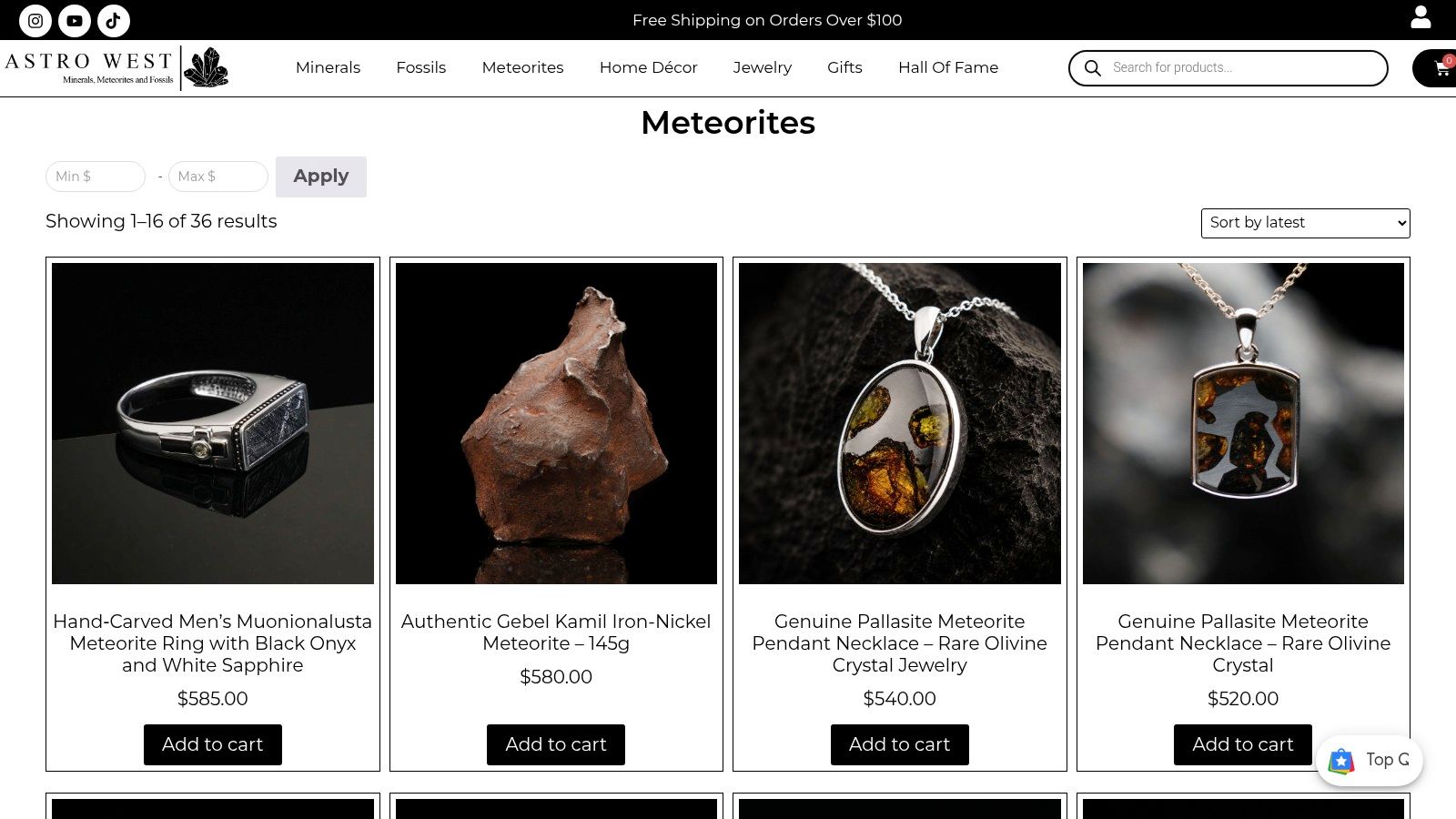
For buyers evaluating options, a broad meteorite collection at Astro West is useful as one factual reference point because it shows how different meteorite forms are presented across collecting categories. The main lesson, however, is strategic. Select fewer pieces, but select better ones.
Benchmark Sales: Examples of Market-Defining Meteorites
Benchmark sales do more than set records. They teach collectors how value is assigned at the top of the market.
The point that often gets missed is simple. Per-gram pricing and total-piece value are not the same measure. Small, scientifically important fragments can post extraordinary prices per gram because the material is scarce and research-driven. Large, intact, visually commanding specimens often trade on a different basis. Their value comes from scale, completeness, display presence, and the fact that only one buyer can own that exact object.
The Martian sale that reset expectations
A major Martian sale made that distinction clear, as noted earlier in the article. The result drew attention because the specimen was not just Martian material. It was a large, singular object with serious scientific and collector importance.
That is how expectations get reset in this field. Buyers were not bidding on grams alone. They were bidding on the largest available expression of a coveted classification, with a level of presence that a small research fragment cannot offer, even if that fragment posts a stronger per-gram number.
I explain this point often to new high-end collectors. A tiny labeled piece can be expensive in a laboratory context. A room-defining specimen belongs to the trophy market.
Other classes that define the upper market
Pallasites remain one of the clearest examples of cross-market appeal. Fukang established the model because it satisfies two audiences at once. Scientists value the structure and rarity. Collectors value the stained-glass effect of olivine suspended in nickel-iron. That combination supports strong prices for fine slices and exceptional totals for large, visually balanced sections.
Iron meteorites show a different pattern. They usually do not depend on planetary origin to command attention. They win on form, stability, preparation quality, and surface character. A sculptural individual with strong regmaglypts can hold a room. A well-etched slice can function more like abstract metalwork than a specimen drawer label.
For collectors building judgment before pursuing six or seven-figure material, a smaller authentic Gebel Kamil iron-nickel meteorite is a useful reference point. It shows how iron material carries value through shape, density, patina, and display presence, even at a more accessible scale.
For a closer look at meteorite forms in motion, this video gives useful visual context:
The highest-profile sales share one trait. Several value drivers align in the same specimen at once: rarity, provenance, scientific relevance, preparation quality, and visual authority. That is what defines a market-making meteorite.
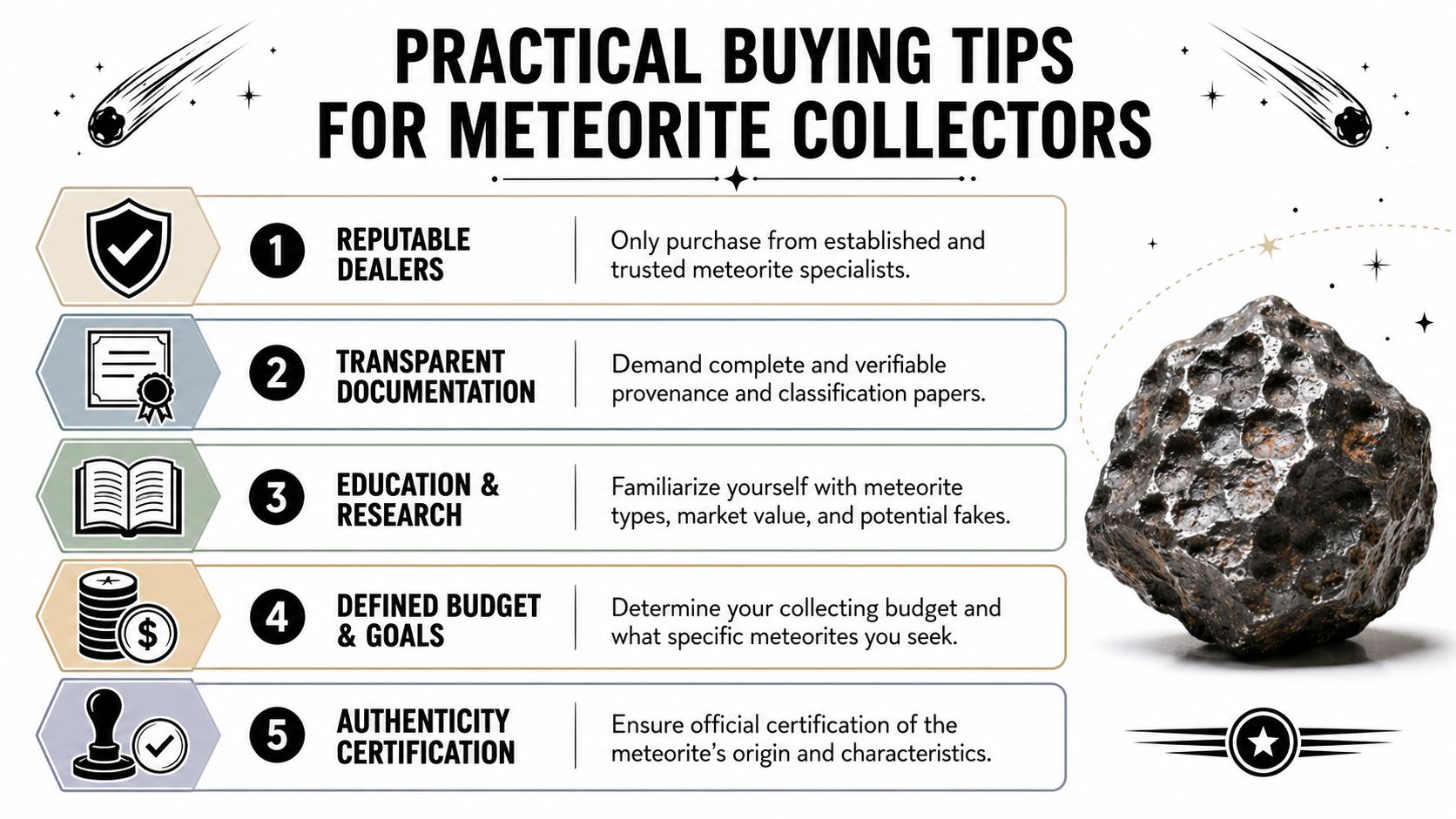
Acquisition Strategy: Practical Buying Tips for Collectors
Buying meteorites well requires restraint. Enthusiasm helps, but process protects capital and preserves collecting standards.
Start with authentication
The first rule is direct. Buy only from established specialists who provide clear documentation. Authenticity isn't a bonus feature. It's the foundation of value.
That matters because the field attracts mistakes and misidentifications. According to Washington University in St. Louis guidance on meteorite realities, over 95% of rocks suspected to be meteorites are terrestrial, and third-party classification can range from $200–$500 per sample. That cost is worth understanding because buyers sometimes overlook how verification affects final economics, especially in higher-value material.
Use a disciplined buying checklist
A practical acquisition review should include these points:
Demand documentation: Ask for classification, find location, and provenance details.
Study the object, not just the label: A famous name doesn't rescue weak preparation or poor presentation.
Match the specimen to the purpose: A research fragment serves a different role than a room-scale display piece.
Factor in verification: Classification and authentication costs influence true value.
Buy for both science and beauty: The best long-term pieces satisfy both.
A smaller object can still be sensible when documentation is strong and the form is attractive. For example, a wearable item such as a genuine Campo del Cielo meteorite necklace may suit a buyer who wants authenticated material in a personal format rather than a cabinet specimen.
Practical rule: If a seller can't explain provenance clearly, move on.
Avoid common mistakes
New buyers often overpay for labels, underweight preparation quality, or confuse online asking prices with real market behavior. They also tend to assume larger always means better. It doesn't.
A well-documented smaller specimen with excellent finish can be the wiser acquisition than a larger but compromised piece. Also, collections gain strength when each object has a clear reason for being there. Random accumulation rarely produces authority.
Shop the Most Valuable Meteorites at Astro West
The most valuable meteorites earn their status through a clear logic. They are rare. They are traceable. They hold scientific authority, and they present with enough visual force to matter as objects in their own right.
For collectors, that combination is what makes meteorites so compelling. They aren't interchangeable commodities. Each serious piece reflects a specific chain of events, from cosmic formation to terrestrial recovery to expert classification and preparation. That layered history is exactly what gives the category depth.
Astro West approaches meteorites as curated acquisitions rather than anonymous inventory. The gallery works with trusted suppliers and field experts, and that matters because provenance and selection discipline are central to this market. Buyers looking for a display-ready iron, a high-interest slice, or a collectible specimen with documentary support should expect that level of care.
Collectors who prefer a compact, documented presentation can also consider pieces such as the Muonionalusta meteorite in a collector's display box. The format reflects a useful truth about the category. A specimen doesn't need monumental size to feel significant if the material, story, and presentation are right.
Every meteorite acquisition should balance beauty with evidence. That is how collections mature, and it is how tangible natural objects hold their relevance over time. Whether you're building a focused cabinet, selecting a statement display piece, or acquiring a gift with lasting substance, the right specimen should feel both impressive and defensible.
Shop Most Valuable Meteorites at Astro West
Astro West offers a refined selection of meteorites for collectors, designers, and buyers who value authenticity as much as appearance. Every piece comes with expert authentication, documented provenance, and is available for immediate acquisition online or in person. You can browse the collection digitally, visit the Manhattan gallery across from the American Museum of Natural History, or speak directly with the team about a specific acquisition goal.
The advantage of buying through a curated source is clarity. You know what the specimen is, why it matters, and how it fits within the broader market for rare meteorites, pallasite meteorites, iron meteorites, lunar meteorites, and Martian meteorites. That guidance is especially important when you're comparing scientific fragments with large display pieces, or weighing rarity against design impact.
If you're ready to explore the most valuable meteorites with confidence, browse Astro West's meteorite collection, visit the gallery, or contact the team directly for help selecting a piece that aligns with your collection, interior, or gifting needs.
Explore Astro West to browse authenticated meteorites online, visit the Manhattan gallery in person, or contact the team directly for guidance on immediate acquisition. Every piece is offered with expert authentication and documented provenance, whether you're seeking a collectible specimen, a display object, or a meaningful gift from the cosmos.