Meta description: Fossil trilobites unite deep-time science, design appeal, and collector value. Learn how rarity, preparation, and provenance shape demand.
A surprising truth sits at the heart of this category. Fossil trilobites are common enough to be familiar, yet exceptional trilobites are very difficult to secure well.
That difference matters.
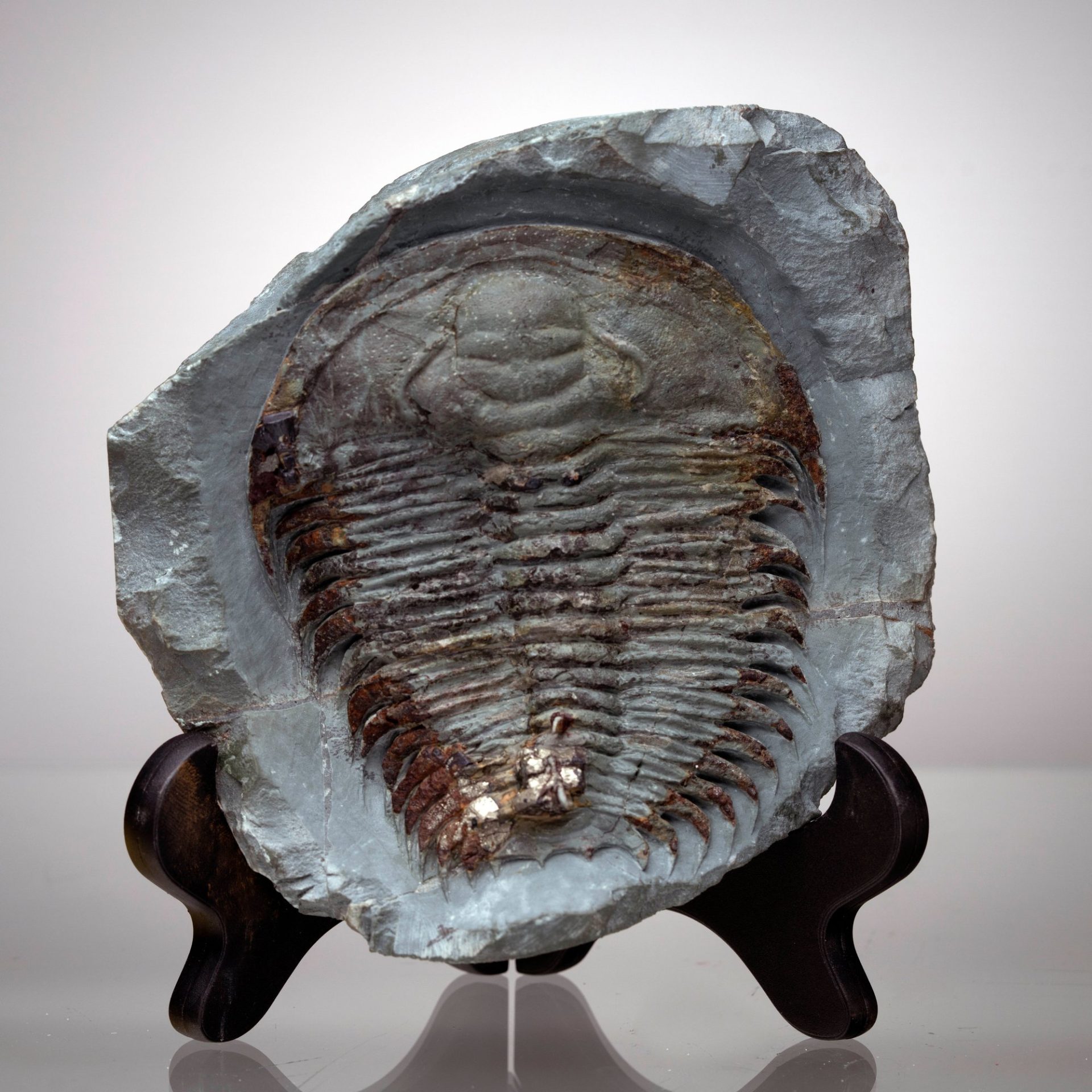
In a gallery setting, I rarely judge a trilobite by species name alone. I look at the full object. I look at the preservation, the preparation, the matrix, the posture, the locality, and the honesty of the work. A basic specimen can function as an accessible introduction to Paleozoic life. A superior specimen can hold the room like sculpture and withstand scrutiny like a research object.
That is why trilobites occupy an unusual place in natural history collecting. They satisfy several audiences at once. Scientists value them because they record ancient marine ecosystems with unusual clarity. Designers value them because their segmented bodies, radial symmetry, and relief on stone read beautifully in interiors. Serious collectors value them because not all fossil trilobites are interchangeable, and the market rewards discernment.
Introduction An Artifact of Deep Time
Trilobites aren’t merely classroom fossils. They are durable records of one of the longest and most varied success stories in animal history. When a collector holds one, they’re holding a marine arthropod that lived in oceans long before flowering plants, birds, or mammals entered the scene.
That deep-time perspective shapes value. A trilobite with crisp anatomy and stable matrix offers more than age alone. It offers legibility. You can read the animal’s form, behavior, and environment directly from the stone.
Why fossil trilobites still command attention
Many fossils impress by scale. Trilobites often impress by detail. Their segmented construction creates natural rhythm. Their cephalon, thorax, and pygidium produce a complete visual composition. Some species carry extravagant spines or striking eye structures that make them feel almost designed for display.
Collectors also respond to the balance between access and selectivity. You can find trilobites at modest levels of the market. However, exceptionally well-preserved, well-prepared, and well-provenanced examples become far more selective acquisitions.
Curatorial rule: In trilobites, abundance at the category level does not reduce the importance of excellence at the specimen level.
Science and aesthetics meet in one object
A strong trilobite specimen performs on three fronts at once:
Scientific value: It preserves anatomy that can support identification and interpretation.
Aesthetic value: It presents cleanly, often with pleasing contrast between fossil and matrix.
Collector value: It benefits from provenance, preparation quality, and species desirability.
That combination is why fossil trilobites have stayed relevant in private collections, museum study collections, and well-appointed interiors. They are small enough to live comfortably in a cabinet, yet complex enough to reward years of looking.
A 300-Million-Year Reign The Geological Story
A trilobite’s long history is not museum trivia. It is the reason the market ranges from modest study pieces to specimens that deserve serious acquisition. Across roughly 300 million years, trilobites changed repeatedly in form, habitat, and distribution, producing a category with exceptional breadth, as noted by the Oxford University Museum of Natural History’s trilobite overview.
For a curator, geological range matters because it creates collecting choice. For a buyer, it creates valuation tiers. A common, flattened specimen from a well-worked horizon can still have teaching value. A scarce species from a narrow stratigraphic window, preserved with clarity and prepared with restraint, occupies a very different class.
Cambrian origins and diversification
The earliest trilobites appear in the Cambrian, and that origin gives certain specimens a premium that is partly scientific and partly psychological. Early representatives connect directly to the first major expansion of complex animal life. Collectors respond to that depth of history, especially when the specimen is complete enough to make the age feel tangible rather than abstract.
Their importance in geology also affects collector interest. Trilobites evolved quickly enough, and spread widely enough, to help specialists correlate rock layers across distant regions. That does not make every trilobite expensive. It does mean the group carries more than decorative appeal. It has serious stratigraphic importance.
Diversity peaked in the late Cambrian and Ordovician, then contracted over long intervals rather than collapsing all at once. By the Permian, trilobites were surviving as the last representatives of a once-dominant group. That late persistence adds narrative force to the right specimen, according to the same source.
Why geological age affects collector interest
Collectors often ask a simple question. Does older mean better?
In the market, the answer is no. Age adds value only when preservation, preparation quality, rarity, and presentation support it. A broken Cambrian trilobite with heavy repair rarely outranks a sharply prepared Devonian specimen with strong relief and excellent provenance.
A useful comparison appears below:
Collecting factor
What it means in practice
Cambrian significance
Appeals to collectors who want direct connection to early animal history and stratigraphic importance
Devonian appeal
Often brings stronger visual drama, especially in sculptural species that display well in matrix
Late survival
Adds narrative interest because these lineages endured repeated environmental change before final extinction
The Devonian holds a special place in the trade for good reason. Many of the trilobites collectors remember first are Devonian forms, often from Morocco, where preparation can reveal bold relief, long spines, and commanding symmetry. Those pieces succeed in a cabinet because they read clearly at a glance and reward close examination. That combination of immediate visual impact and legitimate paleontological interest is what sustains demand.
Clients who study before they buy often appreciate tools that make technical material easier to absorb, including SparkPod's study superpower with audio. In collecting terms, the practical lesson is straightforward. Geological age matters most when it strengthens rarity, story, and display presence at the same time.
Understanding Trilobite Morphology Anatomy as Value
The fastest way to misjudge a trilobite is to treat anatomy as academic trivia. In practice, trilobite morphology drives both identification and value.
A complete trilobite is organized into three major regions. The cephalon is the head shield. The thorax consists of articulated segments. The pygidium forms the tail shield. Buyers should learn that framework first, because every later judgment rests on it.
The three-part body plan
A specimen with a clean cephalon, undisturbed thoracic segmentation, and a complete pygidium usually presents far better than one with breaks in those zones. Segment continuity matters visually. It also matters scientifically, because disruption can blur species-level traits.
The thorax often decides whether a piece feels alive or static. In some trilobites, the segmented thorax creates a graceful line across the matrix. In others, it contributes to enrollment, arching, or dramatic relief.
Trilobites also served as premier index fossils because of rapid speciation and high morphological disparity, including varied eye structures and thoracic segment counts tied to different marine environments, as summarized in the trilobite reference on Wikipedia. For a collector, that means anatomy is not decorative surface alone. It carries stratigraphic and evolutionary meaning.
Eyes, spines, and visible character
Collectors often pay attention to the face first. That’s sensible. Eyes, glabellar shape, cheek detail, and spine symmetry create immediate impact. However, those features can also be the easiest areas to over-prepare or restore, so visible sharpness must be judged carefully.
For study and display alike, auditory explanation can help decode this anatomy. Resources such as SparkPod's study superpower with audio show how spoken interpretation can make complex visual structures easier to retain, especially for younger collectors or family audiences.
A later paragraph is the right place for moving media, because anatomy benefits from a pause and then a second look.
Molting and why articulation matters
Molting shaped the fossil record, but it also complicates connoisseurship. Not every trilobite fossil represents a fully preserved carcass. Some represent shed exoskeletal material. That distinction doesn’t make a specimen unworthy, but it does affect how one reads completeness.
When I assess a specimen, I ask simple questions first:
Are the body sections anatomically coherent? Misaligned parts can signal disturbance or assembly.
Do the eyes and margins look naturally integrated? Abrupt texture changes deserve scrutiny.
Does the matrix support the fossil convincingly? A good specimen should sit in stone, not on stone.
A Catalog of Trilobite Fossils Species and Presentation
Two trilobites can share a label and differ sharply in value. One reads as a pleasant fossil. The other holds a room, rewards close study, and belongs in a serious collection.
The difference usually comes down to species, presentation, and how convincingly the specimen carries its form. As curators and collectors know, buyers do not pay only for taxonomic identity. They pay for visual authority, rarity within the market, and the degree to which a specimen shows the character of its genus without apology.
Enrolled, spiny, and highly expressive forms
Enrolled trilobites remain popular because they offer an instantly legible composition. The posture is compact, protective, and satisfying from almost any angle. Good examples also suit smaller interiors, where a contained silhouette can read more clearly than a broad, delicate spread.
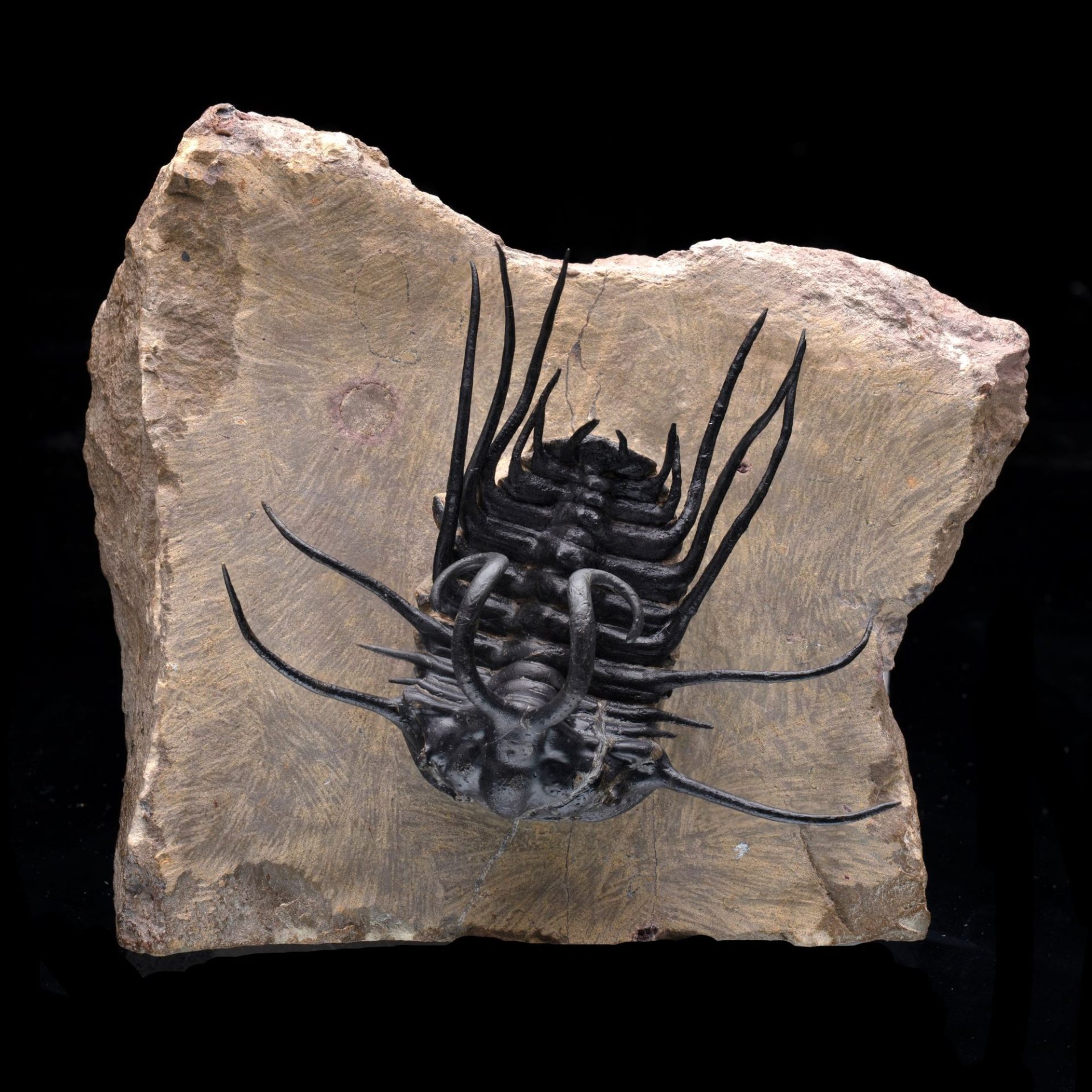
Spiny species occupy a different tier of collecting. They ask more of the stone, more of the preparator, and more of the buyer’s eye. Long genal and thoracic spines create drama, but they also introduce risk. A spectacular outline can justify a premium, especially when the fragile extremities remain coherent and balanced across the slab. A well-presented Dicranurus trilobite on original matrix shows why advanced collectors pursue these forms. The value is not only in the species name. It sits in the difficulty of preserving that architecture without visual interruption.
Devonian trilobites and Moroccan trilobites
Among commercial categories, Moroccan trilobites hold enduring market strength because they combine strong species variety with striking presentation. Many arrive on matrix that adds contrast and sculptural depth, which matters in a gallery setting. For collectors building a display rather than a drawer of study pieces, that visual presence carries real weight.
Devonian trilobites often stand out for the same reason. They can offer richer relief, more elaborate ornament, and a stronger decorative footprint than flatter, more common forms. Within that group, some genera attract buyers who want refinement rather than extremity. A specimen does not need the longest spines in the case to be desirable. In many collections, restraint, symmetry, and surface quality create the better long-term acquisition.
The strongest trilobites do more than prove age. They present geological history with the composure of sculpture.
Matrix-mounted versus free-standing presentation
Presentation changes market perception, and often the final price.
A matrix-mounted trilobite usually carries greater curatorial confidence. It preserves context, gives the fossil a natural setting, and tends to disguise less because the specimen remains integrated with its host rock. Collectors who value authenticity and stable display often prefer this format, especially for rarer or more expressive species.
A free-standing trilobite can be impressive, but the margin for error is narrow. Every repaired edge, every softened contour, and every imbalance in preparation becomes easier to spot because nothing frames or supports the fossil visually. The best examples feel disciplined rather than aggressively extracted.
For practical collecting, the choice often comes down to intent:
Matrix-mounted pieces: Strong for context, structural stability, and conservative acquisition.
Free-standing pieces: Strong for immediate visual impact when preparation is restrained and technically sound.
Natural relief specimens: Strong for collectors who want both geological setting and sculptural presence.
Experienced buyers compare species and presentation together, not separately. The same trilobite can trade as a modest decorative fossil in one format and as a serious collector specimen in another, depending on relief, matrix shape, balance, and how much of the animal’s original character remains visible.
From Seabed to Specimen Fossilization and Preparation
Collectors benefit from understanding why trilobites fossilize so well. Their exoskeletons were composed of calcite, and they molted repeatedly, which increased the number of preserved carapaces. Those factors helped create a rich fossil record on every continent, as explained by the University of Kansas Geokansas trilobite resource.
That abundance is a gift. It is also a trap. Because trilobites are widely available, buyers sometimes assume every specimen is equally straightforward. It isn’t.
What creates a strong fossil trilobite
Preservation begins in sedimentary environments that can protect fine detail. Calm burial, limited disturbance, and compatible chemistry can preserve segmentation, margins, and relief with remarkable clarity. Poorer conditions can flatten the animal, fragment it, or erase subtle structures.
A high-quality trilobite usually shows three strengths at once:
Stable matrix: The surrounding stone should support the fossil, not crumble around it.
Readable anatomy: Important features should appear coherent, not guessed at.
Surface consistency: Color and texture should feel integrated across the specimen.
Restoration exists on a spectrum. Some stabilization is normal and responsible. Matrix backing, crack consolidation, and restrained infill can protect a specimen for long-term display. Problems begin when restoration replaces observation.
What doesn’t work for a serious buyer is obvious invention. Painted surfaces, repeated spine patterns, unnatural symmetry, or matrix that looks carved to flatter the fossil all deserve caution. Composite pieces can also appear in the market, especially where high-value forms tempt aggressive reconstruction.
A careful buyer should examine:
Warning sign
Why it matters
Uniform texture across fossil and fill
May indicate concealed repair
Suspicious symmetry in broken-prone features
Can suggest fabricated spines or margins
Tool marks in matrix recesses
May reveal over-preparation
Detached “floating” details
Can indicate assembled elements
Buy the specimen whose honesty survives magnification. Surface drama alone isn’t enough.
The Art of Collecting Authentic Trilobite Specimens
Value in fossil trilobites doesn’t come from a single trait. It comes from a combination of rarity, preservation, preparation, provenance, and visual authority. That’s why two trilobites from the same broad category can sit at very different levels of the market.
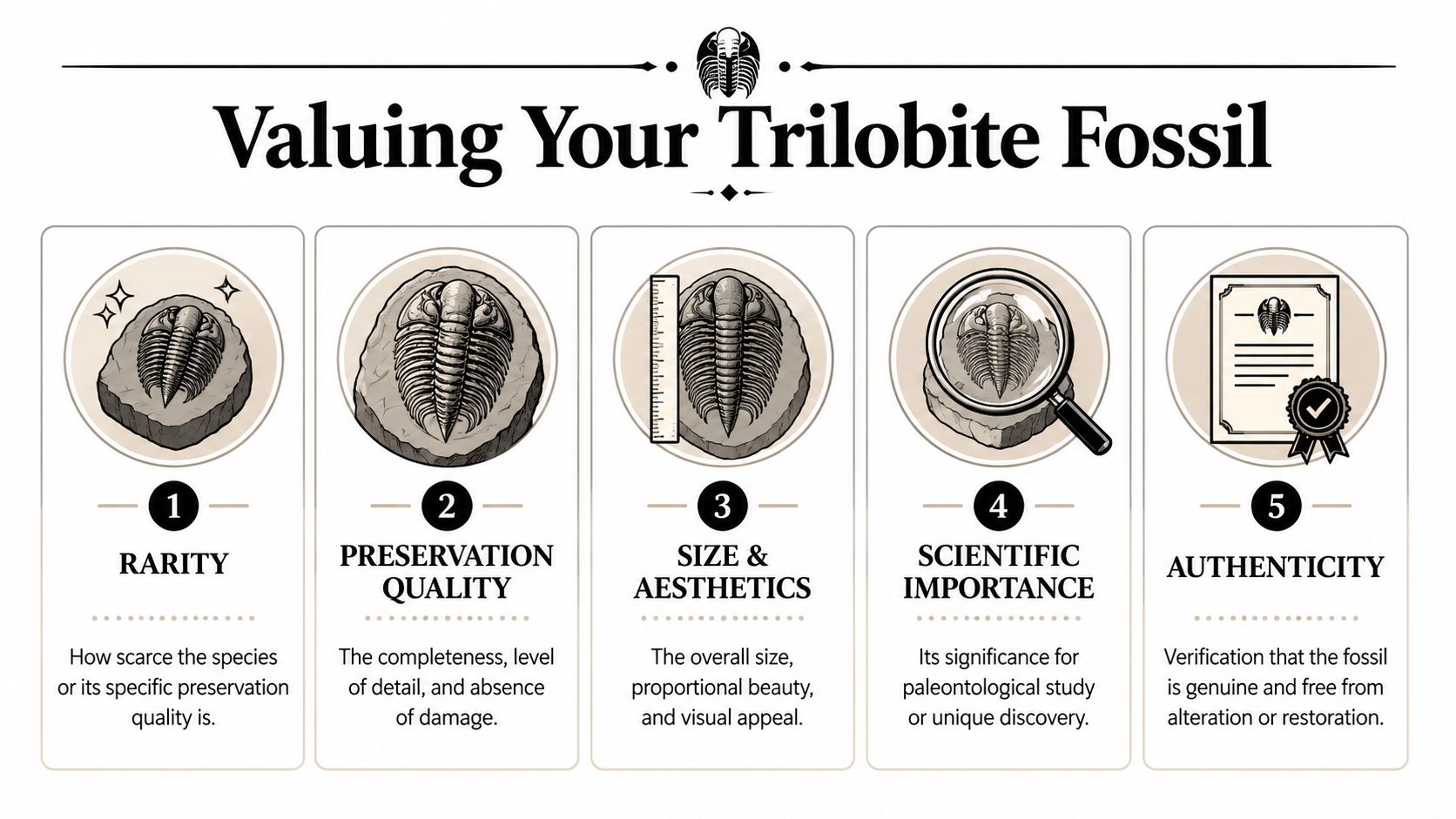
The five factors that shape collector value
Below is the framework I use most often when guiding buyers toward authentic trilobite specimens.
Rarity: Species rarity matters, but so does specimen rarity. A common species in unusually fine condition can be more compelling than a scarcer species with weak presentation.
Size and aesthetics: A larger specimen can command interest, but proportion matters more than raw scale. Balance, contrast, and posture often decide display value.
Scientific importance: Specimens with diagnostic detail, unusual preservation, or notable locality can appeal to advanced collectors.
Authenticity: Verification, traceability, and disciplined restoration practices protect long-term confidence.
Provenance and preparation separate the field
Many buyers either build a serious collection or stall with decorative purchases. Provenance doesn’t need to be theatrical. It needs to be clear. Locality, species attribution, and confidence in the chain of custody all help the specimen hold value over time.
Preparation is equally decisive. Excellent work looks almost invisible. It reveals. It doesn’t perform. When a trilobite appears too perfect in a way that denies the behavior of stone, experienced buyers step back.
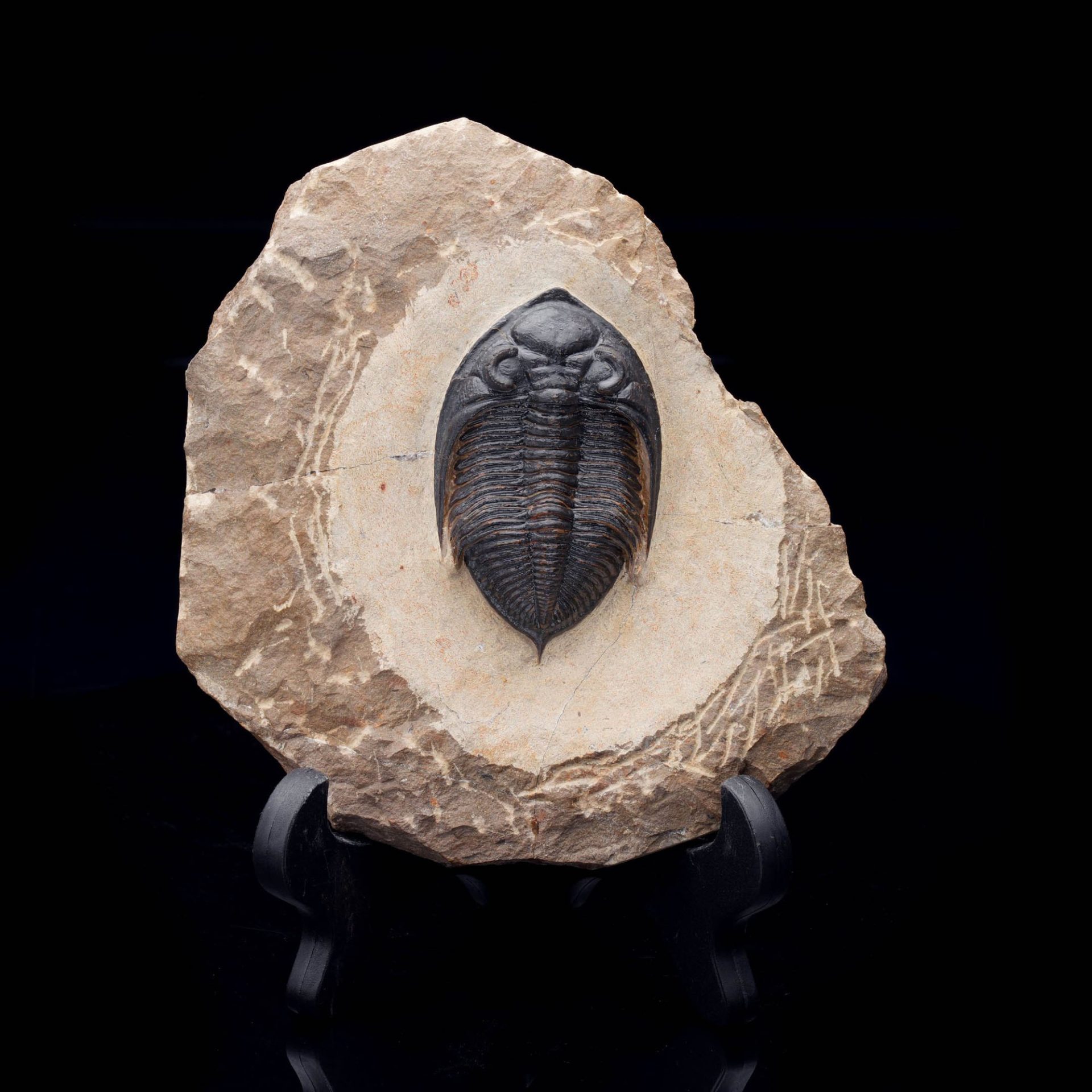
A matrix-mounted genuine trilobite fossil on natural matrix offers a useful model for this discussion because it highlights the exact balance collectors should seek. The matrix provides context, while the fossil remains the central visual event.
Why imperfect specimens can matter more
The market often favors pristine examples first. That preference is understandable. Yet not every collector should ignore damaged or unusual pieces. Malformed trilobite fossils bearing injuries from failed predation reveal predator-prey dynamics, and these imperfect specimens carry ecological stories that polished perfection cannot offer, as discussed in the PMC study on malformed trilobites.
That creates a refined collecting niche. A “battle-scarred” trilobite won’t replace the demand for a beautifully complete specimen. However, it can add intellectual depth to a collection in the same way a repaired but historically important object can matter in other fields.
The best collections don’t only show beauty. They show selection, judgment, and a point of view.
Conclusion The Enduring Legacy of Fossil Trilobites
Fossil trilobites endure because they reward every level of looking. A new collector sees symmetry and age. A seasoned collector sees species, preparation, and rarity. A curator sees a specimen that can function as science, sculpture, and historical evidence at once.
That relevance hasn’t ended with the classical literature. New work continues to expand what these animals can tell us. Recent research on soft tissue preservation in Olenoides serratus has revealed functional details of trilobite limbs, gills, and even mating appendages, which shows that these animals still hold unanswered questions for science, as reported by Sci.News on the Burgess Shale trilobite study.
For that reason, a strong trilobite never feels finished in meaning. It remains open to study, comparison, and reinterpretation. In a private collection, that is a rare advantage. The object remains visually satisfying, yet it also keeps giving back intellectually. Few fossils do that with such consistency and grace.
Collectors who want fossil trilobites with credible provenance, careful preparation, and gallery-level presentation can explore curated examples through Astro West. The right specimen should hold up as natural history first, and only then as design and acquisition.