A Collector’s Guide to the Juniper Ridge Opal Mine
When collectors think of world-class opals, their minds often jump to Australia. However, a remote Oregon mine produces America’s most spectacular and investment-worthy fire opals. The Juniper Ridge Opal Mine is not just another rock deposit; it is the legendary source of gems defined by a fiery internal glow and extreme rarity, positioning them as tangible assets for collectors and designers.
Discovering Oregon's Premier Opal Source
In the world of fine minerals, a specimen’s origin story is critical. This provenance defines its character, scarcity, and ultimately, its value. While Australia’s sedimentary opals dominate the global market, gems from Oregon’s Juniper Ridge Mine are a different breed. They are born from a far more violent geological past.
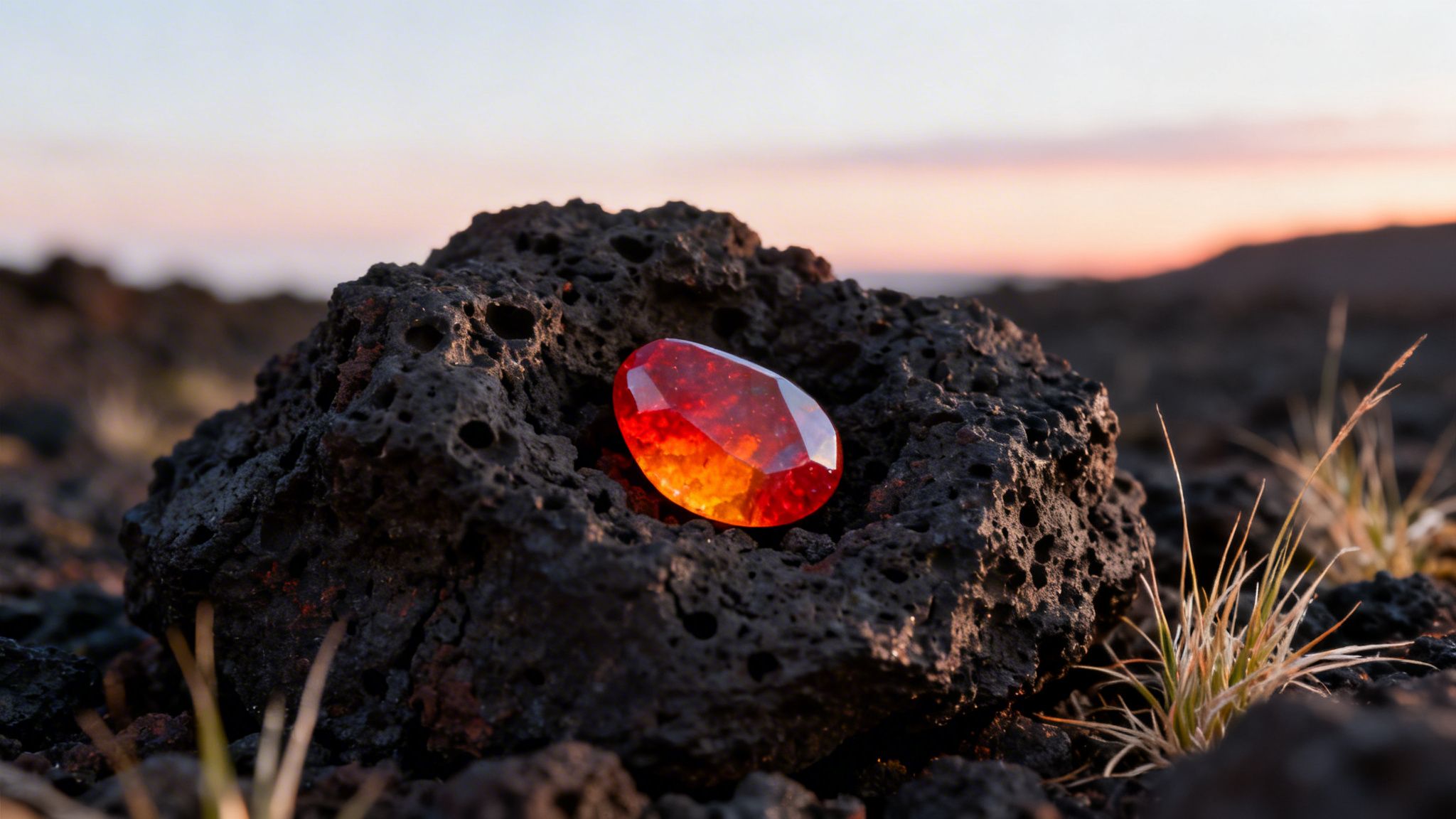
Unlike their Australian counterparts, these opals form inside unforgiving volcanic rock. This formation process is incredibly rare. As a result, it yields a much smaller, less predictable supply. Miners must painstakingly chip each opal from its dense basalt matrix. This difficult, labor-intensive work demands immense dedication.
A Beacon for Collectors
For serious opal hunters, the Juniper Ridge Opal Mine is legendary. The mine rests in the rugged terrain of Lake County, Oregon. Dedicated miners Joe Gassaway and Ken Newnham have worked it since the early 2000s. Their efforts have unearthed stunningly vibrant yellow, orange, and deep red fire opals.
Some specimens have reached an astonishing 30 cm across. This is a remarkable size for gems formed in such challenging conditions. To appreciate the mine's output, one should review the field reports from mineral experts who have studied its production.
The harsh environment that creates these opals gives them their unique personality and value. Therefore, it imbues Juniper Ridge opals with exceptional clarity and a powerful, uniform glow. This internal fire is what separates them from more common varieties, making them true collector's items.
A specimen's value directly reflects its story. For Juniper Ridge opals, that story is one of volcanic fire, geological scarcity, and expert recovery. This narrative transforms a beautiful stone into a collectible asset.
The Foundation of Value
To fully appreciate opals from Juniper Ridge, one must see them as more than stones. They are long-term stores of value, much like fine art or a vintage watch. Their worth comes from a sophisticated blend of factors beyond simple aesthetics—qualities our experts at Astro West are trained to identify.
Here is a brief overview of the key characteristics for opals from this mine.
Juniper Ridge Opal Specimen Profile
Attribute
Specification
Origin
Juniper Ridge Opal Mine, Lake County, Oregon, USA
Type
Volcanic Fire Opal
Colors
Yellow, orange, and deep red
Formation
Forms in hard basalt rock (vesicles)
Key Miners
Joe Gassaway and Ken Newnham
Maximum Size
Specimens up to 30 cm reported
Defining Feature
Intense, uniform internal glow
Market Status
Investment-grade; highly collectible
This profile highlights the specific traits that make these opals so sought-after. Now, let’s break down the most important drivers of their value.
These key factors include:
Color Intensity and Purity: The deep, saturated reds and oranges are the most coveted. Therefore, they command the highest prices.
Geological Provenance: A confirmed origin from this specific mine guarantees its rarity and unique formation history.
Specimen Integrity: Opals preserved within their natural basalt matrix are considered "natural sculptures," adding significant value.
Clarity and Size: Larger, clearer stones free of significant inclusions are exponentially rarer. As a result, they are more valuable.
This combination of qualities positions Juniper Ridge opals as curated pieces of natural history. Each one represents a rare collision of geological chaos and breathtaking beauty. Consequently, it earns a rightful place in any premier collection.
What Makes a Juniper Ridge Opal Valuable?
Placing a price on a Juniper Ridge opal is different than valuing a diamond. Most people know the "four Cs"—carat, cut, clarity, and color. However, volcanic fire opals from this Oregon mine play by their own set of rules. Their worth is a mix of geological rarity, visual power, and market demand, making them comparable to rare coins or fine art.
Understanding what drives their value is key to seeing the difference between a pretty stone and a true investment-grade specimen. For example, a small, decent-quality opal might be worth a few hundred dollars. An exceptional one can easily command thousands. While color is the first thing everyone notices, it is far from the only factor.
Why Color Is King
The single most defining feature of a Juniper Ridge fire opal is its incredible, uniform color. Unlike the "play-of-color" seen in a typical precious opal, these gems are prized for their deep, consistent internal glow. This single quality is the absolute cornerstone of their value.
The most coveted specimens have a saturated, fiery red color, often described as “cherry” or “crimson.” These intense reds are exceptionally rare. As the color shifts toward orange and then yellow, the price per carat generally follows suit. That said, a large, perfectly clear yellow opal can still be incredibly valuable.
The Key Factors That Build Value
Beyond its dominant color, several other crucial details determine an opal's market price and its potential as an investment.
Clarity and Translucency: The best specimens are highly translucent. This quality allows light to enter the stone and ignite its internal fire. Opaque or cloudy opals are worth significantly less because murkiness smothers their captivating glow.
Size (Carat Weight): Like any gem, size matters. For Juniper Ridge opals, however, value increases exponentially with size. This is especially true for stones over 5 carats with top-tier color and clarity. Finding a large, clean fire opal is a true geological rarity.
Presence in Matrix: For mineral collectors, an opal in its natural basalt host rock is often more valuable than a cut gem. These "matrix specimens" are natural sculptures, telling the complete story of their violent, volcanic birth. Additionally, the contrast between the fiery opal and dark basalt creates an impossible-to-replicate aesthetic.
Integrity and Condition: The opal must be stable. It must be free of major cracks, fractures, or "crazing"—a web of fine lines caused by dehydration. A solid, stable stone is essential for preserving its long-term value.
Valuing a Juniper Ridge opal is an exercise in appreciating rarity. A specimen that combines intense red color, high clarity, large size, and pristine condition in its matrix is the pinnacle of collectibility. That is where you will find the highest investment value.
When considering the financial side of collecting, understanding the principles of valuation is essential. Parallels with coin collecting offer insights applicable across collectible asset classes.
Provenance: The Ultimate Value Multiplier
Ultimately, confirmed origin is non-negotiable for any serious, investment-grade specimen. An opal with documented provenance from the Juniper Ridge Opal Mine will always carry a premium. This traceability guarantees its rarity and unique formation story, setting it apart from more common opals.
At Astro West, our direct relationships with the mine’s operators provide this essential verification. This ensures every piece we offer is an authentic, appreciating asset. For more on how origin affects a gemstone's value, our guide on precious vs. semi-precious stones provides excellent context.
A Legacy of Rarity in Oregon Opal Mining
To understand why Juniper Ridge opals are a sound investment, one must understand their history. Oregon’s opal history is not one of massive, industrial-scale mines like those in Australia. Instead, it is a story of small, specialized operations and boutique discoveries. That history is not just a fact; it is the foundation of their rarity and a powerful driver of their appreciation.
The story of Oregon opal begins in the late 1800s. Early prospectors, drawn to the state's wild geology, discovered the first finds. This sparked local excitement but established Oregon's reputation for unique but scarce gemstones. That legacy of limited production continues today, keeping demand well ahead of supply.
The Rise of an American Gem
For decades, Australian opals held a near-total grip on the global market. As collectors sought more than just a pretty stone, however, an appetite grew for gems with a real story. This was the moment high-quality American opals had been waiting for.
Savvy collectors and investors began hunting for non-Australian opals. They placed a premium on unique geological fingerprints and provenance. This surge in demand, met with naturally low supply from mines like Juniper Ridge, created the perfect conditions for a serious jump in value. The market was awakening to a new reality: rarity, not just beauty, drove long-term worth.
A limited production history is a powerful value amplifier. Unlike assets with vast, untapped reserves, the finite nature of Juniper Ridge opals provides a strong basis for their continued appreciation. This is similar to a limited edition artwork or a vintage luxury watch.
This shift is reflected clearly in pricing trends. Over the last two decades, top-tier Oregon opals have shown a steady increase in value. Specimens once seen as niche curiosities now command prices rivaling fine gems from more famous global sources. High-profile sales at auction and in private deals confirm this upward trend, cementing their status as true investment-grade assets.
Juniper Ridge in Context
The Juniper Ridge Opal Mine fits perfectly into this narrative of exclusivity. Its history is woven into Oregon's broader opal story, with nearby sites like the Pacific Opal Mines being mapped as early as 1897. These early operations evolved, eventually becoming the modern fee-dig and specialized mining locations of the 2000s under operators like Joe Gassaway and Ken Newnham. The mine's location, 60 miles from Lakeview in Lake County, has been a consistent source of exceptional fire, moss, and precious opals. One can explore the geology by reviewing the historical data on Mindat.org.
This long but limited history has two critical implications for investors:
Established Provenance: Decades of operation provide a rich, verifiable history. This is a requirement for any high-value collectible.
Proven Scarcity: The mine has never been a source for mass production. This reinforces its reputation for yielding only rare, top-quality specimens.
This historical backdrop provides solid justification for the current market value of Juniper Ridge opals. It shows a clear, logical pattern of appreciating value built not on hype, but on the economics of supply and demand. For an informed collector, this legacy of rarity is the ultimate proof of a sound and compelling find.
The Art of Selecting Your Specimen
Choosing a Juniper Ridge opal is more than picking a stone. It is a balancing act between the mindsets of a mineral collector and a high-end interior designer. Each views the stone through a unique lens, and understanding both is key to appreciating its true worth.
At Astro West, we inhabit both worlds. We curate our opals to meet the exacting standards of collectors who demand a perfect geological record. We also find those statement pieces that can anchor an entire room. It is an art form that transforms a raw mineral into a showpiece valued for its natural story and visual power.
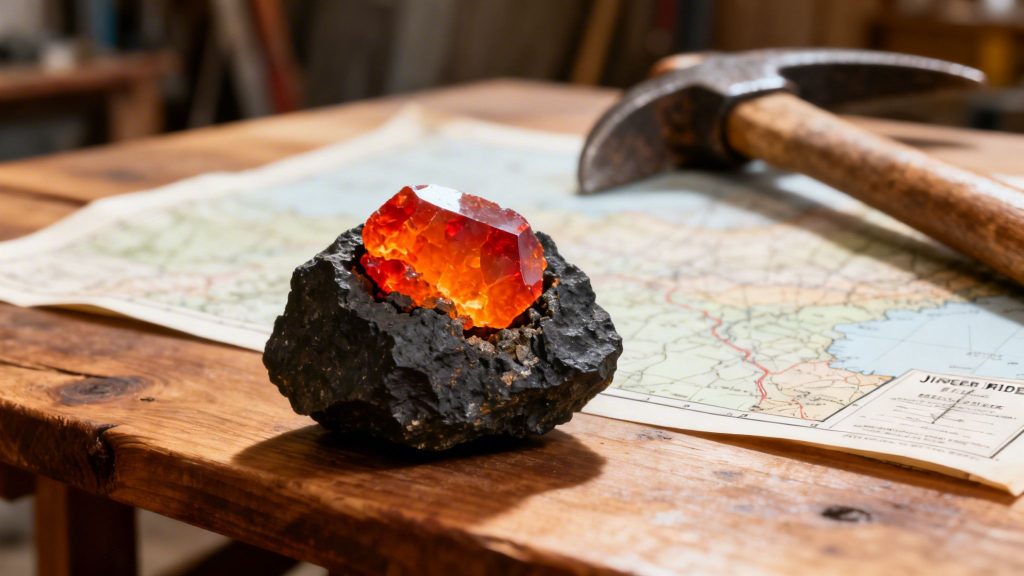
For the dedicated collector, the ultimate prize is often an untouched nodule in its host rock. These are not just opals; they are complete geological artifacts. A fiery gem still wrapped in its dark basalt cradle tells the full story of its volcanic birth—a narrative that is priceless.
Curating for Collectors
The criteria for a top-tier, collection-grade Juniper Ridge opal are strict. It all comes down to preservation and the story the stone tells.
Intact Matrix: A significant portion of the original basalt host rock must be present and stable. This provides crucial context and a stunning visual contrast that dramatically boosts the specimen's value.
Pristine Nodule Form: We look for untouched nodules that have not been polished or reshaped. They offer a pure glimpse into the opal’s natural state, straight from the earth.
Exceptional Color and Clarity: Even in the matrix, the opal itself must exhibit the top-tier color and translucency the mine is famous for. A fiery red or orange glow against dark rock is what every collector desires.
The Designer’s Focal Point
For an interior designer, however, the focus shifts to pure visual impact. Here, a Juniper Ridge opal is more than a specimen. It is a powerful focal point, a piece of raw, natural art that commands attention and defines a space.
A designer sees the specimen’s potential to make a statement. For instance, the electric red of a fire opal can become the primary color accent in a sleek, minimalist room. Its raw, organic form can beautifully soften the hard lines of modern architecture. In this world, the opal’s value is measured by its power to create bespoke luxury and spark emotion.
A Juniper Ridge opal in a designed space is an immediate conversation starter. It is a testament to the untamed beauty of the natural world, thoughtfully curated and presented with artistic intent. This elevates it from a mineral to a central element of high-end interior design.
We guide designers to find pieces that perfectly match their vision. For example, a large matrix specimen with a bold slash of orange opal might become a stunning centerpiece. A curated group of smaller, polished fire opals could be arranged in a custom display. The point is to harness the stone's inherent drama.
Our extensive crystal identification guide offers a strong foundation for designers and new collectors alike. Ultimately, the selection process is an art form. It requires an expert eye to match the perfect natural sculpture to the perfect environment.
Acquiring Authentic Specimens with Confidence
How can one be certain an opal is a genuine, investment-grade specimen from the Juniper Ridge Opal Mine? In a market where a stone’s story is everything, provenance is not a detail—it is the foundation of value. For a collector or designer, buying a piece without a verifiable history undermines its long-term worth.
At Astro West, we eliminate that uncertainty. Our sourcing is direct and personal. We do not work through middlemen or anonymous resellers. Instead, we have built direct, trusted relationships with expert miners like Joe Gassaway and Ken Newnham. This mine-to-gallery approach is the only way to guarantee authenticity and a clear chain of custody.
The Power of Direct Sourcing
Our experts travel to the source. We stand in the field, evaluating potential acquisitions alongside the people who pulled them from the earth. This allows us to vet each specimen against our strict criteria for color, integrity, and aesthetic impact before it enters the market. We are not just buying minerals; we are curating pieces of natural history.
This distinction is critical. It transforms a purchase into a curated experience built on expertise and trust. When you acquire an opal from Astro West, you are not just buying a stone. You are gaining access to a verified natural treasure, hand-selected for its beauty and investment potential.
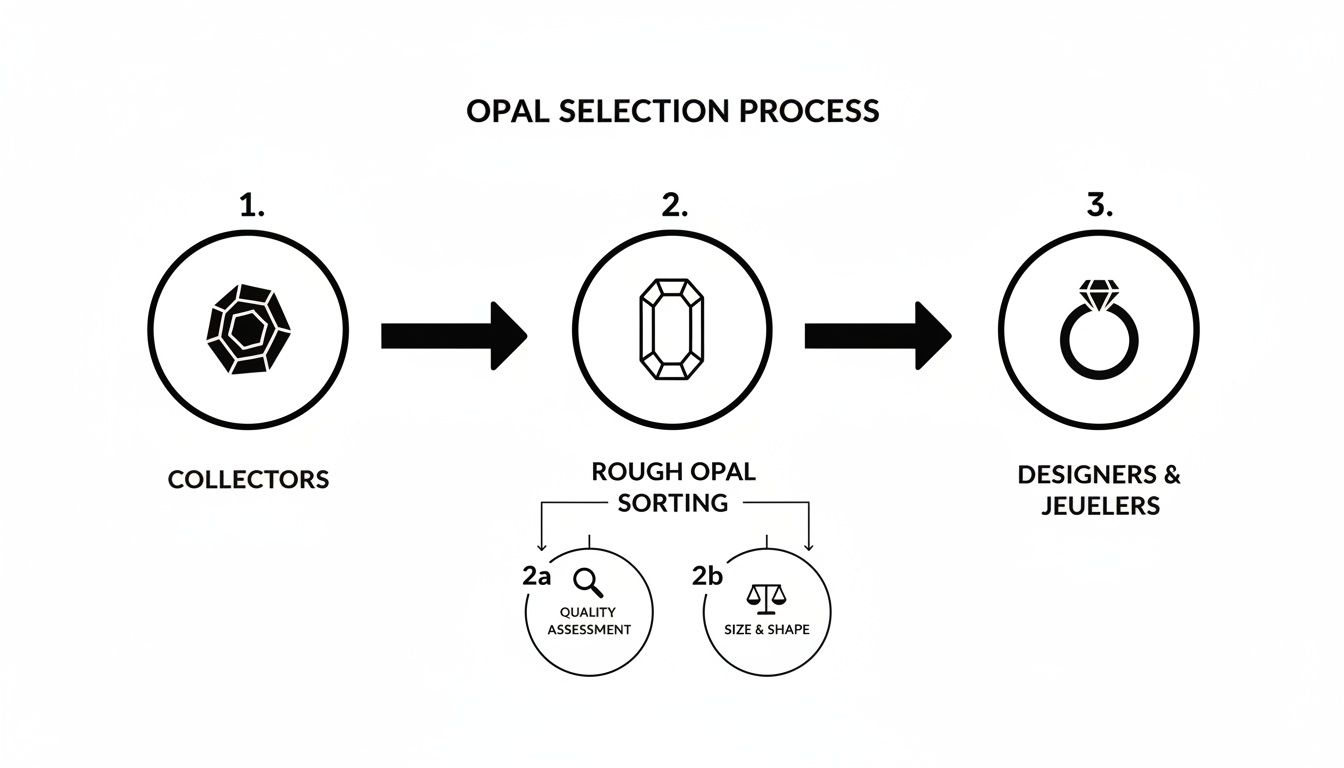
This flowchart shows how we meticulously sort through rough opal. We separate pieces for distinguished collections from those with the aesthetic pop needed for bespoke design.
As you can see, the path is different. Collectors prioritize geological perfection and provenance. Designers, however, hunt for that immediate, breathtaking visual impact.
Vetting for Long-Term Value
Our selection process is unapologetically rigorous. Much opal comes from the ground, but only a tiny fraction has the rare qualities of an investment-grade asset. Our direct access to the Juniper Ridge Opal Mine lets us sift through hundreds of specimens to find the select few that make the cut.
We specifically look for:
Irrefutable Provenance: Every piece must have a clear, unbroken story from mine to gallery. For us, this is non-negotiable.
Superior Aesthetic Qualities: We hunt for specimens with the most intense fire, exceptional clarity, and a compelling presence.
Ethical Sourcing: Our personal relationships with the miners ensure every stone we acquire supports responsible, sustainable practices.
An asset's value is anchored in its story. By sourcing directly from the Juniper Ridge Opal Mine, we ensure that story is authentic, complete, and verifiable—the bedrock of any sound investment in fine minerals.
This rigorous curation reinforces our role as a trusted gallery, not a mass retailer. We provide our clients with exclusive access to the mine’s best. Therefore, we ensure each piece is a worthy addition to a distinguished collection or design project. Our guide on how to start a collection of rare rocks and minerals is a great starting point for new collectors.
Caring For Your Oregon Opal Investment
Acquiring a Juniper Ridge opal is like acquiring fine art. It is the start of a relationship with a rare natural treasure. Its value and beauty, like a vintage watch or a master painting, depend on proper care. Protecting your Oregon opal is key to safeguarding its stunning appearance and ensuring it remains a valuable asset for generations.
The opals from the Juniper Ridge opal mine are hydrophane, meaning they naturally hold water. This characteristic is the secret to their care. If the opal experiences rapid changes in temperature or humidity, its internal water can evaporate too quickly. This can cause a web of fine fractures called crazing, which is permanent and diminishes the stone’s value.
Creating a Stable Environment
Your primary goal is to create a stable, consistent environment for your opal. Sudden shifts, like moving it from a humid room to a dry one, can stress the stone. If you must move it between different climates, do it slowly to allow gradual acclimation.
To protect your investment, follow these golden rules:
Avoid Direct Sunlight and Heat: Never display your opal in direct sunlight or near a heat source. Heat will evaporate water from the stone, causing irreversible damage.
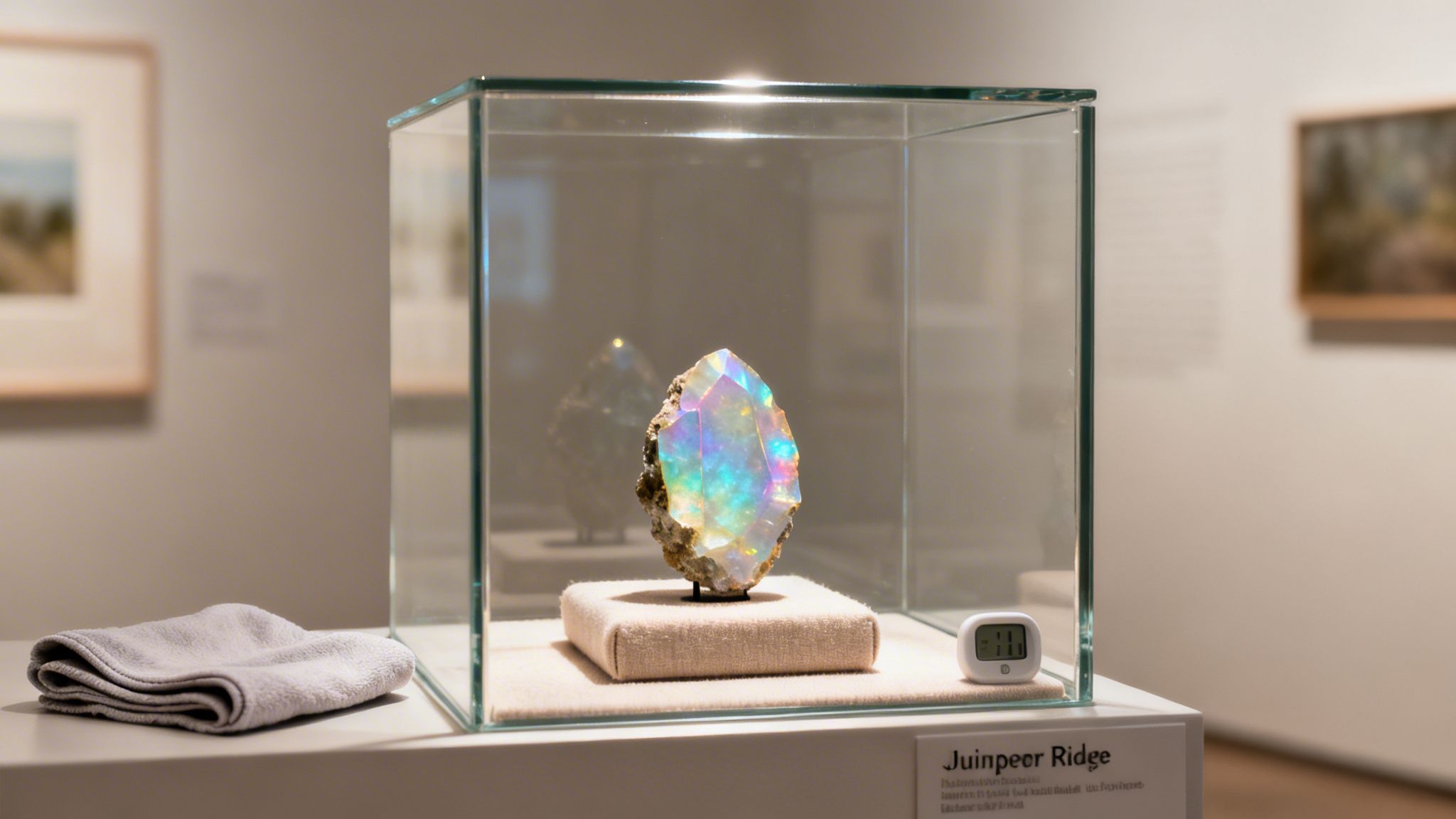
Maintain Stable Humidity: A simple solution is placing a small dish of distilled water inside the display case with your opal. This creates a stable microclimate, preventing the stone from drying out.
Use Soft, Secure Mounts: Ensure any display stand is made of soft materials that will not scratch the opal or its matrix. A secure, custom-fit base is also crucial to prevent accidental falls.
Proper Lighting and Display
Lighting can make an opal’s inner fire come alive, but the wrong kind can be destructive. You want to highlight its mesmerizing color without causing harm.
An opal’s value is intrinsically tied to its pristine condition. Proper care is not merely maintenance; it is an active strategy for asset preservation. Protecting the specimen from environmental stressors ensures it remains a treasured showpiece and a sound store of value.
For the best presentation, use low-wattage, diffused LED lighting. LEDs generate almost no heat and emit no harmful UV radiation, making them the perfect choice. For a museum-quality look, exploring options in a rock collection display case can provide ideas for a secure and beautiful exhibit.
Ultimately, caring for a Juniper Ridge opal means respecting its unique geological origins. By providing a stable, secure, and thoughtfully lit home, you ensure this stunning piece of natural art will continue to captivate—and appreciate in value—for years to come.
A Collector's Q&A on Juniper Ridge Opals
This section addresses the most common questions we hear from collectors and designers about these incredible Oregon opals. Think of this as practical advice from the source. It is the kind of insight that helps you navigate the market with confidence and appreciate what makes these gems so special.
Whether you are considering your first piece or adding a major specimen, these answers come from our years of hands-on experience. They reflect our direct relationships with the miners themselves. Our goal is to provide the clarity you need to invest in a piece of American geological history.
Are Opals From the Juniper Ridge Mine a Good Investment?
Yes, for the right pieces. High-quality opals from the Juniper Ridge Mine have all the elements of a strong investment. They are exceptionally rare, their color is unique, and collector demand for top-tier American gemstones is growing. It is the classic recipe for long-term value.
Think of it like the market for fine art or rare luxury watches. These are tangible assets, and the best-in-class examples have a history of steady appreciation. With a strictly limited supply from one location, pristine Oregon opals are well-positioned to see their value climb. A top-tier Juniper Ridge specimen is not just a beautiful stone; it is a genuine store of value.
What Makes Juniper Ridge Fire Opals So Valuable?
Value comes down to the fire. A Juniper Ridge fire opal's value is directly tied to the intensity and evenness of its color. The specimens that fetch the highest prices glow with a deep, saturated red or a pure, electric orange. Unlike common opals, true fire opals from this mine have an incredible translucency and an inner glow.
When world-class color is combined with other key factors, the specimen’s value can increase exponentially. These details separate a nice stone from a true treasure:
Large Size: Finding a large stone free of major distracting inclusions is incredibly rare.
Pristine Condition: Specimens that are stable and without cracks or "crazing" are always more desirable and valuable.
Matrix Presence: An opal still nestled in its natural basalt host rock is prized as a natural sculpture.
When all these elements align perfectly, you have a specimen intensely sought after by collectors worldwide.
The most reliable way to guarantee you are purchasing a genuine, investment-grade Juniper Ridge opal is to acquire it from a reputable gallery. An established source with direct mining relationships ensures verified provenance.
How Can I Verify an Opal Is From Juniper Ridge?
The single most important way to verify a Juniper Ridge opal is through documented provenance. At Astro West, we build that provenance by working directly with the mine operators. These are relationships built over many years, which give us a clear, unbroken chain of custody for every specimen we acquire.
Our experts then meticulously inspect each piece. They cross-reference its characteristics against known geological markers unique to the Juniper Ridge Opal Mine. This direct-sourcing method eliminates guesswork, giving you absolute confidence that you are acquiring an authentic specimen.
At Astro West, our reputation is built on the authenticity and quality of every specimen in our gallery. Our direct relationships with the world's most important miners and field experts ensure that each piece we offer is a verified, investment-grade treasure. Explore our curated collection of fine minerals and bring home a genuine piece of natural history.