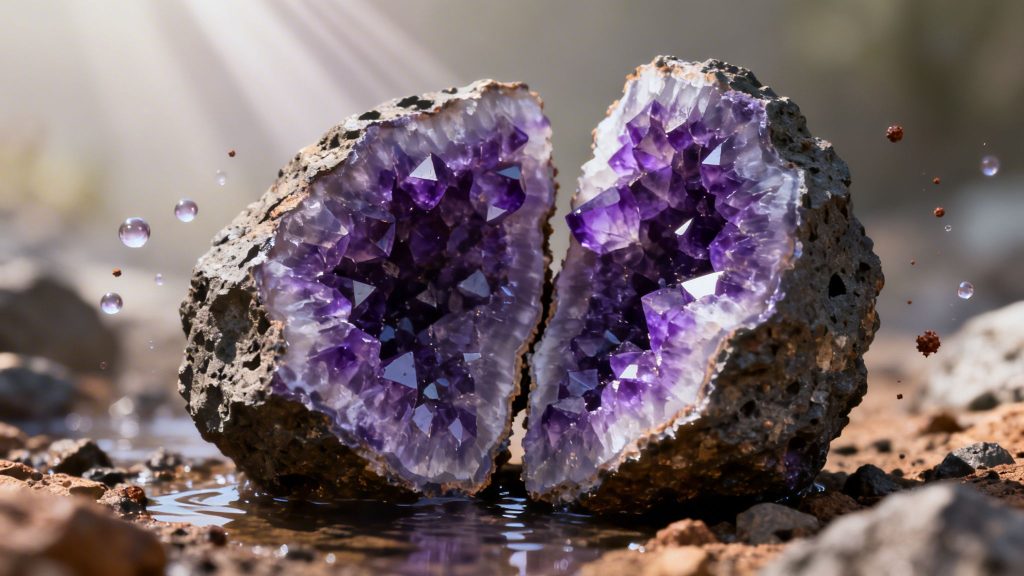
The deep, regal purple of amethyst doesn't come from a single ingredient but from a slow-burning geological recipe that unfolds over millions of years. It begins with clear quartz, born from silica-rich hydrothermal fluids. The secret twist? Trace amounts of iron are trapped inside the crystal as it grows. Over eons, gentle, natural radiation from the surrounding host rock alters these iron impurities, transforming them and giving birth to the iconic purple hue prized by collectors and designers alike.
The Recipe for a Royal Purple Crystal
The journey from a few simple geological ingredients to a breathtaking amethyst crystal is a stunning display of Earth's natural artistry. This isn't a process that happens overnight. It's a meticulous sequence of events requiring the right elements and conditions to converge over immense stretches of time, resulting in a unique piece of natural history.
At its core, amethyst is a variety of quartz (silicon dioxide), one of the most abundant minerals on the planet. Its unique value comes from the specific trace elements and the protected environment in which it grows. This natural drama typically unfolds in one of two settings: the hollow, gas-bubble voids left behind in ancient volcanic rocks, or deep fractures and veins within the Earth's crust.
Essential Ingredients and Conditions
For amethyst to form, a specific set of factors must align perfectly. Every component plays a critical, irreplaceable role, influencing everything from the depth of the purple color to the size and clarity of the individual crystals. It's a natural chemical reaction that needs the perfect laboratory—the Earth itself.
Take away just one of these key components, and you'd simply end up with common clear or milky quartz.
The core recipe includes:
A Source of Silica: The absolute foundation is silicon dioxide, typically dissolved in superheated water. This mineral-rich cocktail, known as a hydrothermal fluid, is the liquid medium from which the crystals will slowly precipitate and grow.
The Presence of Iron: This is the magic ingredient. Just trace amounts of ferric iron (Fe3+) must be incorporated into the quartz crystal lattice as it forms. This impurity is the latent potential for color, patiently waiting for the final step to activate it.
A Source of Natural Radiation: The final touch is a long, slow bath of gamma rays from naturally occurring radioactive elements in the host rock. This energy is the catalyst that alters the iron atoms, creating "color centers" that absorb specific wavelengths of light, producing the signature purple shades.
Time and Stability: This entire process is incredibly slow. It demands a stable environment with consistent temperatures and pressures for millions of years, allowing large, well-formed crystals to build up layer by microscopic layer.
This intricate dance of chemistry and geology is what gives us the world's amethyst treasures, from the massive, jaw-dropping geodes of Uruguay to the delicate, perfect crystals found in Vera Cruz, Mexico.
To make it even clearer, here's a quick breakdown of the essential players in amethyst's creation story.
Key Factors In Amethyst Formation
Component
Role In Formation
Common Geological Source
Silicon Dioxide (SiO2)
The fundamental building block of the quartz crystal structure.
Dissolved in hot, underground water (hydrothermal fluids).
Iron (Fe3+)
Acts as the chromophore (color-causing agent) when irradiated.
Leached from surrounding rocks and carried by hydrothermal fluids.
Natural Radiation
Alters the electronic state of the iron, creating purple color centers.
Trace radioactive elements (like uranium or thorium) in the host rock.
A Cavity or Fissure
Provides the protected open space needed for crystals to grow.
Gas bubbles in volcanic rock (geodes) or fractures in bedrock (veins).
Stable Environment
Allows for slow, uninterrupted crystal growth over geologic time.
Deep burial within the Earth's crust, protected from rapid changes.
Each of these factors must be present for nature to produce a genuine amethyst specimen.
The Building Blocks: Silica and Iron
To truly understand how amethyst is made, we must start with the basics. Every piece of amethyst, from a tiny crystal point to a massive geode, starts its journey as a simple solution of silicon dioxide (SiO₂) dissolved in superheated water. This humble mixture is the foundation for every variety of quartz.
Imagine ancient, superheated water flowing through the Earth's crust. As it moves, this water acts as a natural solvent, picking up and carrying dissolved silica from the rocks it passes through. This silica-rich liquid is the lifeblood of quartz formation—a ready-made soup for growing crystals.
But if you only have a pure silica solution, you will only ever get clear quartz, or what we call rock crystal. To achieve that incredible purple, another key ingredient must join the process: iron.
The Essential Role of Silica
Silica is ubiquitous. It is one of the most common compounds in the Earth's crust, making up nearly 60% of its mass. It's the primary component of sand, granite, and countless other rocks. When geological conditions are just right, this silica dissolves into those hot, underground fluids, creating a saturated liquid that will eventually cool and deposit crystals.
The process is analogous to making rock candy. You dissolve sugar in hot water, and as the water cools, the solution becomes supersaturated, causing sugar crystals to form on a string. Nature operates on a similar principle. As that silica-rich water cools or the pressure changes, the silicon and oxygen atoms begin to link together into a perfectly ordered, repeating pattern—the classic hexagonal shape shared by all quartz crystals.
Introducing the Color Catalyst: Iron
Here is where the transformation happens. While the quartz crystal is slowly growing, tiny iron ions (specifically, ferric iron or Fe³⁺) floating in the fluid get incorporated directly into the crystal's atomic structure. These iron impurities essentially take the place where a few silicon atoms should be.
This is the single most important step in creating amethyst. Without these trace iron impurities, the crystal would never have the potential to become purple.
The amount of iron required is incredibly small—often just a few parts per million—but its presence is absolutely essential. This iron doesn't make the crystal purple right away; it sits dormant within the structure, a hidden potential waiting for one final step. In other minerals, iron plays a more direct role, creating the bold red in a beautiful hematite-coated quartz cluster.
The concentration and placement of these iron impurities ultimately determine the depth and evenness of the amethyst's final color. This explains why some crystals have a rich, uniform purple, while others may have lighter spots or distinct color zones. The simple addition of this one element completely changes the game, setting the stage for an ordinary quartz crystal to become the regal gem we know as amethyst.
Where Amethyst Grows: Geodes and Veins
Now that we have our basic ingredients—silica-rich water with a dash of iron—they need a safe place to work their magic. Nature offers two primary workshops for this process, each producing amethyst with its own distinct character. These geological crucibles are either hollow cavities in volcanic rock, known as geodes, or deep fractures in the Earth's crust, called hydrothermal veins.
The environment where an amethyst crystal is born is a huge part of its story. Whether it grew slowly inside a sealed volcanic bubble or more rapidly in a deep fissure determines its final size, shape, and overall appearance—the very qualities that collectors and designers get excited about.
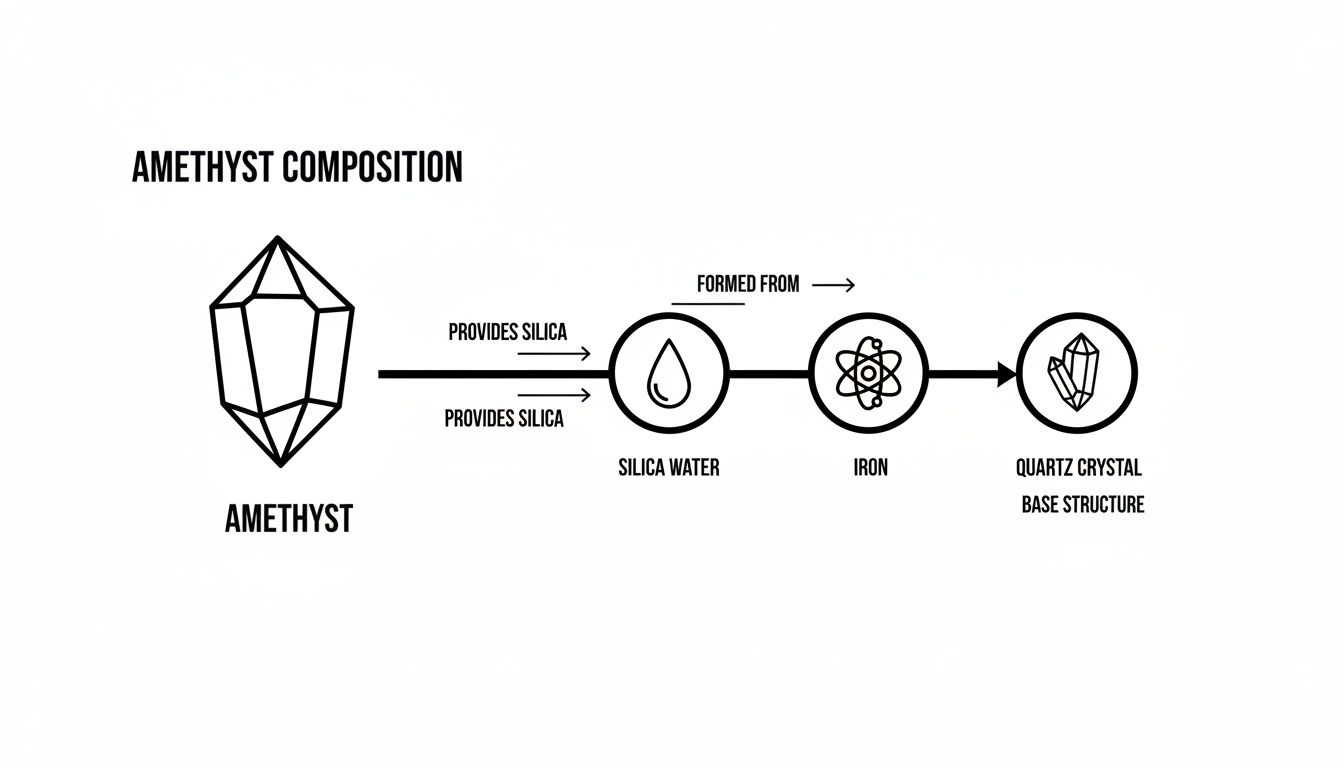
This concept map breaks down the simple, yet essential, ingredients needed to kickstart the whole process.
You can see how the silica-rich water is the foundation for the basic quartz structure, while iron is the critical guest that makes the future purple color possible.
Inside a Volcano: The Birth of a Geode
The most breathtaking amethyst specimens often come from geodes. These are nature’s treasure chests, formed inside volcanic rocks like basalt. The process begins when gas bubbles get trapped in molten lava as it cools and solidifies.
These trapped bubbles create hollow, round, or almond-shaped pockets inside the now-hardened rock. Over millions of years, these empty chambers become the perfect protected nurseries for crystals to grow.
Slowly but surely, groundwater loaded with dissolved silica and trace minerals seeps into these cavities. As this mineral soup gradually cools or evaporates, it can no longer hold all of its dissolved contents. The silica begins to precipitate out of the solution, depositing microscopic layers of quartz crystals onto the inner walls of the cavity.
This slow, undisturbed growth process is what allows for the formation of large, perfectly terminated crystals that point inward, creating the breathtaking, sparkling interiors of the amethyst geodes prized by collectors.
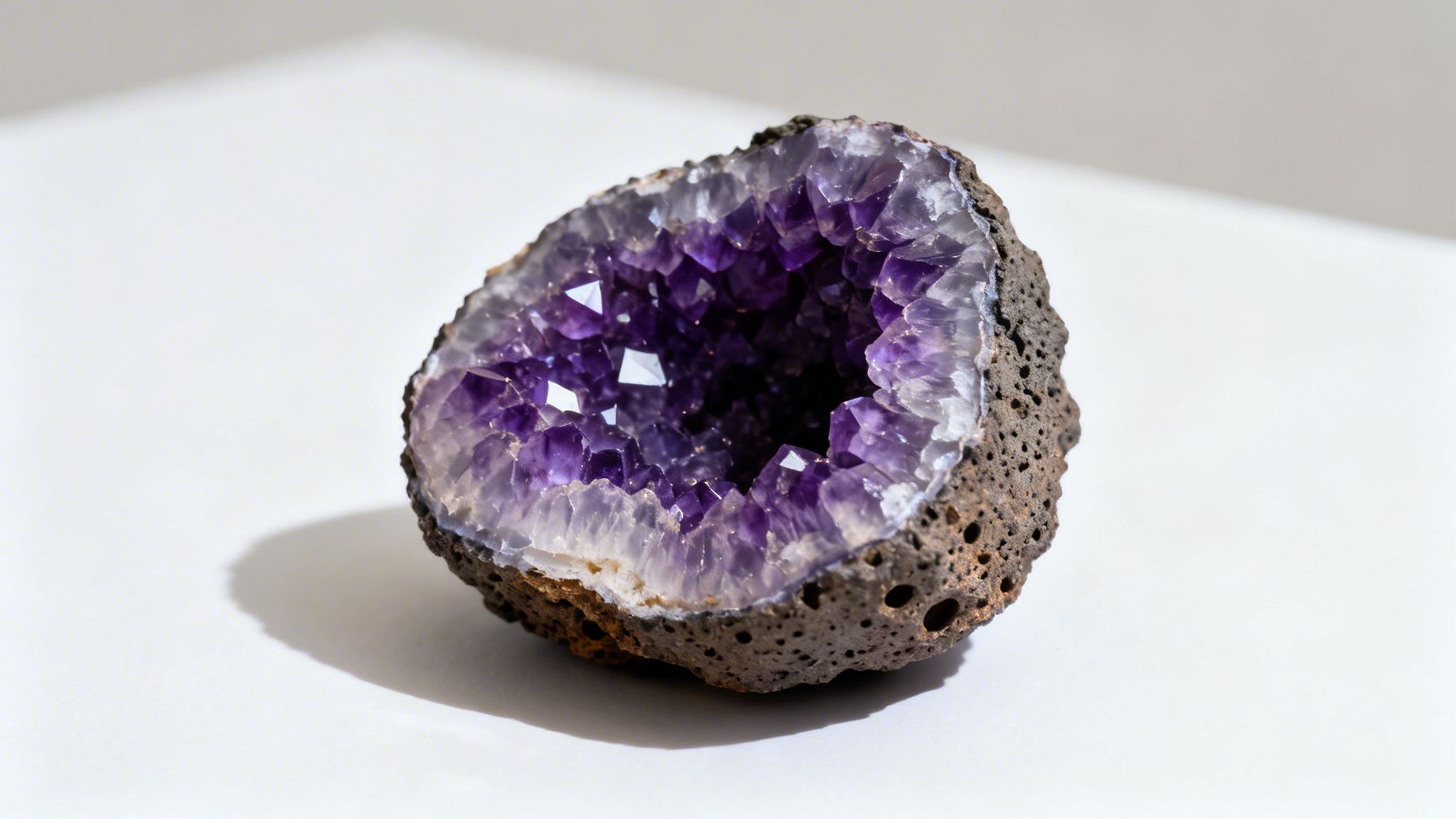
The outside of the geode is typically a tough layer of chalcedony that acts as a durable shell, keeping the pristine crystal environment inside safe for eons. The final result is a self-contained masterpiece of natural art, like this beautiful amethyst geode slice that perfectly showcases its layered growth and stunning interior.
Deep Within the Crust: Hydrothermal Veins
The other primary location where amethyst forms is within the cracks and fractures of the Earth's crust. These fissures, created by the stress of shifting tectonic plates, act as a natural plumbing system for superheated, mineral-rich fluids.
Unlike the quiet, closed-off world of a geode, these veins are often much more dynamic. Hot, pressurized water packed with silica and iron is forced through these fractures. When the fluids encounter cooler areas or the pressure drops, the minerals rapidly fall out of solution, lining the walls of the crack with quartz crystals.
This process creates what are known as amethyst veins or lodes. Amethyst that forms this way often has a different character than its geode counterparts.
Crystal Habit: Vein crystals might grow in dense mats or clusters instead of pointing neatly inward from a hollow space.
Associated Minerals: They are often found with other minerals that form under similar conditions, like calcite or pyrite. For instance, Astro West features exceptional specimens like a rare tourmaline and quartz from Brazil, which formed in a similar hydrothermal vein environment.
Appearance: Vein amethyst can show beautiful banding or color zoning, which tells the story of how the fluid chemistry changed over time.
Research into the massive amethyst geodes of Uruguay reveals a fascinating story. These deposits formed approximately 134 million years ago as the supercontinent Gondwana was breaking apart. Massive basaltic lava flows created the initial cavities, but instead of high-temperature hydrothermal fluids, relatively cool groundwater, between 15 to 60 °C, percolated through the rock over millions of years, slowly dissolving silica and iron to grow the crystals. You can explore the detailed findings from Göttingen University's research, which challenges older theories and highlights the power of low-temperature, long-duration geological processes. This evidence shows that no matter the path, the Earth finds remarkable ways to create these purple masterpieces.
The Final Touch: Natural Radiation and Color
Imagine a clear quartz crystal, freshly formed, with tiny iron impurities perfectly settled into its structure. At this point, it holds no hint of purple. It’s a blank canvas, a vessel of pure potential waiting for one final, transformative touch from the Earth itself.
That last step is a slow, patient process of natural alchemy, powered by the subtle but persistent energy deep underground.
Over millions of years, the host rock surrounding the quartz crystal emits faint but steady streams of natural gamma radiation. This isn't anything dramatic; it's the gentle energy released from the slow decay of radioactive elements like uranium and thorium, which are naturally present in rocks like granite. This gentle irradiation is the key that finally unlocks the crystal’s hidden color.
The entire process hinges on this critical interaction between energy and matter. When a gamma ray passes through the quartz, it carries just enough energy to displace an electron from one of those iron (Fe³⁺) impurities.
This energetic event fundamentally changes how that specific iron atom interacts with light. It creates what scientists call a color center—a localized defect in the crystal lattice that is now capable of absorbing certain wavelengths of light.
Think of this newly formed color center as a highly specialized filter. When white light enters the crystal, this specific spot in the structure absorbs the yellow portion of the spectrum. Since the yellow light has been subtracted, our eyes perceive the light that’s left over: a beautiful, captivating blend of violet and purple.
From Trace Elements to Deep Hues
The richness and particular shade of an amethyst’s purple are directly tied to the concentration of these color centers. The more iron impurities that are altered by radiation, the more yellow light gets absorbed—and the deeper and more saturated the resulting purple becomes.
This simple mechanism is behind the incredible diversity of amethyst shades we see in nature:
Delicate Lilac: Crystals with fewer iron impurities or those exposed to less radiation only develop a subtle, pale violet hue.
Royal Purple: Specimens from environments rich in both iron and natural radiation develop a dense network of color centers, resulting in the deep, velvety purples prized by collectors.
Color Zoning: Sometimes, the iron isn't distributed evenly, or the radiation exposure is inconsistent. This creates distinct zones of darker and lighter purple within a single crystal, telling a fascinating story of its growth history.
This entirely natural process is incredibly slow, unfolding over millions of years as the crystal patiently waits in its dark, underground nursery. The faint, ambient radiation is just strong enough to activate the color but gentle enough to avoid damaging the crystal’s structure. It's a perfect example of the elegant precision of geology.
The magic of how amethyst forms isn't just about its chemical ingredients. It’s about this final, energetic blessing from the Earth—a slow-burn reaction that transforms a common mineral into a coveted gem, giving each crystal its unique voice, from a whisper of lavender to a declaration of deep, commanding purple.
A Global Tour of Iconic Amethyst Mines
While the science behind amethyst formation is universal, the Earth itself is a wonderfully diverse laboratory. The unique geology of different regions produces amethyst with its own distinct personality—from its specific shade of purple to its crystal habit.
Exploring the world’s most famous amethyst localities reveals how local conditions shape the final masterpiece. This global perspective is crucial for any serious collector or designer who values provenance. Knowing where a piece comes from means knowing its story, which is why at Astro West, we make it a priority to source from these iconic locations.
From the colossal geodes of South America to the rare vein deposits of North America, each mine offers a unique chapter in the story of amethyst.
Brazil and Uruguay: The Geode Giants
When most people picture amethyst, they’re likely thinking of the massive, cathedral-like geodes that serve as breathtaking statement pieces in luxury interiors. The world’s primary source for these natural wonders are the basalt fields of southern Brazil and northern Uruguay.
These neighboring regions share a geological history that created the perfect recipe for growing enormous, crystal-lined cavities. Millions of years ago, vast lava flows blanketed this area. As the molten rock cooled, huge gas bubbles became trapped inside, forming hollow pockets that would one day become the world-famous geodes we see today.
Amethyst from this region is known for a few key traits:
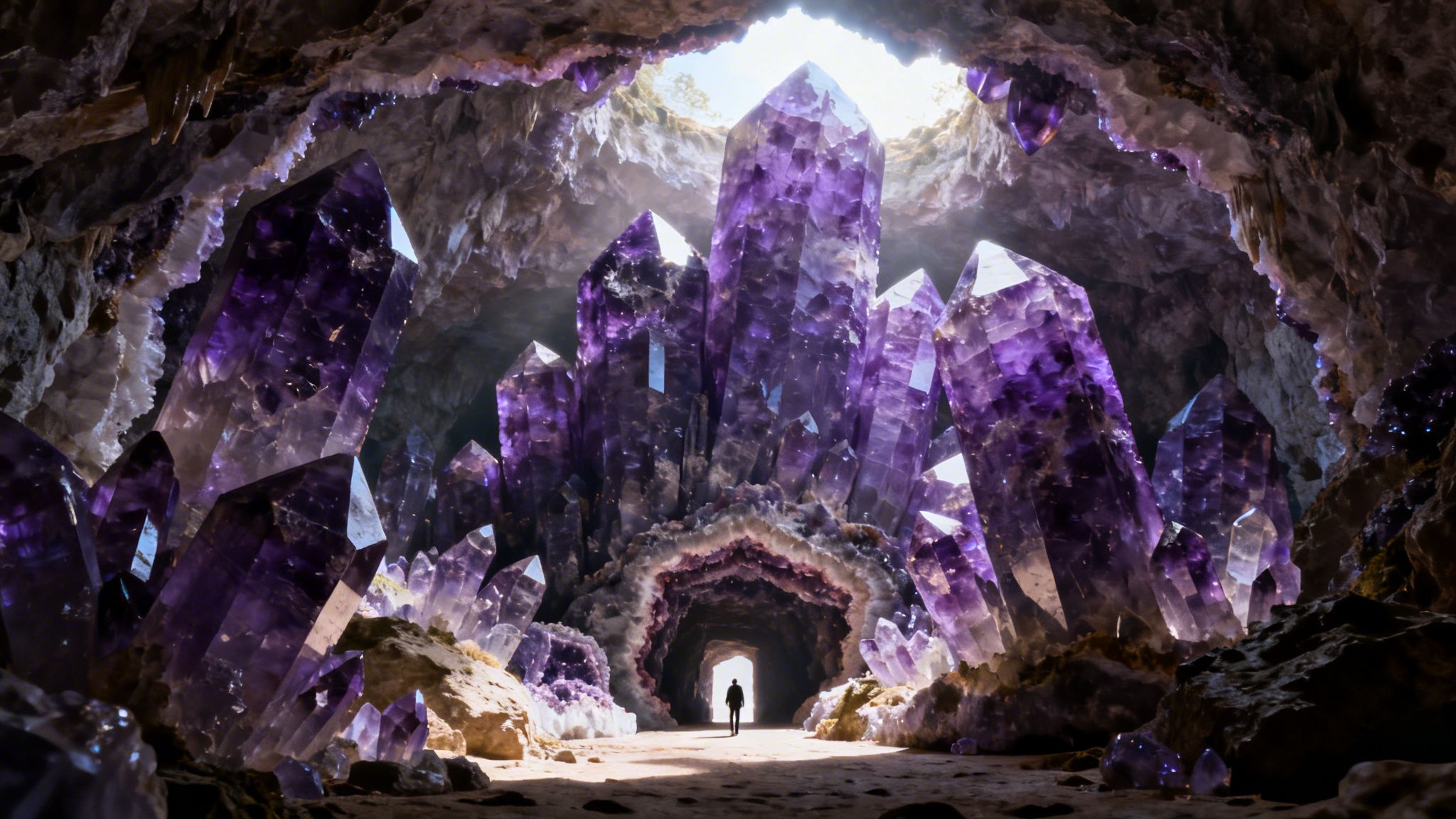
Immense Scale: Geodes here can range from just a few inches across to towering structures a person could stand inside. This is a direct result of the enormous gas voids left behind in the thick basalt flows.
Deep, Saturated Color: Uruguayan amethyst, in particular, is famous for its deep, royal purple hues. This indicates that the mineral-rich fluids that seeped into these geodes carried a high concentration of iron, which was then fully activated by eons of natural radiation.
Layered Growth: Many geodes from this area show distinct layers of agate or chalcedony lining the outer rim before the amethyst crystals begin—a beautiful record of the changing fluid chemistry over millennia.
The sheer volume and quality of amethyst from this corner of the world have made it the global standard for high-end decorative specimens. The stable, protected environment inside these basaltic pockets allowed crystals to grow slowly and perfectly, resulting in the pristine treasures sought by collectors today.
The Four Peaks Mine: An American Treasure
In stark contrast to the geode fields of South America, one of North America’s most important amethyst deposits tells a completely different geological story. The Four Peaks Mine, nestled high in the rugged mountains of Arizona, is famous for producing vein-hosted amethyst of exceptional color and quality.
Instead of forming in volcanic bubbles, this amethyst grew within deep fractures in much older rock.
The Four Peaks Mine is home to North America's largest amethyst deposit, with crystals that formed in volcanic rocks approximately 1.4 billion years old. Here, hydrothermal fluids carrying silica and iron were forced into deep fissures. As these superheated fluids cooled, crystals began to grow along the walls of the fractures. Arizona now produces over 70% of the amethyst in the United States, and Astro West is proud to partner with local diggers to trace each piece’s unique story back to this historic location.
The distinct "Siberian" red-purple flashes seen in Four Peaks amethyst are a direct result of its unique formation within these ancient fissures. This specific geological setting created a gem prized by royalty and collectors for its rare and beautiful coloration.
The amethyst from Four Peaks is a perfect example of how vein deposits can yield gems with unique characteristics not found in geodes. The pressure and temperature changes within these deep fractures influenced the crystal growth, creating stones so fine they have been featured in royal collections around the world. This American locality proves just how diverse the processes of amethyst formation can be—and that spectacular crystals can arise from dramatically different geological playgrounds.
What to Look for in a Quality Natural Amethyst
Once you understand the wild geological journey amethyst takes—from a hot silica soup to an irradiated masterpiece—you're ready to start collecting with a discerning eye. This isn't just academic trivia; it's practical knowledge that helps you spot true quality. Evaluating a natural amethyst means looking past the pretty purple and reading the subtle clues left behind by its formation.
Separating a fine, collector-grade specimen from a more common piece comes down to three main things: color, clarity, and crystal form. These aren't random features. They're a direct report card from Mother Nature on the amethyst’s history—how pure its mineral bath was, how stable its nursery, and how intense its final radioactive glow-up.
Evaluating Color Saturation and Tone
Without a doubt, color is the single most important factor for amethyst. The ideal is a deep, rich purple without any muddy brown or bronze tints. But it's the tone and saturation that truly separate the good from the great.
Saturation is the intensity of the purple. The most valuable amethysts have a powerful, vibrant purple hue. You'll often hear the term "Siberian" used to describe this top-tier deep purple, which often flashes secondary hints of red or blue.
Tone is the color's lightness or darkness. If a piece is too dark, it can look almost black in normal lighting, hiding its beauty. If it's too light, the color looks weak or "washed out." The sweet spot is a medium-dark tone that lets that gorgeous purple shine through.
Uniformity is also crucial. The best specimens show even color distribution, without distracting patches or zones of lighter or darker purple.
When you see that perfect, deep coloration, you know the conditions were just right. There was sufficient iron available in the solution, and the crystal received a long, steady dose of natural radiation to activate it.
Clarity and Crystal Integrity
Right after color, you want to look at clarity. In the world of fine minerals, clarity is more than just being see-through. It’s about the absence of internal fractures, distracting inclusions, or surface blemishes that detract from the crystal's raw beauty.
High-quality specimens grew in calm, protected pockets, allowing their atomic structure to lock into place without stress. This results in pristine, water-clear crystals that act as perfect windows for their internal color. Think of the coveted Vera Cruz amethyst, famous for its exceptional clarity and luster; those crystals are a testament to a peaceful upbringing.
The specific location where a crystal grows plays a massive role in its final appearance. For instance, some Canadian amethyst localities tell a unique story of low-temperature formation. Amethyst from La Manche, Newfoundland, grew in steep veins over 370 million years ago in a shallow part of the Earth's crust where the fluids were only about 75°C. This very specific history, confirmed by GIA studies, shaped the mineral's final character. You can read more about these fascinating Canadian deposits and their unique formation conditions to get a better sense of how a crystal's home address influences its quality.
Got Questions About Amethyst Formation?
To round out our deep dive into the geological magic behind amethyst, let's tackle a few of the most common questions we hear. Getting a handle on these details can really deepen your appreciation for how this incredible purple quartz comes to be, and why every single piece is a unique slice of natural history.
How Long Does It Take for Amethyst to Form?
Patience is a virtue in geology. Amethyst formation is an unbelievably slow process that plays out over immense geological timescales, often taking millions of years. The speed of growth hinges entirely on the stability of the environment—including temperature, pressure, and a steady, uninterrupted flow of silica-rich water.
Inside the quiet, protected cavity of a geode, the conditions are ideal. Crystals build up layer by microscopic layer, a painstaking process that eventually results in the large, perfectly-formed points that collectors dream of. This immense timeframe is what makes every amethyst a true relic of an ancient Earth.
Can Amethyst Lose Its Purple Color?
Yes, that gorgeous purple isn't always permanent. The color, which is a gift from natural radiation, can be sensitive to both high heat and excessive direct sunlight.
Heat Treatment: When heated to extreme temperatures (around 400-500°C), the color centers that create the purple hue become unstable. The stone then transforms into the yellow, orange, or brown shades we know as citrine. In fact, most of the citrine on the market is produced this way.
Sunlight Exposure: Like a fine painting, years of exposure to direct, intense sunlight can cause the UV rays to make that vibrant purple fade. This is why we always recommend displaying your best amethyst specimens away from windows that receive direct sun all day.
Why Do Some Amethysts Have Different Shades of Purple?
The incredible variation in amethyst’s color is a direct map of its unique life story. The richness of the purple comes down to two main factors: how much iron was present in the quartz as it grew, and how much natural radiation it was exposed to over the eons.
A crystal that formed with plenty of iron impurities and received a long, steady dose of gamma rays will develop that deep, saturated purple everyone loves. If those conditions fluctuated, you get what’s known as color zoning—where a single crystal might show distinct bands of light and dark purple, literally charting its own growth through time.
Every mineral in the Astro West collection tells a story millions of years in the making. Understanding how amethyst is formed connects you to its incredible journey from a simple solution to a treasured natural sculpture. Explore our curated collection and bring a piece of Earth’s artistry into your own space. Discover our full collection of fine minerals and décor at Astro West.