Imperial Topaz: A Collector’s Guide to the Gem of the Sun
Imagine holding a piece of the sunset in your hand—that’s the essence of Imperial Topaz. This magnificent gem is in a class all its own, celebrated for a breathtaking color palette that captures the warmth of solar fire. Unlike common yellow or blue topaz, which are often treated, its stunning golden-orange to reddish-pink hues are completely natural, making it one of the most coveted gems in the world.
What Makes Imperial Topaz So Extraordinary
Imperial Topaz isn't just another pretty stone. Its value and allure come from a rare combination of natural characteristics that simply can't be replicated. It’s a true collector’s prize, defined by its rarity and a truly unique visual flair.
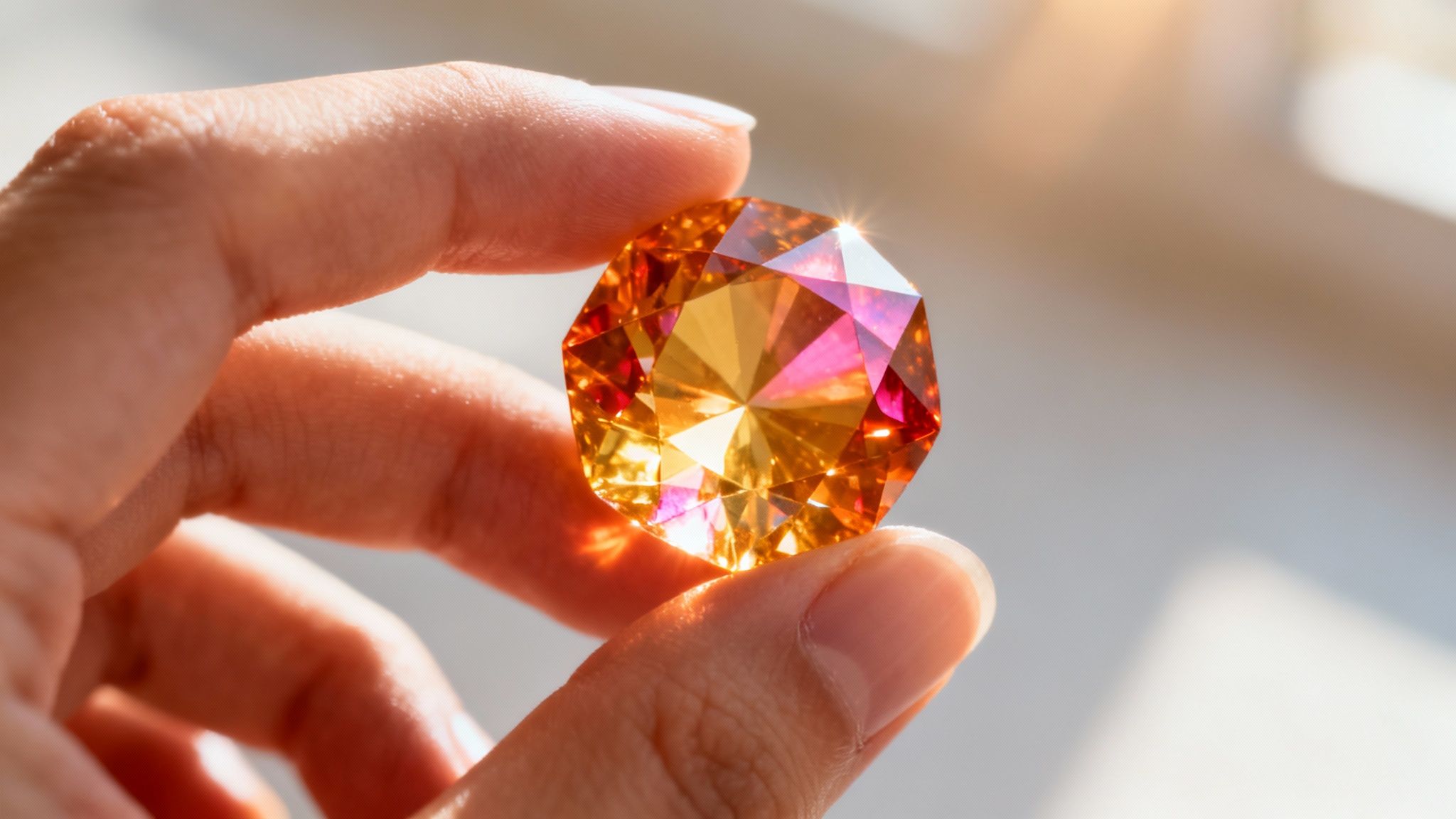
For collectors and designers, its most captivating feature is its strong pleochroism. This is an optical phenomenon where the crystal shows different colors when you view it from different angles. A single stone might shift from a rich, golden orange to a delicate sherry-red or a soft pinkish hue. It creates a dynamic play of light and color that makes every single gem a unique work of art.
The Hallmark of Rarity and Prestige
The prestige of Imperial Topaz is deeply tied to its exclusive origin. The vast majority of authentic, high-quality specimens come from just one region in Brazil. This fact alone severely limits its global supply and cements its status as a collector's dream. This geographic exclusivity is a huge driver of its investment potential. Unlike more common gems, the finite supply of Imperial Topaz ensures it will remain a treasured and appreciating asset.
This gem's story is one of natural artistry and geological scarcity. Its value is not just in its beauty but in its provenance, making it a tangible piece of Earth’s history that resonates with both aesthetic and investment appeal.
This guide will walk you through everything you need to know about this exceptional gemstone, from how it's formed and graded to how to select a world-class specimen from a trusted expert like Astro West. Just as Imperial Topaz captivates with its unique hues, the world of precious gems offers other extraordinary examples; for instance, you can explore the allure of color diamonds to appreciate how color elevates rarity and value across different minerals.
Tracing Imperial Topaz to Its Brazilian Roots
The story of genuine Imperial Topaz is completely tied to one legendary place on Earth. Unlike other gems found on multiple continents, this rare treasure is the product of a unique geological event concentrated in a single, historic region of Brazil. Its value, scarcity, and undeniable mystique are all rooted in that specific soil.
For centuries, the world's only meaningful source of gem-quality Imperial Topaz has been the mines around the old city of Ouro Preto—which means "Black Gold"—in the state of Minas Gerais. This area is the cradle of the finest specimens, producing the signature fiery colors that define this elite gemstone. The geological conditions here are perfect, creating a specific mineral "recipe" that has never been duplicated anywhere else.
The Unique Geological Recipe
So, what makes the geology of Ouro Preto so special? The formation of Imperial Topaz requires an incredibly precise mix of elements and conditions. It's a silicate mineral of aluminum and fluorine, but its famous color comes from trace amounts of chromium. The specific geothermal and hydrothermal activity that occurred in the host rocks of this Brazilian region provided the one-in-a-million environment for these elements to crystallize into the magnificent gems we see today.
Think of it like a complex natural recipe where every single ingredient and every step in the process must be absolutely perfect.
The provenance of an Imperial Topaz isn't just a detail; it's the core of its identity. A stone's journey from the specific mines of Minas Gerais is a crucial part of its story and a primary driver of its value.
This is exactly why collectors and connoisseurs place such an immense premium on a Brazilian origin. It's a guarantee of authenticity and a direct connection to the historic legacy of the world’s most celebrated topaz.
Why a Brazilian Origin Commands a Premium
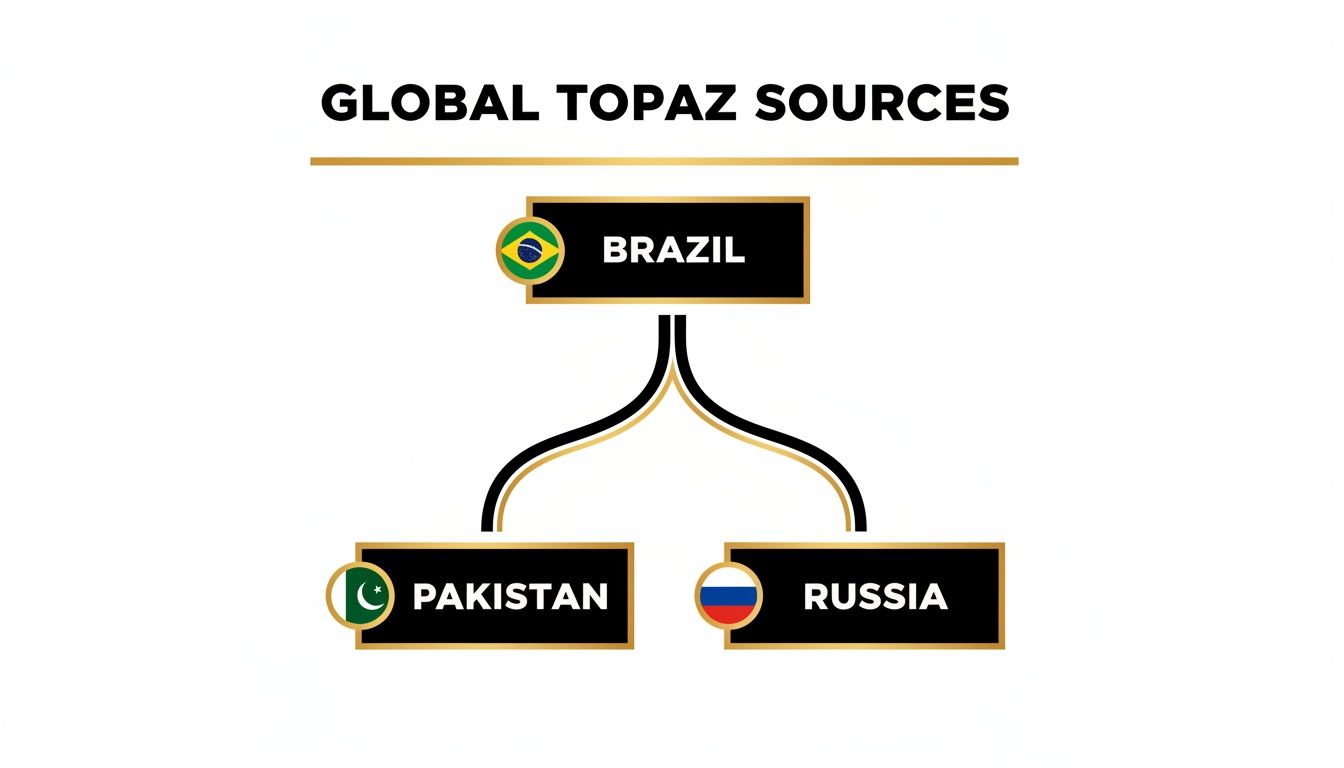
The entire market for Imperial Topaz is defined by this one geographic point. While small, secondary deposits have popped up in places like Pakistan and Russia, they just don't compare in quality or quantity to what comes out of the Brazilian mines. Ouro Preto remains the world's undisputed capital for Imperial Topaz, producing stones that command top-tier valuations across international markets.
In fact, gems from established Brazilian mines typically fetch 20 to 40 percent higher prices per carat than comparable specimens from other sources. You can explore more about this market dynamic and learn about topaz valuation.
This distinction is critical for any serious buyer. The name "Imperial" isn't just a description of color—it’s a nod to its regal Brazilian heritage. That’s why Astro West cultivates direct relationships with miners in the Ouro Preto region, ensuring every specimen we offer, like this exquisite Imperial Topaz from Brazil, has an unimpeachable provenance. This direct access allows us to secure authentic, high-caliber crystals that truly embody the spirit of this legendary gem.
Understanding this origin story is the first step in appreciating the profound rarity and enduring value of true Imperial Topaz.
How to Grade Imperial Topaz Like an Expert
When you're looking at a gemstone like Imperial Topaz, it takes more than a quick glance to see what you've really got. While the famous "Four Cs" of diamond grading—Color, Clarity, Cut, and Carat Weight—give you a great starting point, this gem plays by its own rules. Getting to know these little differences is what separates a casual admirer from a true connoisseur.
These grading factors aren't just technical details on a lab report; they're the elements that give Imperial Topaz its soul. A tiny shift in hue from golden to reddish-orange or a particularly skillful cut can elevate a stone from simply pretty to a breathtaking piece of natural art. This is the knowledge that lets you assess quality like a pro and feel confident in what you're buying.
Color: The Most Important Factor
In the world of Imperial Topaz, color is king. Hands down, it's the biggest driver of both value and desire. A simple "golden-orange" might get you in the ballpark, but the hues that collectors and jewelers truly covet are far more specific.
The absolute pinnacle—the most sought-after and valuable color—is a rich, reddish-orange. You’ll often hear it described with romantic names like "sherry red" or "peachy pink." This incredible saturation, a gift from trace amounts of chromium in its crystal structure, is exceptionally rare. Just below that are the vibrant golden-orange and peachy-orange tones, which are more classic but still highly prized. The yellowish-orange or champagne hues, while still lovely, are considered the most common and therefore less valuable.
One of the key giveaways of a top-quality Imperial Topaz is its strong pleochroism. As you turn the stone in the light, you should see distinct flashes of different colors—usually reddish or pinkish tones—dancing within the main golden body. This gorgeous optical trick is a signature of genuine, high-grade Imperial Topaz.
Clarity and Cut: Unlocking the Inner Fire
While color gets all the glory, clarity and cut are the crucial supporting cast that lets the star shine. A top-tier Imperial Topaz should be what we call "eye-clean," meaning you can't see any inclusions just by looking at it. Luckily, this gem's crystal structure means it often forms with remarkable clarity, so any noticeable internal flaws will pull its value down significantly.
The cut is where human skill meets the raw potential of nature. A master gem cutter doesn't just carve a shape; they study the crystal's unique orientation to bring out its best brilliance and that all-important pleochroism. Some of the most popular cuts for this stone include:
Emerald Cut: This elegant, rectangular shape with its stepped facets does a fantastic job of showing off the gem's deep, even color.
Oval Cut: A timeless choice that really dials up the stone's brilliance and can often make it look larger for its carat weight.
Pear Cut: This teardrop shape is a beautiful hybrid, combining the fire of a round cut with the unique form of a marquise.
A great cut isn't just about the shape; it's about how the stone plays with light. When it's done right, the gem will return a lively, scintillating light back to your eye, making its magnificent color come alive. For those who collect raw mineral specimens, like this beautiful Topaz Cluster from Astro West, the focus shifts from faceted brilliance to the natural perfection of the crystal points and its undisturbed geological form.
To help buyers make sense of the market, here’s a simple breakdown of how color grades influence value.
Imperial Topaz Color Grading Scale
This table outlines the primary color grades for Imperial Topaz, from most valuable to standard, to help buyers understand market preferences and value.
Color Grade
Description
Relative Value
Top Sherry / Red
Deep, reddish-orange to pinkish-orange with strong saturation. The most coveted and rare.
Highest
Orange / Peach
Vibrant golden-orange or peachy-orange. The classic and highly desirable Imperial color.
High
Golden / Yellow
Bright golden-yellow to yellowish-orange. Often called "precious topaz."
Medium
Champagne / Brown
Light yellowish-brown to pale orange. Beautiful, but more common and accessible.
Standard
As you can see, the presence of those rare red and pink tones is what truly pushes a stone into the top tier of the market.
Carat Weight and the Fifth C: Country of Origin
Just like with other rare gems, size matters—a lot. The value of Imperial Topaz grows exponentially as the carat weight increases. A single five-carat stone is worth far more than five one-carat stones of the exact same quality. Any stone that tips the scales at over ten carats with top-tier color and clarity is a true rarity and considered an investment-grade treasure.
Finally, we get to the unofficial but critical fifth 'C': Country of Origin. As we've covered, true Imperial Topaz is tied to a very specific place on the map. A verified Brazilian origin, especially from the historic mines of Ouro Preto, is the gold standard. This isn't just a fun fact for a label; it's a pedigree that acts as a guarantee of quality and authenticity, dramatically increasing a stone's value and appeal for serious collectors.
This diagram illustrates the hierarchy of global topaz sources, cementing Brazil's top-dog status for the highest quality gems.
The map clearly puts Brazil at the top, showing exactly why its provenance is such a crucial factor for connoisseurs when grading and valuing this exceptional gemstone.
Decoding Market Value and Investment Potential
Figuring out what an Imperial Topaz is really worth means looking past its incredible beauty and digging into the factors that drive its value on the market. Unlike gems you see in every jewelry store, Imperial Topaz doesn't have a standard price tag. Instead, its value is a careful assessment of rarity, quality, and origin—and that’s where a beautiful stone becomes a serious asset with long-term potential.
The price-per-carat for Imperial Topaz can swing wildly, creating a market where knowing your stuff is everything. A small, one-carat stone with a nice golden color might be fairly affordable. But as you go up in size, color richness, and clarity, the value doesn't just climb—it skyrockets. An exceptional five-carat stone isn't five times the price of a one-carat gem; it could easily be twenty times more valuable because stones of that size and quality are just that rare.
Price Per Carat and Market Realities
On the global stage, Imperial Topaz is recognized as a premium gem, and its prices reflect that scarcity. The range can be staggering, from around $100 to over $1,800 per carat for the absolute best specimens. For a good-quality, medium-sized gem, you can expect to see retail prices in the $200 to $400 per carat range.
While smaller stones might start around $50 per carat, those exceptional, large pieces with the coveted sherry-red color can easily blow past $1,000 per carat. As the carat weight increases, the price jumps dramatically because finding large, high-quality crystals is a true challenge. For a deeper dive into how rarity shapes these numbers, you can discover more insights about topaz valuation on Gemselect.com.
This pricing is a world away from common blue topaz. While pretty, blue topaz is almost always colorless topaz that’s been treated with irradiation and heat. It’s mass-produced and everywhere, making it a fun fashion stone but not a serious investment. Natural, untreated Imperial Topaz, on the other hand, is a geological treasure whose value is protected by its naturally limited supply.
Imperial Topaz as a Stable Tangible Asset
For collectors and investors, Imperial Topaz is a solid, appreciating asset. Its value is anchored by two simple economic principles: extreme scarcity and steady demand. Since the vast majority of gem-quality material comes from just one place—Ouro Preto, Brazil—the supply is naturally capped. As those historic mines slowly get depleted, the rarity of existing stones only grows, paving the way for strong, long-term appreciation.
The real investment wisdom behind Imperial Topaz lies in its verifiable provenance and untreated nature. An untreated specimen with documented Brazilian origins isn't just a gemstone; it's a portable store of value with a story that can't be cooked up in a lab.
This makes it a compelling piece to add to a diversified portfolio. If you're interested in the investment side of collecting, it helps to understand how other rare items are managed. You can explore more about tangible assets as an investment to get a broader sense of what goes into building a resilient collection.
Ultimately, choosing to invest in Imperial Topaz is about more than just market trends. It’s an investment in natural art, geological history, and a beauty that lasts. By understanding what dictates its value—from the specific reddish tones in its color to its Brazilian pedigree—you can confidently pick a piece that is not only a joy to own but also a sound financial holding for years to come.
Inspiring Ways to Collect and Display Imperial Topaz
Beyond the grades and market values, the real joy of Imperial Topaz is bringing its solar warmth and natural artistry into your life. It’s about transforming a geological wonder into a personal treasure.
Whether you're a passionate mineral collector, an interior designer hunting for a statement piece, or a jewelry aficionado, this gemstone offers endless ways to be appreciated.
The journey of collecting is deeply personal, and Imperial Topaz offers a captivating path. For some, it starts with a single, perfectly formed raw crystal, its natural terminations telling the story of its birth deep within the earth. For others, the goal is to build a suite of faceted gems that show off the full spectrum of its rare colors, from golden champagne to the prized sherry red.
For the Mineral Collector
Building a fine mineral collection is like curating Earth’s art. A top-tier Imperial Topaz specimen is a cornerstone piece, valued not for its faceted brilliance but for its raw, untouched beauty. Collectors should keep an eye out for specimens with key aesthetic and geological features.
Pristine Crystal Form: Look for well-defined, sharp crystal faces and undamaged terminations. A doubly terminated crystal—perfect on both ends—is a huge prize.
Matrix Association: A crystal still attached to its host rock, or matrix, gives it invaluable geological context. Specimens on a contrasting matrix, like white albite, create a stunning visual pop.
Exceptional Color and Clarity: Even in its raw state, the rich, saturated golden-orange hue and internal clarity of the crystal are what it's all about.
A piece like this magnificent double-terminated champagne topaz on albite from the Astro West collection is a perfect example of what to look for—a collector-grade specimen that combines natural form with aesthetic power.
For the Interior Designer
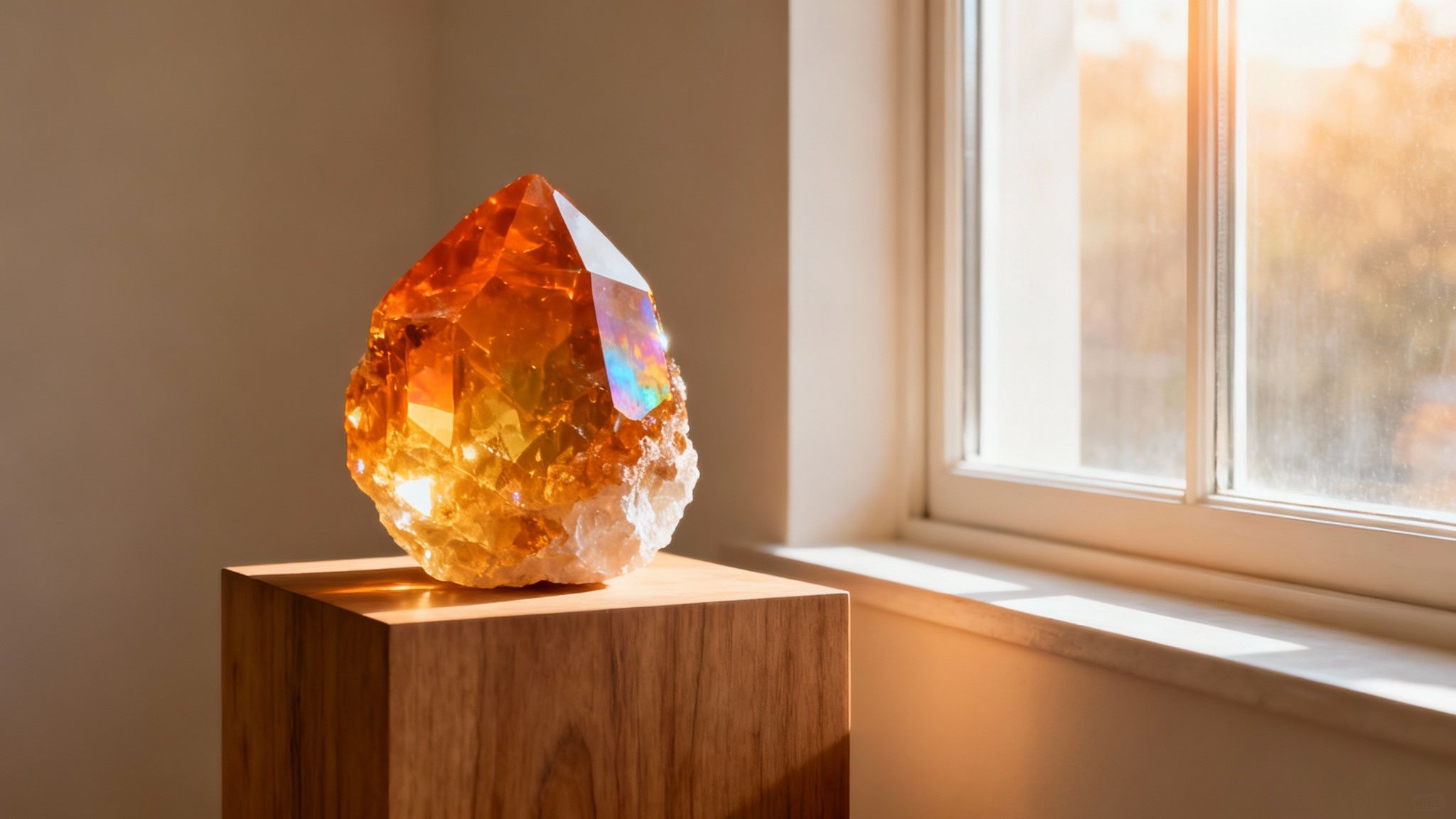
In luxury interiors, a large, high-quality Imperial Topaz crystal is more than just a decorative object; it’s a sculptural focal point. Its warm, radiant energy can anchor a room, adding an organic elegance that manufactured items just can't replicate.
Placed on a console table, a bookshelf, or a mantelpiece, it catches the light and draws the eye, radiating a golden glow.
The unique color of Imperial Topaz works with a wide range of design palettes, from minimalist neutrals to rich, dramatic tones. It acts as a natural source of warmth, balancing cool materials like marble and steel while harmonizing with wood and organic textiles.
Strategic lighting is key here. A focused spotlight can illuminate the crystal’s internal features and highlight its pleochroism, creating a dynamic display that shifts and changes throughout the day. This turns the stone from a static object into a living piece of art that interacts with its environment.
For the Jewelry Lover
As a wearable treasure, Imperial Topaz truly comes alive. Its hardness of 8 on the Mohs scale makes it durable enough for everyday jewelry, yet its rarity ensures it always feels exclusive. Jewelry designs that feature this gem often keep things simple, letting that incredible color take center stage.
Consider these timeless ways to wear it:
The Statement Ring: A large, emerald-cut or oval-cut Imperial Topaz set in warm yellow or rose gold creates a powerful and sophisticated look that's hard to ignore.
The Delicate Pendant: A smaller, pear-cut or round-cut gem on a simple chain allows the stone's fire to rest near the heart, offering a subtle yet captivating sparkle.
Elegant Earrings: Matched pairs of Imperial Topaz, whether as simple studs or dramatic drops, frame the face with a warm, flattering light.
Ultimately, whether it's displayed in a collection, anchoring a room, or worn as a personal emblem, Imperial Topaz is a celebration of natural beauty, rarity, and timeless style.
Proper Care for Your Imperial Topaz
A gem as special as Imperial Topaz deserves a little thoughtful care to keep its solar brilliance shining for generations. It’s a pretty durable stone, ranking a solid 8 on the Mohs scale of hardness, but it has one particular quirk you need to know about: perfect cleavage.
Don't let the term fool you. Perfect cleavage just means that, like a diamond, it can split cleanly along its internal crystal planes if it takes a sharp, direct hit. It’s not fragile, but it does mean you’ll want to protect it from hard knocks. That’s really the most important part of keeping it safe for the long haul.
Cleaning Your Imperial Topaz
Keeping your Imperial Topaz brilliant and fiery is simple. You don't need harsh chemicals or abrasive cleaners—in fact, you should definitely avoid them. A gentle touch is always the best approach.
Just follow these easy steps:
Mix up a simple bath: Fill a small bowl with warm water and a few drops of mild dish soap.
Let it soak: Pop your topaz jewelry or mineral specimen in the solution for a few minutes. This will help loosen any oils or dust that have built up.
Gently scrub: Use a very soft toothbrush to lightly clean the stone. Pay special attention to the nooks and crannies in jewelry settings where grime loves to hide.
Rinse it well: Hold the piece under warm running water until every last bit of soap is gone.
Pat it dry: Use a soft, lint-free cloth to gently dry your topaz. It's better than air-drying, which can leave annoying water spots.
A crucial word of caution: never use ultrasonic or steam cleaners on Imperial Topaz. The intense vibrations from these machines can stress the gem along its natural cleavage planes, potentially causing fractures and permanent damage.
Proper Display and Storage
How you store your Imperial Topaz is just as important as how you clean it. For a piece of jewelry, like this gorgeous Topaz and Sapphire Ring, the best practice is to keep it in its own soft pouch or in a fabric-lined jewelry box. This prevents harder gemstones like diamonds or sapphires from scratching its surface.
If you're displaying a raw crystal, find a spot for it away from high-traffic areas where it could get accidentally knocked over. While the color of Imperial Topaz is quite stable, it’s still smart to avoid placing it in intense, direct sunlight for long periods, as this can cause the magnificent color in some specimens to fade over time. A well-lit shelf away from a window is the perfect place to show off its natural pleochroism without any risk.
Your Imperial Topaz Questions, Answered
To wrap things up, let's go over some of the most common questions we get from clients and readers. Think of this as a final checklist to make sure you’re confident and ready to find the perfect Imperial Topaz, whether you're a collector, designer, or jewelry lover.
Is Imperial Topaz the Same as Orange or Yellow Topaz?
No, they are worlds apart in both rarity and value. While they're all part of the topaz family, the "Imperial" title is exclusively for a specific, very rare variety known for its rich golden-orange to reddish-pink hues.
A key tell is its pleochroism—that subtle reddish flash you see from different angles, which is absent in common yellow topaz. True topaz imperial is prized because its stunning color is completely natural and untreated, making it far more valuable.
Does Imperial Topaz Need Special Treatments or Enhancements?
Absolutely not. In fact, its natural, untreated state is the very reason it’s so celebrated. Unlike blue topaz, which is almost always created by irradiating and heating common colorless topaz, the prestige of Imperial Topaz comes from its untouched beauty.
When you're buying an investment-grade gem, getting confirmation that the stone is natural and untreated is standard practice. Any reputable dealer will provide this information without hesitation.
Why Is Brazilian Imperial Topaz So Much More Valuable?
For this particular gem, provenance is everything. The mines in Ouro Preto, Brazil, are the one and only historic source for the world's finest Imperial Topaz. This area is legendary for producing crystals with the most sought-after, deeply saturated sherry-red and peachy-pink colors.
This long-standing reputation for unmatched quality, combined with its status as the world's primary supplier, gives Brazilian specimens a premium that serious collectors and gem connoisseurs actively seek out.
Can Imperial Topaz Fade Over Time?
The color is generally quite stable, but like many gemstones, it can be a bit sensitive to prolonged, direct sunlight or intense heat. This is just a natural characteristic of the topaz mineral family.
To keep its magnificent hue just as vibrant for generations, it's best to avoid storing or displaying it where it will be hit by constant, direct sun. Following the proper care we outlined earlier will protect your investment and ensure its fiery color remains as beautiful as the day you got it.
At Astro West, we take immense pride in sourcing only the most exceptional and authentic natural history specimens. We invite you to explore our curated collection of fine minerals and discover the perfect piece to elevate your home or collection.