Afghanistan Jade Guide: How to Identify afghanistan jade and Its Value
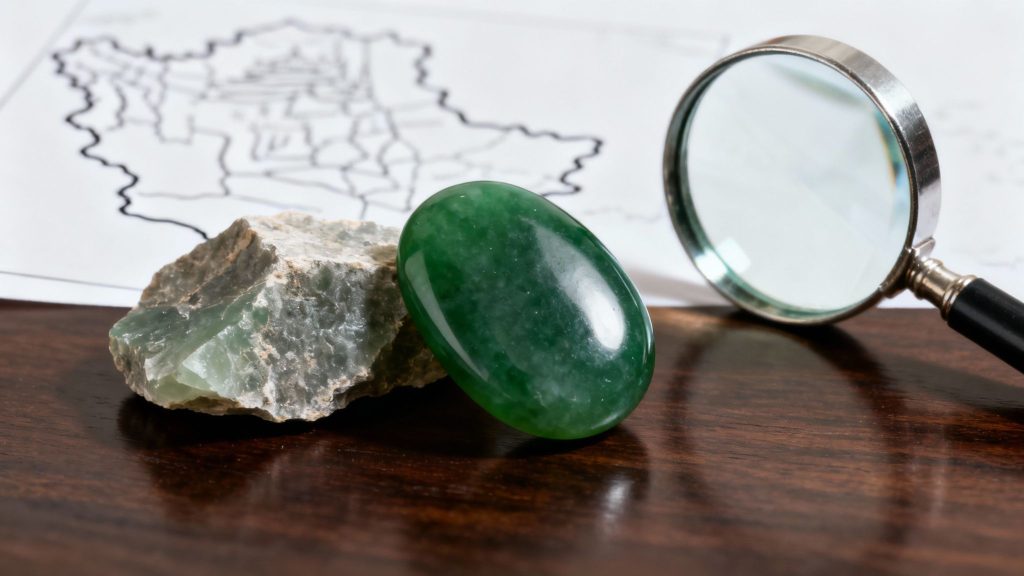
When you hear “jade,” what comes to mind? For most people, it’s the intricate carvings of ancient China or the stunning, emerald-green jewelry from Myanmar. But tucked away in the rugged mountains of Afghanistan lies a different but equally significant chapter in the long story of this revered stone.
Afghanistan jade is a story of geology, culture, and trade that stretches back thousands of years.
Uncovering the Story of Afghanistan Jade
Unlike the translucent, vibrant jadeite that commands the high-end market, Afghan jade is nephrite. Think of them as two distinct members of the same family. Both are genuine jade, but they have different chemical makeups and crystal structures.
Nephrite’s real strength lies in its microscopic, interlocking fibers. This structure gives it an exceptional toughness that made it the perfect material for ancient tools, weapons, and ornaments built to last.
A Legacy Carved in Stone
The history of gemstone mining in this region is legendary. Afghanistan’s story with gems goes back over 7,000 years, with jade, emeralds, rubies, and the iconic lapis lazuli forming the backbone of ancient trade routes. These routes were the arteries connecting Central Asia to the rest of the world.
Treasures from these Afghan mines have found their way into some of the world's most famous collections, from the British Crown Jewels and the Royal Crown Jewels of Russia to the breathtaking inlays of India's Taj Mahal. Their presence there speaks volumes about their global prestige.
Understanding this historical context is key. Afghanistan jade isn't some new discovery. It's a gemstone with deep roots, tied to the very same trade networks that moved lapis lazuli and other legendary minerals from these mountains across the globe.
This guide is your deep dive into this unique material. We’ll explore where it comes from, how to identify the real deal, and the complex market dynamics and ethical questions that come with it.
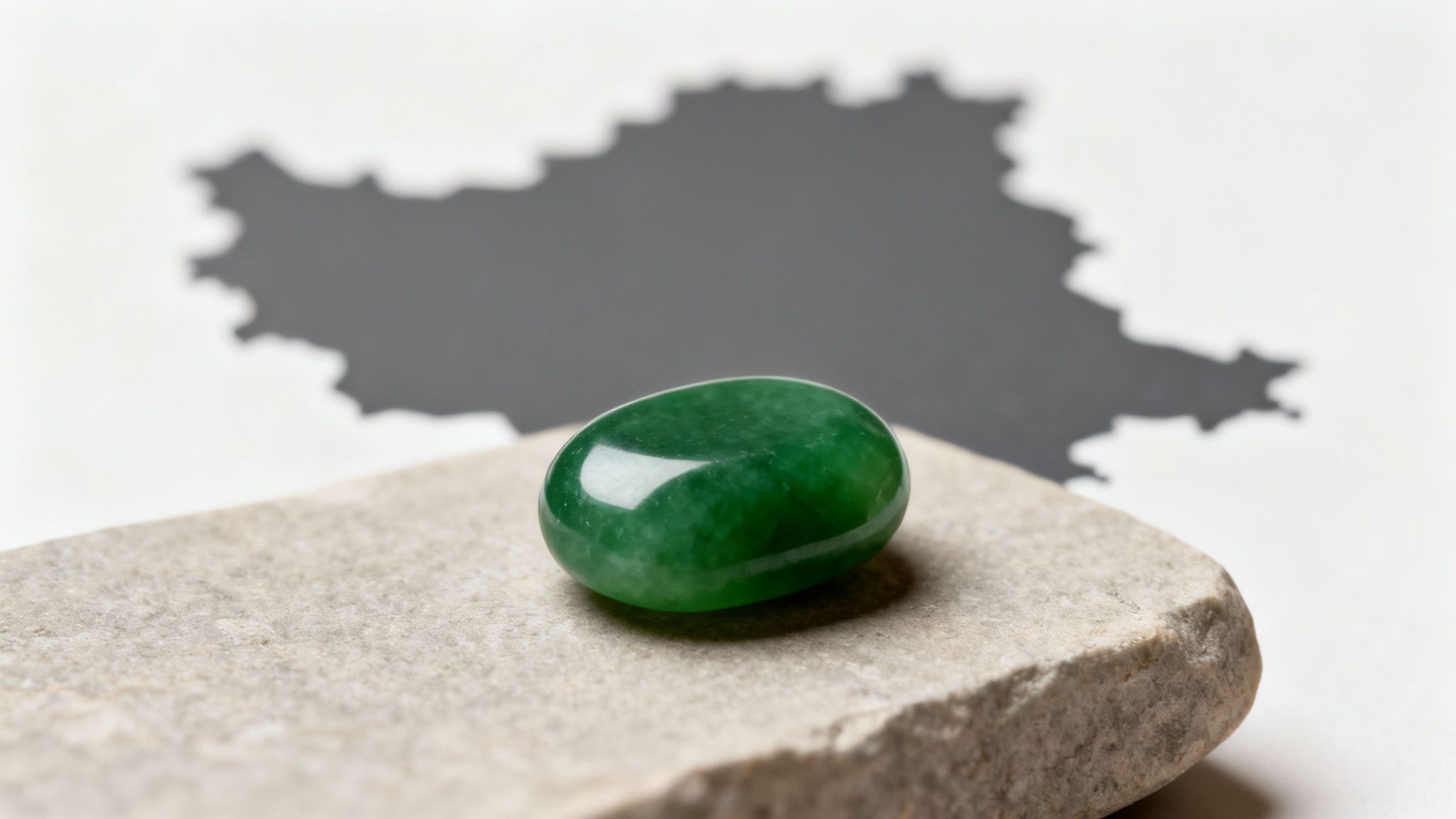
Whether you're looking at a simple polished stone, like this beautiful jade freeform from nearby Pakistan, or a masterfully carved sculpture, knowing its story adds incredible depth and value. By the end, you'll have a new appreciation for why this specific type of nephrite deserves a much closer look.
How Afghan Nephrite Jade Is Formed
To really get Afghan jade, you have to appreciate the incredible geological journey it takes. It’s a story of raw power, where common, everyday minerals are cooked and squeezed deep within the Earth into something exceptionally tough and beautiful.
Think of the two main types of jade—nephrite and jadeite—like saltwater and freshwater pearls. They’re both pearls, sure, but they form in totally different environments and have unique internal structures. While jadeite is born from high-pressure, low-temperature conditions, the nephrite from Afghanistan comes from a much hotter process.
A Recipe of Heat and Pressure
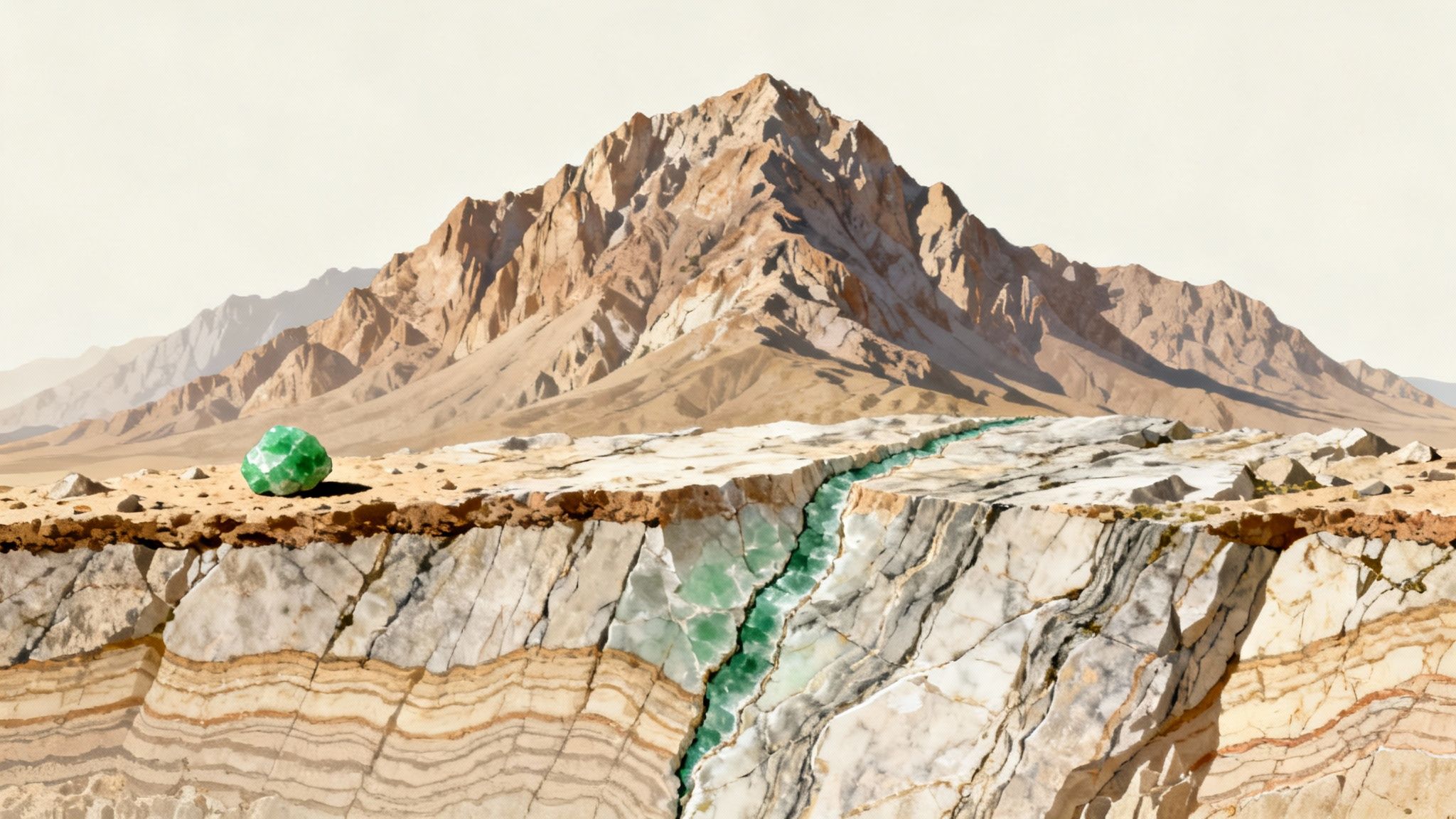
Afghan jade is a classic product of contact metamorphism. This happens when scorching hot magma forces its way up through the Earth’s crust, making direct contact with existing rock layers. In Afghanistan's rugged mountains, this usually means the magma is pushing into beds of dolomitic marble or serpentinite.
It's a lot like baking. The intense heat from the magma acts like an oven, cooking the surrounding rock. Add in the immense pressure from the tectonic plates that shoved the Hindu Kush mountains skyward, and you have the perfect recipe for jade.
This process completely rewrites the original rock’s chemistry and structure. Minerals in the serpentinite or marble recrystallize, rearranging themselves into the dense, interlocking fibrous structure that makes nephrite what it is.
This felted, fibrous arrangement is the secret to nephrite's legendary toughness. Unlike gemstones with a rigid crystal lattice that can fracture cleanly, nephrite’s fibers are woven together. This makes it incredibly resistant to breaking or chipping—a quality prized by ancient craftsmen for making tools and sacred objects that would last for generations.
The Source of Its Signature Colors
The beautiful spectrum of colors in Afghan jade, from creamy whites to deep spinach greens, comes directly from its chemical makeup. The specific minerals hanging around during its formation act like natural pigments, coloring the final stone.
Iron and magnesium are the two key players here. The ratio between them dictates the final hue of the nephrite.
High Magnesium Content: When magnesium dominates the mix, you get lighter-colored jades—think creamy whites, pale yellows, and soft grays.
High Iron Content: As the iron concentration climbs, it brings in the green. More iron means a deeper, richer green, eventually leading to the highly sought-after “spinach green” variety.
Essentially, every piece of Afghan jade holds a chemical fingerprint of the specific geological pocket where it was born.
Afghanistan's Key Jade Localities
The geology across Afghanistan isn’t uniform, so nephrite found in different regions can have its own distinct personality. While mining is often small-scale and informal, certain areas are known hotspots for this remarkable stone.
The rugged terrain of provinces like Badakhshan—already famous for its lapis lazuli—and its neighboring regions hold significant nephrite deposits. The unique conditions in each valley or mountainside influence the stone’s final color, texture, and translucency. This is why some Afghan jade looks waxy and opaque, while rarer pieces might show a beautiful, subtle glow. This geological diversity is what makes collecting Afghan jade such a fascinating pursuit; each piece tells a unique story of its fiery origins.
A Practical Guide to Identifying Real Afghanistan Jade
Telling the difference between authentic Afghanistan jade and a convincing fake can feel intimidating, but you don't need a gemology degree to make a good call. It’s all about moving past the textbook definitions and learning to trust your own senses. Real Afghan nephrite has a signature combination of visual and physical traits that become reliable clues once you know what you're looking for.
The very first thing to do is just look at it. Genuine nephrite has a subtle, almost greasy or waxy luster that is incredibly difficult for fakes to replicate. It shouldn't look glassy or overly shiny like a piece of polished quartz. Instead, it has a soft, inviting sheen that seems to glow from within rather than simply reflecting light off the surface.
This inner glow is directly connected to its translucency. Hold the stone up to a bright light. You won’t be able to see clearly through it, but a quality piece of afghanistan jade will let some light pass through, especially around the thinner edges. This creates a soft, halo-like effect—a far cry from the stark transparency of glass or the dense opacity of other stones.
Key Physical Characteristics
Beyond what your eyes can tell you, the way the stone feels in your hand offers some of the most powerful clues. Nephrite is surprisingly dense, and that density gives it a noticeable heft. If you hold a piece of real jade in one palm and a similarly sized piece of a common imposter like serpentine in the other, the jade will feel significantly heavier.
Another classic test is all about touch. Jade is a fantastic thermal conductor, meaning it pulls heat away from your skin with surprising efficiency.
A piece of genuine nephrite jade will feel distinctly cool and smooth to the touch, almost like holding a piece of ice that doesn't melt. It will slowly warm up to your body temperature, but that initial coolness is a dead giveaway of its authenticity.
Finally, there’s the sound test. Gently tap two pieces of real jade together. You should hear a clear, melodic, bell-like chime. This is completely different from the dull, low-pitched "clink" you’d get from softer stones or the sharp, high-pitched sound of glass. It’s a simple audio cue, but it's a surprisingly effective way to separate the real from the fake.
Comparing Nephrite to Common Fakes
To make identification even easier, it helps to know what you’re up against. The market is flooded with simulants—materials that look like jade but are something else entirely. Serpentine, often misleadingly sold as "new jade," is probably the most common one out there. To get a better feel for the real deal, it’s worth exploring a curated collection of authentic tumbled green jade stones.
Here’s a head-to-head comparison to help you spot the differences in the wild.
Authentic Afghan Nephrite Vs Common Simulants
Knowing the key differences between real nephrite and its most common look-alikes is your best defense against fakes. This table breaks down what to look for—from hardness to telltale visual cues.
Characteristic
Afghanistan Nephrite
Serpentine ("New Jade")
Dyed Quartzite
Glass
Hardness (Mohs)
6.0 – 6.5
2.5 – 5.5 (Softer)
~7.0 (Harder)
~5.5
Feel & Weight
Cool, dense, and heavy for its size.
Feels slightly waxy or soapy; noticeably lighter.
Granular texture; average weight.
Can be cool, but often feels lighter.
Luster
Waxy to greasy with a soft internal glow.
Greasy or waxy, but often looks more dull.
Vitreous (glassy) and often unnaturally shiny.
Very glassy and reflective.
Telltale Signs
Extremely tough, resists scratching from a steel knife.
Can be easily scratched by a steel knife blade.
May show dye concentrated in cracks or a grainy texture.
May contain tiny air bubbles or swirl marks from molding.
After spending some time handling different materials, these distinctions will start to feel second nature.
It’s also crucial to be aware of common treatments. Some lower-quality jade is dyed to punch up its color or treated with polymer resins to fill in fractures and improve its appearance. Always check a piece for unnatural color concentrations, especially in cracks, as this is a clear red flag for dye. By training your eyes and hands, you'll quickly develop a reliable feel for what makes afghanistan jade a truly unique and valuable gemstone.
Understanding the Market Value of Afghan Jade
To really get a feel for where Afghan jade stands, you have to see it as a niche player with a ton of untapped potential. Its value isn't just about being "jade"; it's a story told through its rarity, quality, and the tough journey it takes from a remote mountain mine all the way to a collector's shelf.
The global jade trade is an absolute giant, and it's almost entirely dominated by jadeite from Myanmar. In this massive market, Afghanistan is just starting to make a name for itself with nephrite. The contrast is pretty stark: Myanmar cranks out around 20,000 tons of jadeite per year, which is over 90% of the world's supply and fuels a mind-boggling $10-30 billion annual trade. Meanwhile, newer sources like Afghanistan contribute much smaller, often undocumented amounts. This deep dive into the jade market really puts the scale into perspective.
This isn't just a numbers game; it's a fundamental difference in how the material is sourced. Myanmar's production is industrial, while Afghanistan's is artisanal—often just small crews working in incredibly hard-to-reach areas. That limited, less predictable supply is a huge part of what defines its place in the market.
Key Drivers of Value
Not all Afghan jade is created equal. Far from it. A few critical factors separate a run-of-the-mill stone from a true collector's piece. Much like other prized gems from the region, such as this stunning natural Kunzite crystal from Afghanistan, specific qualities are what really drive the price.
Here's what makes the biggest difference for afghanistan jade:
Color Intensity: This is, without a doubt, the most important factor. The richest, most uniform "spinach green" commands top dollar. Equally valuable is the pure, almost glowing white known as "mutton fat" jade, though it's much harder to find from Afghan sources.
Clarity and Translucency: The best material has a smooth, silky texture with no dark spots, fractures, or distracting mineral bits. The more light that can pass through it—that classic inner glow—the more its value skyrockets.
Quality of Carving: For pieces that have been worked, the artist's skill can be just as important as the raw stone itself. Intricate designs that respect the jade's natural form and color are what collectors hunt for.
A small, flawlessly colored and translucent cabochon can be worth significantly more than a much larger, opaque boulder with inconsistent color. It’s a classic case of quality over quantity.
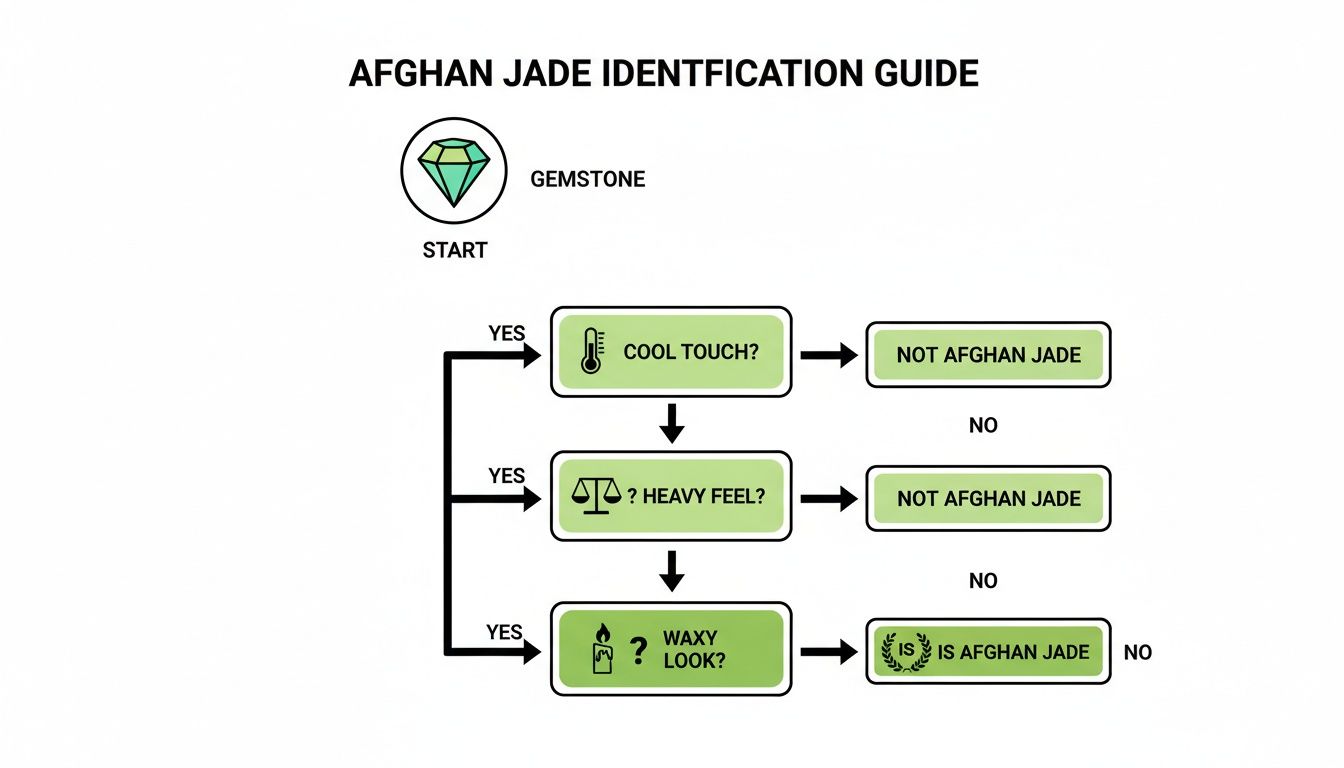
This simple decision tree gives you a great starting point for how to approach a potential piece of Afghan jade.
As you can see, the first steps are all about simple, hands-on tests. How does it feel? Does it have that characteristic coolness, heft, and luster? These are the foundational checks you make before digging any deeper.
The Journey to the Global Market
The road Afghan jade travels to reach buyers is anything but direct. Because of regional instability and a lack of formal infrastructure, a lot of the raw stone is first carried across the border into Pakistan.
From there, it finally enters the global supply chain. A huge portion heads to carving centers in China, where the expertise and deep cultural appreciation for nephrite are strongest. The rest of the material filters out to Western markets, where it's picked up by lapidary artists, jewelers, and mineral collectors. Every step of this complicated journey adds to the final price tag. For anyone curious about the broader market forces that shape gemstone values, these financial literacy resources can offer some helpful context.
As the old, established jade sources start to thin out, the market is slowly but surely turning its eye toward new suppliers. If the trade in afghanistan jade can become more stable and transparent, its potential to grow in value—especially for top-tier specimens—is enormous.
The Ethical Challenges of Sourcing Afghanistan Jade
The journey an Afghan jade specimen takes from a remote mountain crevice to a collector’s shelf is rarely straightforward. While its deep green allure is undeniable, appreciating this material fully means taking an honest look at the serious ethical hurdles involved in sourcing gems from a region marked by instability and a lack of formal oversight.
Navigating this terrain is incredibly complex. Unlike corporate mining operations with strict protocols, the vast majority of afghanistan jade is extracted by small, artisanal miners. These are often local families or communities working in dangerous conditions with only basic tools, which creates a supply chain that’s nearly impossible to trace from start to finish.
This unregulated environment has real consequences for both people and the land. With no formal oversight, standards for worker safety, fair pay, and responsible mining practices are practically nonexistent. The environmental impact, like unchecked water use or landscape damage, often goes unmonitored in these isolated areas.
The Impact of Regional Instability
The political and social turbulence within Afghanistan adds another profound layer of difficulty. Every ethical dealer aims for a transparent, conflict-free supply chain, but achieving that here is a monumental task. The informal, cash-based nature of the trade makes it almost impossible to guarantee that funds from gem sales don't, at some point, benefit conflicted parties.
This reality places a heavy burden of responsibility on dealers and collectors. It’s not just about acquiring a beautiful stone; it's about participating in a complex social and economic ecosystem where every transaction has potential ripple effects. The same careful sourcing required for gems like this beautiful watermelon tourmaline from Paprok, Afghanistan applies to every mineral that comes out of the region.
The core ethical dilemma is this: while boycotting these stones could cut off a vital source of income for local miners and their families, participating in the trade without extreme diligence risks perpetuating a system with serious flaws. Responsible sourcing becomes a balancing act of supporting local artisans while demanding as much transparency as possible.
This situation is magnified by shifting global market dynamics. As traditional sources of nephrite start to run dry—Myanmar’s famous mines like Tawmaw and Hweka are nearly depleted after decades of intense extraction—the world is looking for new suppliers. This puts Afghanistan's latent potential under a microscope and shines a harsh light on the sourcing practices coming out of the region. For a deeper dive, check out GIA's report on gemstones from Afghanistan.
Making Conscious Purchasing Decisions
So, what can a conscientious buyer do? Your power lies in asking the right questions and choosing to work with dealers who are open about the challenges and transparent about their process.
Here are the key questions to ask your dealer:
Can you describe your supply chain? While they might not know the exact miner, they should be able to walk you through the journey the stone took to reach their shop.
What is your relationship with your suppliers? Look for dealers who have long-standing, direct relationships with trusted contacts on the ground. It’s a very good sign.
How do you vet your sources? Ask them what steps they take to feel confident their material is as conflict-free as it can be.
Choosing to buy afghanistan jade is a decision that goes far beyond aesthetics. It’s a commitment to engaging with these tough questions and supporting dealers who prioritize ethical transparency in a deeply complicated market.
How to Care for and Collect Your Gemstone
Whether you have a single beloved piece of Afghanistan jade or you're planning a full-blown collection, knowing how to care for it is key. You want to protect its beauty and value for the long haul.
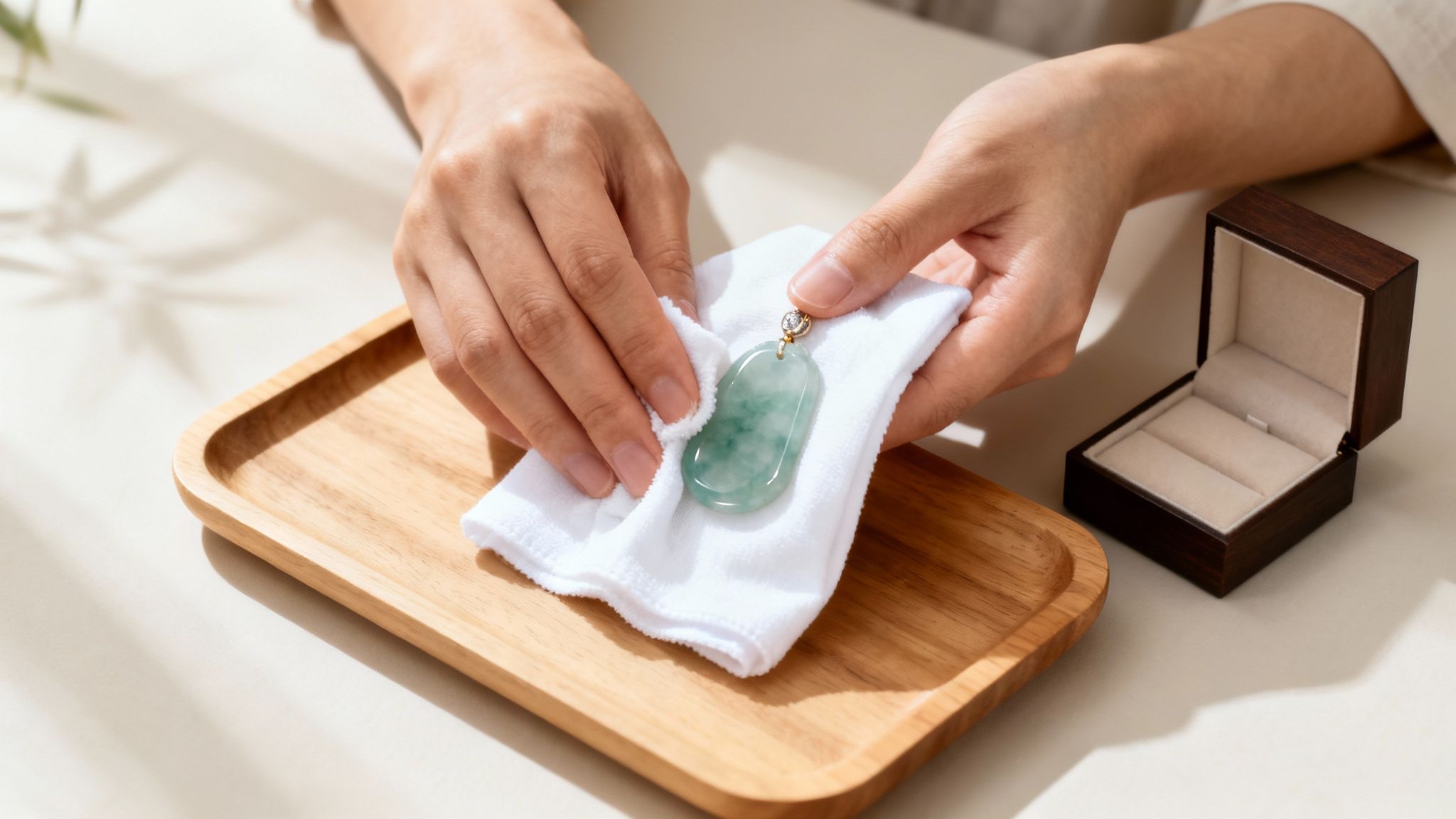
The good news is that nephrite is incredibly durable, but a few simple rules will keep it looking pristine. The best way to clean your jade is with a soft cloth, some lukewarm water, and just a touch of mild soap. You’ll want to steer clear of harsh chemicals or ultrasonic cleaners, which can dull the stone's surface over time. Just gently wipe the piece, rinse it well, and pat it dry with a soft, lint-free cloth.
Best Practices for Storing Your Jade
Proper storage is what prevents scratches and accidental damage. While nephrite is tough, it’s not invincible—harder gemstones like diamonds or sapphires can easily scratch it if they’re jumbled together.
Individual Storage: Keep your jade in its own soft pouch or a dedicated compartment in a fabric-lined jewelry box.
Avoid Piling: Never just toss jade pieces into a drawer together. The friction can cause abrasions and ruin the polish.
Climate Control: Store it away from direct sunlight or extreme temperature swings, which can stress the stone over the long term.
Protecting your investment is simple. By giving your Afghanistan jade its own space, you ensure its unique luster and smooth finish are preserved for a lifetime.
Strategies for Building a Collection
Starting a collection of afghanistan jade is an exciting journey, and your approach will likely shift as you learn more and your eye develops. For a broader perspective on various types of gemstones, including their significance and use in jewelry, you might explore a comprehensive general guide to birthstones.
If you’re just starting out, your best bet is to begin with smaller, high-quality polished stones from sellers you trust. This lets you get a real feel for authentic material without a massive initial investment. Look for pieces that have good, even color and that nice, waxy translucency.
Once you feel more confident, you can start hunting for more specialized items. High-quality rough specimens are fantastic because they show the jade in its raw, natural state, straight from the earth. Intricate carvings are another great path, where the value is a mix of both the stone’s quality and the carver’s artistry.
For these higher-value pieces, provenance and documentation are essential. They’re your proof of the stone’s origin and history, which adds enormously to its story and worth.
A Collector's Q&A on Afghanistan Jade
To wrap things up, let's tackle some of the most common questions that come up when collectors start getting serious about Afghanistan jade. Think of this as your quick-reference guide to the key points we've covered.
Is Afghanistan Jade the Same as Chinese Jade?
Yes and no. While they share the "jade" name, it's a bit more complicated than that. Historically, the term "Chinese jade" referred to top-tier nephrite from ancient sources like Khotan. Afghanistan jade, on the other hand, is nephrite that comes specifically from modern mines inside Afghanistan's borders.
So, while they are the same mineral (nephrite), their unique geological birthplaces can create subtle differences in color, texture, and how light passes through them. To make things even more confusing, today the term "Chinese jade" is often used in the market to mean jadeite from Myanmar—a completely different mineral altogether.
What's the Most Valuable Color for This Jade?
Just like with other world-class nephrites, the colors that really get a collector's heart racing are a deep, even spinach-green and a pure, buttery white known as "mutton fat" jade. When a piece of Afghan material shows off one of these top-tier colors without any distracting blemishes, fractures, or dark spots, it will always command the highest prices. The richness and consistency of the color are everything.
A stone's value is a direct reflection of its rarity and visual appeal. For nephrite, a pure, consistent hue is the ultimate mark of quality, signaling that the stone formed under ideal geological conditions.
How Can I Be Sure My Jade Is Ethically Sourced?
This is, without a doubt, one of the biggest hurdles when collecting gems from this part of the world. Verifying an ethical supply chain for Afghanistan jade is incredibly tough due to regional instability and a near-total lack of formal mining regulations. There’s no simple certificate you can get.
Your best bet is to work with reputable, transparent dealers who are willing to have an open conversation about their sourcing. Ask them how they get their material, who their contacts are on the ground, and what steps they take to ensure their stones are as conflict-free as possible. A dealer's willingness to engage in that discussion is a huge green flag.
Is Afghanistan Jade a Good Investment?
Like any collectible gem, its investment potential is directly tied to its quality and how rare it is. Truly exceptional, top-color specimens of Afghanistan jade are hard to come by and have a strong chance of appreciating in value, especially as other major jade sources around the globe start to dry up.
That said, it's still a pretty specialized corner of the gem market. If you're looking at it from an investment angle, you absolutely must prioritize certified, high-grade pieces that have a clear history from a trusted and knowledgeable source. The more common, commercial-grade material is gorgeous for decor, but it just doesn't have the rarity needed to see its value climb significantly over time.
At Astro West, we take pride in navigating these complex markets to bring you authenticated, ethically sourced minerals. Our experts meticulously vet every single specimen, so you can build your collection with total confidence.
Explore our curated collection of fine minerals and gemstones today at https://astrowest.com.