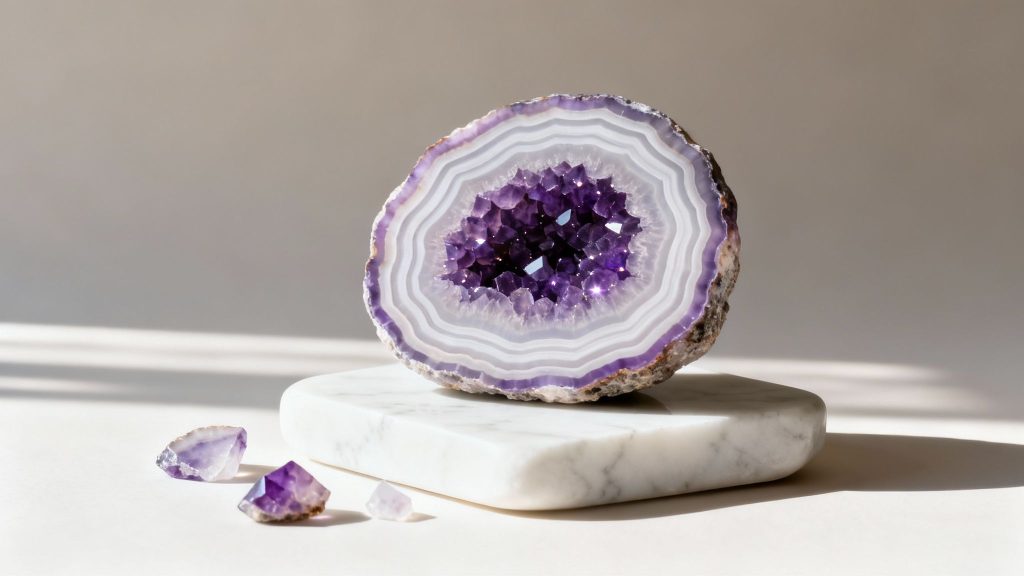
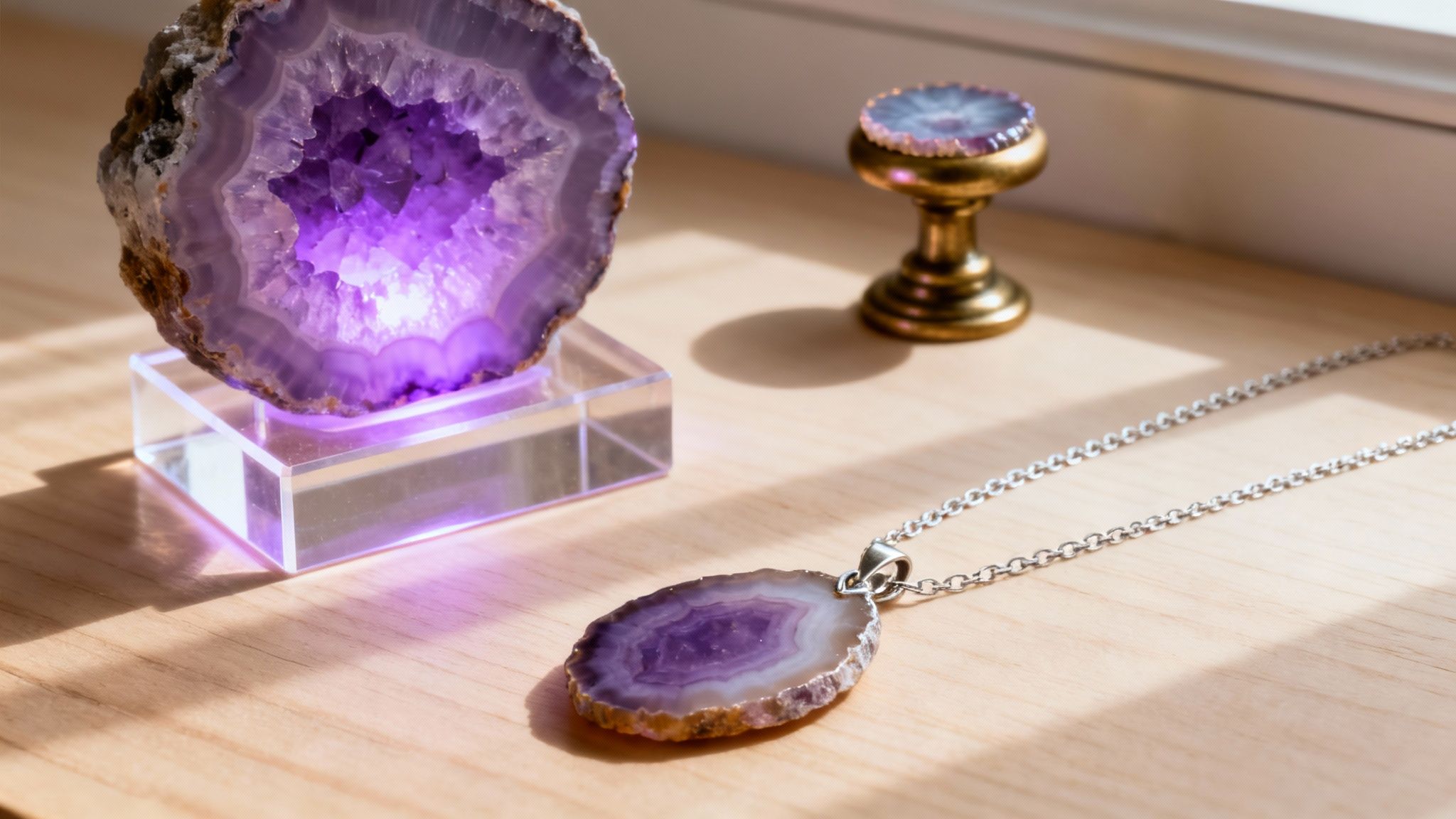
An agate amethyst geode is like opening a time capsule—concentric chalcedony bands embrace a core of violet quartz, all hidden within volcanic rock.
Discovering Agate Amethyst Geode
Picture a sun-dappled cave, dust motes dancing in the air. You spot a nondescript lump that glints purple where sunlight strikes. Your pulse quickens. One crack later, swirling bands and glittering amethyst crystals spill into view.
For both rookies and seasoned collectors, these geodes fascinate with:
Intricate banding patterns that chronicle mineral-rich waters
Sparkling violet quartz crystals catching every ray of light
Natural artistry prized in décor, meditation, and display
Each band is a chapter of Earth’s story; every crystal, a jewel born over eons.
Think of this formation as the planet’s secret journal—layers recording volcanic pulses and slow mineral infusions. It’s geology distilled into a single, breathtaking object.
Interior designers, crystal enthusiasts, and collectors treasure geodes for more than looks. They become conversation starters, focal accents, and tools for quiet reflection.
In the sections ahead, we’ll:
Unpack formation processes step by step
Reveal grading benchmarks for both agate banding and amethyst quality
Map out typical sizes, price ranges, and ethical sourcing tips
Share care, cleaning, and display ideas
Explore jewelry designs, home décor styling, and gift-worthy experiences
For a complementary deep dive into related specimens, don’t miss our detailed guide on agate slices.
Why Geodes Captivate
Geodes are storytellers, each one preserving eons of cooling flows and crystal growth in a single sphere.
Stay with us for engaging, clear explanations—whether you’re just starting your collection or curating a museum-worthy display.
How Agate Amethyst Geodes Form
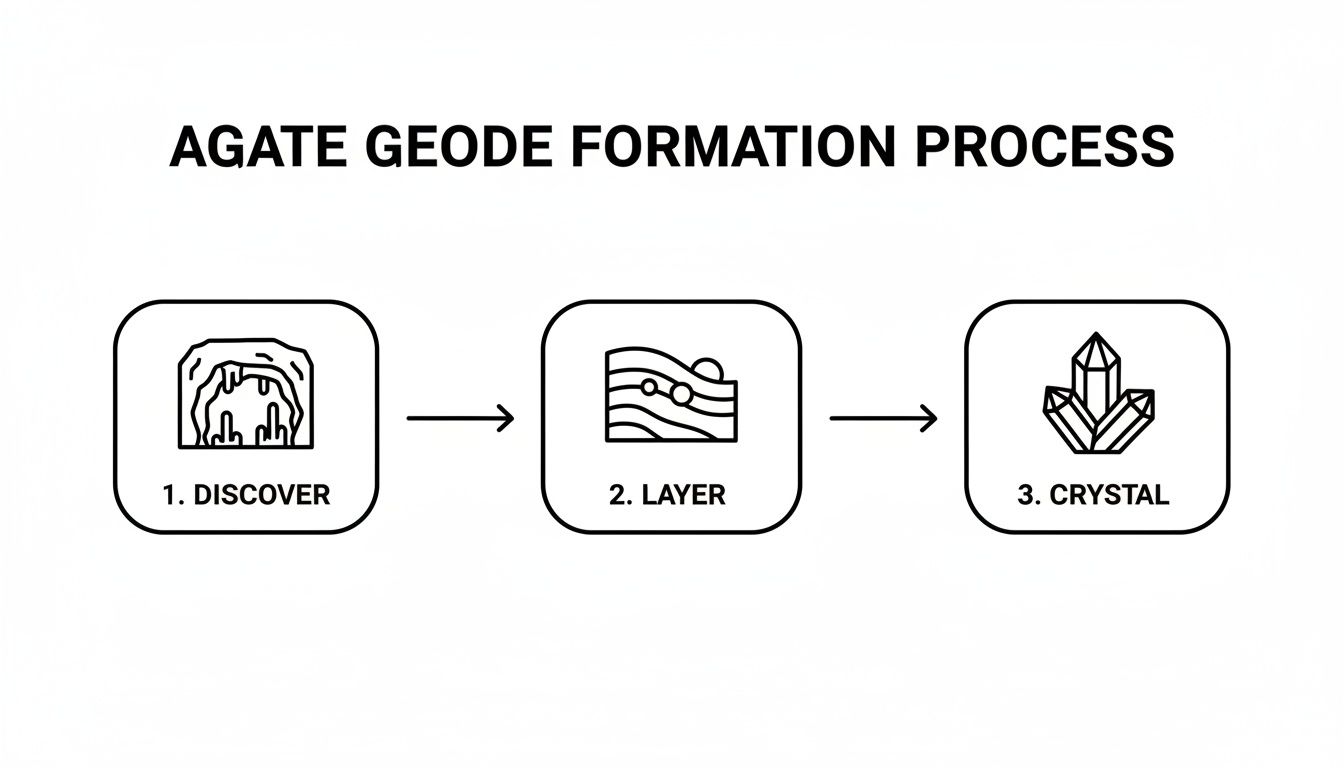
Picture molten basalt pouring across an ancient plain, its surface glowing like liquid glass in the fading light. Within that fiery river, tiny bubbles of gas become trapped, foreshadowing the hollow heart of a future geode. Over countless centuries, mineral-laden waters will slowly infiltrate those cavities, laying down layer upon layer of crystalline beauty.
Initial cooling and trapped gases carve out the empty chambers.
Silica-rich fluids seep in, depositing microcrystalline chalcedony in rhythmic bands.
Later, iron and silica arrive to fashion the inner quartz and vivid violet amethyst crystals.
Early Banding And Cavity Formation
As the lava flow solidifies, it leaves behind small voids—think of them as nature’s waiting rooms. Into these nests, silica-rich solutions creep, depositing whisper-thin sheets of chalcedony. Each band, from under a millimeter to several millimeters thick, captures a snapshot of shifting chemistry deep underground.
Much like counting growth rings on an old oak, reading agate banding lets us trace Earth’s fluid history. In some geodes, you’ll see dozens of alternating hues—creamy whites, rusty oranges, smoky grays—each line marking a new chapter in the planet’s long story.
"Every band is a chapter; every crystal is a jewel in Earth’s crown."
Crystal Growth And Advanced Research
Once the chalcedony framework is in place, the real magic begins. Periodic surges of groundwater deliver trace metals—iron, manganese—and fresh silica. Under just the right temperature and pH, these ingredients spark the nucleation of quartz and amethyst points. The result is a dazzling inward spray of crystals, like fireworks frozen in stone.
Researchers focused on Uruguay’s Los Catalanes district discovered that these agate-lined, amethyst-filled geodes formed in Early Cretaceous basalt flows around 134 million years ago. For a deep dive into the science, check out the full study below.
The infographic below breaks down each stage with clear visuals.
A Timeline To Remember
Seeing the process laid out side by side brings millions of years into perspective:
Stage
Timeframe
Cooling & Cavity Formation
0 to 10,000 years
Chalcedony Banding
10,000 to 100,000 years
Quartz & Amethyst Crystal Growth
0.1 to 5 million years
Early layers often appear in the first 100,000 years, while the deep violet glow of amethyst may take millions more to fully develop. These milestones help collectors appreciate the sheer scale of geologic time.
By grasping how an agate amethyst geode evolves—from a simple gas bubble to a treasure chest of bands and crystals—you’ll deepen your appreciation for every specimen’s unique story. In the next section, we’ll cover quality benchmarks and grading tips so you can pick standout geodes for your collection.
Recognize cavities as the geode’s birthplace.
Read banding like pages in Earth’s logbook.
Admire crystal growth as nature’s crowning flourish.
This geological marvel invites us to peer into Earth’s hidden laboratories and marvel at the treasures formed over millions of years.
Identification And Grading Of Agate Amethyst Geode
Evaluating an agate amethyst geode often starts with its concentric agate bands—imagine counting the rings of an ancient tree trunk. Each ring’s thickness, uniformity, and color contrast tell part of the story.
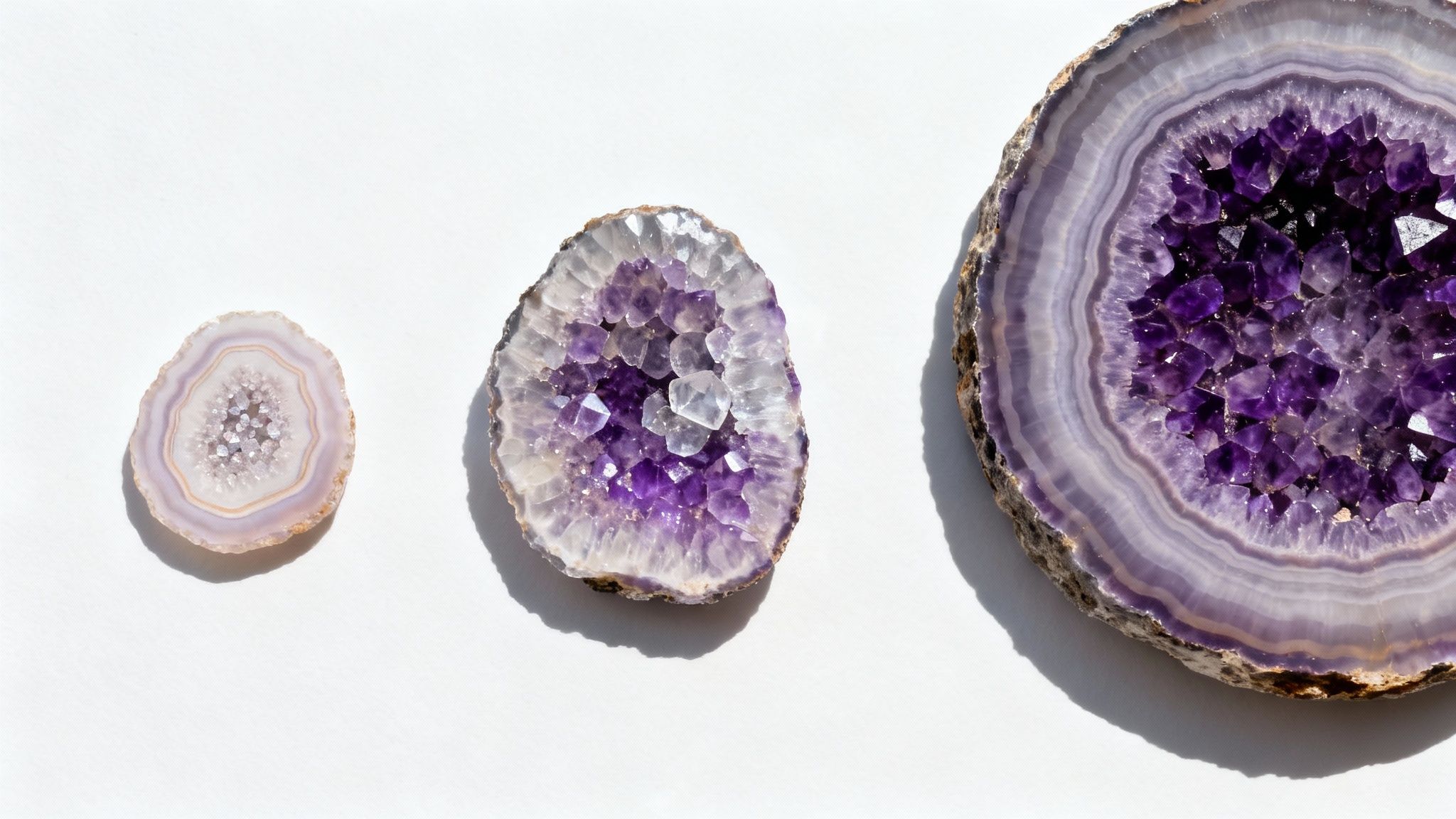
Then you turn to the amethyst core. Shades can range from pale lilac to a rich, velvety violet. Crystal size and consistency play a huge role in a specimen’s desirability.
Band thickness from 0.5 mm to several millimeters
Symmetrical rings for balanced visual impact
Vibrant contrast between adjacent layers
Agate Banding Checklist
Where a geode comes from directly shapes its look. Brazilian slices often glow with warm honey bands, while Uruguayan examples favor cooler gray tones and sharper purple centers.
Symmetry isn’t just aesthetic—it ensures light refracts evenly, which can raise a geode’s market value. And the clearer the bands, the more you’ll pay.
Aim for band width consistency within ±0.2 mm
Fewer inclusions or cloudiness equals a higher clarity grade
Crystal clusters larger than 3 cm per point often land in top-tier collections
Weathering at the cut edge also matters; a clean, fresh break is preferable.
Perfectly concentric bands add up to higher grade scores
Comparison Of Agate Banding And Amethyst Quality Grades
Below is a side-by-side look at grading criteria for agate banding versus amethyst crystals. Use this to see how each feature contributes to overall value.
Feature
Agate Banding
Amethyst Quality
Entry-Level
Thin, uneven layers
Light lavender color, small points
Mid-Tier
Consistent bands, moderate contrast
Medium saturation, good clarity
Top-Tier
Thick, sharp rings with vivid alternation
Deep violet hue, large flawless crystals
This comparison table highlights where you might compromise (for budget buys) or invest (for museum-level specimens).
Scoring And Real Examples
Many dealers break down each attribute on a 1–10 scale for transparency.
Band Symmetry: 1 (irregular) to 10 (perfectly concentric)
Contrast: 1 (subtle) to 10 (highly vivid)
Saturation: 1 (pale) to 10 (deep royal purple)
Crystal Size: 1 (tiny) to 10 (gem-quality clusters)
For instance, a 5-inch Uruguayan slice might score symmetry 8, contrast 7, and saturation 9. A 12-inch Brazilian specimen earning top marks can command upwards of $5,000. These numbers help set realistic budgets and expectations.
Numeric grading turns subjective beauty into transparent data
Tips To Spot Fakes
Inspect edges under strong light for uneven dye absorption
Use a loupe to search for unnatural color zoning or residues
Request provenance documents and lab reports
Detecting dyed or synthetic geodes protects both your investment and your reputation as a collector.
Balancing agate banding and amethyst quality gives you the confidence to choose specimens that fit your taste and your wallet. For even deeper market context, explore pricing trends on FossilEra.
Buying Guide And Pricing For Agate Amethyst Geode
Finding a genuine agate amethyst geode begins with setting clear objectives and understanding the market. A little homework on where and how these specimens travel can save both time and money.
Supply chains from Brazil and Uruguay dominate globally, shaping availability and fair pricing. If you’re just starting out, consider snapping up a few budget-friendly slices. They’re perfect for honing your eye before you invest in larger, more complex pieces.
Remember that regional differences—shipping fees, import duties, even certifications for ethical sourcing—can nudge prices up or down. Crystals with richer color and heftier clusters typically carry a premium. And if you’re ordering from abroad, don’t forget to budget for taxes and customs charges.
On the industry side, the global agate market was valued at around USD 3.1 billion, with South America supplying over 65% of rough exports. North America and Asia-Pacific drive strong retail demand amid a forecast CAGR near 4.1%. Learn more about agate market findings on ReportsAndData.
Average Price Ranges by Geode Size
Use the table below as a quick reference to see what small through large agate amethyst geodes typically cost at retail.
Size Category
Average Price Range (USD)
Small (2–4 inches)
$30 – $100
Medium (5–8 inches)
$150 – $350
Large (9–12 inches)
$400 – $800
Exhibition (13+ inch)
$1,000+
Even within these brackets, museum-grade specimens (think flawless banding and deep violet cores) can push prices much higher. Use this guide as a starting point, then adjust for quality, provenance, and rarity.
Factors Affecting Price
Color Saturation: Deep violet hues command top dollar.
RockCollectorsHub – User-rated dealers and bulk-buy options
MuseumGemAuctions – Exclusive, museum-quality pieces with archival records
Don’t overlook local gem and mineral shows—examining geodes in person can be eye-opening. For side-by-side comparisons, check out our detailed amethyst geode slice guide on Astro West.
Negotiation Tips And Warning Signs
A few simple tactics can help you secure a better deal without jeopardizing quality:
Bundle multiple pieces for a lower per-item price
Inquire about last-season stock or overstock markdowns
Always confirm shipping insurance on high-value parcels
Use friendly, professional follow-ups rather than hard bargaining—it goes a long way with trusted dealers.
Transparency in pricing and certification is the hallmark of reliable gemstone trading.
Be wary if a seller:
Refuses to show lab reports or detailed grading data
Quotes prices well below market averages
Can’t provide traceable provenance
Operates behind unverified or anonymous profiles
Printable Buying Checklist
Keep this checklist handy whether you’re shopping online or at a show:
Define your target size and budget
Verify geographic origin and shipping lead times
Request lab reports or third-party certifications
Inspect color saturation and banding clarity
Confirm return policy, insurance, and packaging standards
Look for ethical sourcing labels or fair-trade certificates
Armed with these pointers, you’ll shop confidently and find an agate amethyst geode that’s both beautiful and bona fide.
Happy hunting!
Caring For And Displaying Agate Amethyst Geode
Caring for your geode is like tending a living artwork. A simple dusting keeps the banding crisp and the crystals shimmering.
To begin, always scan the edges for any loose fragments before you pick it up. Press gently to latch them in place.
Use a soft brush—an artist’s paintbrush works well—to whisk away dust. Avoid scratching the crystal faces.
For a deeper clean, mix a drop of mild soap into warm water. Wipe the surface with a soft cloth, then blot dry.
Never soak your geode for more than a minute or two. Trapped water in tiny crevices can dull the sparkle over time.
“Routine care preserves both beauty and structure over decades,” says a curator at the A.E. Seaman Mineral Museum.
Every few months, rotate your display to guard against uneven sun exposure. Keep room humidity at 40%–60% to prevent microfractures.
And steer clear of direct heat or cold drafts.
Cleaning And Maintenance
Dust Off Gently Start with a soft paintbrush or microfiber duster.
Wipe Carefully Dab a cloth dampened with mild soap solution—no harsh scrubbing.
Air Dry Fully Lay it face up and let it dry for at least 24 hours.
Inspect Crystals Use a hand lens to spot loose points before moving back to display.
Recommended Supplies
Microfiber cloth for gentle polishing
Artist’s paintbrush for detailed dusting
Distilled water to avoid mineral deposits
pH-neutral soap to protect the crystal structure
Quick Mist Tip
Lightly mist with distilled water between full cleanings to keep dust from settling.
Display And Styling Ideas
Choosing the right stand turns your geode into a centerpiece. Consider:
Acrylic Stands for clear, unobtrusive support
Shadow Boxes to wall-mount slices like gallery art
LED Backlighting to bring out the violet hues
Mirrored Bases that reflect every sparkling facet
UV-Filter Glass for long-term color protection
Group slices by color gradient to craft a cohesive arrangement. Pair them with potted succulents for an earthy, organic contrast.
A seasonally adjusted routine keeps your geode looking its best. In winter, indoor heat can dry out the air—run a humidifier or set the geode on a pebble tray.
During summer, shield it from direct sunlight or apply UV-filter film.
Follow these quarterly care steps:
Spring: Dust and inspect once a month
Summer: Rotate and shield from sun every month
Fall: Give a mild soap cleaning every six months
Winter: Check humidity with a hygrometer each month
Also:
Avoid moving geodes between extreme temperatures too quickly
Always monitor nearby humidity levels
With this approach, your agate amethyst geode will stay radiant through every season.
Happy displaying and caring for your agate amethyst geode.
Enjoy the natural artistry daily.
Jewelry And Home Decor Ideas
Like miniature landscapes, the cross section of an agate amethyst geode tells its own story. Slip that slice into a silver frame and suddenly it’s wearable history. Designers often use slab slicing to preserve the outer banding—each pendant becomes a fossil-like cameo.
Beyond simple frames, wire wrapping has become a favorite. Thin silver or gold wire weaves around jagged edges, almost like a custom-made basket. The wrap secures the crystal without covering its glittering interior.
For a richer look, some makers insert geode crescents between rosewood or brass accents, crafting heirloom-quality keepsakes that stand the test of time.
Jewelry Applications
Slab Slicing With Edge Polishing: Smooths the perimeter so the chalcedony bands really pop.
Wire Wrapping Techniques: Employ flexible gauge wire that bends to each crystal’s unique shape.
Mixed Metal Settings: Pair silver, gold, and brass to highlight color contrasts.
“A geode pendant is like wearing Earth’s memoir,” says a jewelry artisan at Astro West.
From a bohemian leather-cord necklace to a refined chain, geode jewelry adapts to every style. Beginners can start by slipping a small agate slice onto a jump ring and chain. More advanced crafters often embed micro-slices in resin layers for extra depth and dimension.
Home Decor Inspirations
Split geode halves transform into bookends that seem to float on a shelf. The natural weight keeps them grounded, while the glossy interior makes for a stunning focal point.
Coffee Table Display: Tuck thin slices under glass to protect fragile crystals and show off the banding.
Backlit Wall Art: Mount slices on a lightbox so the colors glow through every ring.
Cabinet Hardware: Drill geode halves into knobs for an earthy twist on traditional pulls.
In a minimalist workspace, a single agate slice on a concrete stand creates a clean, calming accent. Designers also love pairing geodes with live succulents or air plants—soft greenery set against solid crystal makes the contrast sing.
Gather small geode fragments and pre-cut bezel trays.
Mix epoxy resin and set stones into pendant blanks.
Let it cure for 24 hours before polishing.
Attach chains or earring hooks to complete each piece.
This straightforward project lets newcomers explore geode crafting at home with minimal tools. Even broken geode pieces or budget-friendly slices become standout accessories.
Whether brightening up your jewelry box or adding flair to a shelf, these geode ideas bridge natural wonder with everyday style. Place each slice with intention, care for it gently, and you’ll spark conversations for years to come.
“Decorating with geodes brings a timeless elegance to any space,” notes a designer at Astro West.
Mix a couple of geode accents with soft textures—like linen pillows or glass vases—for a balanced display. Happy creating every day!
Gift Ideas And Experiences
Picture a quiet winter evening by the fire as you place an agate-amethyst geode under the tree. Its inner crystals shimmer like captured starlight, hinting at journeys that began millions of years ago.
A geode isn’t just a decorative stone—it’s a story you give. It transforms a simple celebration into a ritual that connects the past and the present.
Seasonal Occasion Ideas
Perfect for any milestone, from frost-kissed holidays to cozy birthday mornings. Consider these moments:
Housewarming: A polished geode slice on a custom stand brings natural warmth to a new space.
Anniversary: The deep violet core mirrors a love that grows richer with time.
Graduation: A burst of crystals symbolizes fresh starts and inner resilience.
“Giving a geode is gifting eternity in a box,” says a curator at Astro West.
Experiential Gift Options
For many collectors, the memory of discovery means more than the specimen itself. Turn your gift into an experience:
Geode Cracking Workshop – Break open your own geode and reveal the hidden crystals inside.
Private Studio Tour – Go behind the scenes to see how experts cut and polish these stones.
Virtual Mineral Expedition – Stream a live rock-hunting trip with a geologist as your guide.
Add personal touches for extra meaning:
Engrave the display stand with a date or name for a lasting reminder.
Include an educational booklet that outlines how geodes form and are graded.
Pair the stone with a handmade wooden box, complete with festive carvings and a velvet pouch.
A handwritten note describing the geode’s symbolism adds a final magical touch.
When the recipient lifts the lid, they uncover more than crystals—they reveal a narrative of Earth’s deepest secrets.
A Christmas Tale: Eternity in a Box
Under the soft glow of candlelight on Christmas Eve, Sarah carefully untied the jute ribbon around her father’s gift. Inside sat a small agate amethyst geode, its violet crystal heart framed by concentric bands of chalcedony. As she turned it in her hands, she felt the weight of millions of years—ancient lava flows, slow mineral infusions, and the patient artistry of Earth itself.
Her father’s eyes sparkled as he held the geode up to the tree lights. “This reminds me of our family,” he whispered. “Each band is a year we’ve shared, and these crystals are the moments that shine brightest.” In that moment, the geode became more than a mineral specimen. It became a bridge between past and future, a promise that their bond was as enduring as the stones of the planet.
As carols drifted through the room, Sarah realized that this gift—born of time and forged in fire—would stand as a symbol of their eternal connection for every Christmas to come.
Personal Keepsake Options
A custom display elevates your geode into a cherished heirloom. Consider these upgrades:
Engraved Display Plaque stamped with special dates or family initials.
LED Backlight Module for soft illumination that enhances violet hues.
Educational Booklet detailing formation history and grading highlights.
Custom Gift Box lined with satin fabric and a branded closure.
Each thoughtful detail adds depth to your story. Present your geode with a commemorative certificate or tuck it into a velvet pouch, and let the moment become unforgettable.
Frequently Asked Questions
Q: How can I spot a natural agate amethyst geode versus a dyed or synthetic piece? A: Real geodes reveal gradual color transitions and gentle banding quirks you won’t see in dyed or lab-grown samples. If you shine a strong light on a fake, the color often pools in cracks or looks unnaturally even.
Inspect the edges of the cavity and the rim for any stray color stains. And always ask for provenance documentation—it’s the best way to confirm you’re holding a genuine treasure.
Tip: Always request a lab report or third-party assessment to verify natural origin.
Assessing Display Environment
Your geode’s beauty depends on how you show it off. Direct sun can wash out the violet quartz over time, so choose an area with soft, indirect lighting.
Aim for room humidity between 40% and 60% to keep the crystals from developing tiny fractures.
Place specimens on sturdy stands or inside shadow boxes.
Rotate each piece once a month for even light exposure.
Consider UV-filter glass if your display spot gets bright afternoon sun.
Cleaning And Maintenance
A little care goes a long way. Every two to three months, dust the interior gently with a soft brush. For a deeper clean:
Mix a few drops of neutral soap into distilled water.
Test on a small patch first, then wipe interiors with a lint-free cloth.
Rinse with distilled water and let the geode air dry face up.
Before you put it back on display, give it a once-over to spot any loose crystals.
Tip: Schedule a thorough inspection once a year to catch early signs of structural wear.
Value And Long-Term Care
Several factors influence how a geode ages in value. Origin, color depth, and band symmetry all play a role. Specimens from Uruguay and Brazil boasting intense hues often appreciate by 5%–10% annually.
Factor
Impact on Value
Color Saturation
Deep violet cores command premiums
Band Clarity
Sharp, uniform rings attract collectors
Crystal Size
Larger, intact points boost prices
Provenance
Documented origins enhance resale
A secure stand and stable climate control will help you avoid cracks that can erode value. For top-tier specimens, professional encapsulation is worth considering.