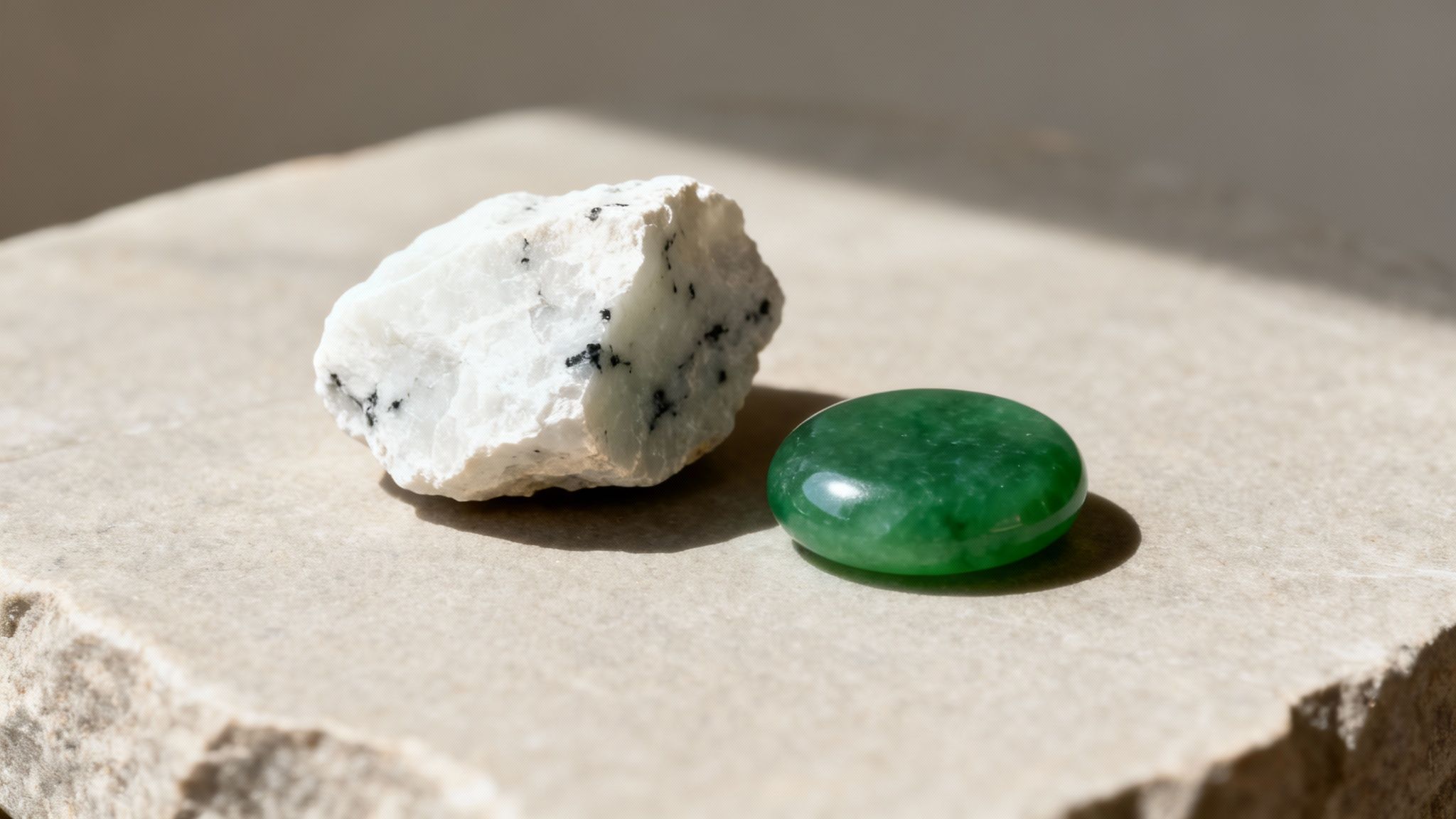
Afghanistan Jade Stone A Guide to Real Nephrite and Its Value
So, you’ve come across the term Afghanistan Jade Stone. It’s an evocative name, painting a picture of exotic origins and precious green gems. But before you get too carried away, it's critical to understand that you're almost always dealing with nephrite jade or minerals that look a lot like it, such as serpentine.
This isn't the rarer, more expensive jadeite you might find in Myanmar, a distinction that immediately shapes its identity and value on the market. The real story of this stone is tied to its deep roots in regional history and its growing appeal to collectors worldwide who appreciate it for what it truly is.
Decoding the Identity of Afghan Jade
The world of gemstones is full of fascinating materials, and "Afghanistan Jade" is a perfect example of a trade name that tells you more about a stone's origin and look than its specific mineralogy. To really get what makes this gem special, we need to peel back that commercial label and look at its true composition.
Think of this guide as your starting point. We'll set the stage for a deeper dive into what this stone is, where it comes from, and how to tell an authentic piece from an imitation.
What Afghanistan Jade Truly Is
At its heart, genuine Afghanistan Jade is nephrite, one of the two distinct minerals officially classified as jade. Nephrite is a calcium and magnesium silicate known for its incredible toughness. This durability comes from a fibrous, interlocking crystal structure—imagine a tightly woven rope that's incredibly difficult to break, even if it isn't the hardest material around.
Its more famous cousin, jadeite, is a sodium and aluminum silicate. Jadeite has a granular structure, making it harder but also more brittle. While both are beautiful, the nephrite coming out of Afghanistan has a unique aesthetic all its own.
The Common Lookalikes
The term "jade" gets thrown around a lot in the market, which naturally leads to some confusion with other green stones. Serpentine, especially a variety called bowenite, is one of the most frequent stand-ins. It shares a similar green color and waxy luster, but it's significantly softer and less dense than true nephrite.
A key takeaway for any collector is that trade names like "Afghan Jade" or "Pakistan Jade" almost invariably refer to nephrite or serpentine, not the highly prized jadeite. Understanding this difference is the first step toward making an informed purchase.
To help clear things up, here’s a quick comparison of the key players.
Afghanistan Jade at a Glance
Attribute
Afghanistan Jade (Nephrite)
Jadeite
Common Imitations (e.g., Serpentine)
Mineral Group
Amphibole
Pyroxene
Serpentine Group
Chemical Formula
Ca₂(Mg,Fe)₅Si₈O₂₂(OH)₂
NaAlSi₂O₆
(Mg,Fe)₃Si₂O₅(OH)₄
Hardness (Mohs)
6.0 – 6.5
6.5 – 7.0
2.5 – 5.5 (Much softer)
Crystal Structure
Fibrous & Interlocking
Granular & Interlocking
Layered or Fibrous
Toughness
Exceptionally Tough
Tough, but Brittle
Fair to Poor
Luster
Waxy to Greasy
Vitreous (Glassy)
Waxy, Greasy, or Silky
Color Range
Greens, white, cream, brown, black
Wide range, incl. vibrant greens, lavender
Greens, yellow-green, brownish
Typical Value
Moderate
High to Extremely High
Low
This table makes it easy to see how nephrite holds its own unique spot, distinct from both the super-valuable jadeite and the much softer serpentine often passed off as jade.
Getting a handle on what makes Afghanistan Jade unique is much easier when you have a broader understanding of gem properties. You can learn more about natural stones and their characteristics to build up that foundational knowledge.
Where Afghan Jade Comes From
The story of Afghan jade begins deep inside the earth, forged by the immense geological power of the Hindu Kush mountains. This isn't a stone found in sprawling, open-pit mines. Instead, its origins lie in the remote, rugged terrain of a landscape famous for its staggering peaks and notoriously difficult access.
Nephrite forms inside metamorphic rocks—rocks that have been completely transformed by unbelievable heat and pressure miles below the surface. Imagine a natural pressure cooker, where minerals are forced to recrystallize and change. In this intense environment, fine, fibrous crystals of nephrite interlock, creating a material known for its exceptional toughness.
This messy geological process means nephrite deposits don't appear in large, convenient masses. They're scattered in unpredictable veins, making any kind of large-scale industrial mining totally impractical. That simple fact has shaped everything about how this stone is found and extracted.
The Human Element of Extraction
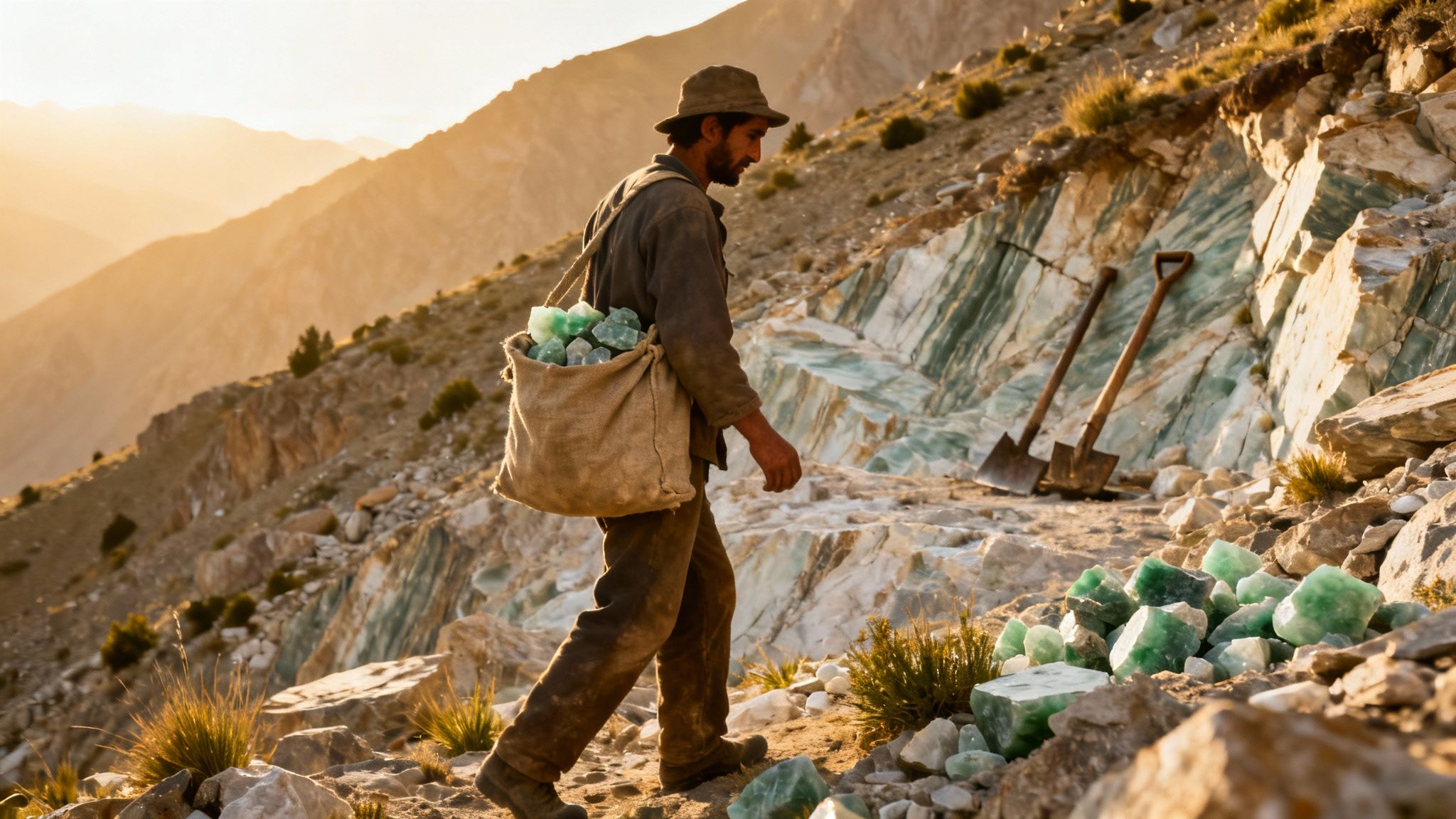
Getting Afghan jade out of the ground is a true testament to human grit. The work falls to small-scale, artisanal miners who navigate treacherous mountain passes, often using traditional tools and methods handed down through generations. These are small, localized, and incredibly physically demanding operations.
The conditions are harsh, and the payoff is never certain. Miners have to locate the jade-bearing rock, then painstakingly extract the rough stone by hand. This labor-intensive first step is just the beginning of a long journey from a hidden mountain vein to a polished gem on the global market. The sheer difficulty of its extraction is woven into the stone's story and its value.
An Informal and Elusive Trade Network
Once it’s out of the ground, the rough stone enters a complex and often informal trade network. Because the mining isn't centrally controlled or officially documented, getting reliable production numbers is nearly impossible.
A great deal of the raw material is transported across the border into neighboring Pakistan for cutting and processing—a journey that further blurs its exact origins. It’s common to find beautiful examples of this regional stone, like this jade freeform from Pakistan, which shows off the material after it has been worked.
The journey of an Afghan jade stone is one of geological intensity and human perseverance. From its formation under extreme pressure to its extraction by hand, every piece carries a story of a hidden geological treasure brought to light through immense effort.
While Afghanistan isn't as famous for jade as places like Myanmar, geological surveys have long confirmed the existence of jade-bearing metamorphic belts throughout the Hindu Kush. These reports point to a geologically significant potential that has fueled artisanal mining for decades, even if the trade itself remains largely in the shadows. This hidden narrative is what makes Afghan jade a truly fascinating material for collectors and designers alike.
Learning to See the Signs of Real Afghan Jade
Developing an eye for genuine Afghanistan nephrite is a bit like learning to recognize a unique fingerprint. It’s all about spotting the distinct visual and tactile clues that separate the real deal from a sea of lookalikes. Once you know these signs, you can appreciate the stone’s authentic character long before you even think about buying.
The first giveaway is its color. Forget the electric, almost neon greens of high-grade jadeite; the color palette for Afghan nephrite is far more earthy and subtle. Think creamy whites, pale yellows, and a whole spectrum of greens—from a soft, milky sage to a deep, rich spinach hue.
These colors are almost never perfectly uniform. Instead, you'll find gorgeous swirls, mottles, or faint veins running through the stone, each one telling a little story about its geological journey. You can see this natural artistry on full display in polished pieces, like this beautiful Afghanistan Jade freeform that really shows off its organic patterns.
Its Signature Luster and Feel
Beyond color, the most telling sign is its luster. Real nephrite has a soft, waxy, or even slightly greasy sheen. Imagine the subtle glow of a high-quality candle rather than the brilliant sparkle of a diamond. It’s this understated luster that gives it such a warm, inviting appearance.
When you hold a piece, it should feel smooth and almost oily to the touch—a classic tell for experienced collectors. If a stone looks glassy, overly shiny, or feels cold and slick, that’s a red flag. You might be looking at an imitation like green quartz or even just plain glass.
Toughness Over Hardness
One of the most misunderstood things about nephrite is its toughness. On the Mohs scale, its hardness is a respectable 6.0 to 6.5, meaning harder materials can scratch it. But its internal structure makes it exceptionally tough.
This distinction is critical: hardness is resistance to scratching, while toughness is resistance to breaking or chipping. Thanks to its densely interlocked fibrous crystals, nephrite is one of the toughest natural minerals on Earth.
This incredible durability is precisely why it was used for ancient tools, weapons, and intricate carvings that could withstand detailed work without fracturing. A piece of genuine Afghan jade feels solid and resilient in your hand, able to take a knock far better than its hardness level might suggest. That inherent strength is a core part of its identity.
How to Confidently Identify Authentic Nephrite
Okay, let's move beyond just looking at the stone and get our hands dirty. Telling real Afghan jade apart from its many lookalikes—like serpentine, bowenite, or even dyed quartz—doesn't always require a gemologist's lab. With a few simple, hands-on tests, you can build the confidence to spot genuine nephrite and dodge the fakes.
Relying on color alone is a classic rookie mistake. Lots of common, less valuable minerals share that familiar green hue. The real secret to identification lies in testing the stone's physical properties, not just its looks.
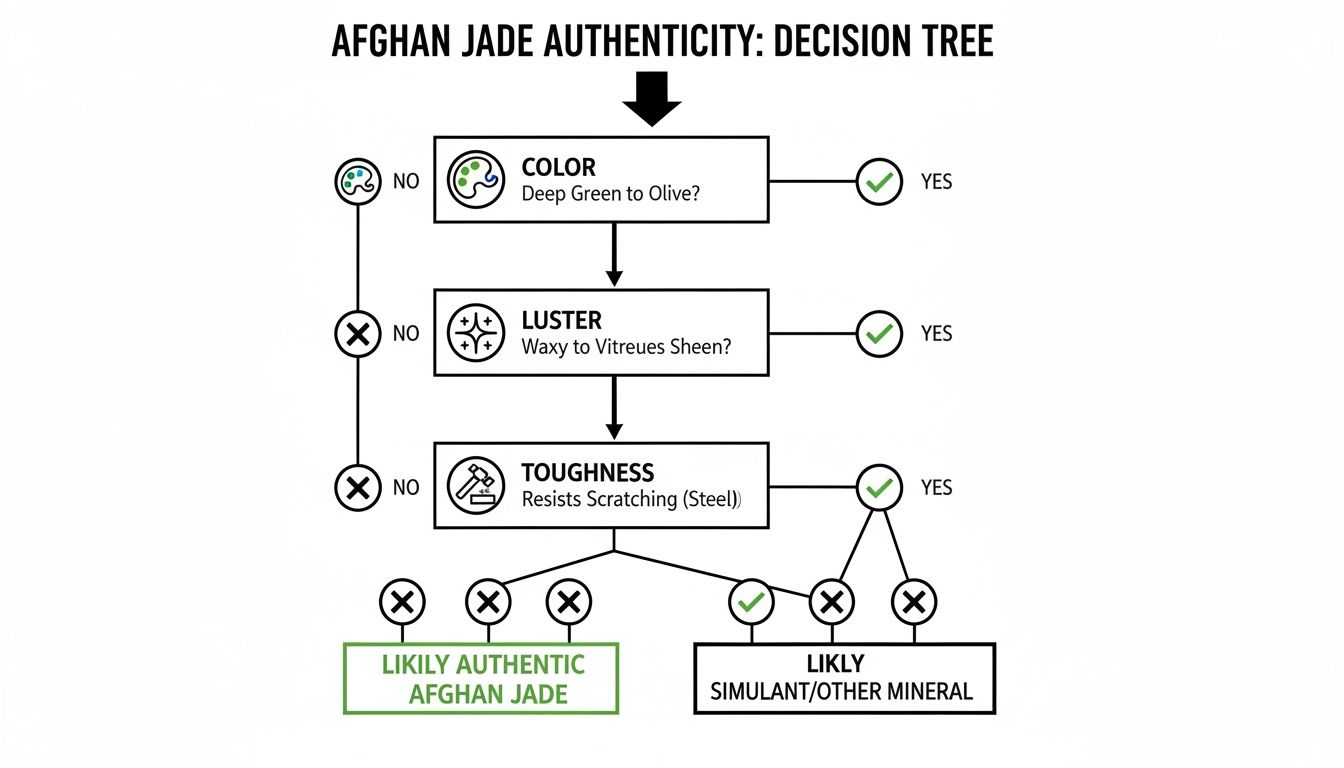
This quick decision tree gives you a roadmap for that initial assessment. It walks you through the key signs of Afghan jade, from its distinct luster to its legendary toughness.
As you can see, it's the combination of a waxy luster, an earthy green color, and exceptional toughness that really points to genuine nephrite.
The Density Test: A Hefty Feel
One of the first things you'll notice is its weight. Nephrite has a specific gravity between 2.90 and 3.03, which makes it feel surprisingly heavy for its size. Common imitators like serpentine, on the other hand, feel noticeably lighter.
Try this: hold a piece of suspected nephrite in one hand and a similarly sized piece of a known imitator in the other. The real deal will have a satisfying, substantial heft to it. It’s a gut feeling, but it’s one of the most reliable first impressions you can get.
The Sound Test: The Signature Clink
Here's another great, low-tech test: listen to it. When you gently tap two pieces of nephrite together, they produce a high-pitched, almost musical "clink." That distinct chime comes from its dense, tightly packed microcrystalline structure.
Imitations like serpentine or soapstone give off a much duller, lower-pitched "clack" or "thud" when tapped. The difference is subtle, but with a little practice, your ears can become an excellent tool for identification.
This test is especially handy when you're looking at beads or bangles, where that resonant chime is much easier to hear.
The Hardness Scratch Test
Now, here's an interesting one. While nephrite is incredibly tough (meaning it resists breaking), it's not exceptionally hard. It scores between a 6.0 and 6.5 on the Mohs hardness scale. This little fact gives us a perfect way to separate it from softer fakes like serpentine, which usually ranks between 2.5 and 5.5.
Here’s how you can do a quick scratch test:
Find an inconspicuous spot on the stone, like the bottom or back where it won't be seen.
Use a steel blade, like from a pocketknife (which has a hardness of about 5.5).
Try to scratch the stone with firm, controlled pressure.
If the blade just leaves behind a metallic streak that you can wipe away, the stone is harder than the steel—a very strong sign you're holding nephrite. If the blade actually digs in and leaves a permanent scratch, the stone is softer. It's almost certainly serpentine or another common imitation. This one simple test can expose a huge number of fakes on the spot.
Jade Identification Test Cheat Sheet
When you're out in the field or at a show, it helps to have a quick reference. This cheat sheet compares the key physical properties of nephrite against its most common imitators.
Test/Property
Nephrite Jade
Serpentine (Bowenite)
Aventurine Quartz
Mohs Hardness
6.0 – 6.5 (won't be scratched by steel)
2.5 – 5.5 (easily scratched by steel)
7.0 (will scratch steel)
Sound Test
High-pitched, musical "clink"
Dull, low-pitched "clack" or "thud"
High, glassy "tink"
Feel/Density
Dense, heavy, substantial feel
Noticeably lighter, sometimes greasy
Feels similar to glass, can be hefty
Luster
Waxy, greasy, or oily sheen
Waxy, greasy, or silky
Vitreous (glass-like) with "aventurescence"
Remember, no single test is foolproof. The real confidence comes from combining these observations. If a stone feels heavy, sounds right, and passes the scratch test, you're very likely looking at genuine nephrite.
Understanding the Value and Ethics of Afghan Jade
What makes one piece of Afghan jade worth a few dollars while another commands thousands? It all comes down to the subtle details. Unlocking the market value of this stone means looking at it through the eyes of a gem expert, focusing on three critical factors that separate the ordinary from the extraordinary.
How Experts Grade Afghan Jade
First and foremost is color. This is the single most important factor. The ideal Afghan jade boasts a rich, uniform green that’s deeply saturated and consistent throughout the entire piece. Think of a vibrant, pure spinach-green or an emerald-like hue—that's the color that fetches the highest prices.
Next up is translucency. This is all about how light interacts with the stone. While you won't find perfectly transparent nephrite, the best pieces have a noticeable glow when you hold them up to a light source. It's an inner radiance, almost as if the stone is lit from within. Opaque, flat-looking stones just don't have the same life to them and are valued far lower.
Finally, there's texture. The finest nephrite has an incredibly smooth, fine-grained structure that feels almost silky and takes on a stunning polish. Any coarseness, pitting, or visible fractures will dramatically reduce a stone’s value and appeal.
Navigating the Ethics of Sourcing
Beyond its physical beauty, the story behind Afghan jade is complex. The reality for anyone looking to buy is that the gemstone trade in Afghanistan is largely unregulated. Most of the material moves through informal networks, completely off the books and without official oversight, which makes tracing a stone from the mine to your hands incredibly difficult.
The informal supply chain means that questions about labor conditions, environmental impact, and fair compensation are often met with uncertainty. Acknowledging this lack of transparency is the first step toward becoming a more responsible collector.
While not as famous as the country's lapis lazuli, jade follows the exact same path. Artisanal miners extract the rough stone, which is then passed to traders who move it through regional hubs in Pakistan, China, and the Gulf. From there, a small portion makes its way to global workshops. In places like East Asia, demand is high, and prices can skyrocket from just tens of dollars to thousands per kilogram depending on its quality. For a deeper dive into this trade network, GIA's report on gemstones from Afghanistan offers some fantastic insights.
How to Make a Responsible Purchase
So, how can you make a choice you feel good about? It really boils down to prioritizing transparency and building relationships with sellers you can trust.
Here’s a practical approach:
Ask Direct Questions: Don’t be shy about asking a seller where their stones come from and what they know about the supply chain. They might not have the full story, but their willingness to even have the conversation is a great sign.
Support Established Vendors: Dealers who have been in the business for years often have long-standing relationships with their regional suppliers. They're far more likely to have a handle on sourcing their materials responsibly.
Focus on Finished Goods: Sometimes, it’s easier to trace the ethics of a finished piece. For example, with something like this handcrafted jade and lapis lazuli bowl, the artisan's story might be more accessible than that of the raw stone.
By asking the right questions and choosing your sources wisely, you can invest in a beautiful Afghanistan jade stone with greater confidence. You'll know you’ve made a choice that is not just financially smart, but ethically considered, too.
Caring for Your Jade Collection
Once you’ve brought a piece of Afghanistan jade into your home, you'll want to make sure its beauty lasts a lifetime. Nephrite is an incredibly tough stone, but that signature waxy luster you fell in love with needs a little care to stay brilliant.
The best way to clean your treasures is surprisingly simple: just use lukewarm water and a mild, phosphate-free soap. A soft cloth or a very gentle brush is all you need to wipe away any dust or oils that have built up over time. It’s crucial to steer clear of harsh chemicals, abrasive cleaners, and especially steam cleaners, as they can permanently dull the stone’s polished surface.
Proper Cleaning and Storage
Ultrasonic cleaners are also a no-go. While nephrite itself is tough enough to handle the vibrations, these machines are notorious for loosening jewelry settings or worsening tiny, invisible fractures that might already exist within the stone.
A huge part of proper care is simply how you store it. Nephrite has a Mohs hardness of 6.0-6.5, which means harder, more common gemstones like quartz (a 7) or diamonds (a 10) can easily scratch it. Always keep your jade pieces tucked away separately in a soft cloth pouch or a lined jewelry box.
This one simple step prevents a lot of accidental heartbreak from other items in your collection. You can see how well these stones hold up when cared for by looking at these beautiful examples of tumbled green jade, which really showcase the material’s lasting appeal.
Interestingly, some of the gentle techniques used for polishing marble countertops can give you an idea of the light touch needed to maintain your stone’s shine. Follow these straightforward tips, and your jade will stay just as stunning as the day you first saw it.
Your Top Questions About Afghan Jade
Jumping into the world of gemstones can feel a little overwhelming, especially with a stone as misunderstood as Afghan jade. To clear things up, I’ve put together answers to some of the most common questions we hear from collectors and designers.
Think of this as your go-to guide for a quick reality check, helping you buy, identify, and appreciate this beautiful stone with a lot more confidence.
Is Afghan Jade the Same as Jadeite?
Nope, they’re different. The stone marketed as Afghan Jade is almost always nephrite, which is one of the two minerals correctly called jade. The other is jadeite, a much rarer and often pricier cousin with a different chemical makeup.
While both are incredibly tough, jadeite is famous for its almost electric, vibrant greens and a glassy shine. Nephrite, on the other hand, usually shows off softer, earthier greens and has that classic waxy or almost greasy feel that collectors love.
Why Are There So Many Fakes on the Market?
It’s the perfect storm, really. You have intense global demand for jade meeting a complicated, often informal supply chain from places like Afghanistan. This creates a huge opportunity for imitations to flood the market. The most common lookalikes are serpentine (especially a variety called bowenite), aventurine quartz, and even cleverly dyed marble.
These other stones are way more common and cheaper to get, so it’s easy for a dishonest seller to turn a big profit by passing them off as the real deal. This is exactly why learning a few basic identification tests—like checking hardness, density, and that signature luster—is a non-negotiable skill for any buyer.
The name "Afghan Jade" is a trade term. It points to a stone's origin and look, not its exact mineralogy. This wiggle room in the naming is often exploited, making it easier for sellers to market stones that aren't true nephrite.
What Makes a Piece of Afghan Jade Valuable?
The value of an afghanistan jade stone really boils down to three key things:
Color: The most sought-after pieces have a rich, uniform, and deeply saturated green. The more even and vivid the color, the more it’s worth.
Translucency: The best specimens aren't totally opaque; they let a little bit of light pass through, giving them a beautiful inner glow. Stones that look flat and lifeless are less valuable.
Texture: A fine, smooth, and even texture is the goal. You don't want to see any graininess, pits, or fractures, especially on a carving where the surface has to be flawless.
How Can I Support Ethical Sourcing?
This is a tough one, mostly because the Afghan gem market isn't highly regulated. Your best bet is to buy from reputable dealers who are open about where their stones come from. Don't be shy—ask them directly about their supply chains and the story behind their pieces. While perfect traceability is rare, established vendors who have built long-term relationships with their suppliers are always your most reliable choice.
At Astro West, we're committed to sourcing high-quality, authentic minerals and gemstones you can feel good about. Take a look at our curated collection and find a piece with a story you can trust.