When you hear "10 karat gold wire," think of it as the workhorse of the jewelry world—a perfect blend of beauty and brawn. It’s an alloy made of 41.7% pure gold mixed with 58.3% stronger metals, giving it a durability and affordability that pure gold just can't offer. This specific recipe makes it a go-to material for both professional jewelers and passionate hobbyists, especially when preparing for the busy holiday season, from Black Friday sales to unique Christmas gifts.
Understanding the Karat System and 10k Gold
Before we get into the nitty-gritty of 10k gold wire, let's break down the "karat" system. It’s simply a scale to measure gold purity, with 24 karat (24k) being the top—100% pure gold. But here's the thing about pure gold: it's incredibly soft. You could practically bend it with your hands, which means it would scratch, dent, and lose its shape in no time if used for everyday jewelry.
To solve this problem, jewelers mix pure gold with other metals to create an alloy. This isn't just about making the gold stronger; it also changes its color and, importantly, brings down the price.
The Recipe for 10 Karat Gold
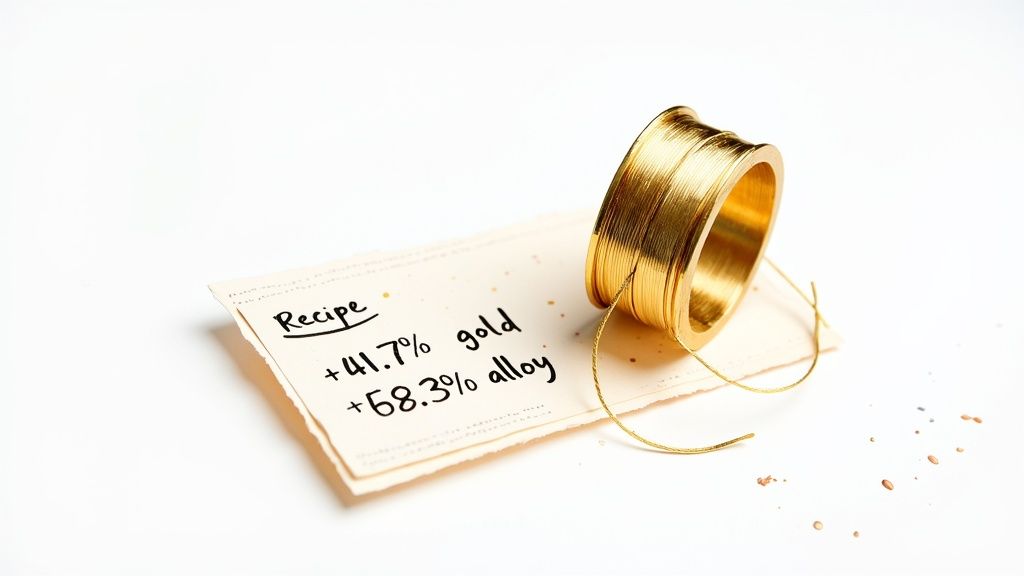
The term "10 karat" tells you exactly what’s in the mix. Imagine a recipe with 24 total parts. For 10k gold, 10 of those parts are pure gold, and the other 14 are a mix of other metals.
Pure Gold Content: 41.7% (that's 10 divided by 24)
Alloy Metal Content: 58.3% (the remaining 14 divided by 24)
These alloy metals are usually a combination of silver, copper, and zinc. This blend is what gives 10k gold its signature toughness, making it a fantastic and cost-effective choice for everything from sturdy rings to delicate wire-wrapped pendants featuring stones like labradorite or fluorite. Of course, knowing your gold purity is key, which is why it's always good to learn how to tell real gold from fool's gold like pyrite.
A Major Player in the Precious Metals Market
The demand for strong, beautiful materials like 10 karat gold wire is huge. The global precious metals wire market, which includes all kinds of gold wire products, recently hit a valuation of around USD 13.55 billion. That number really shows you how vital these wires are for jewelry making and other industries.
While we're focused on 10k gold wire for making jewelry, it’s interesting to see how gold is valued in other forms. Take collectible gold coins like the Half Sovereign, which are prized for their high gold content and history. This wider context really helps you appreciate the versatility and timeless appeal of gold in all its forms.
The Unique Personality of 10k Gold Wire
Beyond the numbers on a spec sheet, 10 karat gold wire has a distinct personality—a set of working properties that come alive at the jeweler's bench. These traits—its color, hardness, and how it holds up over time—are what really matter when you're turning a spool of wire into a finished piece. Getting to know them is the key to knowing exactly how your design will look, feel, and last.
One of the most charming things about 10k gold is its color. It’s not the deep, almost brassy yellow of higher karats. Instead, 10k offers a softer, more subtle buttery hue. This gentle color comes from the higher percentage of alloy metals like copper and silver, which beautifully temper the intense yellow of pure gold.
This makes it an incredibly versatile metal. It pairs wonderfully with a huge range of gemstones without ever stealing the show. Whether you’re wire-wrapping a delicate aquamarine or setting a bold lapis lazuli, 10k gold acts as a complementary frame, not a competing focal point. Imagine crafting a stunning Mother's Day gift by wrapping a vibrant rose quartz—the subtle gold will enhance the stone's natural beauty perfectly. If you're looking for inspiration, take a look at our guide to the best gemstones for jewelry.
Hardness and Durability
Let’s be honest: the main reason jewelers reach for 10k gold wire is its incredible durability. Pure 24k gold is notoriously soft—beautiful, but totally impractical for anything that’s going to see daily wear and tear. By blending gold with stronger alloys, 10k wire achieves a fantastic hardness that stands up to scratches, dings, and bending.
This resilience makes it the go-to material for high-contact jewelry that needs to hold its own.
Rings and Bracelets: These pieces take a beating. The strength of 10k gold means they’ll keep their shape and integrity through constant use.
Structural Components: Think about the parts that do all the work—clasps, ear wires, and ring shanks. Using 10k wire gives them the reliable strength needed to keep your creations secure.
Here’s a good way to think about it: if 24k gold is like soft clay that's easy to shape but just as easy to damage, then 10k gold is like fired ceramic. It's still beautiful, but it's tough enough for real life. That robustness gives you peace of mind that your hard work is built to last.
Tarnish Resistance
A question that comes up a lot is how well 10k gold wire resists tarnish. Because of the higher concentration of alloy metals (especially copper), it’s not completely immune to oxidation like 18k or 24k gold is. Over time, and with exposure to certain chemicals or even just the air, it can develop a slight patina.
But here’s the good news: it's far more tarnish-resistant than sterling silver. Any darkening that occurs is usually minor and buffs away in seconds with a soft polishing cloth. A little bit of routine care is all it takes to maintain that warm, lustrous shine for years, ensuring your jewelry looks just as brilliant as the day you made it.
Comparing Gold Karat Properties
To really understand where 10k fits in, it helps to see it side-by-side with its higher-karat siblings. Each one has its place in the workshop, and choosing the right one often comes down to balancing durability with color and purity.
Property
10 Karat Gold
14 Karat Gold
18 Karat Gold
Pure Gold Content
41.7%
58.3%
75%
Hardness/Durability
Very High
High
Medium
Color
Subtle, pale yellow
Rich, warm yellow
Deep, vibrant yellow
Tarnish Resistance
Good
Very Good
Excellent
Best For
Rings, bracelets, clasps
All-purpose jewelry
Fine jewelry, earrings, pendants
Price Point
Most Affordable
Mid-range
Premium
As you can see, 10k gold wire really shines when it comes to strength and affordability, making it a practical and beautiful choice for hardworking jewelry.
Choosing the Right Wire Gauge for Your Project
Picking the right thickness, or gauge, for your 10 karat gold wire is one of the most critical decisions you'll make for any piece. This choice doesn't just shape the final look; it dictates the piece's strength and how it holds up over time. It’s a lot like choosing the right thread for sewing—a delicate silk scarf needs a fine thread, but a heavy canvas bag demands something much tougher to hold everything together.
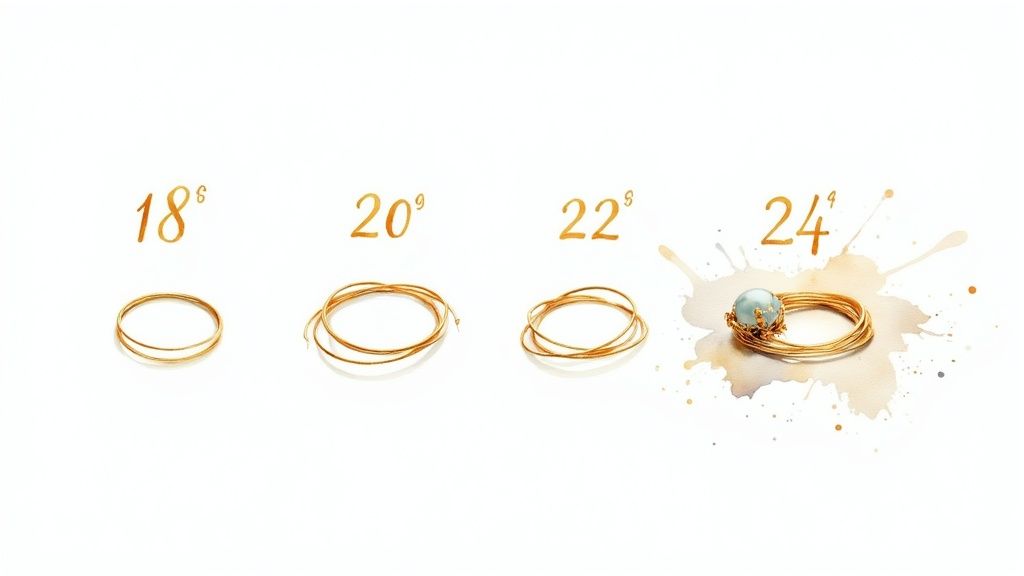
In the world of jewelry wire, the gauge system works backward: the lower the number, the thicker the wire. It feels a bit strange at first, but once you get the hang of it, you'll be grabbing the perfect wire without a second thought. The most common gauges you'll work with in 10k gold are 18, 20, 22, and 24, and each has its own special purpose.
Heavier Gauges for Structure and Support
When your design needs a solid backbone, heavier gauges are your go-to. These thicker wires provide the rigidity needed for parts that take on weight or the stress of daily wear.
18 Gauge (1.02mm): This is a seriously robust wire. It’s perfect for creating sturdy ring bands, heavy-duty clasps, and the frames for larger pendants that might feature a piece of petrified wood or a striking malachite cabochon.
20 Gauge (0.81mm): A bit more versatile but still plenty strong, 20 gauge is a real workhorse for many jewelers. It’s the sweet spot for making ear wires, reliable jump rings, and medium-duty clasps that look elegant but are built to last.
Think of these gauges as the skeleton of your jewelry. They provide the structural integrity you need to support your artistic vision and the beautiful stones you've chosen. The type of gemstone can also influence your design, a topic we explore in our guide to precious vs. semi-precious stones.
Lighter Gauges for Detail and Delicacy
For all the fine details that truly make a piece sing, you’ll want to reach for the thinner, more flexible lighter gauges. These wires are all about intricate work where any bulk would just get in the way.
22 Gauge (0.64mm): This gauge is a fantastic middle-ground between strength and flexibility. It’s brilliant for wire-wrapping smaller stones like citrine, creating decorative loops, and making delicate chain links that still have some durability.
24 Gauge (0.51mm): When precision is everything, 24 gauge is your answer. This super-fine wire is what you'll use for intricate coiling, weaving, and wrapping the tiniest gemstone beads where a delicate touch is non-negotiable.
Interestingly, it seems we're not the aonly ones thinking about materials like 10 karat gold wire. Search data shows that interest in "gold jewelry wire" consistently peaks around October, most likely as makers gear up for the holiday season rush. Mastering both heavy and light gauges means your creations will be structurally sound, beautifully detailed, and ready for any season.
Essential Techniques for Working with 10k Wire
Working with 10 karat gold wire is a really rewarding experience, but you have to get a feel for its unique personality. It’s a specific blend of strength and precious metal, and understanding how it behaves when you bend, twist, and shape it is the first step toward creating professional, durable pieces that look incredible.
One of the first things you'll run into is a concept called work-hardening. Think about bending a paperclip back and forth—with each bend, the metal gets stiffer and harder to move. The exact same thing happens as you form, hammer, or draw your 10k wire. This is actually a good thing, as it adds strength and resilience to finished parts like clasps and ear wires.
But if you’re trying to create delicate curves or intricate wraps, that same stiffness can turn into a real problem. Push it too far, and you risk snapping the wire or ending up with a lumpy, uneven finish. That's where annealing comes in.
The Art of Annealing
Annealing is just a fancy word for heating the metal to soften it up and reverse that work-hardening. It’s like hitting a reset button, restoring the wire’s original flexibility so you can keep shaping it without fighting against its tension. For 10k gold wire, the process is pretty straightforward, but it does demand a bit of care.
Set Up Your Space: Always work on a heat-proof surface like a soldering block. You'll need a torch with a gentle flame, a small bowl of water for quenching, and a pair of tweezers.
Heat Gently: Move your torch flame evenly across the wire until it glows a faint, dull red. It’s easy to overheat it, which can damage the alloy, so try to do this in a dimly lit room where you can spot that subtle color change.
Quench and Clean: As soon as it’s heated, quickly drop the wire into your water to cool it down. You’ll notice some dark discoloration on the surface—that’s oxidation. Just pop it into a pickle solution to clean that off before you start working again.
This simple cycle of working the wire, annealing it when it gets stiff, and cleaning it allows you to tackle far more ambitious designs. A clean and organized bench makes these steps much safer and more efficient. For a smooth workflow, knowing how to organize craft supplies is a game-changer, keeping everything from your torch to your pickle pot right where you need it.
Tips for Soldering 10k Gold
Soldering is how you’ll join pieces of wire to create seamless connections. With 10k gold, the secret is managing your heat and choosing the right solder so you don’t accidentally melt your project or create a discolored, ugly joint.
One of the most common mistakes is just blasting the piece with too much heat. The goal is to heat the metal just enough for the solder to flow, which always happens at a lower temperature than the melting point of the gold wire itself.
To get a clean, strong bond, always use solder made specifically for 10k gold. Gold solder comes in different temperature grades—easy, medium, and hard—which flow at progressively higher temperatures. A great pro-tip is to start with hard solder for your first connection, then switch to medium and easy for any later joints on the same piece. This simple trick prevents you from accidentally re-melting your previous work.
10k Gold Wire vs. Other Jewelry Wires
Picking the right material is one of those make-or-break moments for any jewelry project. When you're working with 10 karat gold wire, it helps to know not just its own quirks, but how it stands up against the other options out there. This is how you make sure your final piece has the right look, durability, and value you're aiming for.
The most obvious comparison is with other solid gold alloys. While 10k gold is tougher and more durable, higher karats like 14k and 18k offer a richer, deeper yellow hue thanks to their higher pure gold content. The trade-off is pretty straightforward: 10k is the champion for durability and affordability, while 18k is prized for its luxurious color and tarnish resistance. For many jewelers, 14k hits that sweet spot right in the middle.
If you want to get deeper into making smart purchases, our jewelry buying guide is packed with valuable insights.
Solid Gold vs. Gold-Filled vs. Gold-Plated
Understanding the difference between solid gold, gold-filled, and gold-plated wire is one of the most critical concepts for a jeweler. It’s the difference between lasting value and a finish that’s just temporary.
Think of it like this: solid gold is like a piece of solid oak furniture. Gold-filled is a high-quality wood veneer, and gold-plated is a thin layer of wood-patterned wallpaper. One is a solid material through and through, while the others are just a surface treatment.
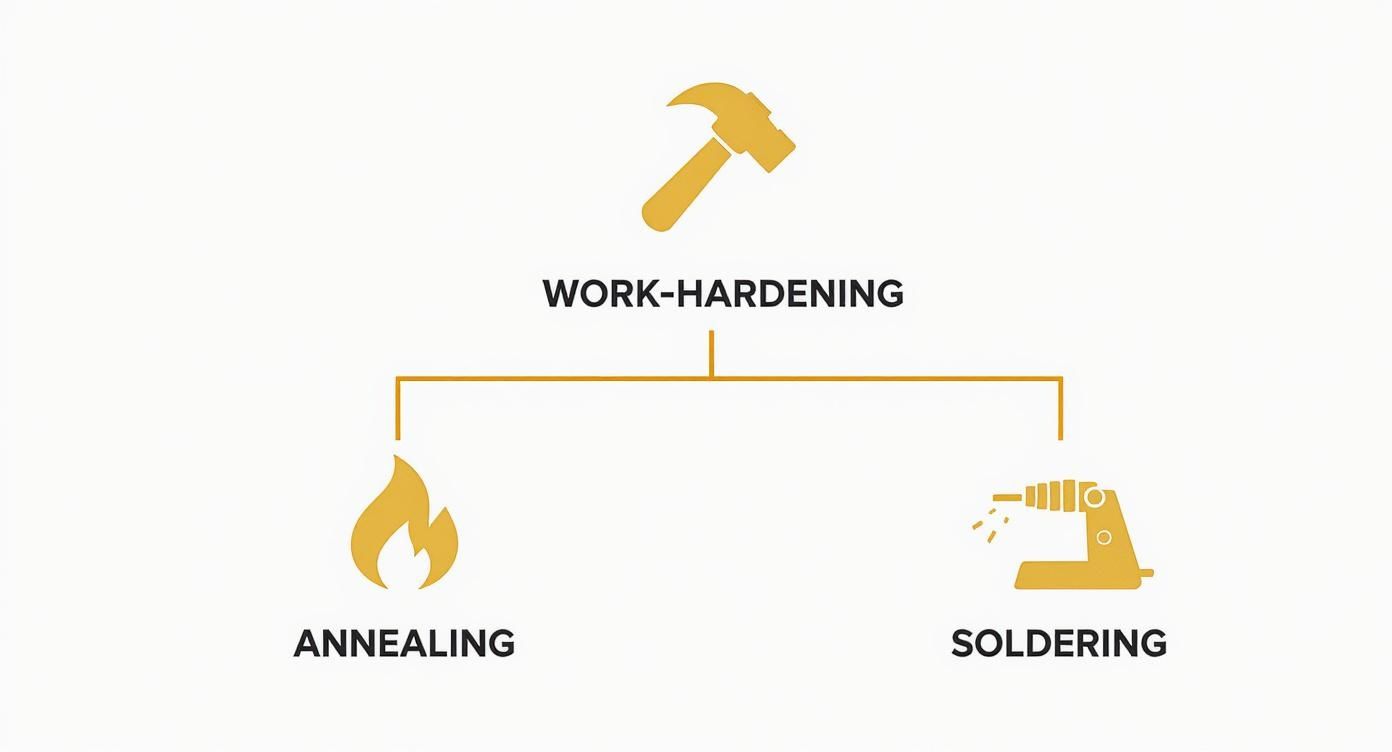
Techniques like work-hardening, annealing, and soldering are really only relevant for solid and gold-filled wires, where the material integrity goes deep.
The diagram above shows that the core composition of your wire dictates which techniques you can even use, which is why choosing the right type from the start is so important.
Here’s a quick rundown of how they differ:
10k Solid Gold Wire: This is a true alloy. The gold and other metals are mixed together at a molecular level, so the material is consistent all the way through. You can sand it, solder it, and polish it without ever worrying about exposing a different metal underneath.
Gold-Filled Wire: This option has a thick layer of gold—legally, it has to be at least 5% (or 1/20) of the total weight—that is mechanically bonded with heat and pressure to a base metal core, usually brass. It gives you the look of solid gold at a fraction of the cost and is durable enough for daily wear, often lasting 10-30 years with proper care.
Gold-Plated Wire: This wire has just a microscopic layer of gold (often less than 0.05% of the weight) applied through electroplating. This incredibly thin coating can wear off quickly, revealing the base metal beneath. It's really not suitable for high-quality jewelry that's meant to last.
Making the Right Choice for Your Project
So, which one should you choose? Your decision really boils down to your project's goals, your budget, and how long you want the piece to last.
For heirloom-quality jewelry that’s meant to be passed down through generations, nothing beats solid gold like 10 karat gold wire. If you're creating high-quality pieces but need a more affordable option, gold-filled is an excellent alternative. Gold-plated wire, on the other hand, is best saved for practice pieces or fashion jewelry where longevity isn’t the main goal.
Getting these fundamental differences straight empowers you to pick the perfect material to bring your creative vision to life with confidence and integrity.
Got Questions About 10 Karat Gold Wire? We’ve Got Answers.
Even after getting familiar with the basics, you probably still have a few questions floating around about working with 10 karat gold wire. Let's clear those up. Here are some of the most common things jewelers and hobbyists ask, answered in a straightforward way to help you get started on your next project with total confidence.
We'll tackle everything from tarnish and skin sensitivity to making the right call between different karats.
Does 10k Gold Wire Tarnish Easily?
This is easily one of the most frequent questions. While 10k gold is incredibly resistant to tarnish—especially when you compare it to something like sterling silver—it's not completely immune. Because it's made of 58.3% other metals, it can slowly darken over time when exposed to air and certain chemicals.
But here’s the good news: this is usually a very slow process and is ridiculously easy to manage. A quick wipe with a soft polishing cloth is almost always all it takes to bring back its warm, brilliant shine. Simple as that.
Is 10k Gold Wire Good for Sensitive Skin?
For the vast majority of people, the answer is a resounding yes. 10k gold is generally considered hypoallergenic and is worn every day by millions without any trouble at all.
That said, it does contain a higher percentage of alloy metals like copper or nickel, depending on the specific mix. This means someone with an extreme metal sensitivity might have a reaction. If you know you have a severe allergy, playing it safe and opting for 14k or 18k gold, which have more pure gold, is usually the smarter choice.
Key Takeaway: While 10k gold is a great fit for most, its alloy content is something to keep in mind for anyone with known, severe metal allergies. Always put comfort and safety first, whether you're making a piece for yourself or a customer.
Can I Solder 10k Gold Wire with Silver Solder?
Using the right solder is absolutely non-negotiable if you want a professional finish. It is not recommended to use silver solder on 10k gold wire, and for two very important reasons.
A Weak Bond: Silver solder and gold alloys just aren't formulated to work together. Using the wrong one will likely result in a weak joint that could easily fail down the road.
A Bad Color Match: The solder point will have a noticeably different, silvery color that sticks out like a sore thumb against the warm yellow of the gold. It creates a visibly flawed seam that cheapens the look of the piece.
Always, always use gold solder that is specifically made for 10k gold. It’s the only way to guarantee a strong, seamless, and perfectly color-matched bond.
Why Would I Choose 10k Gold Wire Over 14k?
The choice between 10k and 14k gold wire usually boils down to balancing two key things: durability and cost.
Durability is where 10k gold really shines. Its higher alloy content makes it harder and much more resistant to scratches and dings. This makes it a fantastic material for jewelry meant for everyday wear, like rings and bracelets that are going to see a lot of action.
Cost is the other major selling point. With less pure gold in the mix, 10k wire is naturally more affordable. This opens up possibilities, allowing you to create larger, more substantial pieces or experiment with intricate designs without the hefty price tag of 14k gold. While its use in jewelry is well-known, gold wire also has crucial industrial applications. The global gold bonding wires market, used in semiconductor manufacturing, reached USD 3,221 million and is projected to grow, showing the metal's broad importance. You can learn more about the growth of the gold bonding wire market and its industrial significance.
At Astro West, we believe that the right materials can elevate any creation. Whether you're crafting a durable ring with 10 karat gold wire or setting a stunning meteorite fragment, our curated collection of fine minerals, fossils, and jewelry-making supplies provides the quality and inspiration you need.