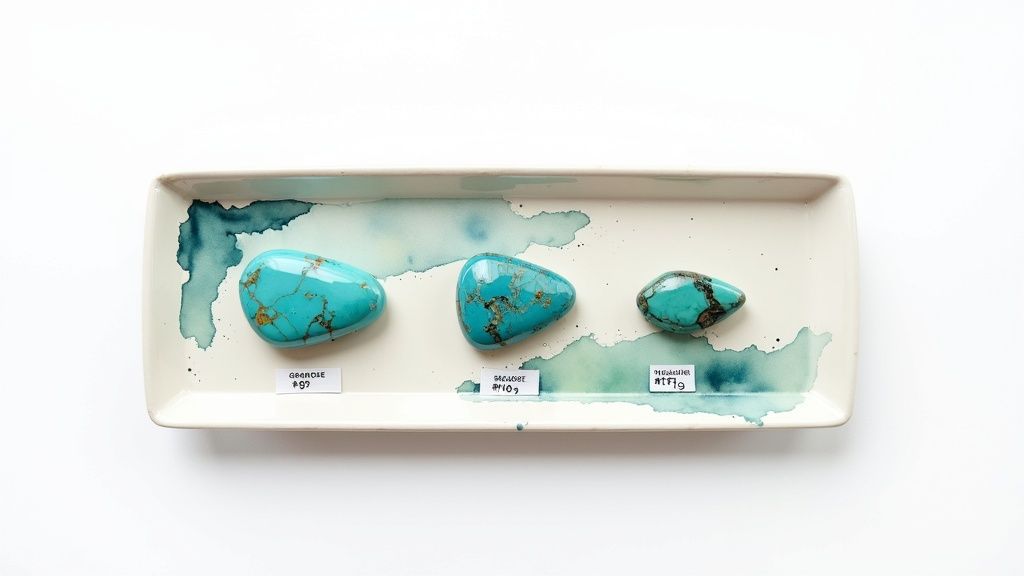
When it comes to American gemstones, few names carry the weight and mystique of the #8 turquoise mine. Discovered back in 1929 near Carlin, Nevada, this legendary site is now closed, a fact that has cemented its output as a finite, highly sought-after treasure among collectors. Whether you're searching for a unique gift for a loved one this Valentine's Day or adding a piece of history to your own collection, understanding this mine's legacy is key.
The Enduring Legend of the #8 Turquoise Mine
In the world of American turquoise, the #8 mine is royalty. Even though its productive years are a distant memory, the mine's legacy thrives in the brilliant stones that carry its name. For collectors, jewelers, and anyone who appreciates natural history, #8 turquoise is far more than a mineral—it's a tangible piece of American mining history.
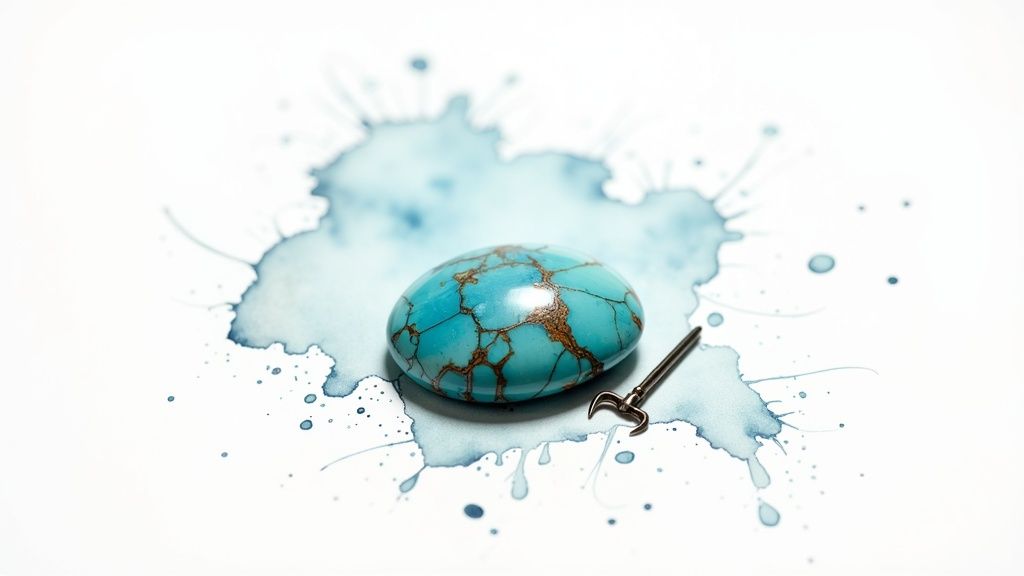
What gives this particular turquoise its unmistakable signature? It’s all about that classic visual punch. The stones are famous for a stunning spiderweb matrix, where delicate, intricate lines of dark host rock weave through a backdrop of soft powder blue or a deep, rich sky blue. This beautiful contrast is the mine's calling card, making every single cabochon a unique piece of natural art.
Why This Mine Is So Celebrated
The story behind the #8 mine is one of those happy accidents. It wasn't found during a quest for turquoise at all; the deposit was stumbled upon in 1929 during a copper exploration. But the sheer quality of the turquoise quickly overshadowed everything else.
By the 1950s, the mine was a powerhouse, producing some of the finest turquoise on the planet. Its fame was forever sealed when it produced the largest single turquoise nodule ever recorded—a beast of a specimen weighing over 150 pounds.
The closure of the #8 turquoise mine in 1976 transformed its output from a commodity into a true collectible. With no new material coming out of the ground, every existing piece became part of a finite and increasingly precious supply.
This scarcity is a massive part of its allure. Unlike minerals still being actively mined, like fluorite or aquamarine, the available pool of #8 turquoise only gets smaller. Think of this guide as your map to understanding this iconic American gemstone, covering everything from its storied past to the specific traits that define its lasting value.
What Makes #8 Turquoise a Collector's Classic
For both seasoned collectors and those just starting their journey with minerals like jasper or malachite, #8 turquoise presents a unique opportunity. Owning a piece is like holding a time capsule. Before we dive deeper, here’s a quick look at what makes this stone a must-have.
#8 Turquoise Mine at a Glance
Characteristic
Description
Distinctive Spiderweb Matrix
Golden-brown to black webbing creates a dramatic and highly sought-after pattern that is instantly recognizable.
Historical Significance
Its discovery and operational history are deeply woven into the fabric of 20th-century American mining lore.
Finite Supply
The mine’s closure guarantees its rarity, driving collector demand and preserving its long-term value.
Vibrant Color Palette
The range from pale to deep blue provides a spectrum of aesthetic options, each with its own unique character.
Ultimately, several key factors come together to give #8 its legendary status:
Its Unmistakable Look: That signature spiderweb matrix is instantly recognizable and always in demand.
A Rich History: The mine is a core part of 20th-century American mining lore.
Guaranteed Rarity: With the mine closed, what’s out there is all there is. This drives demand and preserves its value over the long haul.
A Spectrum of Blues: The colors range from pale, soft blues to deep, intense hues, offering a variety of aesthetics for every taste.
Whether it’s set in a piece of heirloom jewelry or displayed as a raw specimen, #8 turquoise tells a powerful story of geological wonder and human discovery.
Tracing the History of Nevada's Storied Mine
Every legendary gemstone has a story, and the tale of the #8 turquoise mine is a classic chapter in American mining lore. Its history isn't one of grand design, but of a happy accident that would completely change the turquoise world. The journey started back in 1929, deep in the rugged landscape of Eureka County, Nevada—a place known more for its gold and copper than for brilliant blue stones.
Prospectors combing the area weren't even looking for turquoise. Their eyes were on more traditional metals. But while exploring a copper claim, they stumbled upon something truly extraordinary: rich, vibrant veins of a bright blue mineral. That accidental find was the birth of the #8 turquoise mine.
At first, the turquoise was just a beautiful byproduct of the main copper mining operation. But the exceptional quality of the stones quickly caught the eye of miners and jewelers alike. The vivid color, and especially the unique matrix patterns, were unlike anything else coming out of Nevada at the time. This distinctive character set the stage for its rapid climb to fame.
The Golden Age of Production
By the middle of the 20th century, the #8 mine was no longer an afterthought. It had become a powerhouse under the guidance of legendary Nevada miners, earning a reputation for producing some of the finest turquoise on the planet. The mine really hit its peak in the 1950s, a period often called its golden age.
During this era, the mine cranked out huge quantities of high-grade material, cementing its place among the great American turquoise sources. Its fame shot through the roof with a truly monumental discovery—the largest single nodule of gem-quality turquoise ever recorded.
This colossal specimen weighed an incredible 150 pounds, a record that has stood for decades. It was a tangible symbol of the mine's incredible potential and became a legend in its own right, spoken of with reverence by collectors and miners.
This period of abundance truly showcased the mine’s remarkable geological gifts. The output was so massive that it supplied artisans all across the Southwest. Native American jewelers, particularly from the Navajo and Zuni tribes, were transforming the raw stone into breathtaking works of art. The mine’s distinctive spiderweb material became a signature look in high-end silverwork, which only fueled its popularity even more.
The End of an Era
Like all great mining stories, the productive years of the #8 turquoise mine had to end. After decades of yielding remarkable material, the economic and geological realities of mining kicked in. The most accessible, high-quality turquoise deposits were gradually mined out, making it harder and less profitable to keep going.
The mine’s machinery fell silent, and major turquoise production officially stopped in 1976. That closure was a turning point. It transformed #8 turquoise from a beautiful, available material into a finite and irreplaceable piece of history.
That historical context is everything. Because the mine is closed, every genuine piece of #8 turquoise on the market today is a relic from a bygone era. It's a time capsule from a closed chapter of American mining, a finite artifact that can't be replicated. This scarcity is what really drives its desirability and lasting value. Owning a piece of #8 turquoise isn't just about admiring its beauty; it's about holding a tangible piece of history in your hands.
The Unique Geology of #8 Turquoise
What makes #8 turquoise so iconic? The secret is buried deep in the earth, the result of a specific geological recipe that played out over millions of years in Eureka County, Nevada. Turquoise itself is a straightforward mineral—a hydrous phosphate of copper and aluminum—but the conditions of its formation are what give each stone its unique personality.
Think of it like baking a cake. You can start with the same basic ingredients, but tiny changes in temperature, timing, or extra spices create something completely different. The #8 mine was the perfect geological kitchen, where just the right amounts of copper, aluminum, and phosphorus-rich water seeped into the cracks of the host rock. This slow, patient process allowed the vibrant blue mineral to crystallize, laying the foundation for the gemstone we prize today.
The Artistry of the Spiderweb Matrix
The single most defining feature of #8 turquoise is its spectacular spiderweb matrix. This isn't just some random pattern; it's a geological story told in stone. The "spiderweb" is actually made of remnants of the original host rock, often a hard, dark material like chert or limonite.
Imagine a beautiful ceramic vase that develops fine cracks over time. If you were to fill those cracks with dark ink, you’d see an intricate network of lines spreading across the surface. That’s a great way to picture how the spiderweb matrix formed. As the host rock fractured under immense geological pressure, turquoise-forming solutions filled the larger voids. The smaller cracks and leftover bits of host rock remained, creating those delicate, web-like patterns that contrast so beautifully with the blue turquoise.
This is why you'll see such a variety in the #8 matrix:
Black Matrix: Often created by the presence of iron pyrite.
Golden-Brown Matrix: Typically a result of iron oxide, or limonite.
Reddish Webs: Can indicate other forms of iron mixed into the host rock.
The sheer beauty of these patterns is why collectors clamor for specimens with a strong, well-defined web. For anyone interested in seeing more examples, our collection showcases a variety of minerals with fascinating inclusions, from tourmalated quartz to rutilated quartz, highlighting this stunning natural artistry.
A Painter's Palette of Blues and Greens
Beyond its famous matrix, the color of #8 turquoise is just as captivating. It spans a whole spectrum, from a soft, light powder blue to a deep, intense blue-green. These color variations aren't random at all; they’re dictated by the mineral's chemical makeup, specifically the presence of trace metals.
Copper is the main ingredient that gives turquoise its blue hue. The more copper present during formation, the more vivid and deep the blue. But when traces of iron sneak into the mix, it’s like a painter adding a touch of yellow to blue paint—the color shifts towards the green end of the spectrum. This subtle dance of minerals means no two pieces of #8 turquoise are exactly alike. Each one carries its own unique chromatic signature.
Understanding Stabilization: A Practical Necessity
When we talk about turquoise geology, it’s crucial to bring up stabilization. Turquoise is a relatively soft and porous stone, ranking between 5 and 6 on the Mohs hardness scale. This means some natural, untreated turquoise can be fragile and prone to absorbing oils or chemicals, which can change its color over time.
Stabilization is a common and widely accepted treatment where porous turquoise is infused with a clear epoxy resin under pressure. This process fills the stone's microscopic pores, hardening it and making it durable enough for jewelry. It also protects the stone's natural color from changing due to contact with skin oils or lotions.
While some collectors exclusively seek natural, untreated stones, stabilized turquoise offers beauty and durability for everyday wear. This treatment doesn't diminish the stone's inherent beauty; it just ensures it can be enjoyed for generations to come, much like how heat treatment enhances the color of citrine.
How to Identify Authentic #8 Turquoise
Spotting a genuine piece of #8 turquoise is a skill you build over time, like learning to recognize a particular artist's brushstrokes. It’s less about a single feature and more about understanding its unique visual signature. Every piece of turquoise tells a story through its color and matrix, and your job is to learn how to read the geological fingerprints left by the #8 mine. This is what sets it apart from stones from other legendary mines like Kingman or Lone Mountain.
The most famous giveaway is its world-renowned spiderweb matrix. But not all webbing is created equal. The #8 mine is famous for producing a delicate, intricate network of lines in shades of golden-brown, reddish-brown, or a deep, rich black. The key is the balance—the webbing should feel organic and tangled, not like something printed neatly on the surface.
Mastering the Matrix
When you're looking at a potential piece, get up close and personal with the matrix. In a real #8 stone, the lines will vary in thickness and density, creating a pattern that feels alive and dynamic. You might see a tight, dense web in one corner that opens up into a sparser pattern elsewhere. This natural irregularity is one of the strongest signs of an authentic stone.
Think of it like the difference between a real spider's web and a Halloween decoration. The real web has subtle imperfections, threads of varying thickness, and an organic structure. The fake one is uniform and perfect. The matrix in genuine #8 turquoise has that same free-flowing, beautifully imperfect quality that’s incredibly difficult to fake well.
Recognizing Common Imitations
One of the most common lookalikes you'll run into is dyed howlite, a porous white mineral that drinks up blue dye like a sponge. It’s often passed off as turquoise to unsuspecting buyers, but a few simple tricks can help you spot the imposter. The "matrix" on dyed howlite often looks too perfect, with dark lines that seem painted on top rather than being an integral part of the stone.
The color can also be a dead giveaway. Fakes often have a flat, one-dimensional color that lacks the subtle depth you see in real turquoise. A genuine piece will almost always show slight shifts in its blue or green hues, a beautiful testament to its natural formation deep in the earth.
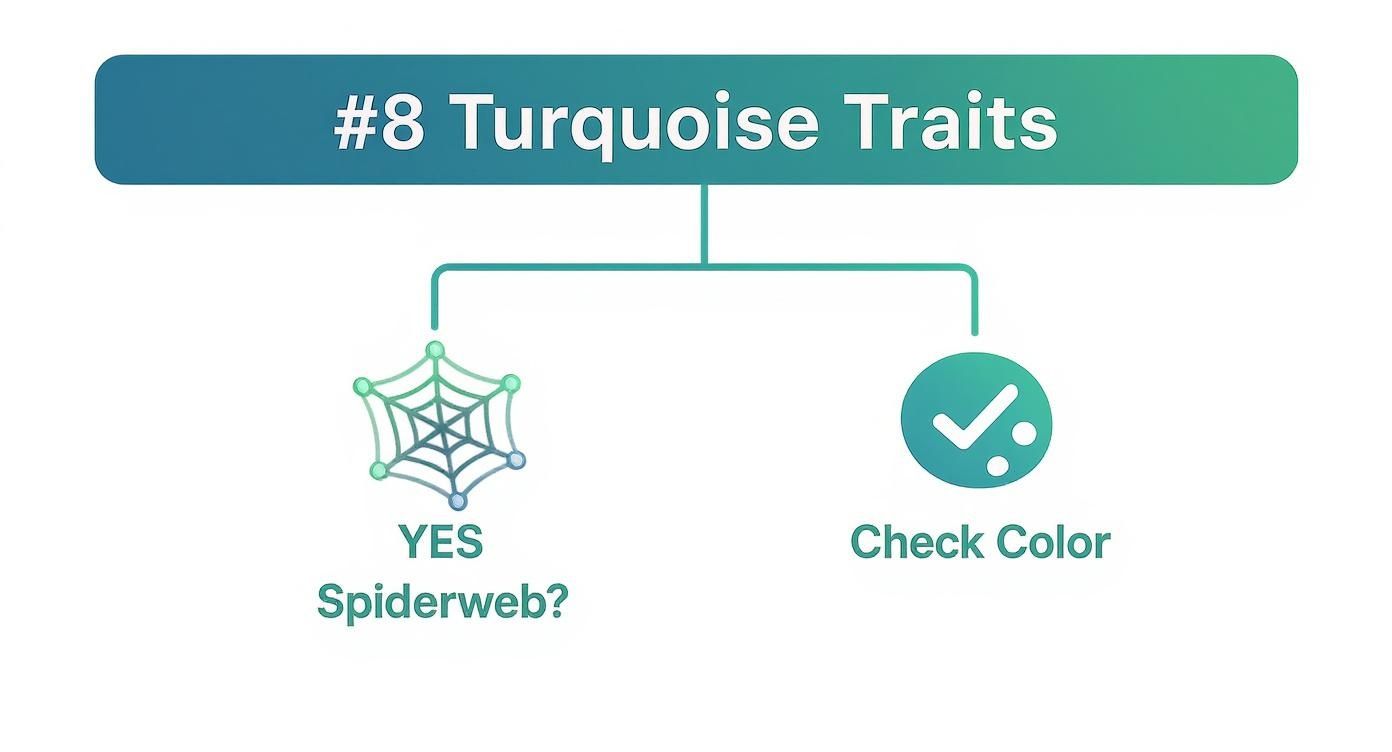
This visual guide breaks down the key traits to look for.
As you can see, it all comes back to that spiderweb matrix. Its presence and character are the primary identifiers for this coveted American gemstone.
A Practical Checklist for Buyers
Getting confident in your identification skills just takes practice. Whether you’re a seasoned collector or buying your first piece, keeping a mental checklist handy is a game-changer. Use these points to guide your eye as you assess any potential #8 turquoise.
Analyze the Matrix Pattern: Look for that natural, intricate spiderweb. Does it vary in thickness? Does it flow organically? Patterns that look too repetitive or printed are a major red flag.
Assess the Color Depth: Check the stone for subtle variations in its blue and green tones. A totally flat, uniform color is suspicious.
Check the Surface Luster: Real turquoise has a waxy to subvitreous luster—think of the sheen on a candle. Fakes made from plastic or resin might look overly glossy or feel strangely light in your hand.
Evaluate the Price: If a deal on #8 turquoise seems too good to be true, it absolutely is. Material from this mine is rare and highly sought after, and its price reflects that.
Learning to see these little details is what makes collecting so rewarding. To build on these skills, our crystal identification guide offers broader tips that apply to all sorts of minerals. For a deeper dive, you can also explore external guides on understanding gemstone quality, as many of the principles for assessing color and clarity carry over.
In the end, though, the surest way to add a genuine piece of #8 turquoise to your collection is to buy from a reputable dealer who can guarantee its provenance.
A Guide to Collecting and Investing in #8 Turquoise
Collecting #8 turquoise is more than just acquiring a beautiful stone; it's like owning a piece of American history. With the mine now closed, every single piece is part of a finite and dwindling supply. This built-in rarity makes it a fascinating area for both new enthusiasts and seasoned collectors, especially when looking for a gift that will appreciate in value for special occasions like Mother's Day.
Practical strategies for collecting can be broken down by experience level and budget. If you're just starting your journey, a fantastic entry point is with smaller, high-quality cabochons. These pieces beautifully showcase the mine’s signature look without the price tag of a larger specimen, helping you learn what to look for in other rare minerals, from labradorite to fossil plates.
Understanding Market Value
The value of any #8 turquoise specimen boils down to a combination of key factors. Getting a handle on these elements is absolutely crucial for making smart purchases. Not all #8 turquoise is created equal, and even subtle differences can translate to significant swings in price.
The main drivers of value include:
The Matrix: A tight, intricate spiderweb in a desirable color like black or golden-brown is the holy grail. The more dramatic and balanced that webbing is, the higher the value climbs.
The Color: Rich, deep sky-blue hues are generally far more valuable than lighter, chalkier tones. Ideally, the color should be vibrant and consistent across the entire stone.
Size and Provenance: Larger stones of top quality are exceptionally rare. On top of that, a clear history or provenance—especially if the stone was part of a known collection—can seriously increase its worth.
For collectors, the goal is often to find a stone that perfectly balances these attributes. A smaller stone with a perfect matrix may be more valuable than a larger one with a less distinct pattern.
Beyond its beauty, many people are drawn to #8 turquoise as an investment. This is especially true during peak shopping seasons like Black Friday and Cyber Monday, when collectors look for rare additions.
Investment-Grade Stones and Artisan Jewelry
For serious investors, the focus sharpens to top-tier, natural (unstabilized) stones that boast impeccable matrix patterns and deep, saturated color. These "gem-grade" pieces are the rarest of the rare and command the absolute highest prices. They're often sold as standalone specimens or are set aside for the finest artisan jewelry.
This brings us to another vital aspect of value: craftsmanship. A spectacular piece of #8 turquoise can have its value elevated dramatically when it's set by a master jeweler. An artist’s skill can transform the stone from a geological wonder into a wearable work of art, adding a layer of human history to its natural story. When you're collecting, always consider the quality of the setting and the reputation of the artist.
Finally, you can't overstate the importance of sourcing. Turquoise is mined all over the world, but the American Southwest is renowned for its premium material. Understanding these geographic origins helps collectors truly appreciate the unique qualities of material from the #8 turquoise mine.
Proper Care for Your #8 Turquoise Treasures
Owning a piece of #8 turquoise is a bit like being the custodian of a small, irreplaceable artifact. It’s a relatively soft and porous stone, ranking between a 5 and 6 on the Mohs hardness scale, so it needs mindful handling to keep it looking its best. Unlike tougher gems like quartz or agate, turquoise is vulnerable to everyday substances that can alter its color and integrity over time.
Chemicals are its primary enemy. Think about common household cleaners, hairspray, perfumes, and even lotions—they all contain ingredients that can seep into the stone's porous surface and cause discoloration. That’s why the first rule of turquoise care is simple: your jewelry should always be the last thing you put on and the first thing you take off.
The Do's and Don'ts of Turquoise Maintenance
Keeping that vibrant color and intricate matrix looking incredible comes down to a few simple, yet crucial, habits. Follow these guidelines, and your #8 piece will remain a stunning part of your collection for generations.
Crucial Do's:
Wipe it down: After wearing your turquoise, gently wipe it with a soft, dry cloth. This quick step removes any skin oils that can build up and dull the stone's natural luster.
Store it thoughtfully: Always keep your turquoise jewelry in a separate pouch or a lined box. This prevents it from getting scratched by harder gemstones.
Critical Don'ts:
Never use chemical cleaners: Stay away from ultrasonic cleaners, steam cleaners, and any kind of jewelry cleaning solution. These harsh methods can strip the stone of its natural oils or even damage the stabilization treatment.
Avoid water immersion: Don’t wear your turquoise jewelry while swimming, showering, or even washing dishes. Prolonged exposure to water, especially chlorinated water, can be seriously damaging.
The safest and most effective way to clean your #8 turquoise is with a soft cloth, slightly dampened with water if necessary. Never use soap or detergents. Just gently wipe the surface and dry it immediately with a separate soft cloth.
Proper Storage for Lasting Beauty
How you store your turquoise is just as important as how you clean it. Because it’s a softer mineral, it can be easily scratched by harder stones like diamonds, sapphires, or even the metal settings of your other jewelry. The best solution is to give each piece its own space.
A dedicated jewelry box with individual, fabric-lined compartments is perfect, but even tucking each item into its own soft pouch will do the trick. For collectors who want to put their specimens on display, a quality rock collection display case not only protects the stone from dust and accidental bumps but also helps create a more stable environment, shielding it from direct sunlight that can cause the color to fade over time. These simple steps ensure your investment from the historic #8 mine remains as beautiful as the day it came out of the earth.
Got Questions About #8 Turquoise?
When you're diving into the world of classic American turquoise, a few questions always pop up, especially with a stone as legendary as #8 turquoise. Let's clear up some of the most common ones so you can collect with confidence.
Is the #8 Turquoise Mine Still Open?
This is the big one, and the short answer is no. The #8 Turquoise Mine near Carlin, Nevada, officially stopped its major turquoise operations back in 1976. The property was later repurposed for gold mining, which put a definitive end to its life as a turquoise producer.
That closure is exactly what makes this material so rare and valuable. Every single piece of authentic #8 turquoise you see today comes from a finite, historical supply that was pulled from the ground decades ago. It's like owning an irreplaceable piece of American mining history.
What’s the Big Deal About the #8 Spiderweb Matrix?
Plenty of mines produce turquoise with webbing, but the spiderweb matrix from the #8 mine is in a league of its own. Its signature look is a delicate, intricate web of golden-brown to black chert running through a backdrop of sky-blue turquoise.
What really gets collectors excited is that stunning contrast between the vibrant blue and the dark, tangled matrix. High-grade #8 spiderweb is considered some of the most beautiful turquoise in the world—it honestly looks like a piece of abstract art made by nature.
How Do I Know if My Turquoise is Really From the #8 Mine?
Authenticating turquoise from a specific mine can be tricky without a trained eye, since looks can sometimes overlap with stones from other Nevada mines. But there are definitely ways to protect yourself.
The absolute best way is to buy from a reputable dealer who specializes in American turquoise. Someone who can guarantee where the stone came from is your greatest asset. Building a relationship with a seller you trust is invaluable in this hobby.
You can also start training your own eye. Spend time looking at photos of authenticated #8 turquoise. Get familiar with its specific range of blues and the unique, often very fine, spiderweb patterns. Over time, you’ll develop a gut feeling for its signature look, which is the first step toward identifying it on your own.
At Astro West, we take pride in offering ethically sourced and expertly authenticated minerals from across the globe. Explore our curated collection to find your own piece of natural history, from the legendary #8 turquoise mine to stunning specimens of fluorite, aquamarine, and beyond.