A Guide to #8 Mine Turquoise and Its Spiderweb Matrix
Imagine a gemstone that perfectly captures the rugged soul of the American Southwest—a brilliant blue canvas shot through with an intricate, golden-brown web. That's the unmistakable magic of #8 Mine Turquoise, a stone that has become one of the most celebrated and sought-after varieties in the world. Its signature spiderweb matrix and incredibly limited supply make it a true prize for any serious collector.
Unveiling a Southwestern Treasure
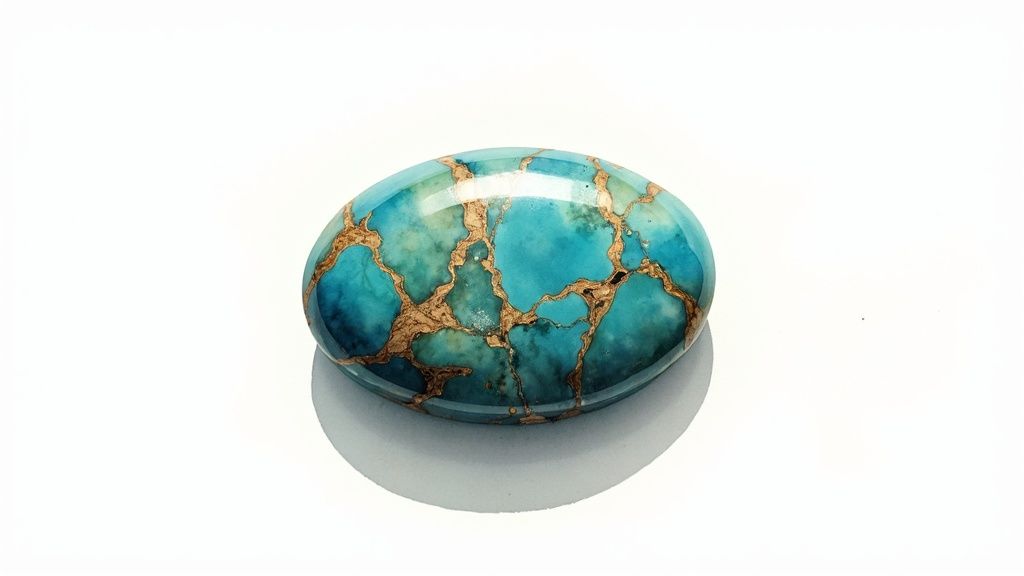
The powerful allure of #8 Mine Turquoise comes down to its one-of-a-kind visual fingerprint and its storied past. Hailing from a now-closed mine in Nevada, this turquoise is instantly recognizable. It’s famous for that signature spiderweb matrix, which can range in color from a warm golden brown to a stark, dramatic black, all set against a backdrop of soft blue to rich blue-green.
This intricate webbing isn’t a flaw; it's the stone's very identity. It ensures that every single piece is a unique work of natural art. Unlike the pure, uniform blue of something like Sleeping Beauty turquoise, the beauty of #8 is found in its complex, delicate patterns. This has made it a long-time favorite among artisans who want to create jewelry with undeniable character.
Here’s a quick rundown of what makes this turquoise so special.
#8 Mine Turquoise Quick Facts
Attribute
Description
Origin
Carlin, Nevada, USA
Primary Mining Years
1929 – 1980s
Color Palette
Light to medium blue, often with a greenish tint
Matrix Style
Distinctive spiderweb pattern
Matrix Colors
Golden brown, reddish-brown, dark brown, and black
Hardness (Mohs)
5-6 (Can be softer; often requires stabilization)
Rarity
High; the mine has been closed for decades
Distinguishing Feature
The combination of its light blue color and dark, intricate spiderwebbing is its most famous trait.
As you can see, the combination of its unique look and limited availability is what really sets it apart.
A Legacy Set in Stone
The #8 Mine was once one of the most productive and significant turquoise sources in the United States. Its output peaked in the mid-20th century, becoming a cornerstone for incredible Native American jewelry, especially within Southwestern communities. However, the mine’s closure in the 1980s due to various pressures abruptly cut off the supply of any new material. You can dive deeper into its place in turquoise history over at TurquoiseMuseum.com.
That closure instantly transformed #8 Mine Turquoise. It went from being a readily available gemstone to a finite, highly prized collectible. Every piece that exists today is a relic from a bygone era of American mining, which only increases its rarity and value over time.
This scarcity means collectors and jewelry lovers are always on the hunt for authentic specimens. Whether you're drawn to its striking appearance or its rich history, understanding what makes #8 special is the first step toward appreciating its true worth. If you want to see what high-quality, raw turquoise looks like, take a look at this stunning 245g Turquoise Specimen from our collection. This guide will walk you through everything you need to know about this legendary American gemstone.
The Story Behind the Legendary #8 Turquoise Mine
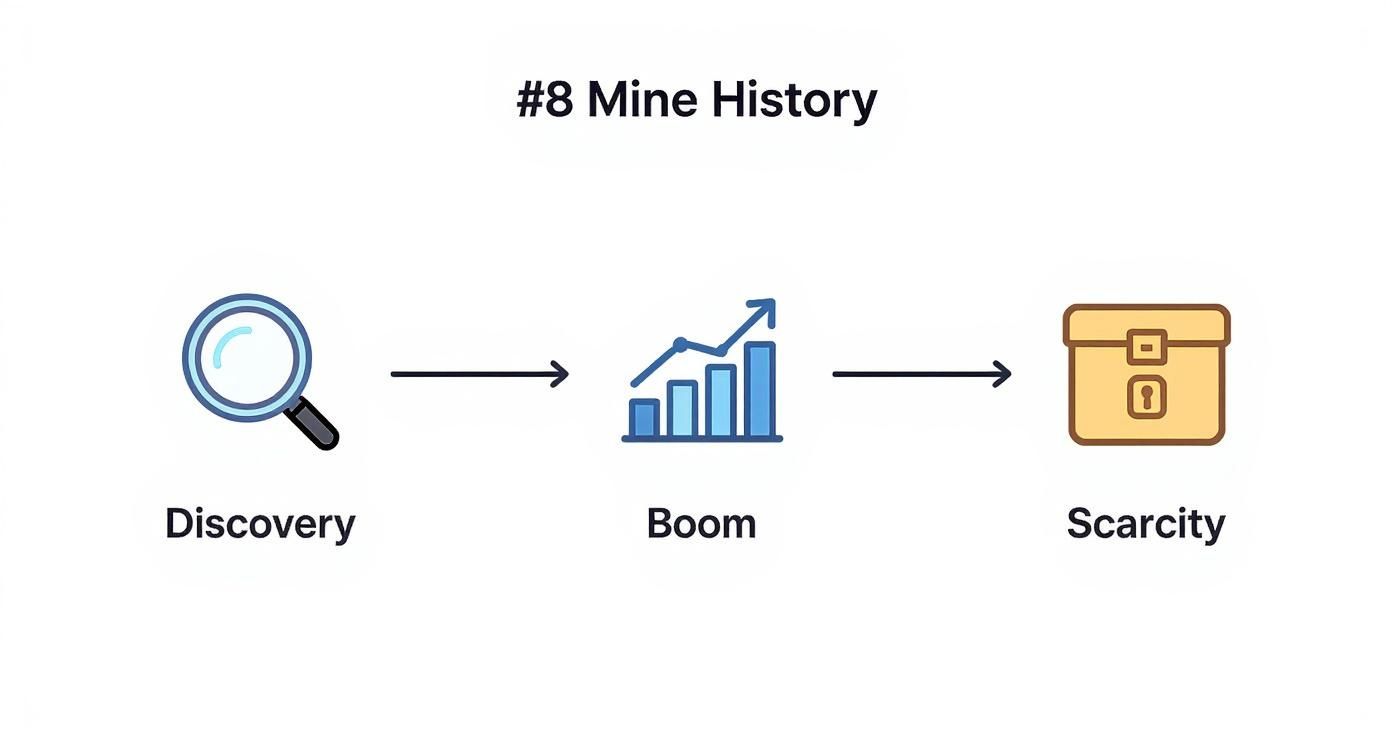
Every iconic gemstone has a story, and the tale of #8 Mine Turquoise is a classic American saga of discovery, boom, and eventual scarcity. Its journey begins not with a search for turquoise, but for gold and copper in the rugged Lynn Mining District of Eureka County, Nevada. In this bustling landscape, the brilliant blue stones were often just a surprising bonus.
The mine itself was formally established in 1929, taking its name from the original mining claim number. For years, this beautiful turquoise was simply a byproduct of the larger gold and copper operations. It didn't take long, though, for the exceptional quality of these stones to catch the eye of savvy traders and artisans.
A Rise to Fame
The mid-20th century was the golden era for #8 turquoise. As the demand for authentic Native American jewelry exploded across the United States, the mine ramped up production. Its signature golden-brown and black spiderweb matrix set against vibrant blue made it an absolute favorite among Zuni and Navajo silversmiths.
This period, from the 1950s through the early 1970s, truly cemented the mine’s reputation. It became one of Nevada's largest turquoise producers, churning out a massive volume of high-quality material that would go on to define an entire generation of Southwestern jewelry. The stone’s character was so distinct that it became instantly recognizable to collectors.
At its peak, the #8 Mine yielded a staggering amount of turquoise—over 1,600 pounds by some estimates. This huge output made it a cornerstone of the American turquoise market before its veins began to run dry.
But like all good things, this boom wasn't meant to last. Natural resources are finite, and the mine’s best days were numbered.
The End of an Era
By the mid-1970s, the most accessible, high-grade turquoise deposits at the #8 Mine had been tapped out. The cost and effort required to extract what little remained just didn't make sense, especially as the operation’s focus shifted back to more profitable metals like gold.
Turquoise production officially stopped in 1976. That closure marked the end of an era, and it fundamentally changed the stone's place in the market. Almost overnight, #8 turquoise went from being a beautiful, available material to a rare, historical artifact.
This sudden halt in supply is exactly why it's so valued today. Every genuine piece of #8 turquoise you see is a finite relic from a specific period in American mining history. The mine’s closure sealed its legacy, ensuring that each stone is not just a gem, but a tangible piece of the past—a collector’s item with a story etched right into its delicate, webbed matrix.
How to Identify Authentic #8 Mine Turquoise
With a market flooded with beautiful blue stones, learning to spot genuine #8 Mine turquoise is a crucial skill for any collector. This isn't about needing a gemology lab; it's about training your eye to recognize the unique artistic signature nature gave this specific stone.
Think of it like learning to identify a painter by their brushstrokes—#8 turquoise has its own distinct, recognizable style that sets it apart from the rest.
The first and most famous trait to look for is the spiderweb matrix. While other mines produce webbed turquoise, the pattern in #8 is often exceptionally fine and intricate. It looks like a delicate, dark web spun across a lighter blue canvas.
This journey from discovery to modern-day scarcity is what defines its value.
As the infographic shows, the mine's closure is what catapulted it into the rare, collectible status it holds today. This history is directly tied to both its identification and its market value.
Analyzing the Color and Matrix
The second key identifier for #8 Mine turquoise is its very specific color combination. The host stone typically features a color palette ranging from a light, soft sky blue to a deeper blue-green. This blue isn't usually as uniform or intense as turquoise from the Sleeping Beauty mine, nor is it as deeply green as some Royston varieties.
It’s the interplay between this specific blue and the matrix that creates the classic #8 look. The webbing itself appears in a characteristic range of shades:
Golden Brown: This is one of the most desirable and recognizable matrix colors.
Reddish-Brown: Often seen alongside darker shades, adding real warmth to the stone.
Dark Brown to Black: Provides a bold, dramatic contrast against the lighter blue.
A key takeaway for identification is that authentic #8 turquoise showcases natural, uneven patterns in its matrix. The webbing should look organic and intricate, not uniform or artificially perfect, which can be a dead giveaway for an imitation.
Distinguishing #8 from Other Turquoise
Building your confidence in identification really comes down to comparing #8 with stones from other famous mines. For instance, Kingman turquoise often has a bold, black matrix that's much less delicate than the fine webbing of #8. Morenci turquoise is famed for its iron pyrite matrix, which gives it a silvery, metallic sparkle that #8 typically lacks.
To sharpen your skills even further, exploring a comprehensive crystal identification guide can give you a broader context for comparing different minerals and their unique properties. It helps to understand what makes each type of turquoise—and other stones like lapis lazuli, malachite, or fluorite—visually distinct.
Ultimately, identifying authentic #8 Mine turquoise is about recognizing its unique combination of light blue coloration and that fine, dark, spiderweb matrix. By familiarizing yourself with these signature traits, you can learn to spot this rare piece of American mining history with much greater confidence and truly appreciate the subtle details that make it so prized.
Understanding the Value and Rarity of This Gemstone
So, why does #8 Mine turquoise command such a high price tag? It really comes down to a perfect storm: a tiny supply, jaw-dropping beauty, and a demand that just keeps growing. Unlike minerals still being pulled from the earth, the story of #8 turquoise has a final chapter. When the mine shut its doors for good in 1976, the stone instantly transformed from a jewelry component into a rare, tangible piece of American history.
That closure created a fixed, finite supply. Every single piece of genuine #8 turquoise you see today is all there will ever be, period. This fact alone makes it a true collector's item and is the primary driver behind its value, turning each stone into an investment in natural art.
Breaking Down the Grading Criteria
Not all turquoise from the #8 Mine is created equal. Gem experts look at a few key characteristics to figure out a stone's value, and understanding these will help you see what separates a good stone from a truly great one.
Color Saturation: The most prized stones pop with a vibrant, saturated light to medium blue. Paler, chalkier pieces are generally less valuable.
Matrix Intricacy: That signature spiderweb matrix is everything. A delicate, intricate, and sharply defined web in golden-brown or black is what everyone wants. Stones with a muddy or blurry matrix just don't have the same appeal.
Stone Size and Integrity: Finding large, intact cabochons of high-grade #8 turquoise is incredibly rare. The value shoots up exponentially with size, as long as the color and matrix quality are also top-notch.
The global turquoise market has changed a lot in recent decades, especially after major American mines like #8 closed down. This caused a huge drop in the total annual output of natural U.S. turquoise right as demand started to climb. As you can imagine, that scarcity sent prices for top-grade material soaring to levels several times higher than they were back in the 1980s.
The absolute best #8 turquoise specimens are those that strike a perfect balance between vivid color and a delicate, high-contrast spiderweb matrix. These top-tier stones are often called "gem grade" and represent the pinnacle of what the mine ever produced.
The shrinking supply of high-quality American turquoise has only amplified the value of stones from famous, now-depleted mines. It's a key reason why certain stones earn their "gem" status. To give you a bit more context, take a look at our guide explaining the differences between precious and semi-precious stones. Rarity, durability, and historical demand are what really separate the two.
Below is a quick breakdown of what makes a piece of #8 turquoise more or less valuable.
Factors Influencing #8 Mine Turquoise Value
Quality Factor
Low Value Indicator
High Value Indicator
Color
Pale, chalky, or washed-out blue
Vibrant, saturated light to medium blue
Matrix
Muddy, indistinct, or splotchy patterns
Fine, intricate, high-contrast spiderweb
Clarity
Dull surface, numerous pits or flaws
Hard, glassy luster with a smooth finish
Size
Small, thin, or fragmented pieces
Large, solid, well-proportioned cabochons
Treatment
Stabilized, color-treated, or backed
Completely natural and untreated
Understanding these factors helps you see why two stones from the same mine can have dramatically different price points.
An Investment in Natural Art
For #8 Mine turquoise, its well-documented history and finite supply elevate it far beyond just another pretty stone. It's a tangible asset with a proven history of appreciating in value. Collectors prize it not just for its unique look but for its locked-in scarcity, making it a crown jewel in any serious mineral or jewelry collection, perhaps as a special Valentine's Day or Mother's Day gift that gains value over time.
How to Properly Care for Your Turquoise
Owning a piece of #8 Mine turquoise is a true privilege, and taking good care of it is the best way to protect your investment. Unlike super-hard gemstones like diamonds, turquoise is a softer, more porous stone. This means it can actually absorb things from its environment—oils, chemicals, and liquids—which can slowly alter its stunning color over time.
Think of your turquoise as a living gem that responds to its surroundings. With a Mohs hardness of just 5 to 6, it's more susceptible to scratches from things you encounter every day, like keys in your pocket or even the metal settings on other jewelry. A little awareness and a simple care routine are all it takes to keep its natural beauty looking brilliant for decades to come.
Safe Cleaning Practices
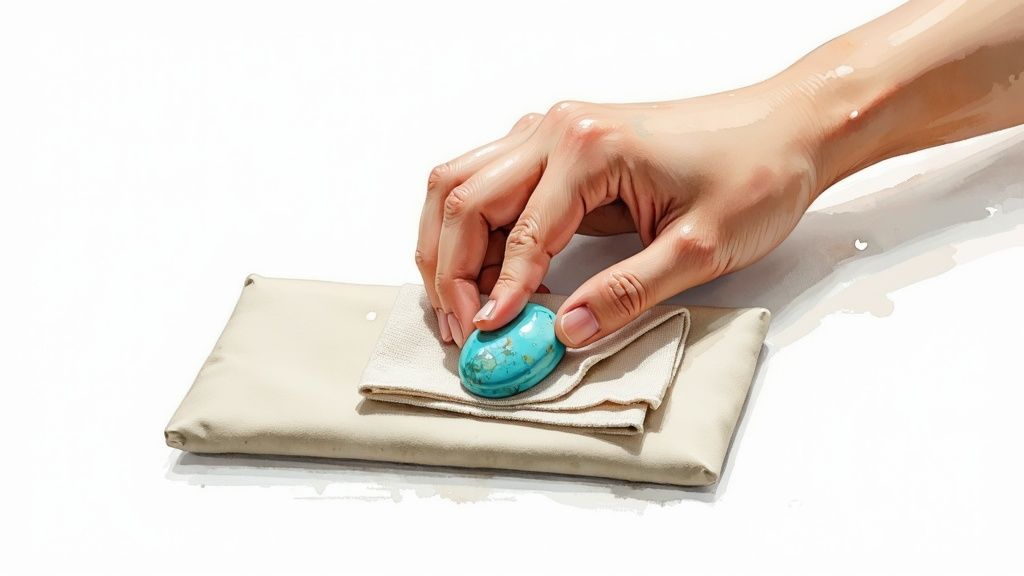
The best way to clean your turquoise is also the easiest. Forget about harsh chemical cleaners or anything abrasive; those will do more harm than good. Most of the time, all you need is a soft, dry cloth to gently wipe away any dust or oils after you've worn it.
For those times it needs a bit more attention, just follow these simple steps:
Dampen a soft, lint-free cloth with water that's about room temperature. Big temperature swings can put stress on the stone, so avoid anything too hot or cold.
Gently wipe the surface of the turquoise. Never, ever submerge the stone or the jewelry in water, especially if it has a backing material.
Immediately pat the piece dry with another soft, clean cloth. This prevents any water from seeping into the pores of the stone.
A good rule to live by is to make your turquoise the last thing you put on and the first thing you take off. This simple habit goes a long way in protecting it from cosmetics, perfumes, and hairspray.
What to Avoid at All Costs
Protecting your #8 Mine turquoise is really just a matter of knowing what it doesn't like. Because it's so porous, it’s highly sensitive to a few common things that can cause discoloration or even structural damage.
Make sure your turquoise stays far away from:
Chemicals: This means everything from household cleaners and chlorine to the chemicals found in your favorite lotions and perfumes.
Oils: Even the natural oils from your skin can gradually darken turquoise, which is why a quick wipe-down after wearing it is a great idea.
Heat and Sunlight: Leaving your turquoise in direct sunlight or exposing it to high heat can fade its color and make the stone brittle over time.
Ultrasonic Cleaners: The intense vibrations these machines create are way too aggressive for turquoise and can easily cause cracks or shatter the stone.
By keeping these simple guidelines in mind, you can effortlessly preserve the incredible color and intricate matrix of your cherished gemstone.
A Buyer's Guide to Collecting #8 Turquoise
Ready to add a piece of American mining history to your collection? Investing in #8 Mine turquoise takes a bit of a discerning eye, but once you know what to look for, you can make a purchase that's both confident and rewarding.
First things first: always try to verify the stone's origin. Don't be shy about asking the seller for provenance information. A reputable dealer will have the details on where the stone was sourced and will be happy to share them. You'll want to keep an eye out for that signature light blue color and the delicate, golden-brown spiderweb matrix that makes #8 so famous.
What to Look For in Quality Pieces
When you’re looking at a piece, you have to consider both the stone itself and the craftsmanship of its setting. Great metalwork will elevate the turquoise's natural beauty, while sloppy work can really take away from an otherwise gorgeous stone.
Stone Integrity: Look for a hard, almost glassy luster on the stone's surface. You'll want to avoid pieces that appear chalky or have a lot of pitting, unless it's clearly a natural part of a raw specimen.
Matrix Definition: The most coveted #8 turquoise has a sharp, high-contrast matrix. The webbing should look crisp and organic, not blurry or smeared.
Authenticity: This is a big one. Ask direct questions about any treatments. Has the stone been stabilized, color-treated, or backed? Natural, untreated stones are the rarest and, without a doubt, the most valuable.
As purveyors of fine and rare minerals, we're passionate about authenticity here at Astro West. We've always believed that an informed collector is a happy collector, which is why we encourage every buyer to ask plenty of questions and build up their expertise.
Developing your knowledge is truly the best tool you have. If you're just getting started, our guide on how to start a collection of rare rocks and minerals is a fantastic resource for building a solid foundation.
As you explore, you'll see how artists use this iconic stone in all sorts of creative ways. You might find unique interpretations, like an Ancient Alien Style Turquoise Tiger Eye Necklace, that showcase how beautifully turquoise can be blended with other gems.
Ultimately, the best way to learn is to see the real thing. We invite you to explore our curated collection to see stunning examples of genuine #8 Mine turquoise and other exceptional gemstones for yourself. With Black Friday and Christmas approaching, it's the perfect time to find a truly unique gift for a loved one—or a well-deserved treasure for yourself.
Got Questions About #8 Mine Turquoise?
When you start digging into the world of rare American turquoise, a few questions always pop up. It’s a fascinating corner of the gem world, so let's clear up some of the common queries about the legendary #8 Mine.
Does All #8 Turquoise Have That Spiderweb Pattern?
While the mine is famous for that incredible, intricate spiderweb matrix, not every single piece that came out of the ground had it. The #8 Mine produced a massive amount of turquoise over the years, and a lot of it was clear, non-matrix stone or had more blotchy, less-defined patterns.
That said, the high-grade, collector-quality material—the stuff that really built the mine's legendary reputation—is almost always the spiderweb variety. It's the signature look everyone hunts for.
Why Did the #8 Mine Even Close?
The mine stopped pulling out turquoise back in 1976. The main reason was simple economics: after decades of work, they had pretty much exhausted the best, most accessible turquoise veins. Getting to what was left became too expensive and impractical, especially since the bigger mining operation was focused on more profitable metals like gold and copper.
The mine's closure is the single biggest reason for the stone's rarity today. With no new supply coming to market, the existing #8 turquoise instantly became a finite, highly sought-after collectible. That's what has driven its value sky-high over the decades.
How Can I Be Sure My Turquoise Is Really from the #8 Mine?
This is the big one. Authenticating turquoise from a specific mine is tough without a seasoned expert, but there are definitely things you can do to protect yourself as a buyer.
Here are a few tips to keep in mind:
Buy from Dealers You Trust: An experienced dealer who lives and breathes American turquoise is your single best asset. They’ll have the expertise to identify the stone and give you the real story on its provenance.
Know the Telltale Signs: Get familiar with the classic #8 look. You're searching for that signature mix of light blue to blue-green color paired with a delicate, golden-brown or black spiderweb matrix. Compare any potential piece to verified photos of #8 turquoise to train your eye.
Ask About Its History: Don't be shy—inquire about the stone's background. While a complete paper trail is a rare luxury, a knowledgeable seller can often trace a piece through past collections or estates, giving you a clearer picture of its journey.
At the end of the day, building a relationship with a source you can rely on is the absolute best way to make sure you're adding a genuine piece of this historic American gem to your collection.
At Astro West, we believe collecting should be a journey of discovery, backed by confidence and expertise. Come explore our curated selection of rare and authentic minerals, from aquamarine to petrified wood, where every specimen tells a unique story of natural history.