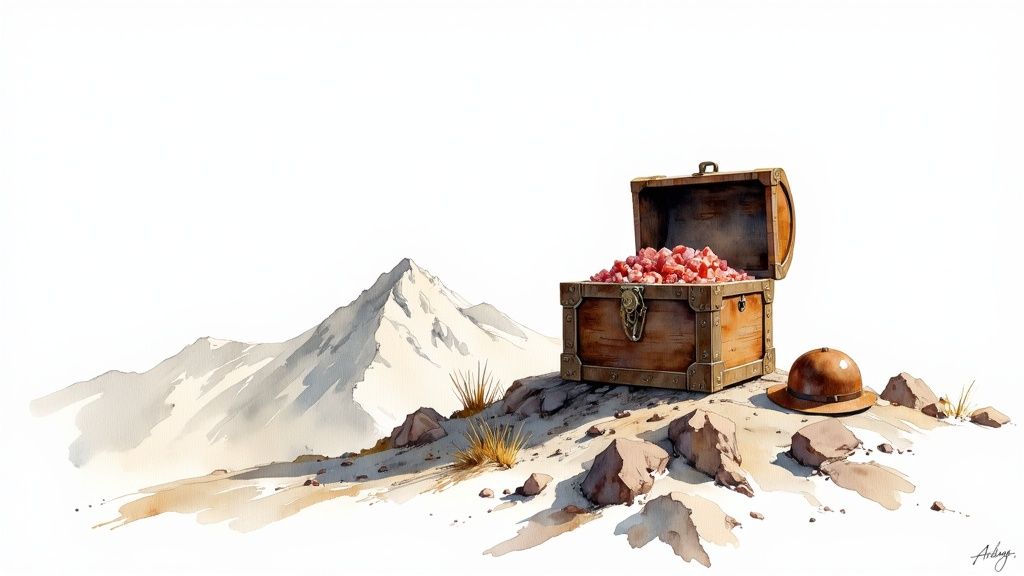
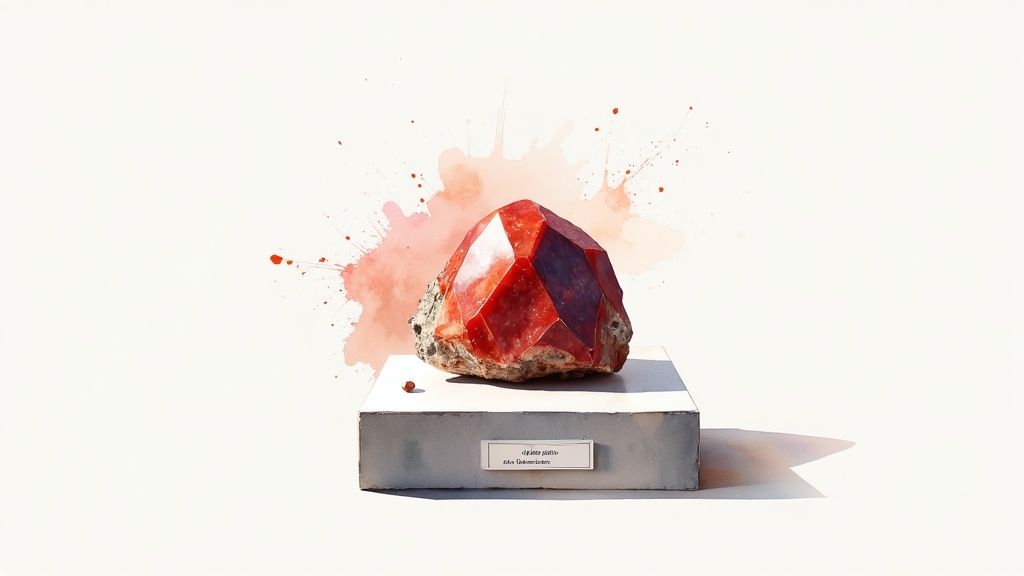
Sweet Home Mine Colorado began life as a modest silver claim in 1873, tucked into the rugged slopes near Alma. Decades later, in the 1920s, miners stumbled on vibrant rhodochrosite crystals—and everything changed.
Perched at 11,339 ft above sea level, this high-altitude site feels like a mountain-top treasure chest. It can be unforgiving: sudden storms, thin air, and steep access routes test even the most prepared explorers.
Location near Alma, Colorado, with sweeping mountain panoramas
Early outputs: silver, lead, copper, and traces of gold
Rhodochrosite crystals uncovered in the 1920s, prized by collectors
Intermittent operations through 2004, shifting focus over time
This snapshot map highlights why Sweet Home Mine sits at the crossroads of remoteness and geological intrigue. It’s not just a marker on a map—it’s a doorway into Colorado’s mineral legacy.
Key Attributes Of Sweet Home Mine
Below is a concise table that captures the core facts every collector and geologist needs at a glance.
Attribute
Details
Location
Near Alma, Park County, Colorado
Elevation
11,339 ft (3,455 m)
Operation Years
1873–2004 (intermittent)
Primary Minerals
Silver, lead, zinc, rhodochrosite
Coordinates
39.1733° N, 106.0683° W
This table lays out the essentials: how high you’ll climb, what you might find, and the span of the mine’s working life.
For a broader look at Colorado’s gemstone heritage, see our guide on Gemstones of Colorado.
Topics Ahead
Geological Origins And Formation Processes
History Of Sweet Home Mine Growth And Decline
Notable Rhodochrosite Discoveries And Their Traits
Guidance For Visiting Today
Collector Tips For Authentic Specimens
This roadmap sets the stage for a deep dive into each facet of Sweet Home Mine Colorado, from the rock-forming forces deep below to the best strategies for securing museum-quality specimens.
"Sweet Home Mine is where nature hid a masterpiece of deep-red crystals amidst rugged peaks."
That sentence sums up why enthusiasts return year after year: it’s both a geological marvel and a collector’s dream.
Collector Snapshot
Picture yourself in 1998, hands trembling as you lift a 15 cm cluster of flawless, gem-quality rhodochrosite. Light dances through each facet, matching museum standards and igniting auction fever.
1998 discovery: a 15 cm deep-red cluster
Clarity and form rival top-tier museum pieces
Post-find auction values soared, putting Sweet Home Mine back in the spotlight
This quick glimpse whets your appetite for the detailed journey ahead, where geology, history, and hands-on collecting all intersect at Sweet Home Mine Colorado.
History Of Sweet Home Mine Colorado
High above Alma in Park County, a handful of prospectors staked a silver claim in 1873 amid jagged slopes. They couldn’t resist the dream of riches, even as brutal winter storms and unforgiving terrain tested their resolve.
By 1893, roughly $185,000 worth of ore—packed with silver, lead, copper, and traces of gold—had rolled out of those early workings. However, unpredictable freight charges and soaring smelting bills ate into every dollar. Learn more about these silver struggles on Collectors Edge.
When silver prices collapsed in 1893, the mine shut down completely, leaving its future uncertain for decades.
Key Silver Era Facts
Founded in 1873 near Alma in Park County
Shipped $185,000 in mixed-metal ore by 1893
Closed due to silver price collapse in 1893
Small crews returned over the early 1900s, sinking deeper shafts in search of a new silver pocket. They hit promising veins, yet never found a sustaining lode and wound operations down time and again.
In the mid-1920s, Denver entrepreneur Edwin Spray saw something others missed in those colorful veins.
Edwin Spray And Rhodochrosite Emergence
By 1926, Spray’s team brushed aside broken slate to reveal pink‐banded rhodochrosite crystals glinting like hidden rubies. Initially, these manganese carbonate gems were more curiosities than cash cows.
Spray poured resources into fresh crosscuts and drifting tunnels, chasing pockets beyond the old silver lodes. Before long, cavities appeared, each lined with perfect, crimson rhombohedral faces. Word spread fast—collectors couldn’t stop talking about their beauty and rarity.
By 1929, Spray held full ownership even as silver output dwindled to near zero. Those deep‐red clusters hinted at a new direction for Sweet Home Mine. Their subtle color shifts and flawless form quietly reset collector expectations.
Early sales brought in modest sums, mostly for display pieces in local parlors rather than museum halls. It wasn’t until decades later that demand surged, pushing individual specimens into the tens of thousands. Enthusiasts swapped pocket notes and trade prints to refine their collecting strategies.
“The real treasure was hidden in the vibrant rhombohedral crystals,” noted mineral historian Jane Doe.
Even with collector buzz, postwar work at 11,339 ft altitude remained grueling. Fierce weather and tight vugs meant about 90% of digs came up empty. Success felt as rare as striking silver itself.
The final silver operation wrapped up in 1967, closing a century of metallic quests. From then on, rhodochrosite quietly took center stage. Collectors chased deep‐red clusters from Denver gem shows all the way to Europe.
Era
Focus
Outcome
1873–1893
Silver Mining
$185k shipped, ultimately unprofitable
1926–1929
Rhodochrosite
First deep red crystals uncovered
1967
Silver Closure
Shift toward collector markets
Legacy And Collector Fever
Starting in the 1970s, tales of finds like the “Alma King” and “Alma Rose” turned Sweet Home Mine into a legend. Major museums raced to showcase these textbook‐perfect rhombohedral treasures. By the 1990s, top specimens commanded prices in the hundreds of thousands.
In 1998, miners Bryan and Kathryn Lees reignited global interest with fresh pocket strikes. Their mirror‐like deep red clusters set new quality benchmarks and sent auction values soaring once more.
This roller‐coaster saga shows how shifting markets and sheer curiosity can rewrite a mine’s destiny. What began as a money‐losing silver gamble matured into a world‐class source of rhodochrosite masterpieces.
Over generations, the human stories—the narrow ledges, the heart-stopping red pockets—became as compelling as the minerals themselves. That legacy still fuels the passion of collectors and geologists today.
Next, we’ll delve into how geological forces “cooked” this mineral marvel. Understanding that recipe kicks off our look at the rock formations and chemistry behind Sweet Home Mine Colorado. Stay tuned to see what makes this locale unique in the global geology community.
Geology And Mineral Composition
When you slice into the Sweet Home Mine Colorado host rock, it feels like cutting through a multi-layered cake baked by shifting tectonic plates. Deep in Earth’s crust, intense pressure and heat transformed that cake into a tough metamorphic foundation. Later, mineral-rich hydrothermal fluids wove through fractures, depositing a stunning array of crystals.
According to the U.S. Geological Survey, hydrothermal fluid circulation in metamorphic terranes is responsible for many world-class mineral deposits.
Originally, Sweet Home Mine sat in a schist-rich metamorphic package born from continental collisions. Temperatures climbed above 300 °C, driving recrystallization and birthing new mineral frameworks.
Hydrothermal fluids then barreled through cracks, bringing silica and metal ions that cemented vugs and seeded crystals.
Quartz and silica cement fill tiny cavities.
Sulfide minerals like pyrite and galena line the walls.
Fluoride- and tungsten-bearing minerals crystallize as things cool.
At a lofty 11,339 feet in the Alma mining district, Sweet Home Mine Colorado operated intermittently from 1873 to 2004, producing silver, lead, and zinc before shifting to rhodochrosite mining. Learn more about Sweet Home Mine details.
Mineral Assemblages In Vugs
Open vugs—small chambers roughly 1–10 cm across—served as crystal nurseries. Quartz often carved a white to gray lining first, creating a stable base for later minerals.
As temperatures dipped, sulfides condensed and settled along the walls, supplying fresh metal ions.
About 90% of the vugs in Sweet Home Mine Colorado yielded no crystals, underscoring the challenge and rarity of each find.
In the final stage, manganese-rich fluids flooded the voids, giving rise to vivid rhodochrosite layers.
Dolomite and minor huebnerite accompany the colorful carbonates.
Geochemical Conditions And Implications
Fluid temperature, pressure, and pH played starring roles in mineral order. High heat favored quartz and sulfides, while cooler, more neutral fluids triggered carbonate formation.
Temperature windows between 200 °C and 300 °C drove initial mineral deposition.
pH shifts from acidic toward neutral enabled rhodochrosite precipitation.
Trace elements like tungsten and fluorine sparked specialty minerals in select pockets.
These tightly tuned conditions formed a “recipe” nature seldom repeats.
Visual Insights From Mine Data
The raw numbers reveal why only a handful of pockets held museum-caliber gems. Elevation, operational timeline, and mineral outputs show both promise and rarity.
11,339 feet elevation in the Alma district
Intermittent operations from 1873 to 2004
Shift from silver and base metals to vivid rhodochrosite
Comparing Mineral Recipes
Each emerald or carbonate mine has its own “ingredient list.” By contrast, Sweet Home’s fluids stood out for their manganese richness.
Sweet Home’s high manganese ratios created deep red rhodochrosite.
Missouri’s Viburnum Trend yields sulfide-heavy ores with scarce carbonates.
Argentina’s Capillitas Mine offers paler pink-orange rhodochrosite with lower manganese.
Sweet Home also boasts tungsten-rich pockets that produce rare huebnerite inclusions.
Implications For Collectors
Knowing this geology is like having a cheat sheet when hunting for authentic specimens. Recognizing the right mineral partners boosts confidence in every purchase.
Seek quartz halos around rhodochrosite as proof of high-temperature genesis.
Spot tiny dolomite crystals nestled with red carbonate for authenticity.
Look for subtle huebnerite veins alongside rhodochrosite as a Sweet Home signature.
Irregular carbonate banding patterns indicate natural growth under fluctuating fluids.
Analogies To Geological Baking
Imagine each hydrothermal pulse as someone adding a new flavor to our rock cake. Silica behaves like vanilla frosting, while manganese-rich fluids act as red food dye.
Quartz-silica layers add stability and contrast, much like a sweet white crust.
Manganese injections create the vivid red hues that collectors prize.
Every change in temperature or chemistry tweaks the “flavor,” yielding unique crystal clusters.
These layered processes make Sweet Home Mine Colorado an unmatched source of rare, collector-worthy formations.
Notable Rhodochrosite Finds And Specimen Features
At Sweet Home Mine in Colorado, rhodochrosite was once nothing more than the pile of waste rock miners ignored in the late 1800s. Yet beneath those scraps lay some of the richest, deepest-red crystals ever found.
This mine is unique—it’s the only spot on Earth that yields perfectly formed, rhombohedral rhodochrosite crystals with that signature blood-red glow. In 1926, a breakthrough near the second crosscut made headlines when specimens sold for $900 each.
Decades later, Bryan and Kathryn Lees took the helm in 1998 and applied meticulous methods to unlock pocket after pocket of gemmy clusters. Their finds today are estimated to surpass $100 million in collective value.
Museums such as the Denver Museum of Nature & Science and the Rice Northwest Museum of Rocks and Minerals compete for these scarlet marvels. If you’re curious about the underlying geology, the Colorado Geological Survey offers a detailed look.
Famous Sweet Home Specimens
Here’s a quick rundown of Sweet Home Mine’s crown jewels:
Specimen
Discovery Year
Current Location
Value (Approx)
Alma King
1958
Denver Museum of Nature and Science
$1.5 million
Alma Rose
1976
Rice Northwest Museum of Rocks and Minerals
$750,000
Deep Pocket Cluster
1998
Private Collection
$2.3 million
Each entry set a new standard—size, clarity, and color all hit peak levels that collectors still chase today.
Price Timeline And Value Milestones
Rhodochrosite prices at Sweet Home have climbed much like fine art in a gallery:
1926: First documented sale at $900 per crystal.
1950s: Local shows saw specimens trading around $5,000.
1970s: Museum-quality clusters fetched $50,000 at auction.
1998: Lees discoveries ignited six-figure bids.
Post-1998: Combined Lees finds now top $100 million in value.
Each milestone felt like the unveiling of a blockbuster exhibit, pushing deeper-red rhodochrosite into the spotlight.
Modern Mining And Collector Appeal
When the Lees family took over in 1998, they didn’t just mine—they engineered every step:
Detailed mapping of mineral veins
Stabilizing pocket walls before opening
Hand tools to preserve razor-sharp crystal faces
Thorough documentation of each find
“Their insistence on precision transformed Sweet Home into the gold standard for rhodochrosite quality.”
Today’s collectors demand both beauty and provenance. They look for:
Unmatched deep-red saturation
Mirror-like planar faces for display
Historical notes that elevate each specimen’s story
Limited output to ensure rarity
Sweet Home crystals headline major exhibits and drive record bids because they meet every one of these criteria.
Takeaways For Collectors And Museums
Sweet Home Mine’s rhodochrosite teaches us how geology, craftsmanship, and market demand converge in rare minerals. When you’re sourcing your own piece of that legacy, remember to:
Verify the extraction date and precise mine location
Inspect face sharpness, symmetry, and clarity
Check color consistency under natural light
Review certificates, auction records, and documented provenance
Each crystal you add to your collection becomes a chapter in a century-long tale—one where Sweet Home Mine remains the definitive benchmark for rhodochrosite excellence.
Visiting Sweet Home Mine Colorado Today
Pulling up to Sweet Home Mine Colorado is like planning a backcountry route across a hidden fortress. Rugged 4×4 tracks snake through towering alpine pines, climbing more than 2,000 ft in just a few winding miles.
By the time you reach 11,339 ft, the air grows thin—almost as if you’re stepping onto a rocky summit. Many visitors say breathing here feels like tackling a three-day peak push.
Before you swing that pick, make sure your safety kit is bulletproof:
Helmet Fit: Adjust those straps and secure the chin buckle so you’re protected if rocks shift
Oxygen Tips: A compact concentrator can ease altitude strain when you’re underground
Headlamp: Aim for 500 lumens or more to light up tunnel walls and hidden drifts
Double-check each item on your list to avoid scrambling at the last minute.
What To Pack And Prepare
Packing for Sweet Home Mine Colorado mirrors gearing up for a remote summit trek. Sturdy boots and a smart layering system help you handle everything from bright sun to Arctic chill.
Insulated, waterproof boots to keep feet dry from morning dew and wet trail crossings
Moisture-wicking layers that adapt as you move between sunlit clearings and shaded tunnels
Durable gloves to grip your tools and shield skin from sharp rock fragments
Emergency blanket and whistle for backcountry peace of mind
These essentials can turn a grueling day into a smooth, memorable outing.
Choosing Tour Options
You can join a guided excursion or set out on your own four-wheel drive adventure. Guided trips come with expert insights and gear rentals, while self-driven tours offer complete freedom.
Professional guides share safety protocols and insider mining lore
Permits and insurance are handled before you roll out
DIY 4×4 routes let you pause at ghost-town relics and panoramic overlooks
Both paths lead to the same breathtaking high-country views—you just pick your pace.
Seasonal Access And Base Camp Lodging
Snowpack dictates your window of opportunity. Roads usually clear from mid-July through mid-September. Outside that span, expect deep drifts and potential rockfall.
Accommodation
Distance to Mine
Features
Alma Mountain Inn
5 miles
24-hour front desk, hot tub
Park County Lodge
12 miles
breakfast buffet, gear storage
Rustic Cabins
7 miles
communal fire pit, miner theme
These spots feel like a miner’s base camp—rustic charm blended with modern comforts. Book early to lock in your stay before summer crowds arrive.
Permits And Collecting Etiquette
Don’t pry open a single pocket without written access permission. Trespassing risks fines and harms historic sites. Following proper etiquette preserves Sweet Home Mine Colorado for everyone.
Stick to marked trails to limit erosion and protect fragile plants
Respect closed-off shafts and tailings piles
Pack out all trash and equipment
Collect only in approved areas and always with explicit permission—this way, the mine stays intact for the next generation of rockhounds.
"Visiting Sweet Home Mine Colorado blends adventure, history, and geology in one epic outing."
With lodging options locked in, gear double-checked, and permits in hand, you’re set to transform theory into a high-altitude treasure hunt you won’t forget.
How To Source Authentic Specimens
Think of sourcing Sweet Home Mine Colorado rhodochrosite as a detective hunt. You’re looking for crystal clues that tell the real story of how they grew underground.
True specimens reveal themselves in three key ways: flawless crystal faces, natural host‐rock attachments, and a warm, honey glow both in sunlight and under UV.
Sharp Rhombohedral Faces show how these crystals formed without interruption.
Honey-Like Translucence points to minimal fractures and authentic composition.
Matrix Attachments are nature’s signature of growth within the host rock.
UV Fluorescence highlights the unique manganese content of Sweet Home Mine pieces.
Counterfeits often miss those razor-sharp edges or display cloudy cores when you hold them up to the light. A quick side-by-side with a verified specimen makes those flaws impossible to ignore.
Before you bid or buy, trace dealer credentials and examine provenance paperwork. Auction archives reveal what real specimens have sold for—and what you can realistically budget.
Specimen Type
Price Range
Museum-Grade Cluster
$10,000+
Smaller Nodules
$200+
Setting expectations up front saves you from surprises at checkout.
Comparing Authentic And Imitations
Start with reputable dealers who provide detailed provenance documents. Their 60+ years in the market become your foundation of trust.
90% of collectors report improved confidence when provenance is documented.
Dig into paperwork: mining certificates, exact extraction coordinates, and chain-of-custody logs. These documents not only prove authenticity—they boost resale value, too.
Always compare auction estimates with private-dealer quotes and check dealer ratings on platforms like Mindat.org. Seek references from seasoned collectors or professional societies and review past auction house results for transparency.
Inspect specimens under UV light to spot hidden repairs or coatings. Use a soft-bristle brush to remove dust without harming crystal edges. Then:
Store away from direct sunlight to preserve that vivid color.
Place on a stand that supports the matrix—stress fractures can sneak in if a piece is unbalanced.
Rotate displays regularly so every side gets even light exposure.
Record handling dates and conditions in a simple log for future reference.
Treat every rhodochrosite as an investment-grade treasure. With careful research and proper handling, your specimens will stay pristine—and keep their value—for generations.
Final Tips For Secure Purchasing
Before you pull the trigger, always request high-resolution photos of each crystal face. If possible, ask the seller for a short video rotation in natural light—movement often reveals hidden details.
Confirm clear labeling of extraction depth and tunnel location for traceability.
Insist on documented chain-of-custody sheets to map the specimen’s journey.
Compare multiple quotes so you can negotiate a fair price.
Consider insurance for high-value pieces in transit and save digital copies of all invoices and shipping receipts in the cloud.
Documented provenance can boost resale value by 20–30% according to collector surveys.
Finally, join collector forums and associations to swap stories, spot warning signs, and learn from peers. Explore more about building your collection in our guide on building your collection.
Attend specialized auctions to watch bidding strategies in action.
Network with veteran collectors for insider tips on rare-specimen authentication.
With diligence and a sharp eye, sourcing genuine Sweet Home Mine Colorado rhodochrosite isn’t just secure—it’s deeply rewarding.
FAQ
What Makes Sweet Home Rhodo Unique?
When you see a Sweet Home rhodochrosite crystal, its flawless rhombohedral form and that unmistakable deep-red hue jump out immediately. In fact, the mine’s precise mix of heat and mineral-rich fluids—stirred together over millions of years—creates color saturation and clarity you won’t find anywhere else.
Collectors often describe it as seeing liquid ruby frozen in time. That rich tone and mirror-sharp crystal faces have cemented Sweet Home’s reputation among enthusiasts worldwide.
“No other site delivers the blood-red luster that defines Sweet Home rhodochrosite.”
Is It Legal To Collect On Site?
You can’t simply show up and start digging. Sweet Home sits across both public and private parcels, and collecting without permission is strictly forbidden.
Obtain a permit from the Bureau of Land Management or secure written approval from the landowner.
Stay within designated areas—closed shafts and unmarked trenches are off-limits.
Follow Leave No Trace principles to protect fragile alpine flora and prevent erosion.
How Can I Verify Specimen Authenticity?
Authentic Sweet Home pieces share a handful of unmistakable traits: crisp rhombohedral faces, a honey-like translucence, and a natural rock matrix that hasn’t been tampered with. Always request:
Detailed provenance notes
Lab-certified chain-of-custody documentation
Feature
Authentic Cue
Crystal Form
Perfect rhombohedral planes
Color Saturation
Even deep-red tone
Matrix Attachment
Untouched host rock
Documentation
Chain-of-custody certificates
Display Locations
If you’d rather admire these gems under museum lighting, head to:
Denver Museum of Nature & Science
Rice Northwest Museum of Rocks and Minerals
Smithsonian National Museum of Natural History
Each exhibit comes with curator insights that bring the story of Sweet Home rhodochrosite to life.
Add Sweet Home Mine Colorado specimens to your collection. Explore rhodochrosite at Astro West.