Think of the Earth as a natural historian, constantly writing down its own story. If that's the case, then sedimentary rocks are its ancient storybooks. These are the rocks formed from layers of sand, silt, mud, and even the remains of ancient life, all pressed together over millions of years.
They’re essentially Earth's scrapbook, preserving moments in time within their distinct, tell-tale layers.
Understanding Earth's Natural Storybooks
Sedimentary rocks are one of the three main rock types, standing alongside their fiery cousins, igneous rocks, and their transformed relatives, metamorphic rocks. But unlike rocks born from molten magma or forged by intense heat and pressure, the story of sedimentary rock is a much gentler tale of accumulation.
Picture dust settling on a bookshelf over years—it’s a similar idea, just on a geological scale. The process begins with particles like sand, pebbles, and shells, collectively known as sediment.
This sediment gets carried and deposited by wind, water, or ice. Over immense spans of time, the sheer weight of new layers piling on top compacts the older sediment below. Water seeps through these packed layers, carrying minerals that act like a natural cement, binding the loose particles into solid stone. This whole transformation from loose sediment to solid rock is called lithification. For a deeper dive into these core concepts, our resources on geology basics are a great place to start.
Why Sedimentary Rocks Are So Widespread
This unique method of formation explains why you can find sedimentary rocks almost everywhere you look. According to data from the U.S. Geological Survey (USGS), they cover approximately 73% of the Earth's current land surface.
While they don't make up a huge chunk of the Earth's crust by volume, they form a thin but incredibly expansive layer over the continents where we live. It’s the stage upon which much of life's history has played out.
The most incredible feature of sedimentary rocks is their ability to hold onto the past. Because they form in relatively cool, low-pressure environments, they are the only type of rock that can preserve fossils, giving us a direct window into ancient life and forgotten climates.
Their layered structure, called strata, is like a timeline written in stone. Each layer tells a story about the world at the time it was formed. A sandy layer might point to an ancient desert or beach, while a layer of fine-grained shale tells of a quiet, muddy seabed from long ago.
To help you quickly identify these story-filled rocks, here’s a simple breakdown of their defining features.
Key Characteristics of Sedimentary Rocks at a Glance
Characteristic
Description
Example
Layered Appearance (Strata)
Distinct, often horizontal layers are visible, showing different periods of deposition.
The colored bands in the Grand Canyon.
Presence of Fossils
Can contain preserved remains of plants, animals, or other organisms.
A shell fossil embedded in limestone.
Composed of Particles
Made from fragments (clasts) of other rocks or organic matter cemented together.
Sandstone feels grainy to the touch.
Often Softer
Generally softer and more easily eroded compared to igneous or metamorphic rocks.
You can often scratch shale with a fingernail.
Variable Colors
Colors depend on the sediment, ranging from light tans to deep reds and dark grays.
The red rocks of Sedona, Arizona.
This table captures the essence of what makes sedimentary rocks so distinct. They aren't just rocks; they're archives of geological and biological history, waiting to be read by anyone curious enough to look.
The Four Step Journey of a Sedimentary Rock
Every sedimentary rock you’ve ever held has a creation story that stretches back millions of years. It’s a remarkable geological saga that we can break down into a four-step journey. To really get a feel for it, let's follow a single grain of sand as it goes from a loose speck to solid stone.
This entire process is a crucial piece of the larger geological engine that shapes our world. If you're curious about how it all fits together, exploring the complete rock cycle is a great way to see how rocks are endlessly transformed.
Step 1: Weathering and Erosion
The story always starts with weathering, which is just a term for existing rocks being broken down. Picture a massive granite mountain. Day in and day out, it gets battered by rain, ice, and wind. Even the tiny roots of plants can push their way into cracks, acting like a slow-motion hammer that gradually crumbles the rock’s surface.
Once a piece is broken off, erosion takes over. A gust of wind might scoop up a tiny, loosened grain of sand, or a trickle of rainwater could wash it away from the rock it once belonged to. This is the moment our grain of sand is set free, kicking off its long journey.
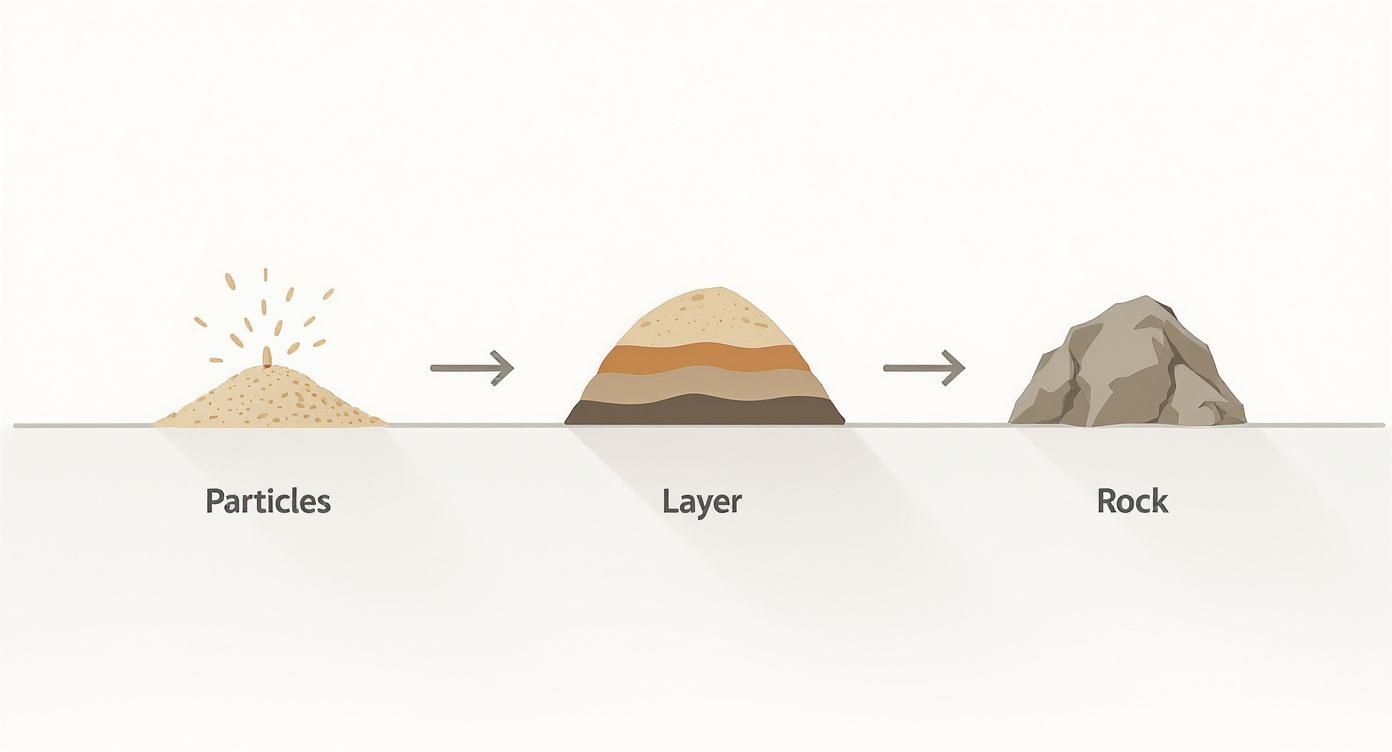
This infographic lays out the simple but powerful flow from loose bits and pieces to layered sediment and, finally, to solid rock.
As you can see, this transformation is a continuous sequence where individual grains get collected, stacked, and eventually locked together into a single geological record.
Step 2: Transportation
Once our grain of sand is free, it’s at the mercy of nature's transport systems. A powerful river might carry it for miles, tumbling along the riverbed with countless other particles. Or maybe it gets swept up by the wind and travels across a vast desert.
During this trip, the sediments are often sorted by size. Heavier bits like pebbles and gravel drop out of the flow first, while lighter materials like sand and silt are carried much farther away. This sorting is why you often find rocks like sandstone in one place and fine-grained mudstone in another.
This journey isn't just about moving from point A to point B. As the particles travel, they bump and scrape against each other, rounding off their sharp edges in a natural polishing process. A grain of sand found far from its source is usually much smoother than one found close by.
Step 3: Deposition
Eventually, the energy runs out. The river current slows as it enters a lake, the wind dies down, or the glacier melts. At this point, the water or air can no longer carry its load of sediment. This is the moment of deposition, when our grain of sand finally comes to rest.
It settles on the bottom of a lakebed, an ocean floor, or a river delta. There, it joins trillions of other particles that have ended their own journeys in the same spot. Over thousands of years, layer after layer of sediment piles up, burying our grain of sand deeper and deeper.
Step 4: Compaction and Cementation
This final step is where the real magic of rock-making happens. Geologists call this two-part process lithification—which literally means "turning to stone."
Compaction: As more and more layers pile on top, the sheer weight creates incredible pressure on the buried sediment below. This pressure squeezes the particles tightly together, forcing out any water trapped in the tiny spaces between them.
Cementation: At the same time, water carrying dissolved minerals like silica, calcite, or iron oxides seeps through the compressed grains. These minerals act like a natural glue, crystallizing between the particles and cementing them into a solid, cohesive mass.
After millions of years of being buried, squeezed, and glued together, our single grain of sand is no longer a loose particle. It’s now an integral part of a brand-new sedimentary rock, holding within it the story of its long and incredible journey.
Exploring the Three Main Families of Sedimentary Rock
Just like a library organizes its books by genre, geologists classify sedimentary rocks into three main families based on how they were created. Each type tells a different story about the environment where it formed, whether it was a rushing river, an ancient ocean, or a dense, swampy forest. Getting to know these categories is the key to reading the history held within each stone.
The three main groups are Clastic, Chemical, and Organic sedimentary rocks. While they all end up as rock through deposition and lithification, the ingredients that form them—the sediments themselves—are completely different. Let's take a closer look at each one.
Clastic Sedimentary Rocks
Clastic sedimentary rocks are the most common type and probably what you imagine when you think of sedimentary rock. The name comes from the Greek word klastos, meaning "broken," which is a perfect description. These rocks are made from the weathered and eroded fragments—or clasts—of other pre-existing rocks.
You can think of them as geological mosaics, built from the recycled pieces of mountains and ancient landscapes.
The size of these fragments is what determines the final rock. For instance:
Tiny, microscopic particles of clay and silt that settle in calm water like a lakebed get pressed into fine-grained rocks like shale and mudstone.
Sand-sized grains, the kind you’d find on a beach or in a desert, are cemented together to become sandstone.
Larger, rounded pebbles and cobbles, tumbled smooth by powerful river currents, form a chunky-looking rock called conglomerate.
Chemical Sedimentary Rocks
Next up are the Chemical sedimentary rocks, which form in a totally different way. Instead of being made from broken rock bits, they form from minerals that were once dissolved in water. It’s a lot like making rock candy at home: as sugar-rich water evaporates, sugar crystals get left behind. Chemical rocks are created through a similar process, just on a much, much grander scale.
This process, called precipitation, happens when a body of water like a shallow sea or a salt lake evaporates, leaving its dissolved mineral content behind. Those minerals crystallize and build up in layers, eventually hardening into solid rock.
One of the most fascinating examples is limestone. As water flows through limestone-rich areas, it picks up microscopic calcite particles. These particles scatter sunlight, which can give rivers and lakes a stunning turquoise color, a process beautifully illustrated in places like Dogwood Canyon in Missouri.
Common examples include rock salt (halite), which forms in evaporated salt flats, and certain types of limestone, created from precipitated calcium carbonate.
Organic Sedimentary Rocks
Finally, we have Organic sedimentary rocks, which are formed from the accumulated remains of living things. Instead of rock fragments or mineral crystals, their primary ingredients are shells, skeletons, and plant matter. Over millions of years, these organic materials are compacted and cemented into solid rock.
Coal is a classic example, formed from the compressed remains of ancient swamp plants. Another well-known type is fossiliferous limestone, which is absolutely packed with the fossilized shells and skeletons of marine creatures like corals and mollusks.
To help keep these straight, this table breaks down the key distinctions between these three fascinating families.
Comparison of Sedimentary Rock Types
Rock Type
Formation Process
Primary Composition
Common Examples
Clastic
Compaction and cementation of broken rock fragments (clasts).
Clay, silt, sand, pebbles, quartz, feldspar.
Sandstone, Shale, Conglomerate
Chemical
Precipitation of dissolved minerals from water, often through evaporation.
Calcite, halite, gypsum, silica.
Rock Salt, Limestone, Chert
Organic
Accumulation and compaction of organic remains (plants, shells).
Carbon (from plants), calcite (from shells).
Coal, Fossiliferous Limestone
Each type provides a unique window into Earth's past, whether it's a clastic rock showing the power of an ancient river, a chemical rock revealing a long-gone sea, or an organic rock preserving the life that once thrived there.
How Geologists Read the Stories Within the Layers
Sedimentary rocks are Earth's history books. Each one is packed with clues about ancient environments, long-lost climates, and prehistoric life. Geologists have learned to read these stone pages, turning a simple rock into a detailed account of a world that vanished millions of years ago.
The most fundamental clue is stratification—the distinct layers, or strata, you can see in formations like cliffs and road cuts. Think of these layers like pages in a book. A sandy layer might tell the story of an ancient beach, while a dark, fine-grained layer suggests a quiet, deep-water lagoon. Each one captures a snapshot in time.
The Principle of Superposition
So, how do geologists read these layers in the right order? They rely on a foundational concept called the principle of superposition. It's actually pretty simple: in an undisturbed stack of sedimentary rock, the oldest layers are at the bottom and the youngest layers are at the top.
It works just like a stack of newspapers in the corner of your room. The one you put down first is on the bottom, and the most recent one is right on top.
This chronological stacking lets scientists build a timeline of geological events. By studying the layers from the bottom up, they can piece together how landscapes changed, seas advanced and retreated, and climates shifted over immense spans of time. To get a better handle on this, it's helpful to learn some geological terms essential for understanding layered formations like the Grand Canyon.
Fossils are the most exciting 'words' written in the pages of sedimentary rock. These preserved remains of ancient life provide a direct connection to prehistoric ecosystems, showing us not just what the world was like, but who lived in it.
The gentle process of sediment piling up creates the perfect conditions for making fossils. When an organism dies and gets quickly buried by mud or sand, it's shielded from scavengers and decay. As the sediment slowly hardens into rock over millennia, the remains can mineralize, leaving a fossil behind.
Unlocking the Past with Modern Tools
Fossils act as critical markers in the geological timeline. Some specific types, known as index fossils, help geologists date rock layers with surprising precision. You can learn more about what are index fossils and how they work in our detailed guide.
Today, scientists also use advanced technology to get even more information out of these rocks. For example, the Sedimentary Geochemical and Isotope Database (SedDB) compiles extensive data from published scientific literature. Such databases help scientists understand a rock's chemical makeup, test models of Earth's ancient surface processes, and track environmental changes through deep time. You can explore more about how these massive datasets are used to study Earth's history and piece together our planet's past.
Famous Sedimentary Landscapes Around the Globe
The very same processes that build sedimentary rocks also happen to carve out some of the most dramatic scenery on Earth. These landscapes are like living museums, offering a front-row seat to the geological forces we've been talking about. They turn abstract concepts into tangible, awe-inspiring places you can actually visit.
It’s no surprise that many of these formations, built layer by layer over eons, are recognized as natural wonders of the world. When you connect these famous spots to their origins, you start to see them through the eyes of a geologist—every formation tells a story of ancient deserts, deep oceans, and forgotten rivers, all recorded in stone.
The Grand Canyon, Arizona, USA
The Grand Canyon is probably the most iconic sedimentary landscape on the planet—a true masterclass in stratification. For millions of years, the Colorado River has been patiently slicing its way down through layer after layer of sandstone, shale, and limestone, exposing a nearly two-billion-year-old diary of Earth's history.
Those distinct red, orange, and tan bands aren't just for show. Each one represents a different chapter of deposition. A layer of Coconino Sandstone tells us about an ancient desert with sweeping sand dunes, while the Redwall Limestone just below it speaks of a time when a vast, shallow sea covered the entire region. It’s a vertical timeline you can trace with your eyes.
The White Cliffs of Dover, England
Stretching along the English coastline, the brilliant White Cliffs of Dover tell a story of microscopic life in an ancient ocean. These impressive cliffs are made almost entirely of chalk, a soft, powdery white limestone.
This specific type of rock formed from the compressed skeletons of coccolithophores—tiny, single-celled algae that thrived in the seas over 70 million years ago. As these organisms died, their calcium carbonate plates drifted to the ocean floor, piling up in thick layers that eventually hardened into the chalk we see today. It’s a powerful reminder of how even the smallest life forms can build something so monumental.
Every single foot of the chalk cliffs represents thousands of years of slow, steady accumulation on the seabed. It’s a beautiful illustration of how immense geological change can happen through a delicate, gradual process.
Guilin's Limestone Karsts, China
The landscape around Guilin, China, looks like something straight out of a fantasy painting, with thousands of steep, dramatic hills rising from a flat plain. These formations, known as karst towers, are what's left of a thick bed of limestone that was deposited on an ancient seabed.
Over millions of years, naturally acidic rainwater seeped into cracks in the limestone. This water slowly dissolved the rock, carving out caves, underground rivers, and the spectacular towers that now dominate the region. This landscape is the perfect example of how a chemical sedimentary rock can be sculpted by weathering and erosion into a scene that feels truly otherworldly.
Your Sedimentary Rock Questions Answered
We've covered a lot of ground, digging into how sedimentary rocks form and the incredible landscapes they build. As with any deep dive, a few questions tend to pop up. Let's tackle some of the most common curiosities to make sure everything is crystal clear.
Think of this as your go-to reference for those lingering "how" and "why" questions about these geological storytellers.
How Can You Tell if a Rock Is Sedimentary?
Spotting a sedimentary rock out in nature is actually pretty intuitive once you know the tell-tale signs. They have a look and feel that’s distinct from the crystalline structure of igneous rocks or the wavy, distorted bands you see in metamorphic ones.
Here are a few dead giveaways:
Visible Layers: The biggest clue is stratification—you'll see distinct layers, almost like pages in a book. These bands can vary in color, texture, or thickness.
A Grainy Feel: Many of these rocks, especially sandstone, will feel gritty to the touch, a bit like sandpaper. That's because you're literally feeling the individual grains of sand cemented together.
Fossils: This is the smoking gun. Sedimentary rocks are the only type that can preserve fossils. If you spot a shell, a leaf imprint, or a bone fragment embedded in the rock, you've found a sedimentary rock.
Relatively Soft: Compared to their fiery igneous or pressure-cooked metamorphic cousins, many sedimentary rocks are softer and can be scratched or broken more easily.
What Is the Difference Between Sedimentary and Metamorphic Rock?
The core difference is all about their origin story. Sedimentary rocks are born at or near the Earth’s surface through a relatively gentle process of accumulation, compaction, and cementation. It's a low-temperature, low-pressure affair.
Metamorphic rocks, on the other hand, are existing rocks (including sedimentary ones) that have been fundamentally changed by extreme heat and pressure deep inside the Earth. This transformation, called metamorphism, rearranges the rock’s entire mineral structure and texture without actually melting it.
Here’s a simple analogy: A sedimentary rock is like making a layered dip by pressing different ingredients together. A metamorphic rock is what happens when you take that dip, seal it in a pressure cooker, and bake it until all the ingredients recrystallize into something completely new.
How Long Does It Take for Sedimentary Rock to Form?
There’s no single stopwatch for this process. The creation of sedimentary rock, known as lithification, works on a geological timescale that’s almost hard to comprehend.
The journey from loose sediment to solid rock can take anywhere from thousands to millions of years. The conditions have to be just right for deep burial to provide enough pressure for compaction, and the slow-moving, mineral-rich water needs time to cement all the grains together. Some fine mudstones might form in a few thousand years, while a thick bed of limestone could represent tens of millions of years of patient accumulation on an ancient sea floor.
Why Are Fossils Found in Sedimentary Rocks?
Fossils are our direct windows into ancient life, and they owe their existence to the unique way sedimentary rocks are made. The gentle, steady buildup of sediments—like silt settling in a quiet lake or sand blanketing a coastline—is perfect for burying and protecting the remains of plants and animals. This process shields them from scavengers and the elements long enough for fossilization to begin.
To learn more about these incredible natural time capsules, check out our detailed guide to the different types of fossils.
The intense heat and pressure that create igneous and metamorphic rocks would completely obliterate any delicate organic remains. That's why sedimentary layers are the world's exclusive, and most precious, archive of prehistoric life.
At Astro West, we believe every rock tells a story. From the fine layers of a sandstone slab to the ancient life captured in a fossiliferous limestone, our curated collection brings Earth's incredible history into your hands. Explore our ethically sourced minerals, fossils, and unique décor to find a timeless piece of our planet's story.