What Are the Different Types of Fossils? A Complete Guide
When you hear the word "fossil," what's the first thing that comes to mind? For most people, it's a massive dinosaur skeleton hanging in a museum. But fossils are so much more than just ancient bones; they're any preserved evidence of life from a bygone era.
Think of paleontologists as detectives at a prehistoric crime scene. Body fossils are the most obvious clues—the remains of the victim, like bones, teeth, and shells. Trace fossils are the footprints, burrows, and bite marks left behind, showing what the creature was doing. And chemical fossils? They're the invisible evidence, the molecular signatures that prove something was once there.
A Journey Through Earth’s Past: An Introduction to Fossils
Holding a fossil is like holding a secret from millions of years ago. It’s a tangible piece of our planet's natural history book, with each layer of rock representing a different chapter in the story of life. These remnants are the only direct evidence we have of prehistoric organisms, allowing scientists to piece together the epic tale of evolution.
Even a single fossil can tell us an incredible amount about an animal's size, diet, and the world it lived in. A close look at a Stegosaurus fossil reveals details about its life and habitat that we couldn't know otherwise.
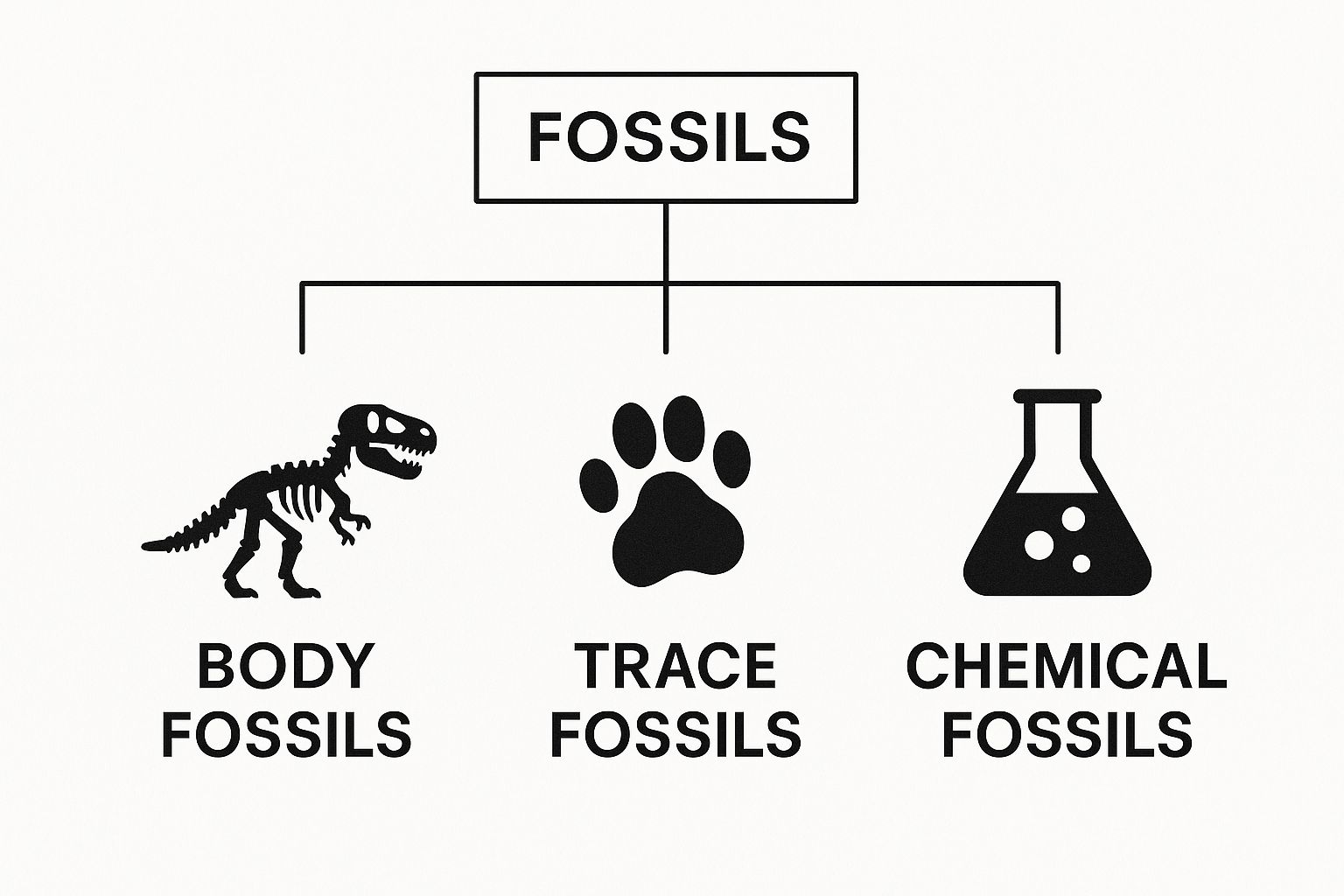
Generally, fossils fall into three main categories, each telling a different part of the story:
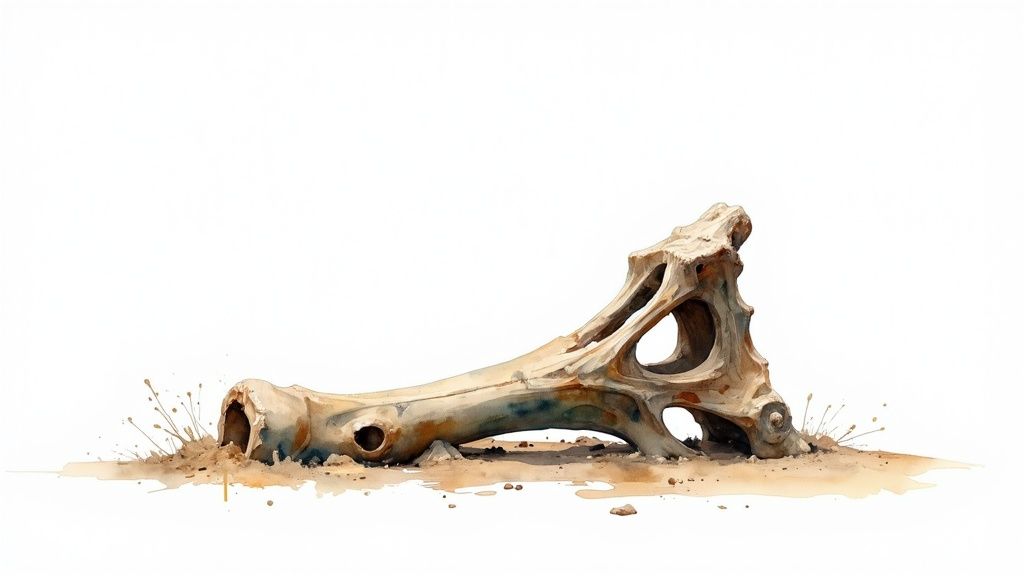
Body Fossils: These are the preserved parts of an organism's actual body. Think bones, teeth, shells, and even petrified wood. They're the classic fossils everyone knows and loves.
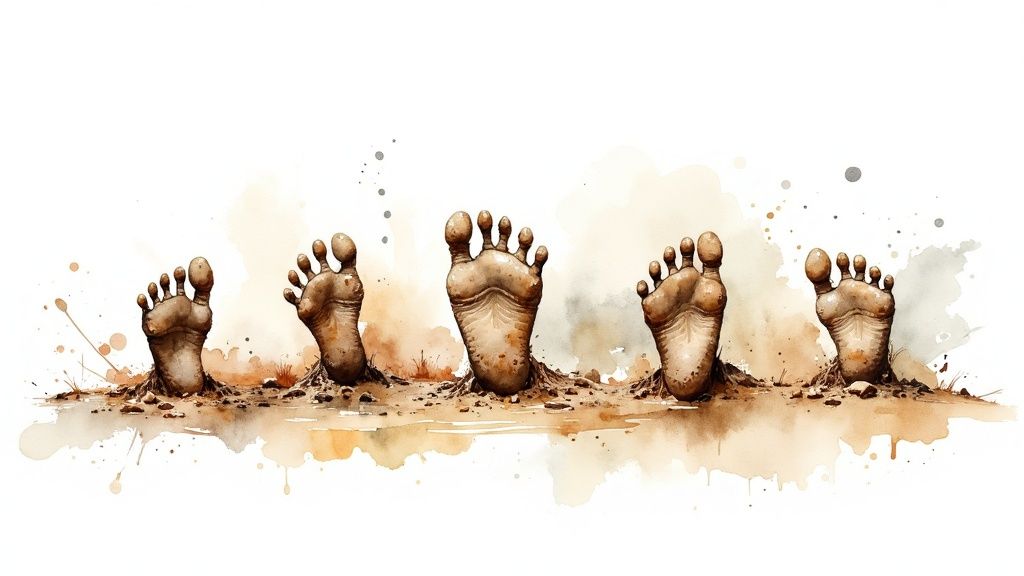
Trace Fossils: This fascinating group captures evidence of an organism's behavior. We're talking about things like footprints, nests, burrows, and even fossilized dung (known as coprolites).
Chemical Fossils: Also called biomarkers, these are the subtle organic molecules left behind by ancient life, like specific proteins or lipids, found preserved within rock formations.
This helpful infographic breaks down the main categories of fossils.
As the diagram shows, every fossil we find branches from these fundamental types, each offering a unique window into the past. Understanding these ancient relics doesn't just teach us about history—it can also spark incredible creativity. It's no wonder people are inspired to create a dinosaur children's story after learning about these amazing creatures.
To help you keep track, here's a quick summary of the major fossil types we'll be exploring.
Quick Guide to Major Fossil Types
Fossil Type
What It Preserves
Classic Example
Body Fossils
The physical remains of an organism.
A T. rex tooth or a trilobite exoskeleton.
Trace Fossils
Evidence of an organism's behavior.
Dinosaur footprints preserved in mudstone.
Molds & Casts
An impression or a 3D copy of an organism.
An ammonite shell imprint (mold) or its filled-in copy (cast).
Imprints
A 2D impression, often of soft materials.
A fossilized fern leaf or an insect's wing.
Chemical Fossils
Molecular evidence of past life.
Organic molecules from ancient bacteria found in rock.
This table gives a bird's-eye view of the main fossil categories. Now, let's dig a little deeper into each one to understand what makes them so special.
Body Fossils: The Tangible Remains of Ancient Life
When most of us think of a fossil, we’re picturing a body fossil. These are the real deal—the actual, physical pieces of an ancient creature that have been preserved through time. They are the tangible evidence that life existed millions of years ago.
This category is home to some of the most awe-inspiring finds in paleontology. It covers everything from the towering skeleton of a Tyramosaurus rex displayed in a museum to the delicate, spiraled shells of ammonites that fit in the palm of your hand.
Body fossils are formed when parts of an organism—almost always the hard parts like bones, teeth, and shells—are buried and protected from decay. Soft tissues rarely stand a chance, but these tougher materials can survive long enough to undergo a remarkable transformation.
From Bone to Stone: The Permineralization Process
So how does a bone become a rock? One of the most common methods is a natural process called permineralization. Think of it as a slow, patient replacement game happening on a microscopic level.
After an organism is buried, groundwater loaded with dissolved minerals like silica and calcite begins to seep into all the tiny, porous spaces within its bones or shell. Over immense stretches of time, these minerals crystallize and harden, essentially filling in the organic framework.
The original material is gradually replaced, creating a stone copy that perfectly preserves the fossil's internal structure. It’s like nature making a perfect sculpture—the original shape is kept, but the substance is transformed into something that can last for eons.
Body fossils are the foundation of our understanding of ancient anatomy. Without the physical evidence of bones, teeth, and exoskeletons, our picture of prehistoric life would be almost entirely blank.
Why Hard Parts Dominate the Fossil Record
The fossil record is completely skewed in favor of these hard parts. It’s a lot like looking at the ruins of an ancient city; the stone foundations are still there, but the wooden homes and fabric tents vanished long ago. The same is true for ancient life.
Geological surveys show that the vast majority of known fossils belong to hard-bodied marine animals. This preservation bias is why fossils like the infamous Megalodon tooth are relatively common finds for collectors. Teeth are made of enamel and dentin—some of the most durable materials in any animal body—making them ideal candidates for fossilization.
You can get a better sense of their impressive size by reading our detailed article on the largest Megalodon shark tooth. The extreme rarity of soft-tissue fossils is what makes them so scientifically priceless, as they offer an incredibly rare glimpse beyond the skeletal framework of these ancient creatures.
Trace Fossils: Reading the Stories of Ancient Behavior
While body fossils give us a fantastic snapshot of what an ancient organism looked like, some of the most fascinating clues from the past show us what it did. These are trace fossils, sometimes called ichnofossils, and they capture moments of ancient life in action. Think of them as the preserved evidence of an organism's behavior, not its body.
It’s like a detective story written in stone. A set of dinosaur footprints isn't just a record of a foot's shape; it can reveal the animal's size, its walking speed, and even clues about whether it traveled in a social herd. These trackways are a direct record of movement from millions of years ago, offering insights that bones alone could never provide.
Trace fossils are absolutely essential for piecing together the behaviors and ecological roles of extinct species. For instance, the famous 3.66-million-year-old Laetoli footprints in Tanzania, documented by the Smithsonian National Museum of Natural History, are direct proof of bipedalism in early human ancestors—a critical moment in our own evolutionary story.
Clues Left Behind in Stone
Trace fossils go way beyond just footprints. Paleontologists uncover all sorts of behavioral evidence, and each piece tells a unique story about a long-vanished ecosystem.
These fossils act like a reel of film from the past, letting us witness the dynamic interactions between creatures and their environments.
Trace fossils are the closest we can get to watching prehistoric life unfold. They preserve actions—a burrow dug, a meal eaten, a step taken—transforming static bones into a dynamic narrative of survival and behavior.
The sheer variety of trace fossils is remarkable, giving us a much richer picture of ancient life. Some of the most common types you’ll encounter include:
Tracks and Trails: These show how animals moved across soft surfaces like mud or sand that later hardened into solid rock.
Burrows and Borings: These reveal how ancient creatures, from tiny worms to early mammals, dug out homes or tunnels to navigate their world.
Coprolites: This is the scientific term for fossilized dung. It might not sound glamorous, but coprolites offer a direct window into an animal's diet and digestive system.
By studying these different types, we can see how creatures interacted with their surroundings and each other. For anyone interested in adding a unique piece of this behavioral history to their collection, you can find authentic coprolite specimens in a collector's box.
Molds, Casts, and Imprints: Nature's Sculptures
What happens when an organism decays so completely that nothing is left but the space it once occupied? That's where molds, casts, and imprints come into play. These fascinating fossils are like nature's sculptures, perfectly preserving an organism's shape and texture without a single molecule of the original creature.
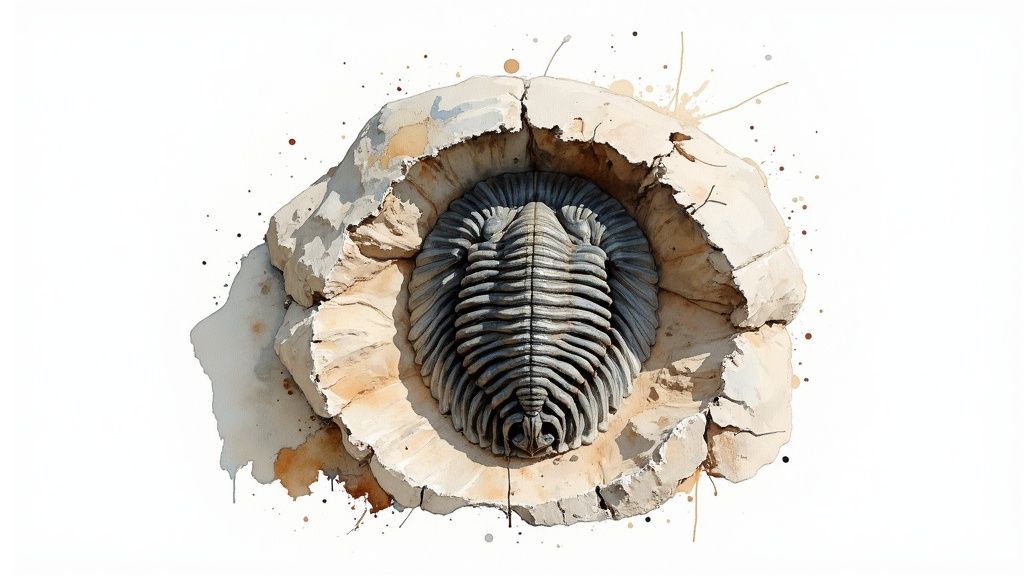
Think about pressing a seashell into wet sand at the beach. That hollow impression you leave behind? That's a mold. In the fossil world, an external mold captures the outer surface details, like the complex patterns on a trilobite's shell. An internal mold is the opposite—it forms when sand or mud fills up an empty shell, hardening to preserve the shape of its interior.
Now, imagine pouring plaster into that sandy seashell impression. The 3D copy you pull out is a cast. Nature does the exact same thing, just much, much slower. Over millions of years, mineral-rich water seeps into a mold, and the minerals gradually harden into a perfect stone replica of the original animal. For collectors, an ammonite fossil on matrix is a classic example of these stunning natural casts.
Delicate Impressions Left in Time
While molds and casts are three-dimensional, imprints are their two-dimensional cousins. These fossils are the flat, delicate impressions left behind when thin objects, like leaves or feathers, were pressed into soft mud or clay.
Imprints are like ancient photographs, capturing a fleeting moment with stunning clarity. They preserve the fine details of life forms that would otherwise be lost forever, telling stories of ancient forests and the evolution of flight.
The original object rots away completely, but its outline is preserved as the sediment hardens into rock. These fossils are remarkable for the incredible level of detail they can hold. You might see the delicate vein patterns in a fern frond or the intricate structure of a prehistoric feather—priceless information for paleontologists piecing together ancient ecosystems.
Chemical Fossils: Uncovering Molecular Ghost Trails
Sometimes, the most powerful evidence of ancient life isn't a bone or a footprint, but something completely invisible. Welcome to the world of chemical fossils, the molecular ghost trails left behind by organisms that vanished hundreds of millions, or even billions, of years ago.
Instead of a physical structure, a chemical fossil is a specific organic molecule that could only have been produced by a living thing. These subtle clues, also called biomarkers, are like a chemical fingerprint proving an organism was present, even when its body has long since disintegrated. Scientists use highly advanced technology to detect these tell-tale lipids, proteins, or pigments preserved deep within ancient rocks.
Piecing Together Primordial Life
Chemical fossils are absolutely essential for peering into the deepest, darkest chapters of Earth's history. Think about it: when you're looking for evidence of microscopic bacteria from billions of years ago, there are no skeletons or tracks to find. It's a completely different kind of hunt.
Instead, scientists search for ancient hydrocarbon molecules that are characteristic of early photosynthetic life.
These molecular ghosts provide some of the most powerful evidence we have for the planet’s earliest inhabitants. They push the timeline of life far beyond what body fossils alone could ever show, giving us our best tool for studying the very dawn of biology.
This type of fossil plays a huge role in piecing together the very first ecosystems. Finding a particular biomarker doesn't just tell us that life existed—it can also tell us what kind of life it was.
Ancient Bacteria: In a game-changing discovery detailed by the journal Nature, specific sterane molecules found in 2.7-billion-year-old shales pointed to the existence of eukaryotes—the complex cells that make up all animals and plants. This suggested complex life might have evolved much, much earlier than we previously thought.
Primordial Algae: Other chemical residues can signal the presence of ancient algae, giving scientists critical clues about how and when Earth’s atmosphere first started filling with oxygen.
Ultimately, chemical fossils are like a secret language written into the geological code of our planet. They don't have the visual punch of a T-Rex skull, but they reveal the unseen life that fundamentally shaped our world from the very beginning.
Answering Your Fossil Finding Questions
Now that we’ve walked through the main types of fossils—from body and trace fossils to those ghostly molecular trails—you probably still have a few questions bubbling up. Let's dig into some of the most common ones to help you on your journey.
What Is the Rarest Type of Fossil?
Hands down, the rarest and most scientifically electrifying fossils are those that preserve soft tissues—things like skin, feathers, muscles, or even internal organs. Because these materials almost always decompose right after death, finding them fossilized means a perfect storm of conditions had to occur. Think rapid burial in an oxygen-free environment, getting flash-frozen in ice, or being trapped in amber.
These finds are the holy grail for paleontologists. Discoveries like the feathered dinosaurs from China, detailed by the American Museum of Natural History, give us a breathtakingly complete picture of an ancient creature, far beyond what bones alone ever could.
Can I Find Fossils in My Own Backyard?
It's absolutely possible, but it really boils down to your local geology. Fossils are almost exclusively found in sedimentary rocks like limestone, sandstone, and shale. These are the rocks formed from ancient layers of sand, mud, and organic bits piling up over eons. If you live in an area with these rock types, your odds are much better.
A quick search for a geological map of your area online can be a great start, or you could even reach out to a local university's geology department. Just remember the golden rule: always get permission before searching on private land, and be sure to check the local rules for collecting on public lands.
When fossils are discovered on private land during official expeditions, they are typically donated to the public trust. This ensures these irreplaceable pieces of natural history are preserved for science and public education, rather than disappearing into private collections.
How Do Scientists Figure Out a Fossil's Age?
Scientists have two main tools in their dating toolkit. The first is relative dating, which is all about context. By looking at a fossil's position in layers of rock, known as strata, they can get a general idea of its age. As a rule of thumb, fossils found in deeper layers are older than those closer to the surface.
For a more precise number, they turn to absolute dating, which often involves radiometric techniques. This process, explained by the U.S. Geological Survey, measures the decay of radioactive isotopes within the rock surrounding the fossil. You've probably heard of carbon-14 dating, which works great for younger organic remains. For the really ancient stuff, methods like potassium-argon dating allow scientists to put a specific age on a fossil, often in the millions of years.
At Astro West, we believe every fossil tells a story millions of years in the making. From the intricate spirals of an ammonite to the powerful serrations on a Megalodon tooth, our curated collection brings the ancient world right to you. Explore our authentic, ethically sourced specimens and find your own piece of natural history at astrowest.com.