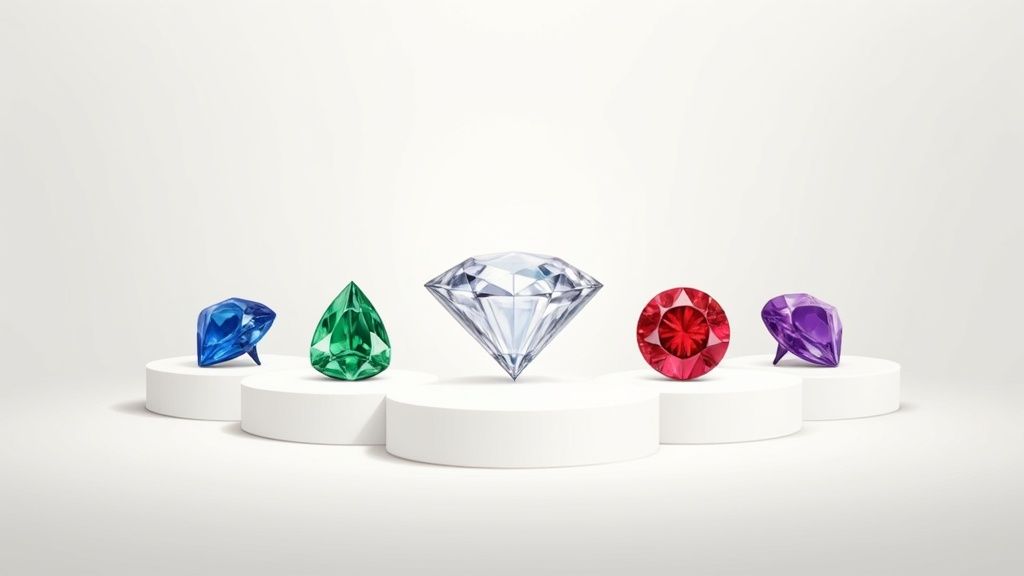
The best gemstones for jewelry are the ones that nail the trifecta of beauty, durability, and value. For pieces you’ll wear every day, like an engagement ring, it’s hard to beat the classics: Diamonds, Sapphires, and Rubies. These stones are at the top of the list for a reason—their incredible hardness and timeless look make them the most practical and beloved choices out there. They can handle the bumps and scrapes of daily life without losing their sparkle.
How to Choose Your Perfect Gemstone
Picking a gemstone can feel overwhelming with all the colors, cuts, and costs to consider. The trick is to simplify your focus. It all comes down to three things: beauty, durability, and rarity. A truly great gemstone isn't just a pretty face; it's tough enough for how you plan to wear it and valuable enough to be a worthwhile investment.
Think of it like buying a classic car. You want one that turns heads (beauty), is built to last for decades (durability), and holds its value—or even appreciates—over time (rarity). The best gemstones manage this delicate balance, which is why they become cherished heirlooms passed down through generations.
Understanding Gemstone Durability
When jewelers talk about durability, the first thing you'll hear about is the Mohs scale of hardness. Developed in 1812 by German geologist Friedrich Mohs, this straightforward scale ranks minerals from 1 (the softest) to 10 (the hardest) based on their relative ability to scratch one another.
A higher number means the gem is far less likely to get scuffed up by everyday encounters with things like countertops, keys, or door frames. This is exactly why Diamond, with its perfect score of 10, is the undisputed king for an engagement ring meant to be worn for a lifetime. Coming in at a close second are Sapphires and Rubies, both ranking a solid 9. They're fantastic runners-up and equally superb choices for jewelry you never take off.
It's easy to think hardness and toughness are the same thing, but they're not. Hardness is all about scratch resistance. Toughness refers to a gem's ability to withstand chipping or breaking from a sudden impact. A diamond is the hardest natural material on Earth, but a sharp, unlucky blow can still chip it.
Balancing Beauty and Practicality
While durability is the practical side of the equation, a gemstone's beauty is what truly captures our imagination. The color, clarity, and cut are what give a stone its unique personality and fire. Beyond just picking what you like, it can be fun to find your personal color palette to see which gemstones might naturally complement your skin tone and style.
If you're just starting to explore the fascinating world of gems, getting to know the unique properties of different stones is a great first step. For a little more guidance, you can check out our guide on the best crystals for beginners to find one that really speaks to you.
To help you get a clearer picture, we've put together a quick comparison of some of the top choices for jewelry.
Top 5 Gemstones for Jewelry at a Glance
This table gives you a quick snapshot of the most popular and durable gemstones, highlighting what makes each one a great choice for different types of jewelry.
Gemstone
Mohs Hardness
Primary Colors
Best For
Diamond
10
Colorless, Yellow, Brown, Pink, Blue
Engagement rings, everyday wear
Sapphire
9
Blue, Pink, Yellow, Green, White
Rings, necklaces, earrings, any daily piece
Ruby
9
Red, Pinkish-Red, Purplish-Red
All types of jewelry, especially statement rings
Emerald
7.5 – 8
Green
Pendants and earrings; rings need careful wear
Amethyst
7
Purple, Violet, Lilac
Pendants, earrings, and occasional-wear rings
As you can see, the "Big Three"—Diamond, Sapphire, and Ruby—offer the best combination of stunning looks and rugged durability, making them ideal for pieces you'll wear and love for years to come.
The Unrivaled Classics: Diamonds, Sapphires, and Rubies
When people talk about the absolute best gemstones for jewelry, a few names always steal the spotlight. Diamond, Sapphire, and Ruby make up the legendary "Big Three," a trio celebrated not just for their jaw-dropping beauty but for their incredible toughness. For centuries, these are the stones that have defined what luxury looks and feels like, becoming powerful symbols of love, status, and lifelong promises.
What ties them together is their shared, rock-solid durability. Each one is tough enough to handle the knocks and scrapes of daily life, making them the most trusted choices for pieces meant to be worn forever, like engagement rings and family heirlooms. They aren't just pretty accessories; they're wearable legacies.
Diamond: The Pinnacle of Hardness and Brilliance
There's a good reason diamonds are the go-to for symbolizing eternal love. Clocking in at a perfect 10 on the Mohs scale, a diamond is the hardest natural substance on our planet. This incredible hardness means it can shrug off scratches from just about anything, keeping its fiery surface flawless year after year.
But a diamond's appeal runs deeper than sheer strength. Its real magic is in the way it plays with light to create that iconic, blinding sparkle. This light show is judged by the famous 4 Cs, the universal grading system that determines a diamond's quality and, ultimately, its value.
Cut: This is often seen as the most critical factor. Cut isn’t about the diamond's shape (like round or princess) but about the precision of its facets. A masterfully cut diamond acts like a tiny hall of mirrors, bouncing light around internally to create maximum brilliance and fire.
Color: For classic white diamonds, the goal is actually a total lack of color. The scale runs from D (completely colorless) to Z (light yellow or brown). Truly colorless stones are the rarest and most valuable.
Clarity: This grades the absence of tiny internal imperfections called inclusions or external marks called blemishes. A "flawless" diamond is incredibly rare, but many inclusions are microscopic and totally invisible to the naked eye.
Carat: This one's simple: it’s the diamond’s weight. While a bigger carat weight usually means a higher price tag, the other three Cs have a huge say in the stone's final look and value.
A common misconception is that carat weight is the same as size. While they're related, the cut of a diamond can make it appear larger or smaller than another stone of the exact same carat weight. Two one-carat diamonds can look worlds apart based on how they're shaped and faceted.
It’s no shock that diamonds absolutely dominate the market. They account for a massive 84.8% of the entire gemstone sector's revenue, proving just how timeless their appeal is.
Sapphire and Ruby: The Dynamic Corundum Duo
Here’s a fun fact: Sapphires and Rubies are, scientifically, the exact same mineral—corundum. The only thing that makes them different is a tiny trace element. If the corundum is red, we call it a Ruby. If it’s any other color—from that classic deep blue to pink, yellow, or green—we call it a Sapphire.
Both of these gems score a 9 on the Mohs scale, making them the second hardest natural gemstones right behind diamonds. This makes them fantastic choices for any kind of jewelry, especially rings and bracelets that tend to see a lot of action.
The Royal Allure of Sapphires
When you hear "sapphire," you probably picture a rich, velvety blue—a color long tied to royalty, wisdom, and the divine. The most legendary sapphires came from Kashmir, famous for a dreamy cornflower blue hue with a soft, sleepy glow. Today, gorgeous sapphires are also found in places like Sri Lanka and Madagascar.
When you're looking at a sapphire, its color is everything. The value hinges on the hue's intensity, saturation, and evenness. A deep, vivid blue that’s consistent throughout the stone will always fetch the highest price. Because of this esteemed history, sapphires and rubies are often called precious stones. To get a better handle on this, check out our article explaining the differences between precious and semi-precious stones.
The Passionate Fire of Rubies
Ruby, often called the "king of gems," is all about its fiery red color, a timeless symbol of passion and power. That stunning red comes from traces of the element chromium. The most coveted rubies have a vibrant, pure red hue often described as "pigeon's blood," a term that originated from the historic mines of Burma (now Myanmar).
Just like with sapphires, a ruby's value is driven first and foremost by its color, with clarity being a close second. Because high-quality natural rubies over one carat are exceptionally rare, they can sometimes command higher per-carat prices than even diamonds.
It's also good to know about treatments. Many sapphires and rubies are heat-treated to improve their color and clarity. This is a standard, widely accepted practice in the jewelry world, but any treatment should always be disclosed by the seller, as it does affect the stone's value.
More Vibrant and Versatile Gemstone Choices
While the "Big Three" are legendary, the world of gemstones opens up into a stunning spectrum of color and character. Once you venture beyond that top tier, you’ll find a vibrant cast of stones that offer breathtaking beauty and their own unique personalities.
These gems are fantastic options for adding rich color and individual flair to your jewelry collection. Many are also more accessible than their top-tier cousins, which often means you can get a larger, more eye-catching stone for your budget. They're perfect for pieces that make a personal statement, from the deep green of an emerald to the serene blue of an aquamarine. Let's dig into some of the best.
Emerald: The Gem of Lush Gardens
Emerald, with its iconic, mesmerizing green, has been treasured for millennia as a symbol of rebirth and love. It’s part of the beryl mineral family and registers a solid 7.5 to 8 on the Mohs scale. That puts it in a durable category, perfectly capable of handling most everyday scratches.
But an emerald's most defining characteristic is also its point of vulnerability. Nearly all emeralds have tiny, natural inclusions—often poetically called "jardin," the French word for garden. These internal fractures create a unique, mossy pattern inside, meaning no two emeralds are ever exactly alike.
These inclusions aren't flaws; they're part of the gem's identity and proof it came from the earth. They do, however, make emeralds a bit more brittle than a sapphire of similar hardness. For this reason, they aren't the best choice for a ring that's going to see constant action.
Emeralds are best suited for jewelry that's less exposed to hard knocks. Think stunning pendants resting safely against the collarbone or elegant drop earrings that frame the face. These settings protect the gem while letting its unparalleled color shine.
When it comes to care, stay away from ultrasonic cleaners and harsh chemicals. They can damage the oils often used to enhance an emerald's clarity. A simple cleaning with warm water, a little mild soap, and a soft brush is all it takes to keep its verdant glow.
Amethyst: The Regal Purple Quartz
For anyone who loves a deep, regal hue, amethyst is a truly captivating choice. It’s the most prized variety of quartz, with rich purple tones that can range from a light, pinkish lavender to a deep, intense violet. It scores a 7 on the Mohs scale, which means it offers good durability for most types of jewelry.
This mix of stunning color and accessibility makes amethyst one of the most popular colored gemstones on the planet. It’s the ideal stone for creating bold, statement pieces without a prohibitive price tag. A large, beautifully cut amethyst can easily become the centerpiece of a dramatic cocktail ring or a striking pendant.
When you're picking out an amethyst, look for one with rich, even color and good clarity. The most valuable stones show off a deep purple with flashes of red or blue.
Styling and Care Tips for Amethyst
Versatile Pairing: Amethyst’s purple hue looks gorgeous with both yellow and white metals. Yellow gold gives it a warm, classic feel, while white gold or platinum creates a sleek, modern look.
Safe Cleaning: Like emeralds, amethysts should be cleaned with warm, soapy water. While it's generally safe for ultrasonic cleaners, you should avoid steam cleaning, as high heat can cause the color to fade over time.
Light Sensitivity: To keep its color vibrant, try not to expose your amethyst jewelry to long periods of intense, direct sunlight.
Aquamarine: The Serene Blue of the Sea
Another enchanting member of the beryl family, aquamarine is emerald's cooler-toned cousin. Its name comes from the Latin for "water of the sea," which perfectly captures its tranquil, clear blue to greenish-blue hues. And just like emerald, it boasts a hardness of 7.5 to 8 on the Mohs scale.
Unlike emerald, though, aquamarine is famous for its exceptional clarity. It's typically found with far fewer inclusions, giving it a clean, crystalline look that sparkles brilliantly. This clarity, combined with its excellent durability, makes it one of the best gemstones for jewelry you plan to wear frequently—including rings.
Larger aquamarine crystals are fairly common, which allows for impressive pieces at a reasonable cost. Its serene color is universally flattering and incredibly versatile, working just as well with casual outfits as it does with formal wear. To keep it looking its best, just clean it with warm water and a soft brush to remove any residue that might dull its icy brilliance.
Unique Gemstones for a Personal Touch
While the classics are classics for a reason, some of the most stunning gemstones are the ones that break the mold. If you're drawn to unconventional beauty and jewelry that tells a story, there are a few gems that have a character all their own.
These stones aren't always celebrated for perfect clarity or unbreakable hardness. Instead, their appeal lies in their mesmerizing visual effects, organic origins, and rare, exotic colors. Choosing one of these means you're not just getting a piece of jewelry—you're getting a personality.
Opal: The Gem of Shifting Colors
Owning an opal is like holding a tiny galaxy in your hand. Its most spellbinding quality is its play-of-color, a hypnotic dance of rainbow hues that flash and shimmer as the stone moves. This isn't just a surface shine; it's light playing through microscopic silica spheres, creating a breathtaking, ever-changing light show.
But all that beauty comes with a need for a little extra care. With a Mohs hardness of 5.5 to 6.5, opals are quite a bit softer than something like a sapphire. They also contain water, making them sensitive to sudden temperature shifts or extreme dryness. This delicate nature means they probably aren't the best choice for a ring you'll wear every single day.
Still, their otherworldly beauty makes them absolutely perfect for special occasion pieces that see less wear and tear.
Earrings and Brooches: These are fantastic settings for opals. They keep the stone protected while putting its vibrant play-of-color on full display.
Pendants: An opal pendant rests safely against the chest, letting its owner admire its shifting colors without much risk of damage.
Careful Wear: If you have your heart set on an opal ring, make sure it’s in a protective bezel setting and wear it with a bit of mindfulness to avoid bumps and knocks.
Pearl: The Ocean's Organic Treasure
Pearls are truly in a class of their own—they're the only gems created by a living creature. Their soft, luminous glow gives them a timeless elegance that feels both classic and deeply personal. But their organic origin also makes them the most delicate gems in the jewelry box, with a Mohs hardness of just 2.5 to 4.5.
This softness means they can be easily scratched by harder gems or even everyday dust. Their beautiful luster can also be dulled by contact with acids found in things like perfume, hairspray, and lotion.
To keep a pearl's beautiful glow, make it the last thing you put on and the first thing you take off. After wearing, a quick wipe with a soft cloth will remove any oils before you store it safely away from other jewelry.
You'll mainly find two types of pearls: natural pearls, which are incredibly rare, and cultured pearls, which are created with a little help from humans. The vast majority of pearls you see today are cultured, which thankfully makes this organic treasure accessible to everyone.
Tanzanite: The Rare Blue-Violet Wonder
Discovered in the foothills of Mount Kilimanjaro, tanzanite is a relative newcomer that has quickly captured the hearts of gem lovers. Its claim to fame is its stunning pleochroism, which is a fancy way of saying it shows different colors—usually brilliant blue, deep violet, and even a hint of burgundy—when viewed from different angles.
Tanzanite lands at a 6.5 to 7 on the Mohs scale, putting it in a similar durability range to amethyst. It’s certainly sturdy enough for most jewelry, but it doesn't have the same resistance to chipping as a sapphire. Because it's sensitive to hard impacts, it’s a better fit for earrings and pendants, or for rings that are worn with care rather than for everyday chores.
The stone’s incredible color and rarity make it an amazing choice for a standout piece of jewelry that’s anything but ordinary. It offers a color spectrum you just won't find anywhere else. While it's a wonderfully unique choice, if you find yourself drawn to stones with softer energies, you might also want to read our article about the gentle magic of Rose Quartz.
When you're choosing a gemstone, you're not just buying a pretty stone. You're making an investment in something that could be passed down for generations. To make sure it lasts, it helps to understand what really makes a gemstone durable. It’s not just one thing, but a trio of properties that work together to keep your jewelry sparkling and safe.
Getting a handle on these three pillars—hardness, toughness, and stability—is the secret to picking a gem that fits your life and knowing exactly how to care for it.
The Three Pillars of Gemstone Durability
When we talk about durability, hardness is usually the first thing that springs to mind, mostly thanks to the famous Mohs scale. But hardness only tells a fraction of the story. For a gem to be truly durable, it needs to be strong in three very different ways.
Hardness (Scratch Resistance): This is all about a gem’s ability to resist getting scratched or scuffed up. Think of it like your phone screen—a higher hardness rating means it’s less likely to show wear from everyday bumps against things like keys or countertops.
Toughness (Chipping Resistance): This refers to how well a gem can handle an impact without cracking or chipping. Picture dropping a glass marble and a rubber ball. The glass is harder, sure, but the rubber ball is tougher because it can absorb the shock of the fall without shattering.
Stability (Environmental Resistance): This is about a gem's ability to hold up against chemicals, heat, and light. A stable gem won't fade if you leave it in the sun for too long or get damaged by the chemicals in your hairspray or cleaning supplies.
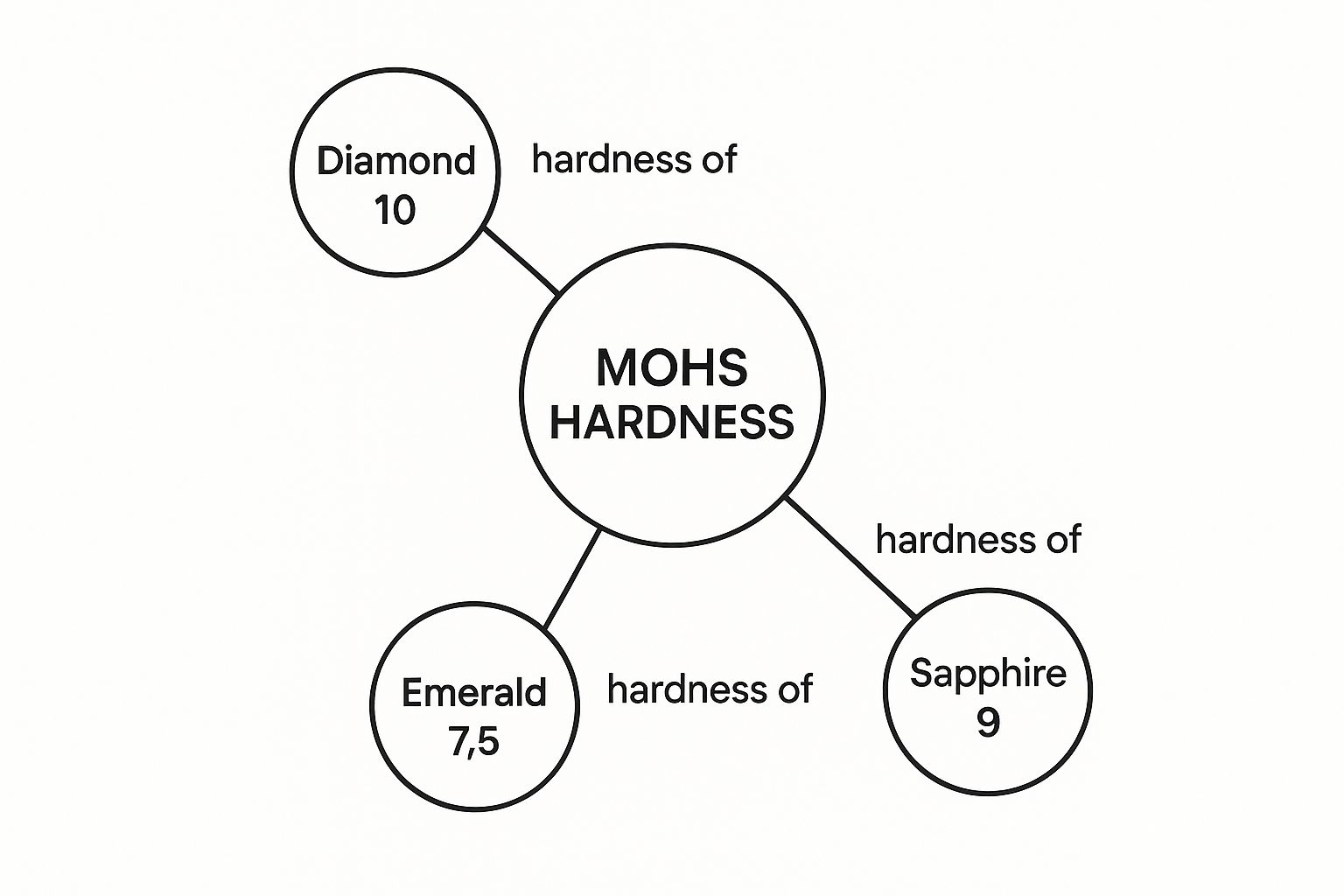
This simple visual breaks down the Mohs scale for some of the most popular gemstones out there.
It really puts into perspective the massive difference in scratch resistance between top-tier stones and shows exactly why diamonds and sapphires are such favorites for rings you plan to wear every day.
Gemstone Durability Comparison Guide
To help you see how different gems stack up against each other, I've put together this quick-reference table. It compares the key durability traits of some popular stones side-by-side. If you need more help figuring out what stone you have based on its unique qualities, our crystal identification guide is an excellent place to start.
Gemstone
Mohs Hardness (Scratch Resistance)
Toughness (Chipping/Breaking Resistance)
Stability (Heat/Light/Chemical Resistance)
Diamond
10 (Exceptional)
Good
Excellent (Resists chemicals and heat)
Sapphire/Ruby
9 (Excellent)
Excellent
Excellent (Very stable, but avoid high heat)
Emerald
7.5 – 8 (Very Good)
Poor to Fair
Fair (Sensitive to heat and harsh cleaners)
Amethyst
7 (Good)
Good
Good (Color can fade with prolonged sun exposure)
Aquamarine
7.5 – 8 (Very Good)
Good
Good (Avoid extreme heat changes)
Opal
5.5 – 6.5 (Fair)
Poor
Poor (Sensitive to heat, dryness, chemicals)
Pearl
2.5 – 4.5 (Poor)
Fair
Poor (Easily damaged by acids and chemicals)
Tanzanite
6.5 – 7 (Fair to Good)
Poor to Fair
Good (Sensitive to sudden temperature changes)
Looking at this, it becomes clear why some gems are perfect for everyday rings while others, like delicate Opals and Pearls, are better suited for special occasions where they won't get knocked around.
Universal Care Guidelines for Your Jewelry
Taking proper care of your jewelry is what ensures those cherished pieces stay brilliant for years to come. With rings, necklaces, and other pieces representing significant personal and financial investments, a little TLC is well-deserved.
Here are a few universal rules to live by when it comes to keeping your gemstone jewelry in pristine shape.
A great rule of thumb, especially for delicate gems like pearls and opals, is to make them the "last thing on, first thing off." That means putting your jewelry on after you’ve sprayed your perfume and hairspray, and taking it off before you do anything else at the end of the day.
Cleaning and Storage Best Practices
Gentle Cleaning is Key: The safest way to clean most gemstone jewelry is with a simple bowl of warm water, a few drops of mild dish soap, and a soft-bristled toothbrush. Gently scrub the stone and setting, rinse it well, and pat it dry with a soft, lint-free cloth.
Steer Clear of Harsh Chemicals: Never let your jewelry come into contact with harsh chemicals like bleach, chlorine, or abrasive household cleaners. They can permanently cloud softer stones and even eat away at the metal settings.
Store Everything Separately: To keep harder stones (like diamonds) from scratching up softer ones, it’s best to store each piece of jewelry by itself. A fabric-lined jewelry box with separate compartments is perfect, but even keeping pieces in individual soft pouches works wonders.
Know When to Take It Off: This is a big one. Always remove your jewelry before you go swimming, hit the gym, do some gardening, or tackle any heavy chores. This protects your gems from hard impacts, scrapes, and nasty chemical exposures.
Answering Your Gemstone Questions
Choosing the perfect stone always brings up a few last-minute questions. It’s completely normal! As you get closer to a decision, you want to be sure you've covered all the bases.
Let's walk through some of the most common queries we hear. This should clear up any lingering doubts and help you feel fantastic about the gemstone you choose.
What Is the Best Diamond Alternative for an Engagement Ring?
If you want something that looks like a diamond and can handle the rigors of daily life, moissanite is an incredible choice. It’s almost as tough as a diamond, ranking at a 9.25 on the Mohs scale, but what really sets it apart is its fire—it actually sparkles more than a diamond.
White sapphires are another classic and brilliant option. Belonging to the corundum family, they have a hardness of 9, making them more than ready for the wear and tear an engagement ring goes through. Both give you that timeless, elegant look without compromising on the resilience you need for a forever piece.
Are Lab-Grown Gemstones a Good Option?
They’re a fantastic option. A lab-grown gemstone is the real deal—it has the exact same chemical, physical, and optical properties as one pulled from the earth. The only thing that’s different is its origin story.
Lab-grown gems can offer incredible value, often letting you choose a larger or higher-quality stone than you might otherwise for the same budget. They're also a great pick if you want a stone with a completely traceable and often more eco-conscious supply chain.
As people have become more educated on them, the market has taken off. The global gemstones market is projected to see significant growth, fueled by the growing excitement for both natural and lab-created stones. You can dive deeper into these market trends in this detailed report on the gemstones market.
How Can I Tell If a Gemstone Is Authentic?
Spotting a real gemstone from a clever fake really takes a trained eye. While you might find some "home tests" online, they’re often unreliable and can even end up damaging your stone.
The only surefire way to know what you have is with a gemological certificate from a trusted lab, like the Gemological Institute of America (GIA). For any piece that’s a significant investment, that paperwork is non-negotiable.
Still, there are a few things you can look for as a starting point:
Look for Inclusions: Natural gemstones almost always have tiny internal quirks called "inclusions." If a stone looks absolutely flawless, even under magnification, it might just be glass or a synthetic copy.
Check the Setting and Craftsmanship: Genuine, high-quality gems are almost always set in precious metals like gold or platinum. If the setting feels flimsy or the workmanship is sloppy, it’s a potential red flag.
Consult a Professional: When you’re just not sure, the smartest move is to take the jewelry to a certified gemologist or a jeweler you trust. They can give you a professional appraisal and tell you exactly what you've got.
At Astro West, we believe every stone has a story worth telling. For over 60 years, our family-run gallery has been dedicated to finding the world’s most incredible fine minerals, fossils, and handcrafted jewelry. We ensure every single piece is ethically sourced and expertly authenticated. Explore our collections and find a natural treasure with a history all its own at https://astrowest.com.